
I. INTRODUCTION
The textbook is one of the devices present within the school setting, and it occupies a significant position of utmost importance. In the schooling process, it is an instrument of mediation between the student and the teacher. In the TB, content and activities composed of texts, systematizations and examples that help the teacher in the dynamics of the classroom, are grouped. Prepared by specialists from different areas, such as: text producers and proofreaders, editors, illustrators, diagrammers and, stemming from the concept of accessibility to all students, the professional sign language interpreter and the Braille text transcriber can be added;1 they become part of the textbook development team.
TB is commonly a printed material, but, with the digital advance, it has been enriched by media components. It can be found in digitized versions, which can be a simple scan of the printed page with the inclusion of animations, website indicating links and/or with a CD-ROM.
From this perspective, this study reflects on textbooks, and, in this specific case, on their accessibility and/or adaptability to sign language for deaf students. The argument for adapting textbooks to Libras2 is based on the guidelines of the document that proposes the implementation of a National Policy on Special Education from the perspective of Inclusive Education (Brasil, 2015). This document highlights that literacy textbooks and para-didactics must be produced in an accessible format in Portuguese language (PL) and in Libras. The same guidance is also found in Decree No. 9,465, as of January 2, 2019, Art. 35, which refers to the Board of Bilingual Education Policies for the Deaf, making explicit, in item V, "[...] the preparation of bilingual didactic materials" (Brasil, 2019, p. 19).
In this sense, it emphasizes that the inclusion of sign language in the textbook does not characterize the elimination of the Portuguese language. On the contrary, it is supported by the idea of a bilingual product/book, where both Libras and PL are present.
Regarding the teaching of PL for the deaf, more specifically the teaching materials, there are still many discussions among researchers, since there is not a significant amount of material for the teaching of a second language that includes bilingual education for the deaf. However, the proposal for the elaboration of a pedagogical resource based on accessibility for the deaf students is guided by Brazilian legislation. It is worth mentioning Decree-Law No. 7,084/20103, which provides for the didactic material programs and makes other provisions. Corroborating the view of an accessible format of a didactic material (DM), Decree-Law No. 5,626/20054 provides for Libras, defends the use and dissemination of this language in educational spaces.
In general, the main problem is that the adoption of a bilingual approach can establish Libras as a language of instruction, but its implementation in didactic resources may mean to face difficulties, because, in this accessibility format, PL remains the official language to read and write, being, therefore, the legitimate language of instruction (Miranda, 2010; 2016; 2019). Thus, it does not meet the needs of deaf children who have PL as a second language, since this is not their first language, nor is it the communicative basis for learning another language.
With that in mind, this study sets out to, firstly, describe its research object: the textbook adapted to Libras. Then, it presents and reflects on a didactic activity applied to deaf students, withdrawn from a textbook adapted to Libras. The exercise proposed the appropriation and use of the alphabetical order in the Portuguese language.
II. DESCRIBING THE OBJECT OF STUDY: PL ADAPTED TO LIBRAS
This section proposes to describe the object of this study: the PL Textbook adapted to Libras. The activity was withdrawn from a PL textbook by Editora FTD (FTD Publishing House), the Porta Aberta (Open Door) collection (2011), grade elementary school, unit 3, pages 49 to 67. The exercise was carried out both in the classroom and in the computer laboratory of the school. The students used the computer and the CD-ROM. It is worth mentioning that the activity was read in PL and Libras (translation) and answered in PL in the printed textbook.
The Porta Aberta collection is a collective work produced by Editora FTD. On the cover of each volume, the school grade each one is aimed at is identified ( , , , or grade elementary school) and the information (rectangular-shaped and in different colors) about the grade, PNLD5, Libras, FNDE6 and free distribution is highlighted. The translation of the Porta Aberta collection was carried out by the Arara Azul publishing house7 in 2010. There is, however, no graphic representation that identifies the material as a textbook also adapted for deaf children, as shown in Figure 1:
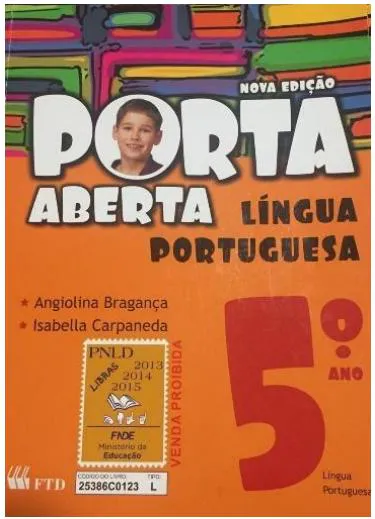
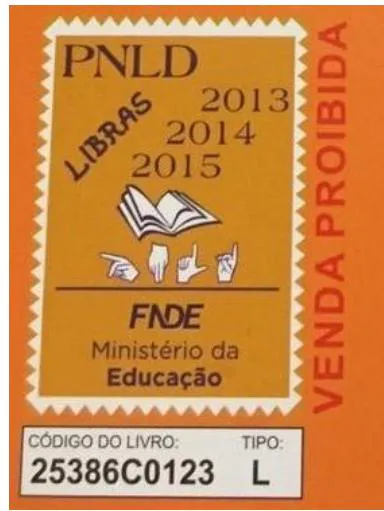
Source: Portuguese Language, 5th grade. Porta Aberta Collection, 2011.
The Porta Aberta, Portuguese Language, is a collection that presents several sections for the study of linguistic knowledge, among them, "Language Study", which prioritizes orthographic conventions and the alphabetic writing system, stimulates reflection on the regularities of alphabetic writing and presents didactic activities that make it possible to learn lexical organization mechanisms through understanding the meaning of words and the meaning of the text and context in which they appear (PNLD, 2016, p. 114).
The whole material is accompanied by a CD-ROM, whose content reproduces each page of the corresponding book and brings its translation into sign language. Deaf students can resort to videos in which a
Libras interpreter appears; that is, the content of this digital media presents, at the end of each sentence, an icon that, when activated, opens a screen with a Libras interpreter. Thus, for each sentence there is an icon that, when activated, displays an interpreter translating the sentence from PL into Libras, as shown in Figures 2 and 3.
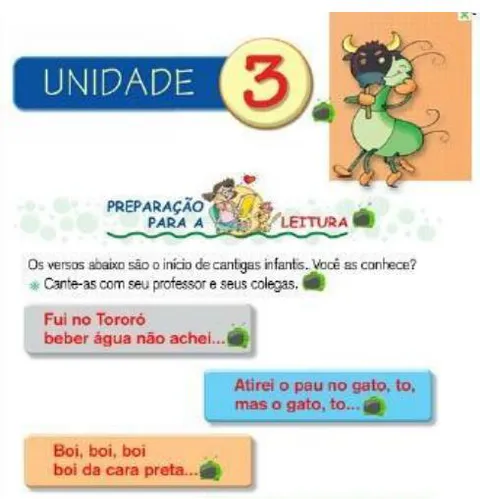
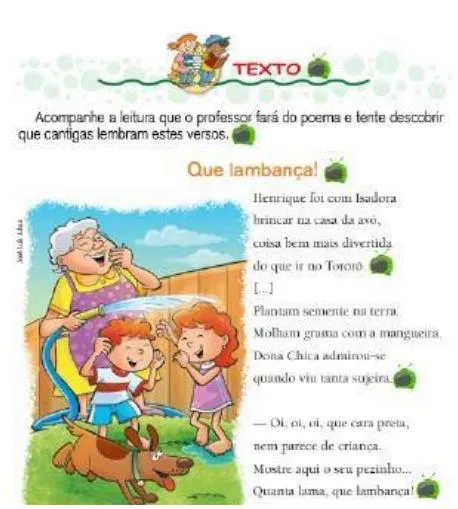
Source: Portuguese: 2nd grade. Porta Aberta, 2011. p. 49 -50.
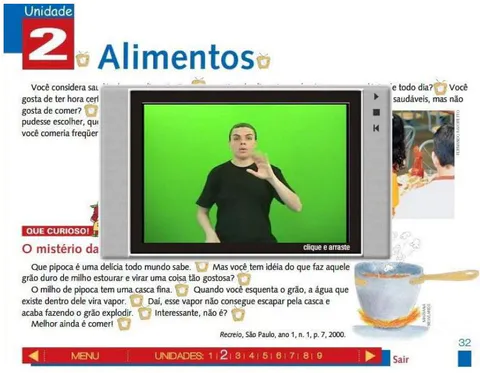
Source: Portuguese: grade. Coleção Pitanguá, 2005. p.
From the next sections on, this study exposes the procedures that designed the execution of the research as for the use and appropriation of the PLTB adapted to Libras by the deaf child.
III. THE CONTEXT OF USE AND
APPROPRIATION OF THE ADAPTED
TEXTBOOK
Located in Belo Horizonte, capital of the Minas Gerais State, Brazil, this school serves deaf students, with or without other impairments, in three shifts. In the morning and afternoon shifts, students of early education, namely deaf children up to six years of age, and elementary school students. In the evening, classes for deaf youth and adults (EJA) take place. Teachers teach using Libras as their base language, and the PL, in its written form, is considered a second language.
This research was carried out in a fifth-grade class, elementary school, in the afternoon shift. Composed of seven students — three boys and four girls, aged between twelve and eighteen.
It is worth highlighting that before entering the classroom, the regent teacher expressed concern about the use of the unit referring to the grade's PL TB. Her argument was the distance from the linguistic reality between deaf and hearing students, since SL was used only at school and those students had few opportunities to interact through PL in the written modality. In order to not embarrass the students and minimize the obstacles with the dynamics of the pedagogical unit, I left free the choice of which textbook the teacher should use, its volume, reference grade and didactic unit.
As aforementioned, the choice was for the PL TB by Editora FTD, the Porta Aberta Collection, grade, Unit 3, 2011, pages 49 to 67. The unit is divided into: (i) "Reading preparation" — children's verses and songs; (ii) "Text" — genre to be read; (iii) "Study of the text" — questions to be answered in writing; (iv) "For fun" — activity with colleagues; (v) "Language study" — alphabetical order, written activity; (vi) "Spelling Bee" — spelling activity; (vii) "Another text" — poem/oral activity; (viii) "Production" — research and reading of poems.
The exercise was carried out in the computer laboratory. Each student sat in front of a computer, used a CD-ROM and the activity was answered individually in the printed material.
In order to analyze these data, the study proposes to present peculiar aspects of the teaching and learning circumstances of PL as a second language through a TB adapted to Libras. However, every pedagogical process has a before and an after moment. This refers to planning, the process and, finally, the result of these didactic practices adopted in teaching.
A relevant fact for the understanding of this sample is to realize that in the different didactic exercises there are several modes of languages, such as Images/SL/PL. It is thereby evinced that Libras circulates as the dominant language among the participants and in the translation windows of the textbook, and PL is found both in the printed and digital text. The imagery mode (FIG. 4) focuses on the TB, however, it is observed that they are designed to instruct, produce understanding either of SL, or of PL. At last, the teaching dynamics allow the different language modes to align and overlap each other, therefore helping specific practices to promote learning.
This way, the sample portrays the linguistic, social and cultural representation of the bilingual space for deaf students. The result of the investigative proposal translates the form and effects on the use of textbooks adapted for the deaf.
When thinking about the preparation of the didactic unit, the specialist is guided by a pedagogical line that results in practical actions in the teaching and learning process. Thus, examining the didactic units presented in the TB, the following order of activities is observed: (i) preparation for reading, which it deals with a basic text. Before starting to read this text, there is previous information that help in the understanding of this textual genre. Right after that, there is item (ii) text studies, which deals with comprehension issues; (iii) vocabulary study, which deals with the study of words and their meanings; (iv) language studies, which deals with grammatical and orthographic aspects. Lastly, item (v) text production, which deals with the production of another text stemming from the basic text.
For this paper, the focus will be on the fourth (iv) didactic sequence, which relates to language studies, more specifically, dealing with orthographic aspects. This activity aimed at teaching the mechanism of PL, a way of agreeing on the different modes of orality within the same language, thus allowing adjustments in the production of writing and the correct use of the language rules.
The activity carried out proposed to exercise the ordering of the letters based on the initial text of this didactic unit. For this action, the exercise was divided into (i) connecting the dots in alphabetical order and discovering the drawing formed, (ii) filling out the alphabet with the missing letters, (iii) filling out the table with the letters that come before and after and (iv) writing words that start with a certain letter (FIG. 4 and 5).
2 Complete o alfabeto com as letras que faiham.





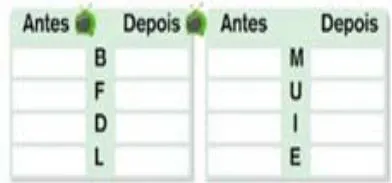
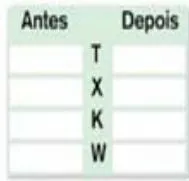
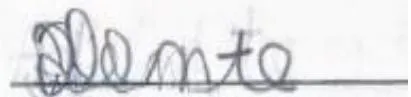
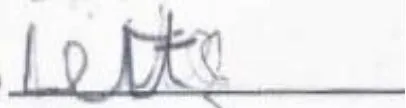
3 Escreva umaPALAVRAqueinicia com:
- a 4' letra do alfabeto
- a 10a letra do alfabeto
- a 1' letra do alfabeto
- a 2a letra do alfabeto
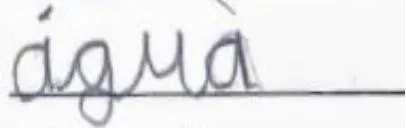
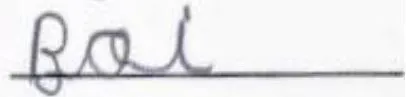
At the beginning of the class, students felt motivated and autonomous when opening and closing the translation windows, changing pages and discovering what interactions they could have with the CD-ROM. Throughout the execution of the task, it was noticed that the participants demanded a lot of attention from the teacher and performed a lot of conversation between the pairs. The teacher could not attend to everyone and asked the Libras instructor for help. Most of the time, the students showed insecurity in their answers and always asked for correction. The activity raised many questions from the students to the adults present.
In the course of the action, it was necessary for the teacher to write, on the whiteboard, the letters of the Portuguese alphabet and their corresponding alphabetical order. Always with the help of spelling the
Manual Alphabet , the teacher explained and exemplified the exercise based on this visual resource. On several occasions, the teacher resorted to the blackboard. It was noted that the strategies used by the educators present did not produce learning effects.
As for the accessibility feature, the "translation window" was activated very few times during the entire event. However, after reading the activity through signs, no change was observed in the performance of the students. The printed TB was accessed most of the time. In short, SL was the dominant language for performing these exercises, but it did not provide an easy understanding of the action.
Faced with the sketch, it is clear that deaf students, even having mastered the PL alphabet by fingerspelling it, were not able to rely on sign language as an aid toward understanding PL in the written modality.
The reflection continues, we start to inquire about the acquisition of SL and how it is fundamental for L2 learning; however, further discussion about the lack of inclusion of deaf students in the same TB activities based on their own language is needed; that is, to promote teaching and learning actions in Libras, so that the deaf student can reflect on the second language from the first one, in a written way.
Confirming the aforementioned point, this study relies upon the work by Maribel Gárate (2014), on the development of reading and writing skills by deaf children in L2. According to this author, it is necessary to stimulate cognitive skills - such as the ability to organize, evaluate and compare information - in their L1 and expect them to apply these skills in their L2, that is, the skills acquired in L1 will be used in L2 and vice versa. This way, activities experienced in SL can be transported into the second language. In doing so, deaf children who do not have a metalanguage in their own language do not have a base of support to develop in L2. The school, the teacher and the SL developers need to produce didactic materials that encourage deaf children to reflect from the SL, and with that, achieve efficiency in a second language.
This sample shows that most deaf children arrive at school with little development in a first language, a fact confirmed by Quadros (1997, 2019), Pereira (2009), Plaza-Pust (2012) and Silva G. (2018). The justification lies in the lack of access, low exposure and interaction through SL. Consequently, not knowing cognitive actions in your language makes cognitive actions in another language difficult. In the process of learning a L2, the learner bases himself on their language to become aware of the differences in the languages involved.
Therefore, this investigation calls for more public and linguistic political projects aimed at educational programs to promote deaf children's access to sign language, stemming from the exposure and interaction with their linguistic peers, in their early years of life. The earlier the deaf child has their locution from Libras, the greater the chances of them developing PL.
IV. FINAL CONSIDERATIONS
The Textbook is an instrument used to create learning conditions and circulates as a product for didactic purposes (LEFFA, 2008). According to Silva (2016), the textbook is a vehicle through which social representations of people, events or objects circulate (p. 114). In the case of a TB for PL teaching adapted to Libras, it can, of course, be assumed that the guidelines for language teaching (linguistic and didactic elements) correspond to the proposed language, and, as the word "adaptation" itself says, it only configures the aspect of translating the TB into another language, thereby presupposing the translation of the written text into the signed text, that is, the translation from the written Portuguese language into the SL recorded by video cameras.
The sample described confirms the complexity in the use and appropriation of adapted materials in a second language on the part of deaf students and bilingual teachers. According to Silva (2016), social agents build representations about the object of teaching and learning a second language (TB), however, when deaf teachers and students are faced with an adapted product (TB), they do not see themselves identified with the discursive modes presented, even if one of these modes points out to their first language. It is noted that, in the textbooks investigated, the statements of the activities and the way in which the student's action is required in the face of that exercise does not promote autonomy, does not promote understanding or promote stimulation, which can cause, in the deaf student, the feeling of incompetence to deal with the task, even though it was requested in their own language, Libras.
Digital technologies have intensified the use of different language modes, although, for deaf children, they are resources that insert SL. However, Libras is not represented with the potential for instruction yet.
For Moses et al. (2018), communication technology must incorporate the linguistic and cultural model of deaf children, even though deaf and non-deaf children exposed to different linguistic models gain empathy through similarity and difference. However, based on the research, the use and appropriation of the TB adapted to Libras confirms that the technology is only an element that gives "visibility" to SL, but does not foster conditions for learning PL as L2.
Regarding the strategies used by those involved in the use of printed/adapted textbooks in SL and how these different modes are treated, it was observed that they were not considered differently, but rather as a support for each other, both students and teachers used both materials (digital/printed). The TB adapted to Libras, on CD-ROM, was used as a support for understanding the written language, that is, for the translation of texts into L2. However, the translation into Libras did not provide understanding in the activities. In this way, the accessible product was not readable to deaf students and the videos in Libras did not create a comfortable environment for reading in signs nor did they help in reading the second language.
The TB adapted to Libras is a fact. Albeit its ineffectiveness is contested and proven, it remains a bilingual instrument and educators who are unaware of the scenario on deafness can take it as a product of prominent place in the different ways of developing didactic resources for deaf children and will effectively become an element of real use. However, the deaf reader needs to find their visual identity, they need to be familiar with the material and experience its interface, first of all, through their language.
This research is a contribution to other investigations within the field of deafness, although we are still at the tip of a pyramid. Therefore, it is considered that this analysis certifies that, for deaf children, the simple insertion of SL is not enough, as this does not guarantee their school development. The obstacles lie in the acquisition of this language, for instance its exposure and use, and in the effective absence of linguistic public policy actions, as what is verified is the belief that the recognition of SL is enough to introduce oneself in the social scenario. Giving visibility does not necessarily reflect on the linguistic and social aspects that involve deaf students. Finally, the sample denounces the need for more research that seek to better integrate ICTs, textbooks and SL/PL to promote teaching and learning, and, for this, the teaching of PL in the written modality.
Footnotes
Sign Language. (p.1) ↩
Brazilian Sign Language. (p.1) ↩
Available at: http://www.planalto.gov.br. Accessed on August, 2014. (p.1) ↩
Decree-Law 5,626/2005 regulates Law No. 10,436, as of April 24, 2002, which provides for Brazilian Sign Language and the Art. (p.1) ↩
National Textbook Program. ↩
Educação de Jovens e Adultos (Youth and Adult Education). (p.4) ↩
Manual alphabet, used to manually spell words (also referred to as hand spelling or fingerspelling), is a resource used by sign language speakers. It is not a language, but a representation code of the alphabetic letters. (p.5) ↩