With this study, we intend to demonstrate that the management of water resources in the south of Angola, between the Republics of Angola and Namibia, is carried out mainly at the state level. Even the 1888 agreement between the Portuguese and Germans, the basis for the agreement to delimit the southern border of Angola between the Portuguese and South Africans (22 June 1926), was related to the need to manage water resources. The use of the waters of the cross-border Cunene river, with a length of more than a thousand kilometers, of which around 70% in Angolan territory and the remainder on the border line with the Republic of Namibia, its diversion to the Etocha lagoon, was the condition unique way to alleviate aridity in Damaralândia, a sine quo non condition for the implementation of this delimitation. These agreements remain in force to this day, complemented by initiatives after independence, with a view to making better use of the Calueque and Ruacaná dams, on the Cunene river, aiming to improve the lives of the populations of both countries, both in terms of water supply and of electrical energy.
## I. INTRODUÇÃO
onsequente processo de ocupação e colonização do continente africano, expressou os interesses das potências europeias que em busca de matérias-primas para o escoamento dos seus produtos, remeteu a África para a condição de colónia de exploração e procurou expandir o seu poder monetário e, deste modo, o comércio com a identificação de mercados consumidores. Com a implantação efectiva do sistema colonial em África, na segunda metade do Séc. XIX as estruturas políticas, económicas e sociais dos africanos alteraram-se e passaram a responder aos interesses dos europeus. No final desse processo, a África consubstanciava-se numa "manta de retalhos"" e o seu traçado fronteiriço, operado pelas potências conquistadoras europeias, foi realizado sem se ter em consideração os povos africanos e a sua realidade histórica e cultural.
As fronteiras dos atuais Estados africanos - não obstante a criação de novas entidades resultantes da redefinição de anteriores fronteiras, casos da Eritreia e do Sudão do Sul - são, ainda, as mesmas 'herdadas' do período colonial e, mesmo que parcial e esporadicamente contestadas e disputadas, são mutuamente reconhecidas.Com percursos de certo modo diferentes, para Augustoni e Viana (2010), os processos de demarcação das fronteiras em África foram sempre conflituosos, levando populações consanguíneas a separarem-se em diferentes países. Esses processos, externamente impostos, modificaram o status quo de África.
Até à colonização de África, a assunção de "fronteiras" ou mesmo de limites fronteiriços no sentido político e geográfico atual, não era uma prioridade político-administrativa para as soberanias locais. A delimitação dos Estados pré-coloniais era móvel e flexível, e o direito consuetudinário não exigia o mesmo tipo de formalidades para a circulação e fixação das pessoas. A consagração de regras de mobilidade estritas surge apenas com a delimitação das fronteiras africanas pelas autoridades coloniais.
Até à chegada dos europeus e à efetiva dominação europeia, a partilha de recursos naturais em África não se submetia a um controlo rigoroso de limites geográficos. Os sobados, segundo Santos (1998) controlavam a mobilidade das populações e a não fixação definitiva de limites fronteiriços permitia um uso de recursos sob formas de regulamentação assentes no costume, na tradição e no direito consuetudinário.
Embora os registos sejam pouco conhecidos, as "fronteiras eram flexíveis" (Santos, pp. 1998-394), o soberano nem sempre tinha uma sede fixa para o seu governo e as populações súbditas nem sempre se fixavam definitivamente num território previamente delimitado.
Com a colonização, os recursos naturais e as formas de desenvolvimento e relacionamento social passaram a ser controladas pelas potências colonizadoras. O colonialismo impôs em África padrões ocidentais (leis, normas, códigos) de gestão dos espaços geopolíticos e dos recursos naturais, e reduziu a capacidade de mobilidade das populações. Com as independências, os novos Estados passaram a gerir, de forma moldada pelos padrões herdados do período colonial, os seus próprios recursos.
Desde há muitos anos, ainda em pleno período colonial, que a bacia hidrográfica do Cunene se enquadra nos grandes empreendimentos de aproveitamento e gestão das águas no Sul de Angola. Paula (2016) defende que no quadro do aproveitamento internacional da bacia do rio Cunene se assistiu a diferenças no posicionamento dos governos de Portugal e da União Sul-Africana/ Sudoeste Africano.[^2] Foram igualmente efetuados estudos minuciosos acerca da fauna, flora, e a outros recursos e riquezas da província.[^6][^4][^7]
O aproveitamento das águas do rio Cunene, com vista a resolver o problema da falta de água no deserto do Kalahari (Sudoeste Africano), actual República da Namíbia e a produção de energia elétrica, foi alvo de acordos entre Portugal e Alemanha e entre a primeira e a União Sul-Africana, que vieram a ser implementados com a construção de barragens (Calueque e Ruacaná, empreendimentos que serviriam, também para o estreitar de relações entre os dois países (Afonso, 2009). Ao governo português cabia uma tarefa adicional: gerir e desenvolver a região do Cunene.
Na ótica de Pereira (2011, p. 69), Angola e os países limítrofes necessitam urgentemente de resolver o paradoxo existente entre a dimensão das reservas de recursos hídricos e a precaridade de distribuição de água potável e água para o gado. Para Álvaro (2011, p. 63) equacionar a questão "da capacidade de resposta institucional para satisfazer as necessidades básicas de consumo das populações e para suster a proliferação descontrolada dum sector informal ligado a venda da água", é um dos mais graves "desafios particulares" dos governos, não só em Angola como em toda a região Austral de África, e no continente em geral.
Segundo Pereira (2011, p. 76), Angola aprovou em 2002 a Lei da Água (Lei $\mathsf { n } ^ { \mathrm { o } } \ 6 / 02$ de 21 de junho), que estabelece, entre outros aspetos estruturantes, [a água como um recurso natural e] propriedade do Estado e (...) parte do domínio público hídrico". A lei consagra que o usufruto deste bem público é de caráter "gratuito e livre quando visam satisfazer necessidades domésticas, pessoais e familiares, incluindo abeberamento e rega" (idem p.77) deixando sempre a possibilidade de na sua gestão participar o sector privado da economia.
Enquanto país privilegiado em recursos hídricos, Angola tem responsabilidades acrescidas na gestão e na governação da água sobretudo das bacias hidrográficas transfronteiriças. Segundo Pereira (2011, p. 77), "ao nível da integração regional, na Comunidade de Desenvolvimento da África Austral, SADC2, e na cogestão de rios como o Congo contíguo a Angola e à RDC, - e o rio Cunene - contíguo a Angola e à Namíbia, o processo de integração tem sido gerador de dinâmicas regionais, com reflexos nos princípios orientadores da gestão dos recursos hídricos." Esta transfronteiraneidade dos rios implica que entre os países integrantes da organização regional, as políticas de governação da água sejam complementares e dirigidas por instituições que se relacionem muito regular e pragmaticamente e se estabeleçam eficientes mecanismos de controlo.
A SADC, constitue oportunidades de concertação e de desenvolvimento sustentado, quantas das vezes permitindo, ou então estimulando, o incremento das relações culturais e comerciais entre populações que partilham, ou não, fronteiras e histórias.
### a) Local da pesquisa
A investigação de campo teve lugar na fronteira sul de Angola, com maior profundidade na parte que abrange a província do Cunene e as regiões fronteiriças da República da Namíbia.
Em termos geográficos, este estudo circunscreveu-se à província do Cunene, na República de Angola3, e à regiões adjacentes na República da Namíbia2, enquanto territórios habitados pelos Ovambo, Himba e Herero, que interatuam há muitos séculos. Desenvolveu-se na linha de fronteira, entre os marcos 1 e 34, onde se encontram aldeias bastante distanciadas umas das outras, com a aplicação de 30 entrevista.
A nossa pesquisa do lado Namíbiano corresponde às regiões fronteiriças de Kunene, Omussati e Ohangwena. Do lado angolano, a província do Cunene totaliza seis municípios; porém, a nossa investigação teve maior enfoque nos municípios fronteiriços de Curoca, Ombadja e Namacunde, correspondente aos marcos fronteiriços 1 no Curoca ao 34, em Namacunde. Os municípios do Curoca, de Ombadja e de Namacunde são localidades situadas na fronteira internacional.
No entanto, e de acordo com o Relatório da Polícia de Guarda Fronteira 2014 do Cunene, a fronteira sul de Angola entre a província do Cunene e a República da Namíbia, tem uma extensão de 460 km, dos quais 340 são terrestres e 120 fluviais, através do rio Cunene. A fronteira sul de Angola, na sua extensão total, tem início na província do litoral Namibe e termina no Cuando Cubango, fazendo fronteira com as Repúblicas da Namíbia e da Zâmbia (MININT, 2014). A dimensão total da fronteira sul é de 137812 km. (MININT POLÍCIA FRONTEIRIÇA DA PROVÍNCIA CUNENE, pesquisa no terreno em 2017/2019). Segundo ANGOP, agência nacional de notícias em 22 de Fevereiro de 2020 tratando dos "Limites fronteiriços em análise pelas autoridades angolanas", cita que a Sul, está a República da Namíbia, com uma extensão de 1.376 km13 (SILVA, S,2020, p 111) em artigo intitulado, As dinâmicas formais/informais e modus operandi da mobilidade da população fronteiriça do sul de Angola.
O estudo das dinâmicas ocorridas no seio dos povos fronteiriços relativamente à mobilidade na fronteira e a gestão de recursos enfatiza que "nas relações dos Ambós angolanos com os seus vizinhos, adquiriram especial relevância as que se processavam com as populações na Namíbia, designadamente com a Ovambolândia, cuja população é da mesma etnia" (Monteiro, 1994, p. 286).
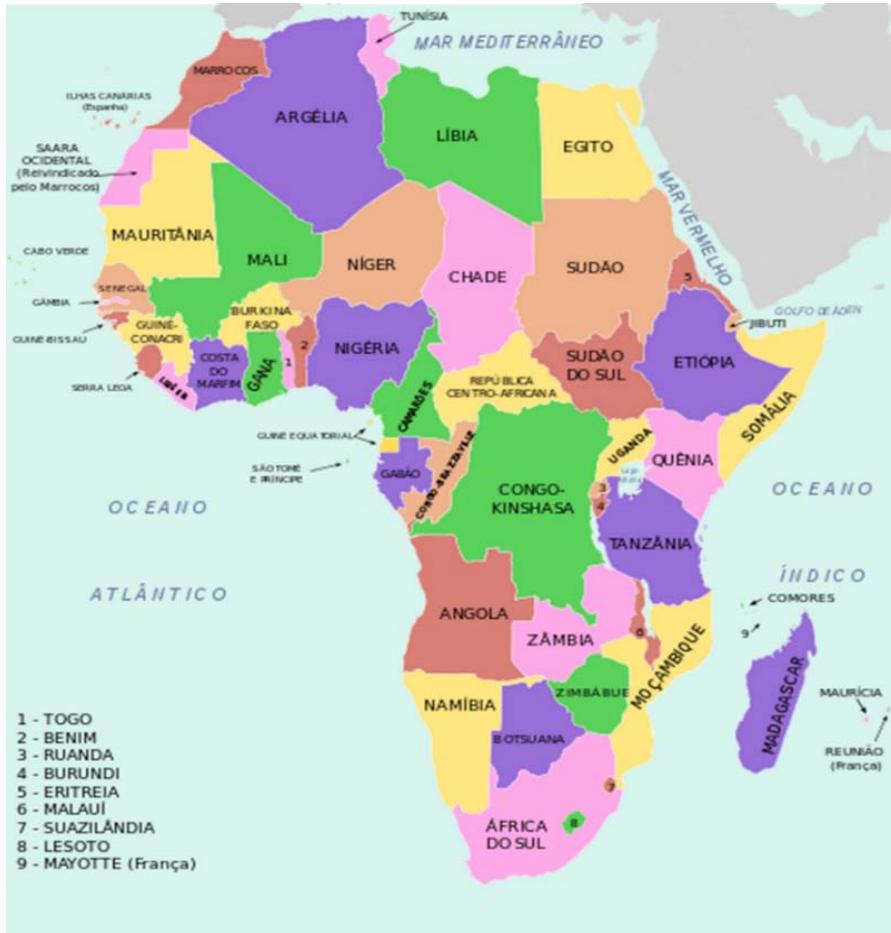 Fonte: CC-BY-SA, Fsolda, 2014
Figura 1: Mapa de África
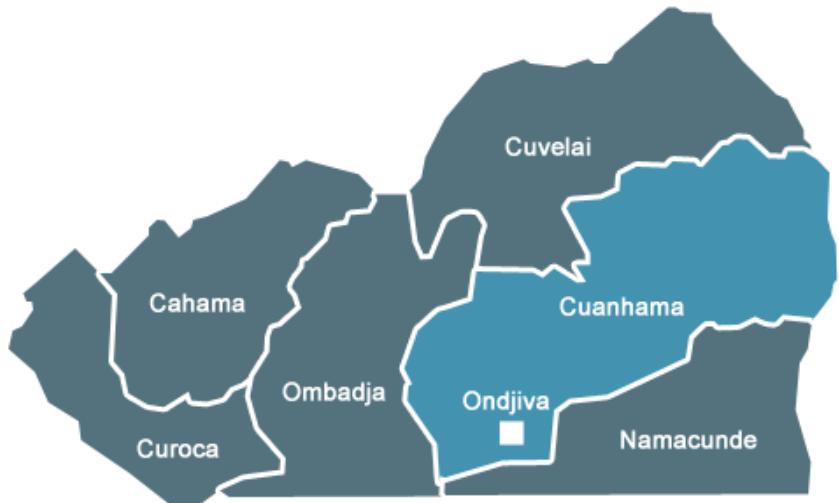 Figura 2: Divisão administrativa da província do Cunene Fonte: Governo Provincial do Cunene (2014).
De acordo a pesquisa efectuada por (SILVA, S, 2020,p 110) dos seis municípios que conformam a província do Cunene, três são fronteiriços, a citar:
- Município de Curoca: Administrativamente tem limite com a província do Namibe, na localidade do Monte Negro. Estende-se do marco 1 até ao marco 3;
- Município de Ombadja: Do marco 3 até ao marco 15;
- Município de Namacunde: Do marco 15 até ao marco 34, na área de Okambolokwena, administrativamente dividida com a província do Cuando Cubango, através da Comuna de Savat.5
A cidade de Ondjiva, capital da província do Cunene, localizada no município do Cuanhama, não é municípios fronteiriço.
Em termos de recursos naturais, Angola tem uma extensa rede hidrográfica, recortando o país de Norte a Sul, com a exceção do extremo Sudoeste, devido à influência do deserto do Namibe. A extensão e a complexidade da rede hidrográfica angolana e a origem planáltica dos seus cursos (Huambo, Bié, Moxico, províncias do Planalto Central) fazem os rios maiores e seus afluentes correr em duas direções: o Cuanza e o Cunene correm em direção ao Oceano Atlântico, os rios Zambeze, Cuando e Cubango em direção ao Oceano Índico. Mesmo não tendo origem em território de Angola, o rio Zaire banha o extremo Norte do país, desagua no Oceano Atlântico e tem a particularidade de entre os seus afluentes contar alguns rios que correm da região planáltica de Angola (MINUA, 2006, apud Jacinto 2012).
A zona fronteiriça do sul de Angola é atravessada, em grande parte, pelo rio Cunene. De caudal bastante irregular, enorme na época das chuvas e muito reduzido na época da estiagem, particularmente em anos muito secos, o rio pode ser atravessado a vau, embora a sua largura seja variável: na região do Humbe chega a atingir 5 a 8 km (Monteiro, 1994, pp. 41-43). O rio Cunene, de águas permanentes e de elevado caudal anual (média de $174 \ m ^ { 3 }$ na foz) atravessa toda a província, correndo de norte para sul, e vai desaguar no Atlântico, na província do Namibe, constituindo-se em troço de fronteira com a República da Namíbia. Nasce nas Boas Águas, Huambo, no planalto Central de Angola, corre para Sul até atingir as quedas do Ruacaná, a partir de onde inflete para Oeste até à sua foz, no Oceano Atlântico. "O rio Cunene tem uma extensão superior a mil quilómetros, dos quais cerca de $70\%$ em território angolano e o restante na linha fronteiriça. A respetiva bacia hidrográfica é da ordem do $130.000 \ \mathsf { k m } ^ { 2 }$, cuja capacidade de irrigação, segundo o antigo projeto luso-sul-africano, pode atingir 472 ha" (Gonçalves, 2010, pp. 247-248).
Paula (2016) aponta o rio Cunene como elemento natural decisivo para a delimitação da fronteira sul, entre Angola e o então designado Sudoeste Africano (Hogan, 2012). O "território fica dentro da área que se manteve litigiosa por muito tempo", que teria levado a prolongados "debates entre os europeus, interessados em definir qual seria a real fronteira entre a então colónia portuguesa e a alemã" (Paula, 2016, p. 90).

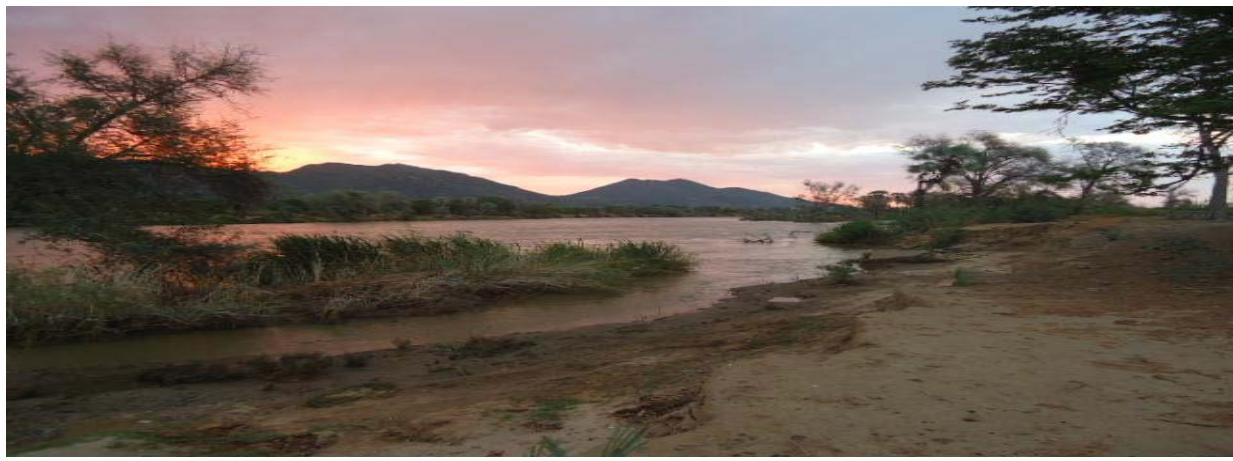
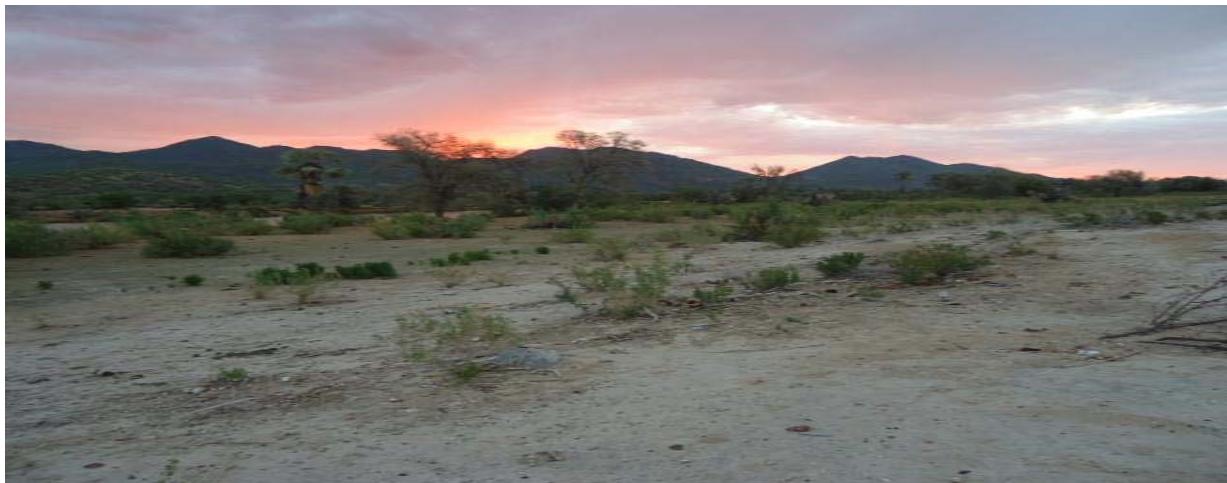 Fonte: Autora, 2017. Figura 3: Diferentes caudais no rio Cunene
A província do Cunene é servida por estradas nacionais (EN 105 e 120), cuja importância tem a ver com ligação do interior de Angola com a República da Namíbia em direção à República da África do Sul, não sendo o Cunene navegável em quase toda a sua extensão. Existem na região rios intermitentes constituintes da bacia hidrográfica do Cunene, como o rio Caculuvar, que atravessa o Município da Kahama, e o rio Cuvelai no Município do Cuvelai. Podem constituirse em fontes de revitalização agropecuária e de produção de energia elétrica por meio de mini-hídricas para uso doméstico ou para a indústria ligeira. Adicionam-se a este potencial de águas permanentes e intermitentes, as mulolas ou cursos de água resultantes de quedas pluviométricas que, com o recurso a furos de certa profundidade, permitem pequenas atividades domésticas. Apesar desta caracterização, a região debate-se com a escassez crónica de água.
Na sua abordagem, Paula (2016) refere que o interesse pelo rio Cunene estaria intimamente ligado à necessidade de os portugueses estudarem/ identificarem as suas eventuais ligações com o rio Zambeze e assim facilitar a elaboração do mapa corde-rosa. É evidente que não há ligação física entre os dois rios; a mira era o uso das suas águas para o assentamento de colonos que implicava a ocupação das terras "Além-Cunene" mediante o combate e a submissão das populações (Cuamatos e Cuanhamas).
Os municípios do Curoca, de Ombadja e de Namacunde são localidades situadas na fronteira internacional. De acordo com o censo de 2014, a província do Cunene tem uma área de 78 $3 ~ 342 ~ \mathsf { k m } ^ { 2 }$ e uma população estimada em 965 288 habitantes. Ondjiva é a sua capital (antiga Vila Pereira dEça).
De acordo com Gonçalves (2010, pp. 244-245) a província de Cunene - anterior Distrito do Baixo Cunene - foi criada a 10 de julho de 1970 por desanexação do Distrito da Huíla.
O étimo Cunene refere-se inicialmente ao rio, tendo sido adotado como designação da província (Estermann, 1983). Segundo Paula (2016), o rio, que se estende por mais de mil quilómetros, atravessa áreas etnolinguísticas dos povos Nyaneka-Humbe, Ovambo e
Herero, habitantes seculares da região do Cuamato e do Cuanhama, que compreendem os territórios da parte do Sul de Angola, e na Namíbia a Ovambolândia a Norte e a Damaralândia a sul desta última, conforme designações coloniais antigas.
Keese (2015, p. 237) salienta que a região do Cunene (que, durante muito tempo, pertenceu ao distrito angolano de Huíla) estava entre as mais baixas na escala de prioridades de desenvolvimento colonial de entre todos os distritos e subdivisões de Angola. O futuro distrito do Cunene é um exemplo particularmente notável das ambivalências, improvisações e contradições que caracterizam a reforma do pós-Segunda Guerra Mundial, não só no caso mais específico português, mas também no caso dos estados coloniais europeus tardios na África Subsariana em geral. A região pode ser comparada a qualquer parte marginal de um território colonial, "subdesenvolvida" mesmo até para os padrões portugueses. No início da década de 1950, os funcionários e planeadores portugueses tiveram de reajustar as suas políticas regionais, numa tentativa de melhorar a face do colonialismo português em Angola, e este processo teve finalmente de incluir as regiões próximas do rio Cunene, que durante muito tempo tinham sido território totalmente negligenciados (Keese, 2015, p. 240).
### b) Metodologia
Em termos metodológicos, a pesquisa apoiouse numa abordagem essencialmente qualitativa, com recurso a diferentes técnicas, como a observação e entrevistas semiestruturadas. Empregam-se métodos de pesquisa qualitativa focando no processo social, segundo Neves (1996), para visualizar os contextos da mobilidade das populações, os modos e estratégias como esta população se relaciona com as fronteiras e otimiza os recursos naturais de que dispõe, e neste particular o recurso hídrico, o rio Cunene.
Na ótica de Duarte (2002, p. 143), este tipo de entrevistas implica uma rigorosa seleção da população e da amostra, ou seja, dos sujeitos a serem entrevistados, visto que a qualidade da amostra implica "qualidade das informações" a partir das quais será possível construir a análise e chegar à compreensão mais ampla do problema delineado".
Em termos de tratamento das entrevistas, foi retirado "material textual" no sentido de permitir desvendar e "quantificar" a ocorrência de palavras/ frases e temas consideradas pertinentes (Coutinho, 2016, p. 217). Com base nesse material foi elaborado um quadro de análise do conteúdo extraído. Começámos por analisar profundamente a informação relevante no âmbito das respostas às perguntas formuladas. Foram compiladas e comparadas as várias respostas sobre a mesma questão com o intuito de posteriormente confrontar com o que foi retirado da pesquisa bibliográfica sobre o assunto. Foram registadas as respostas mais frequentes e relevantes correspondentes a cada pergunta das dez que integram o guião.
Em termos de tratamento das entrevistas, foi retirado "material textual" no sentido de permitir desvendar e "quantificar" a ocorrência de palavras/ frases e temas consideradas pertinentes (Coutinho, 2016, p. 217). Com base nesse material foi elaborado um quadro de análise do conteúdo extraído. Começámos por analisar profundamente a informação relevante no âmbito das respostas às perguntas formuladas. Foram compiladas e comparadas as várias respostas sobre a mesma questão com o intuito de posteriormente confrontar com o que foi retirado da pesquisa bibliográfica sobre o assunto. Foram registadas as respostas mais frequentes e relevantes correspondentes a cada pergunta que integraram o guião. Foram levantadas questões como: (i) de que forma a fronteira alterou o modus vivendi dos povos fronteiriços; ii) como é que os dois Estados e as populações locais têm gerido os seus recursos naturais (água sobretudo do rio Cunene transfronteiriço (Angola/Namíbia), nos diferentes períodos históricos; ii) que estratégias foram criadas e implementadas pelos Estados e pelas populações locais (sobretudo os Cuanhamas, que integram o grande grupo Ovambo), para gerir os recursos sobretudo as águas do rio Cunene?
Para as entrevistas foram selecionados pastores, agricultores, comerciantes, funcionários do governo e da administração, entre outros informantes relevantes. A nível institucional, foram feitos contactos com elementos ligados ao Governo da Província do Cunene, particularmente com funcionários ligados ao sector das águas (Instituto Regulador dos Serviços de Eletricidade e de Águas) para recolha de informação sobre fatores e estratégias das políticas públicas de gestão dos recursos naturais, o modo de atuação da polícia de fronteira dos dois países, a perspetiva dos sobas (autoridades tradicionais) e de outros habitantes locais ligados a temática em estudo.
Pretendeu-se que estas abrangessem a maior variedade possível de atores conhecedores da realidade local e mesmo, sempre que possível, envolvidos em atividades transfronteiriças relacionadas com o objeto da pesquisa. As idades dos entrevistados variam entre os 30 e os 65 anos. As pessoas entrevistadas foram selecionadas aleatoriamente, mas a escolha da amostra foi intencional, na medida em que teve como alva informante conhecedore da realidade local e/ou envolvidos nas referidas atividades. As identidades dos entrevistados são mantidas em sigilo por motivos de proteção de dados pessoais.
O texto esta estruturado em oito principais temáticas: (i) Introdução; (ii) Enquadramento sócio- histórico entre as Repúblicas de Angola e da Namíbia; (iii) Abordagem sócio-histórica sobre fronteiras e sua relação na gestão dual do rio cunene no sul de Angola; (iv) O rio Cunene: as barragens de Calueque e do Ruacaná; (v) Reflexões sobre a gestão dos recursos hídricos transfronteiriços; (vi) Tratamento dos recursos hídricos transfronteiriços em África; (vii) Considerações sobre os recursos hídricos na África austral; (vii) Discussão dos resultados, Reflexões finais e Bibliografia.
## II. Enquadramento Sócio - Histórico Entre as REpúblicas de Angola E DA NAmÍbIa
O desenho de fronteiras políticas de África à semelhança das Américas, passou a ser deste modo, a expressão dos interesses ocidentais acarretando na contemporaneidade, tensões entre povos antes separados e agora unidos sob modelos sociais, culturais e políticos desfasados dos seus padrões de vida. É por este motivo que o racismo e a intolerância encontram raízes no colonialismo devido à contradição entre a missão civilizadora argumentada pela doutrina colonialista e a dominação e subjugação dos nativos. A aculturação africana em favor da identidade ocidental a pretexto de valores universais tornou os povos dependentes das metrópoles, assimilando confusa e precipitadamente formas culturais alheias.
Para Henriques (1997) Angola terá sido das colónias portuguesas em África aquela que esteve mais tempo sob o jugo estrangeiro e aquela de onde se extraiu o maior volume de recursos. Das relações mutuamente vantajosas entre o reino português e a Federação do Congo do século XVI ao contrato e trabalho forçado no século XX, Angola esteve, com maior ou menor interesse, entre as prioridades de Portugal. As suas redes de comércio a longa distância, utilizando pumbeiros/carregadores africanos, intensificaram-se ao longo desta relação, recriando novas relações e novas estruturas sociais e políticas, tal como frequentemente descrito:
"o comércio português colonial impõe uma nova lógica de organização comercial, evoluindo no território controlado pelos Portugueses e definido pelas novas fronteiras coloniais, situação que provoca a desestruturação dos sistemas de complementaridade que organizavam os espaços africanos (Henriques, 1997, p. 72).
Resultando de um conhecimento factual proveniente da penetração, incursões e ocupação colonial e das expedições geográficas de cariz pretensamente científico, Portugal tinha interesses estratégicos e pretendia a hegemonia na região o que passaria pela ligação do Atlântico ao Índico, unindo Angola a Moçambique. Era o sugestivo mapa cor-derosa, que incluía a ocupação das terras situadas além-Cunene, num espaço que se definiria mais tarde como fronteira entre Angola (zona do Cunene e do Cubango) e o Sudoeste Africano. Entretanto, de acordo com Silva S. (2014), Angola era percorrida por grupos ao serviço da Sociedade de Geografia de Lisboa, com o objetivo de esclarecer/descobrir o verdadeiro percurso do rio Cunene e abrir novas rotas para o interior de África, ignorando os anteriores caminhos percorridos por caravanas comerciais.
### a) A perspetiva etno-histórica
O Cunene em movimento: dinâmicas empresariais transfronteiriças, avalia o aparecimento tardio das fronteiras internacionais no Cunene, tal como o faz no documentário Esta Fronteira não Existe (Udelsmann Rodrigues, 2011). De acordo com Monteiro (1994, pp. 207-206), a população Ambó está repartida por Angola e pela Ovambolândia "onde se situa o centro cultural deste grupo étnico, o que constitui reconhecimento de uma estrutura cultural uniétnica", atestando a permanência de laços de união entre uns e outros, sendo a fronteira apenas uma linha convencional, sem grande significado para a população. Quanto a essa questão, O entrevistado 26, funcionário do governo, indicou que "do ponto de vista administrativo a fronteira permitiu uma melhor organização dos Estados, independentemente de como foi efetuada, referindo que separou povos, neste caso o povo Ovambo, onde integra a etnia Cuanhama, mas que na realidade a fronteira sempre foi ignorada e contornados obstáculos no sentido de minimizar fatores impeditivos no seu dia-a-dia, daí as dinâmicas informais funcionarem com o devido conhecimento e controlo dos estados". O entrevistado 27 (funcionário da administração) respondeu que "a fronteira separou estados, mas não povos"
Entretanto, a compreensão da perspetiva etnohistórica da região que passa pela abordagem transfronteiriça de Bollig e Gewald (2009, p. 271) que referem um mesmo grupo a povoar dois Estados soberanos, separados por uma fronteira política. Tal faz com que encontremos nos dois países similaridades nas atividades económicas, assentes na pastorícia, e uma mesma identidade cultural, cuja língua constitui o referencial imediato de que ambos os povos descendem de um tronco comum, atestando a permanência de laços de união entre uns e outros. A população Ambó está repartida por Angola e pela Ovambolândia "onde se situa o centro cultural deste grupo étnico, o que constitui reconhecimento de uma estrutura cultural uniétnica", atestando a permanência de laços de união entre uns e outros, sendo a fronteira apenas uma linha convencional, sem grande significado para a população (Monteiro, 1994, pp. 207-206). Segundo Udelsmann Rodrigues (2017, p. 2), a identidade transfronteiriça concentrou-se progressivamente na ideia de uma divisão entre os dois países, assente na figura de Mandume Ya Ndemufayo, rei dos Kwanhama, que, tendo perecido em 1917, se crê ter sido "enterrado em ambos os lados da fronteira", o corpo do lado angolano e a cabeça do lado namibiano. Estamos perante uma noção de pertença comum, para lá da fronteira. Esta divisão do rei é vista como "símbolo da identidade transfronteiriça de Kwanhama".
O estudo parte do pressuposto de que o processo de construção e constituição das fronteiras entre Angola e a Namíbia e a gestão dos seus recursos em período colonial, - e, em termos genéricos, no continente africano ocorreu, antes de mais, à margem da vontade e dos interesses das populações, alterando profundamente as dinâmicas locais.
As populações adaptaram-se sistematicamente às novas realidades políticas e económicas que as fronteiras impuseram, demonstrando, na luta pela sobrevivência, uma grande resiliência. O estabelecimento da fronteira entre Angola e a Namíbia teve, ao longo dos três períodos históricos analisados, diversas e distintas implicações no que toca à gestão de recursos e à mobilidade das populações.
### b)Relações bilaterais Angola Namíbia
Apesar do racionalismo que encerram as Constituições desses Estados, o controlo da mobilidade nunca foi uniforme, tendo variado nos períodos históricos pré-colonial, colonial e pós-colonial. Este último período conheceu pelo menos duas grandes etapas: a primeira, entre 1975 e 1992, foi dominada pelo conflito militar entre Angola e a África do Sul, culminando com a derrota desta última em 1987/1988, na batalha do Cuito Cuanavale7, abrindo caminho à independência da Namíbia. A batalha do Cuito Cuanavale não teve origem em questões fronteiriças, mas a sua localização na fronteira sul, mais concretamente no Cuando Cubango, teve impacto na vida das populações dos Estados envolvidos.
O contexto de formação de ambos os Estados e a criação da fronteira estabeleceram não só condições sociopolíticas específicas como imprimiram, ao longo dos tempos, características de funcionamento e organização com impacto nas relações bilaterais. Do lado namibiano, a área da "Angra Pequena" foi comprada em 1883 por Adolf Lüderitz, comerciante alemão, a um chefe local do sudoeste africano. Logo no ano seguinte, a 24 de abril de 1884, a zona é colocada sob proteção do império alemão, visando travar possíveis invasões britânicas. Nesse contexto, e em ato contínuo, a 7 de agosto de 1884, a Namíbia torna-se colónia germânica, sob a designação de Sudoeste Africano Germânico. A história regista que os anos subsequentes foram marcados por revoltas dos Hereros, Ovambos e Nama contra a presença alemã, com destaque para a Guerra dos Hereros, em 1904.
Após a Primeira Guerra Mundial, a Alemanha perde o território do Sudoeste Africano em cumprimento do disposto no Tratado de Versalhes (1919), sendo posteriormente administrado pela África do Sul, com base no mandato da Liga das Nações. Em 1946, já sob autoridade das Nações Unidas (que substituíram a Liga das Nações), a África do Sul recusa-se a ceder a tutela do território à ONU, seguindo-se décadas de disputa internacional sobre o território, com sucessivas resoluções da Assembleia-Geral da ONU. Pelo contrário, a África do Sul procura a anexação da Namíbia, que passaria a ser a quinta província do país, estendendo a aplicação do regime de segregação racial ao território. Após décadas de conflito entre a SWAPO® e as autoridades de Pretória, a Namíbia alcança a independência em 1990. De forma sintética dizer que, no início do Século XX, a Namíbia era uma colônia alemã. Após a $1 ^ { \mathrm { a } }$ Guerra Mundial, ela se tornou um território administrado pela Liga das Nações. Após a 2a Guerra Mundial, a África do Sul administrou a Namíbia, até sua independência, em 1990.
O conflito político-militar que opôs, tenaz e longamente, Angola e a África do Sul, foi sobretudo motivado pelo apoio que Angola prestou à SwAPO, na luta pela libertação do Sudoeste Africano (actual Namíbia). Após a independência de Angola, as autoridades decidem apoiar o povo namibiano, autorizando a instalação de bases da SwAPO no seu território e a livre circulação dos seus dirigentes, situação que durou até à implementação da resolução 435/78 do Conselho de Segurança das Nações Unidas sobre a independência da Namíbia. Esta decisão reflete uma irmandade política, mas também uma afinidade étnica, com uma forte dimensão transfronteiriça. Estabelecidas as relações diplomáticas entre Angola e a África do Sul com a Namíbia independente, começa um período de relativo crescimento económico de Angola e a melhoria geral das condições de vida das populações.
Na luta pela independência do país, em confronto com o regime de apartheido da África do Sul, a SWAPO solicitou auxílio de Angola e criou, em território angolano, postos avançados de preparação para a guerrilha. Essas bases eram bombardeadas pelo exército sul-africano, num período em que Angola já se encontrava independente da presença colonial, mas vivendo um momento não menos conturbado da sua história, o período de guerra civilo. Como consequência, o território de Angola foi violentamente agredido, originando consideráveis alterações nas rotinas produtivas e sociais enraizadas desde há séculos, com impacto na capacidade de mobilidade das populações, de ambos os lados da fronteira. Entretanto, quando a Namíbia finalmente alcançou a independência a 21 de março de 1990, em território angolano manteve-se a disputa interna entre os dois partidos rivais, MPLA e UNITA, que duraria até 2002.
Relativamente a Angola, apesar de a sua configuração territorial não apresentar pontos de clivagem representativos, a presença de namibianos sob a direcção da SWAPO11 após a proclamação da independência gerará novas narrativas, que procuraram justificar a invasão sul-africana. Esta foi, no entanto, anterior ao estabelecimento das bases da SwAPO em território da atual República de Angola por ter-se processado no âmbito da operação IA Feature2
- 9 Apartheid foi um regime de segregação racial adotado de 1948 a 1994 pelos sucessivos governos do Partido Nacional na África do Sul, no qual os direitos da maioria dos habitantes foram cerceados pelo governo formado pela minoria branca.
- conflito que opôs Angola e África do Sul em toro da independência da Namíbia está intrinsecamente ligado à guerra civil angolana. Do lado do governo de Angola, o MPLA e as Forças Armadas (FAPLA), com o suporte de Cuba, apoiaram a SWAPO, enquanto a África do Sul apoiou a UNITA (partido de oposição ao MPLA).
- 11 A swAPO (acrónimo de South West African People's Organisation), movimento de libertação da Namíbia, instalou bases em Angola após a independência, em 11 de novembro de 1975. Este movimento lutou contra o regime segregacionista (apartheid) da África do Sul até 1989. Quando a Namíbia finalmente alcançou a independência (21 de março de 1990), o conflito armado em território angolano manteve-se entre o Governo angolano e o partido UNITA até fevereiro de 2002.
- Código da operação militar concebida pelaCIA arovada p Presidente dos EUA, Gerald Ford, a 18 de julho de 1975, visando impedir a proclamação da independência de Angola pelo MPLA devido à sua orientação comunista (Stockwell, 1979). O lançamento da operação foi antecedido do encontro secreto da llha do Sal/Cabo Verde a 14 de setembro de 1974 (Freitas, 1975), em que Angola tornar-se-ia independente no quadro da Confederação Zaire-Angola-Cabinda sob a presidência do Presidente do Zaire (atual República Democrática do Congo), Mobutu Seseseko. De recordar que durante a colonização portuguesa em Angola, os grandes investimentos infraestruturais e industriais (caminhos-de-ferro, portos e aeroportos, indústria de têxteis e oleaginosas, extracção de petróleo, diamantes e ferro, etc.) tiveram participações de capitais de outros Estados ocidentais, como a Grã-Bretanha, a Alemanha, a Bélgica, a França e os EUA (Bender, 1976 e Dilolua, 1978).
(Stockwell, 1979) lançada pelo Presidente dos EUA Gerald Ford a 18 de julho de 1975, coligida com a operação Savannah13.
A designada guerra civil angolana (1975-2002), apesar da sua repercussão internacional14 não resultou de diferendos fronteiriços ou de desentendimentos étnicos no território.O território angolano foi violentamente agredido, originando consideráveis alterações nas rotinas produtivas e sociais enraizadas desde há séculos, com impacto na capacidade produtiva das populações por via da mobilidade em ambos os lados da fronteira em estudo.
REflexÕes Sobre Fronteiras e Sua RElaçÃo na GestÃo Dual do Rio Cunene á Sul de Angola
Os territórios do Sudoeste Africano, colónia alemã, e ainda sem fronteiras definidas, foram palco de conflitos e recontros armados entre tropas portuguesas, alemãs e sul-africanas, auxiliadas por tropas britânicas, sendo a posteriori, a partir de 1919, colocados sob domínio britânico por força do Tratado de Versalhes (Coelho, 2014).
Resultando de um conhecimento factual proveniente da penetração, incursões e ocupação colonial e das expedições geográficas de cariz pretensamente científico, Portugal tinha interesses estratégicos e pretendia a hegemonia na região o que passaria pela ligação do Atlântico ao Índico, unindo Angola a Moçambique. Era o sugestivo mapa cor-derosa, que incluía a ocupação das terras situadas além-Cunene, num espaço que se definiria mais tarde como fronteira entre Angola (zona do Cunene e do Cubango) e o Sudoeste Africano. Entretanto, de acordo com Silva, S. (2014), Angola era percorrida por grupos ao serviço da Sociedade de Geografia de Lisboa, com o objetivo de esclarecer/descobrir o verdadeiro percurso do rio Cunene e abrir novas rotas para o interior de África, ignorando os anteriores caminhos percorridos por caravanas comerciais.
A Sul de Angola, os interesses em ocupar os recursos hídricos do rio Cunene eram múltiplos, com Portugal e a Alemanha a disputar o território. Os esforços e recursos aplicados pelas potências para dominar os recursos hídricos dão lugar a um caso inédito em África, a criação de uma zona neutra, que por muitos anos permaneceu litigiosa.
A partir desta conceção, o rio Cunene que havia já sido elemento chave para as pretensões de travessia da África e para as guerras coloniais, passa a ter outras utilidades, enquanto "objeto de barganha diante da diplomacia internacional, além de demonstrar ser a única solução para amenizar a aridez da Damaralândia" (Paula, 2016, p. 139). De acordo com o autor, as discussões diplomáticas decorridas nos anos 10 do século XX, resultam de uma proposta avançada pela Alemanha, também ávida de dominar espaços com recursos hídricos suficientes para os seus intentos expansionistas, precisamente o rio Cunene, e para encontrar argumentos com elementos geográficos suficientes para definir uma "nova linha" que satisfizesse os seus interesses na região. (Paula, 2016, p. 147).
Precedente à eclosão da Primeira Guerra Mundial, a Alemanha e a Inglaterra negociaram em 1912 um acordo que acabou por não se concretizar. As duas potências pretendiam "desviar suas rivalidades do cenário europeu" (Aparício, 2000, p. 225), jogando com os impérios. Tratava-se de um acordo secreto que previa o seguinte:
"A partilha das colónias portuguesas, sendo Angola destinada a Alemanha, no caso de os Portugueses não conseguirem a segurança do território, pois havia várias revoltas e nem todo o território estava" ocupado". Portanto, a invasão "definitiva" do território Kwanyama deve ser vista também no quadro de necessidade de afirmação internacional e da cobertura que a guerra de 1914-1918 dava a operações militares de grande envergadura contra interesses alemães." (Aparício, 2000, p. 225).
No âmbito da "semana das colónias", Canêlhas (1929) refere, no contexto da delimitação da fronteira sul de Angola, a importância da figura de Carlos Roma Machado de Faria e Maia, coronel e engenheiro que chefiou a primeira missão de delimitação. A respeito da fronteira sul, Canêlhas (1929) pormenoriza o seguinte:
"A delimitação da fronteira sul d'Angola, compreendida Entre-os-Rios Cunene e Cubango, numa extensão de cerca de 450 quilómetros, foi realizada em duas campanhas respetivamente em 1927 e 1928. A delimitação propriamente dita da fronteira teve início em 1927." (Canêlhas, 1929, p. 257).
Foi, assim, num contexto de avanços e recuos que "a 10 de agosto de 1911, o governo português [a sinalizar] para a aprovação da determinação da zona neutra" (Oliveira, 2010, p. 82). Não obstante, tal não significou o fim dos conflitos e das acusações mútuas (Paula, 2016), dando lugar à necessidade de se demarcar definitivamente a linha de fronteira sul de Angola, com o objetivo de garantir a Portugal mais uma parcela de terra e de dificultar o acesso alemão. Tanto oficial como informalmente, na busca individual de recursos hídricos e de acesso a um porto de mar, o território angolano era desejado. Durante muito tempo, o discurso oficial das autoridades alemãs e portuguesas sinalizava a discordância com O comportamento de cidadãos dos respetivos territórios em África, porquanto estes continuavam a cruzar as linhas limítrofes para comerciar ou em incursões bélicas.
Mais tarde, e já em plena vigência da ditadura em Portugal, ainda com uma fronteira conflituosa, mantêm-se os interesses coloniais sobre os recursos do Cunene. Portugal e a África do Sul estabelecem acordos e alianças políticas para o aproveitamento do rio, que darão origem, entre outros, aos empreendimentos do Ruacaná e de Calueque. Assim, segundo Maia (1941),
"A proposta da zona foi feita para por meio dela, poderem obter metade da força motriz das quedas do rio Cunene, entre Cazombue e Roacaná, tal é a largura da mesma zona [...] e fazer depender da passagem de metade de água do Rio Cunene através do Cuamato e Cuanhama até a lagoa Etocha." (Maia, 1941, p. 63).
Esta questão não tinha nada a ver com a delimitação da fronteira (Maia, 1941), mas permitia aos mandatários do Sudoeste Africano disporem da região do Ovambo português, conseguindo o aproveitamento dos canais para conduzir a água para Sul, com potencial de irrigação da região. O acordo para a demarcação da fronteira sul, celebrado entre Portugal e a União Sul-Africana a 1 de julho de 1926, centrava-se na utilização dos recursos hídricos do rio Cunene por parte do Sudoeste Africano.
Entende-se que, o estabelecimento das fronteiras a Sul de Angola (Angola/Namíbia) - e, em termos gerais, em África - foi um processo resultante de interesses particulares na busca e exploração dos recursos naturais das regiões, bem como da implementação dos princípios ditados pela Conferência Internacional de Berlim quanto à partilha e ocupação efetiva de África. Foi um processo de prolongadas e conflituosas negociações entre potências europeias, intercaladas com acordos com alguns chefes africanos, com profundas implicações na mobilidade das populações que habitavam nas zonas fronteiriças. As populações foram obrigadas a transitar de sistemas políticos regidos por normas tradicionais/ consuetudinárias para um regime orientado por filosofias económicas, jurídicas e organizativas estranhas ao seu tradicional, e então já consolidado, modo de vida. A partilha de espaços físicos, cuja natureza permitia mobilidade na gestão dos recursos naturais pelas populações e Estados, era uma destas consequências lógicas.
O estabelecimento da fronteira sul de Angola resultou de protocolos assinados entre Portugal e duas potências (Alemanha e África do Sul). A 30 de dezembro de 1886 foi assinada, em Lisboa, a Convenção que estabelece os limites territoriais das colónias de Angola e do Sudoeste Africano (Namíbia). Com a derrota da Alemanha na Primeira Guerra Mundial (1914-1918), e por força do Tratado de Versalhes (1920) que obriga este país a entregar as colónias às potências vencedoras (Inglaterra, França), a África do Sul assumiu, sob mandato da Sociedade das Nações, o controlo do Sudoeste Africano. É este quadro que explica que os dois países assinassem um acordo, a 22 de junho de 1926, para resolução da questão fronteiriça que tinha ficado pendente no acordo de 1886 com a Alemanha.
Estes - bem como outros acordos relativos a distintas regiões de Angola, que não são objeto desta tese - provocaram, grosso modo, a separação de vários povos. Os Bakongo ficaram entre os dois Congos e Angola, pondo fim à unidade do Reino Congo. Os Lunda, Baluba e os Cockwe ficaram divididos entre o Congo belga, a Zâmbia e Angola. A sul de Angola, o mesmo sucedeu com as áreas etnolinguísticas dos povos Nyaneka-Humbe, Ovambo e Herero, habitantes seculares da região do Cuamato e do Cuanhama, que foram "repartidos" entre os territórios coloniais de Angola e do Sudoeste Africano (actual Namíbia).
Em Angola, onde a independência foi mais tardia, com um complicado processo de descolonização, também há casos de populações separadas (por exemplo, os Chokwes nas Lundas e Moxico, os Kwahamas no Cunene). Se essas fronteiras provocaram mudanças e exigiram adaptações, tanto das populações como dos Estados, não geraram, porém, conflitos graves.
Uma contextualização e enquadramento teórico sobre o estabelecimento das fronteiras de Angola, o caso da fronteira Angola-Namíbia, encerram, para além da compreensão antropológica (por tratar-se de unidades políticas habitadas pelos mesmos grupos etnolinguísticos) um necessário entendimento sóciohistórico que corporiza a influência da expansão europeia na divisão desses povos.
Actualmente os dois Estados, de Angola e Namíbia em sede das relações e do direito internacional incorporam continuamente as dinâmicas socioconstrutivistas das populações nas regulações ordinárias de administração a celebração de diversos acordos.
Efectivamente em relação à gestão de recursos ao nível estatal, a principal questão nesta fronteira diz respeito à água. Efetivamente, o aproveitamento racional das águas do Cunene tem levado a que Angola e a Namíbia considerem válidos acordos vindos das administrações coloniais, a que se juntam diversos novos protocolos. Em 2012 o ministro da Energia e Águas angolano, João Baptista Borges, e o ministro da Agricultura, Água e Floresta namibiano, JonyMutouwa, assinaram em Windhoek um memorando para o uso partilhado destas águas15. A cooperação bilateral no sector da água entre estes dois países vizinhos caracteriza-se pelo desenvolvimento de esforços coordenados para tirar partido do potencial de produção de energia. São evidências desta cooperação o abastecimento em energia elétrica da cidade de Ondjiva e as vilas de Namacunde e Santa Clara, todas em território angolano, a partir da subestação de Onuno situada em território namibiano.
Os governos de Angola e da Namíbia têm um vasto potencial de recursos naturais a explorar, numa ótica de desenvolvimento sustentável. A possibilidade de colocar esses recursos ao serviço das economias e do bem-estar das respetivas populações induz os governantes dos dois países a encontros permanentes e à aprovação de legislação que regule e regulamente a sua utilização. Apesar do potencial hídrico da região sul, sobretudo o Cunene, o período colonial ficou marcado por um acentuado recurso a águas subterrâneas. De modo a assegurar o consumo humano e animal, constroem-se cacimbas com muitos metros de profundidade. Apesar da grandiosidade e volume do caudal de água de alguns rios de Angola, algumas populações viviam numa luta intensa com "dificuldades de acesso a água potável para uso doméstico", bem como para o gado e para a agricultura (Costa, 1906, p. 2).
De acordo com Aniceto Afonso, o aproveitamento das águas do rio Cunene, com vista a resolver o problema da falta de água no deserto do Kalahari (Sudoeste Africano) e a produção de energia elétrica, foi alvo de acordos entre Portugal e a União Sul-Africana, que vieram a ser implementados com a construção de barragens, empreendimentos que serviriam, também para o estreitar de relações entre os dois países. Ao governo português cabia uma tarefa adicional: gerir e desenvolver a região do Cunene (2009, 271, p. 230). A importância do rio para a região fica cada vez mais evidente. O explícito interesse declarado pelos sul-africanos relativamente aos recursos hídricos do Cunene torna patente que "qualquer acordo de delimitação da fronteira que atendesse a solicitação portuguesa, só seria possível mediante um segundo acordo que deveria estabelecer normas para a utilização do rio" (Paula, 2016, p. 158).
Atualmente, os empreendimentos hidrográficos da bacia do Cunene têm uma gestão integrada, a cargo do Gabinete para a Administração da Bacia Hidrográfica do rio Cunene (GABHIC). As infraestruturas planeadas seguem o Plano Geral da Bacia do rio Cunene que, além de serem concebidas para regularização dos diferentes caudais, concorrem para a prossecução dos múltiplos usos que a água pode ter, ao longo do percurso, da nascente para a foz. O esforço para a regularização dos caudais enquadra-se numa gestão ambientalmente sustentável para a satisfação das necessidades das populações que vivem nas zonas contíguas.
Dos resultados obtidos pela pesquisa no terreno, conclui-se que a gestão dos recursos hídricos é feita sobretudo ao nível estatal. Mesmo o acordo de 1888, entre portugueses e alemães, base para o acordo para a delimitação da fronteira sul de Angola entre portugueses e sul-africanos (22 de junho de 1926), relacionava-se com a necessidade de gerir os recursos hídricos. O uso das águas do rio Cunene, o seu desvio para a lagoa Etocha, era a condição única para amenizar a aridez na Damaralândia. Estes acordos vigoram até aos nossos dias, complementados por iniciativas posteriores à independência, tendo em vista um melhor aproveitamento das barragens do Calueque e Ruacaná, no rio Cunene, almejando melhorar a vida das populações dos dois países, tanto em termos de abastecimento de água como de energia elétrica.
Foram as dinâmicas sócio-culturais que mesmo apelidando-os de informais pressionaram as decisões do direito positivo a respeitá-las, porque constituam a fonte de perpetuação civilizacional aquém de qualquer determinismo modernista. Estudos geográficos sobre a região apontam a importância dos recursos naturais que são em grande parte, de caráter transfronteiriço (Angola, 2005), a exemplo, da Bacia do Etocha, na Namíbia em que, "grandes rios, como o Cunene têm drenado para esta bacia por períodos que vão de algumas dezenas de milhares de anos a centenas de milhares de anos formando vastos lagos interiores, de que o último exemplo se encontra patente na caldeira de Etocha e que chegou a estender-se desde o sul da actual Owamboland até à fronteira de Angola" (2005, p. 26).
No que se refere a Angola e Namíbia, as leis que regulam a gestão da agua do rio Cunene são sobretudo regulatórias. A multiplicidade étnica não constitui motivo de conflito como tal, e nem existe uma pressão demográfica que implique desequilíbrio face aos recursos disponíveis. Em suma, a mobilidade populacional na fronteira sul de Angola alterou-se nos três períodos históricos identificados. Numa fase pré- colonial, seria marcada por mais liberdade de movimentos, que passa a ser controlada com a instauração do aparelho estatal colonial. Com a colonização, os recursos naturais e as formas de desenvolvimento e relacionamento social passaram a ser controladas pelas potências colonizadoras. O colonialismo impôs em África padrões ocidentais (leis, normas, códigos) de gestão dos espaços geopolíticos e dos recursos naturais, e reduziu a capacidade de mobilidade das populações. Com as independências, os novos Estados passaram a gerir, de forma moldada pelos padrões herdados do período colonial, os seus próprios recursos. Com a independência da Namíbia 21 março de 1990 e de Angola em 11 de novembro 1975 e consequente fim da guerra civil em Angola em 2002, a fronteira volta a ser mais porosa, permitindo uma maior mobilidade, formal e informal, bem como o desenvolvimento de relações transfronteiriças, a nível individual, comunitário e económico.
## IV. O Rio Cunene: As Barragens de Calueque e do Ruacaná
As análises sobre as lógicas e processos da formação das fronteiras e questão da gestão partilhada dos recursos naturais sobretudo os hídricos entre Angola e a Namíbia na região da fronteira permitiram a análise da problemática e aprofundada reflexão sobre o seu uso e sobre as potencialidades da gestão partilhada em contextos fronteiriços. A exemplo do potencial do rio Cunene, com uma extensão superior a mil quilómetros, dos quais cerca de $70\%$ em território angolano e o restante na linha fronteiriça com a República da Namíbia, transfronteiriço em cerca de 338 km de extensão, que tem em Angola o seu maior volume de água, mas em cujo curso se situam as barragens de Calueque e Ruacaná (lado angolano) que fornecem água também à Namíbia. O fomento agrícola no Calueque é efetuado através do canal que transporta água para a República da Namíbia, com moto bombas que bombeiam água para os campos agrícolas e para consumo.
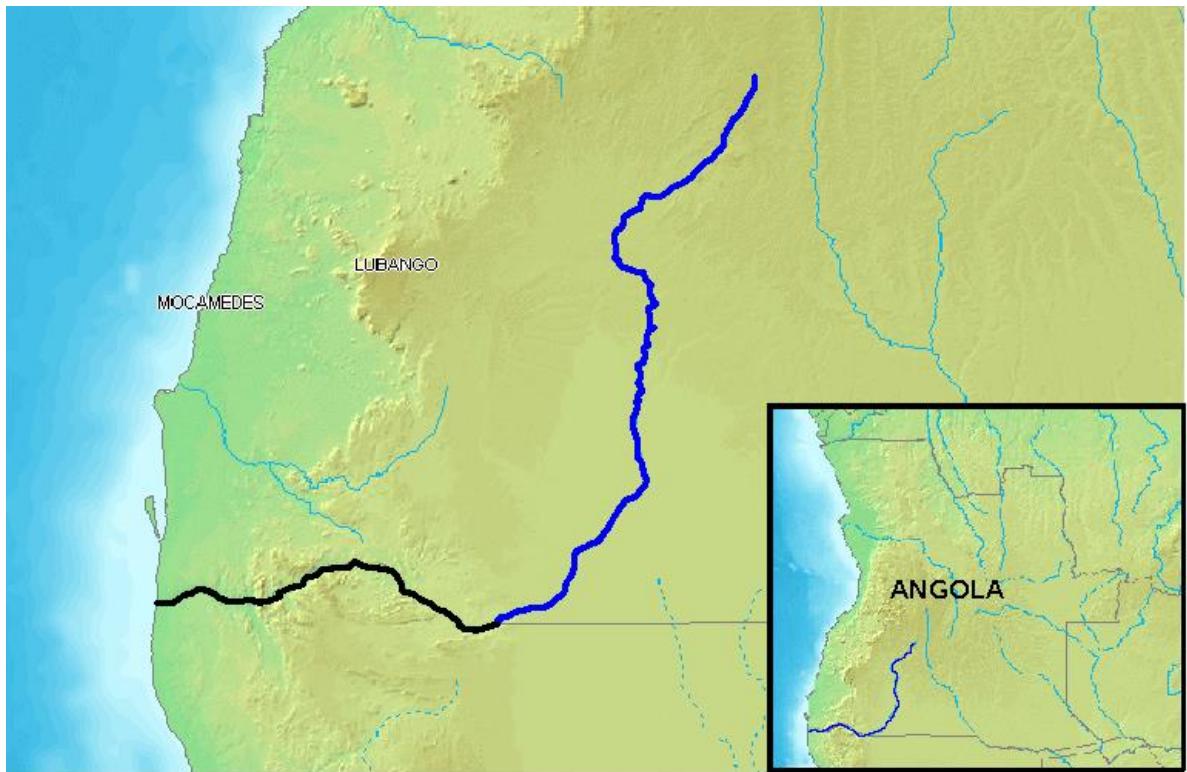 Fonte: https://pt.wikipedia.org/wiki/Rio_Cunene Figura 4: Mapa do rio Cunene17
O território do Sul de Angola e a vizinha Namíbia caracterizam-se por serem uma região geralmente seca, com chuvas intensas, mas muito espaçadas, pelo que o rio Cunene tem um papel decisivo na amenização dos fenómenos naturais. Além da importância que teve para a definição das fronteiras, o rio é importante para a implementação de projetos que buscam reduzir os efeitos da seca na região sul de Angola e Norte da Namíbia. Na sua obra de 2016, O colonialismo espelhado nas águas do Cunene (1884- 1975), Paula analisa a centralidade do rio, tanto para a vida quotidiana das populações como para as relações internacionais.
Conforme o relatório do Governo Provincial do Cunene (2014), o troço internacional do rio Cunene situa-se entre as quedas do Ruacaná e do Monte Negro, correspondendo a 120 km, sendo os restantes 340 km de fronteira demarcados pelo marco 35. A população da província 965 mil habitantes em 2014 concentra-se maioritariamente nos municípios do Cuanhama, Ombadja e de Xangongo (INE, 2014). A província é servida por estradas nacionais (EN 105 e 120), importantes eixos de ligação entre o interior de Angola e a República da Namíbia e a República da África do Sul.
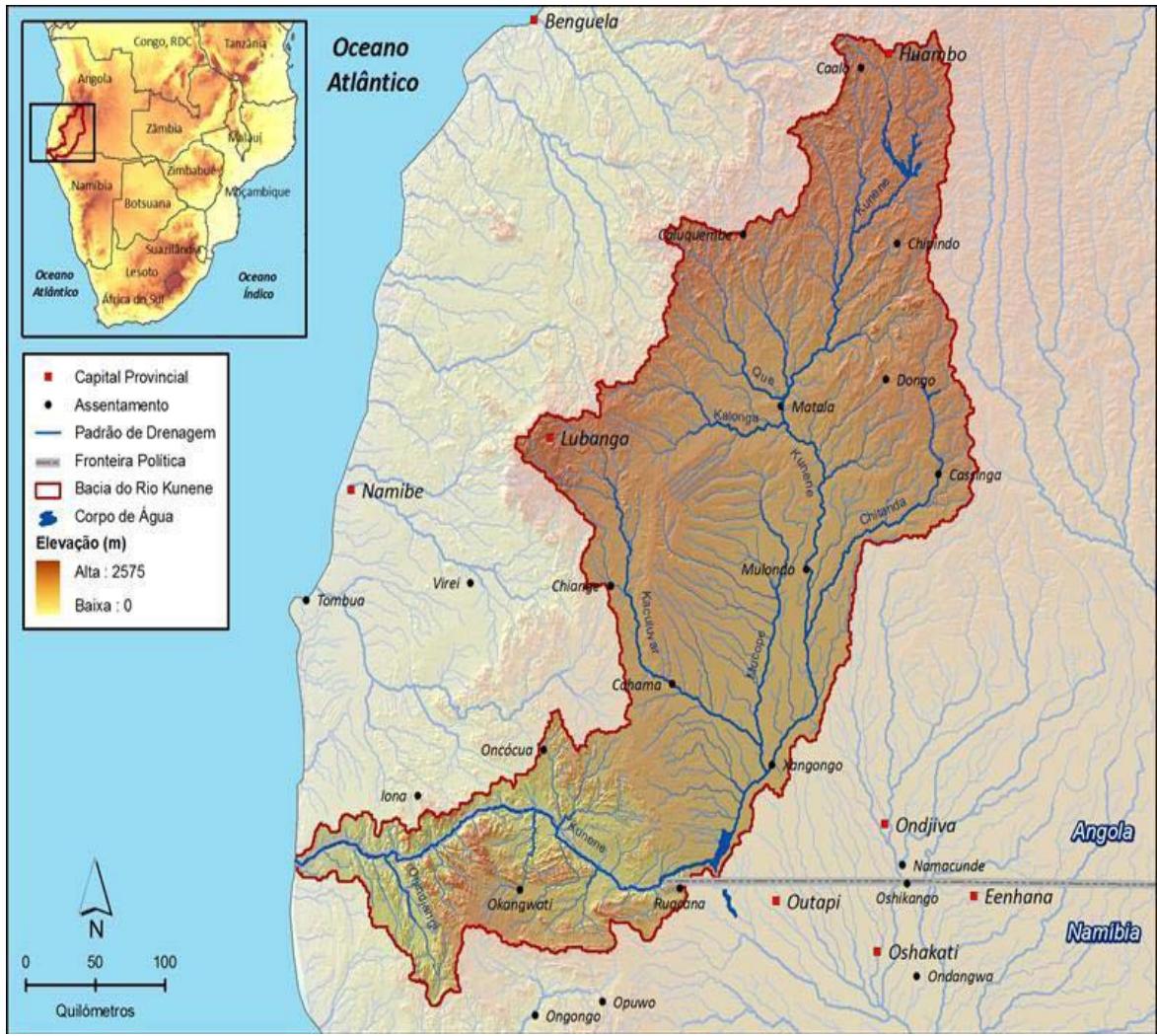 Fonte: AHT GROUP AG 2010
Figura 5: Bacia do rio Cunene
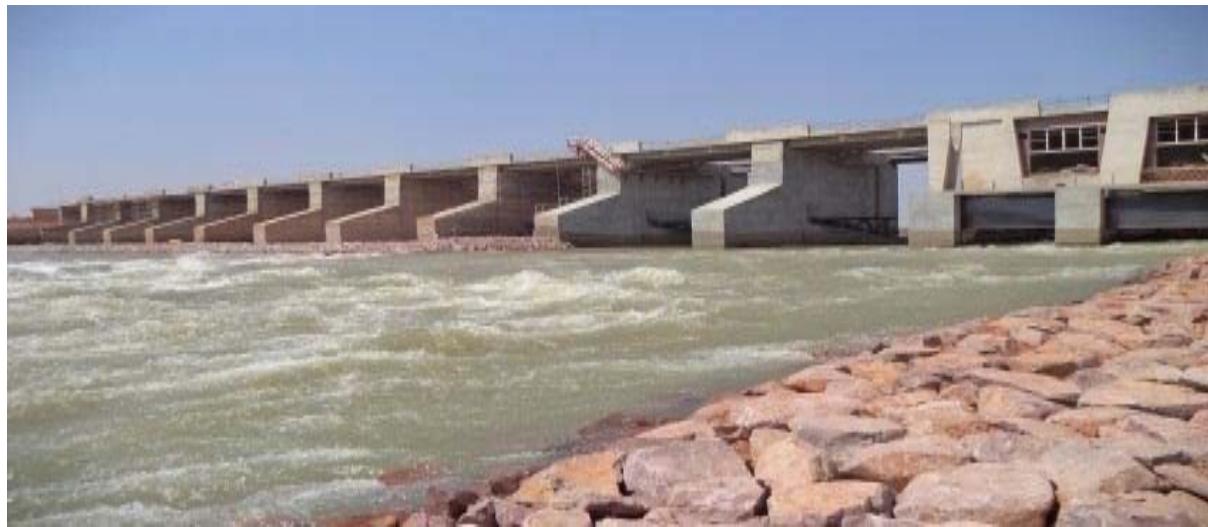 Figura 6: Barragem de Calueque utilizada para o regadio - fomento agrícola e consumo doméstico Fonte: Autora 2014
A água saída de Angola através de um canal proveniente da localidade de Calueque, Município de Ombadja (Angola, província do Cunene) entra na República da Namíbia na Região de Omussati, onde é concentrada e daí aplicada para o uso doméstico, piscicultura e agricultura. A barragem de Ruacaná concentra as águas (albufeira) em Angola, mas, entretanto, os dínamos encontram-se na República da
Namíbia, gerando energia que abastece o Norte do país, nomeadamente as regiões do Kunene, Omussati e Ohanguena. A energia produzida na Namíbia abastece também localidades da República de Angola, como o Chitado e Ruacaná, no Município de Curoca; Naulila e Kalueque, no Município de Ombadja; Santa Clara e
Namacunde sede, no Município de Namacunde; assim como parte da cidade de Ondjiva (capital da província do Cunene) localizada no Município do Cuanhama. (entrevistado A, 54 anos, polícia de guarda Fronteira do Cunene- Angola).
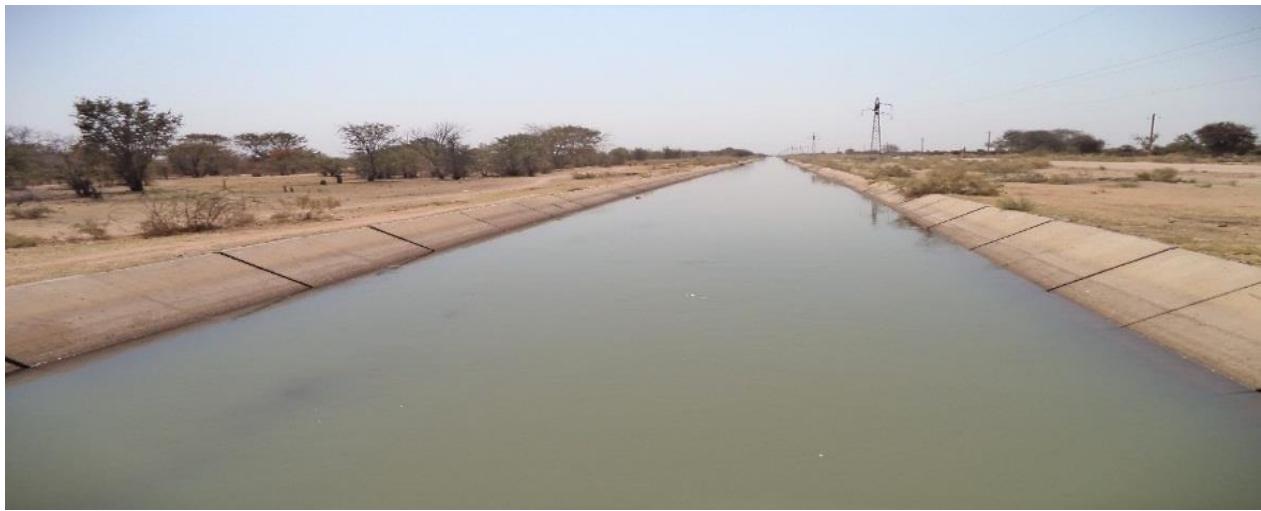 Fonte: Autora 2014 Figura 7: Canal que leva água do rio Cunene a partir da localidade de Calueque até a Namíbia
A importância da barragem de Calueque para o bem-estar das populações dos dois lados da fronteira internacional tem levado a sucessivas missões conjuntas destes dois países. Pretende-se o reforço da cooperação bilateral com vista a uma melhor gestão partilhada dos recursos hídricos, na plena consciência de que ainda não se atingiu o máximo do potencial da barragem.
Para Andreu (2014, s. p.) a água é um recurso que "transcende fronteiras e oferece oportunidades para processos sinergéticos e colaborativos para uma governança global." Os governos de Angola e da Namíbia têm um vasto potencial de recursos naturais a explorar, numa ótica de desenvolvimento sustentável. A possibilidade de colocar esses recursos ao serviço das economias e do bem-estar das respetivas populações induz os governantes dos dois países a encontros permanentes e à aprovação de legislação que regule e regulamente a sua utilização.
Quanto às Quedas do Ruacaná, são conjunto de cataratas e quedas de água formadas pelo rio Cunene, localizada nas imediações da povoação angolana de Ruacaná, precisamente na fronteira Angola-Namíbia. A queda principal tem 120 m de altura e cerca de 700 m de largura na época das chuvas. Para além do potencial hídrico, tem um grande potencial turístico, pois é uma das maiores quedas de água de África. A barragem do Ruacaná, juntamente com a barragem do Calueque, que se situa a cerca de $40 \mathsf { k m }$ a montante, alimenta a central hidroelétrica construída pela África do Sul, na década de 1970, e um sistema de distribuição de água, que serve o norte da Namíbia. A capacidade instalada da central hidroelétrica do Ruacaná é cerca de 240 MW, sendo que O equipamento e instalações de transformação energética se situam na Namíbia.18
O entrevistado 27, funcionário da Administração, diz que a gestão a água (e a eletricidade, quando há produção hidroelétrica) é gerida através de políticas estabelecidas, algumas ainda elaboradas no período colonial, entre portugueses e alemães/sul-africanos. Estes acordos perduraram até aos nossos dias entre a República de Angola e Namíbia, nas barragens do rio Cunene (Calueque e Ruacaná), formal pelos estados e informal pelas populações locais.
Sobre a questão do aproveitamento da água do rio Cunene, o entrevistado 22 (sexo masculino, trabalhador da barragem com certo responsabilidade hierárquica, de 49 anos) começou por fazer uma resenha histórica: "A barragem do Calueque foi construída a 192 quilómetros a noroeste de Ondjiva, no leito do rio Cunene, na povoação com o mesmo nome do município de Ombadja, na Província do Cunene. Para além da regularização fluvial, tem como fim a captação de água para regadio e o abastecimento público. A sua construção teve início em 1972 e foi interrompida em 1976, devido a guerra civil que assolou a República de Angola".
No conjunto dos diversos reservatórios desenvolvidos pelo Estado namibiano, importa referir o grande reservatório artificial de água na área do Epalela, que tem uma enorme capacidade de reserva, que não só recolhe águas do Cunene como aumenta de nível com as águas provenientes da chuva, informação sustentada e referida nas entrevistas. A região norte da Namíbia, mais concretamente a zona do Oshakati, é abastecida de água através de canais provenientes das bacias situadas em Angola, de Calueque e Ruacaná, sendo que é também esta última, com capacidade hidroelétrica, que abastece de energia a cidade de Ondjiva (entrevistado 3, 65 anos, soba, criador de gado).
A energia que que é produzida na barragem do Ruacaná abastece parte das regiões/províncias do Norte da República da Namíbia assim como algumas regiões de Angola na província do Cuneneo. Entretanto, a energia produzida na Namíbia a partir da barragem do Ruacaná, abastece também localidades da República de Angola, como Chitado e Ruacaná no Município de Curoca; Naulila e Calueque no Município de Ombadja; Santa Clara e Namacunde sede no Município de Namacunde; assim como parte da cidade de Ondjiva (capital da província do Cunene). Historicamente, os recursos hídricos da bacia do Cunene têm produzido acordos internacionais para a sua gestão partilhada.
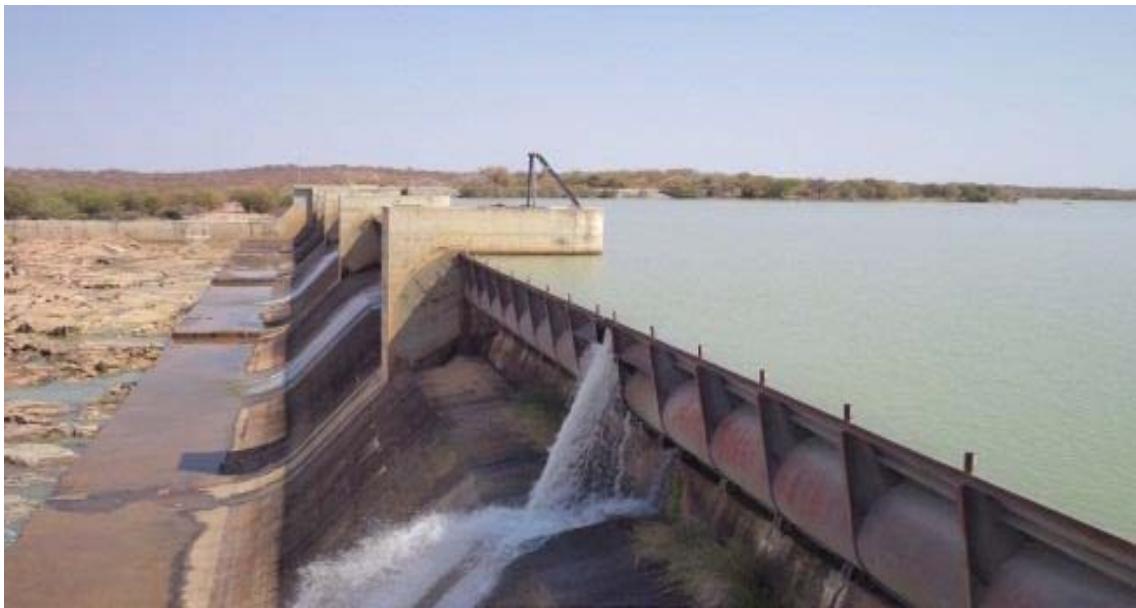 Fonte: Autora, 2014 Figura 8: Barragem do Ruacaná fornece energia eléctrica a uma parte do Norte da Namíbia e algumas localidades de Angola.
De acordo com as entrevistas efetuadas em 2014, "o governo do Cunene abastece de água potável a população a partir da captação do Xangongo, onde é tratada. A água é proveniente do rio Cunene e percorre 96 km por via de uma tubagem para abastecer a cidade de Ondjiva e parte do município fronteiriço de Namacunde, chegando às residências dos consumidores através das torneiras. Parte da sede Municipal de Namacunde e da povoação de Santa Clara são abastecidas através de chafarizes, cuja água é proveniente da Namíbia. Entretanto, dadas as dificuldades, as populações recorrem as cacimbas (poços)", explica-nos o entrevistado 14, de 45 anos (017).
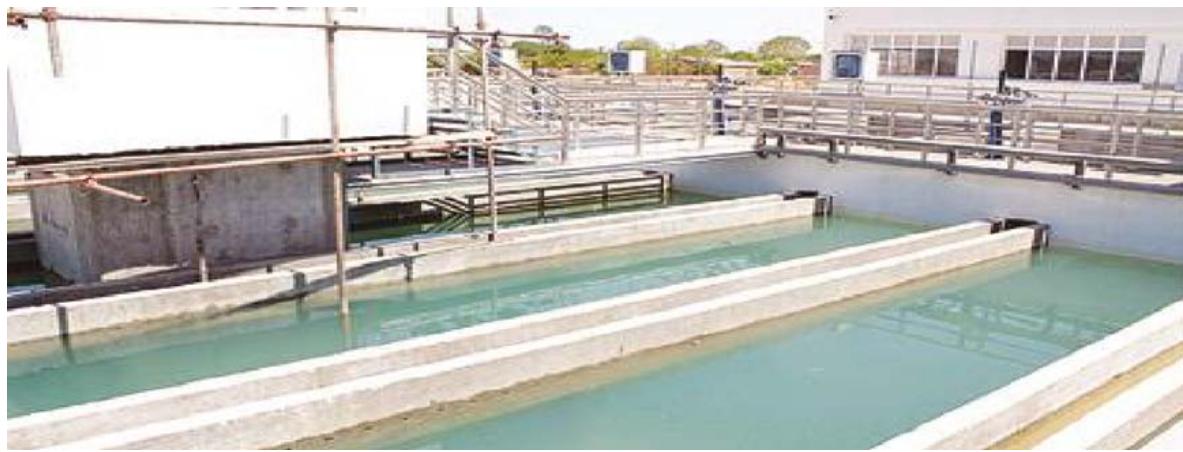 Figura 9: Tratamento de água do rio Cunene em Xangongo/Cunene Fonte:Fo deDomingos Calucipa Kunene (alucipa): AbraãoNdeufekelua, Mwaikafana (..
V Reflexoes Sobre a GestÃo Dos Recursos Hidricos Trans-FRONTEIRIÇOS.
No caso específico da água, alguns estudos indicam que a sua escassez e a sua concentração em determinadas regiões são fatores que podem, na ausência de políticas de gestão partilhada entre Estados, desencadear conflitos (Lopes, 2009). Daí que seja frequente que estes estudos defendam que a gestão sustentada e partilhada dos recursos hídricos é um dos desafios centrais do século XXI (Ferreira e Guimarães, 2003). Historicamente, na região em estudo, as campanhas de ocupação e delimitação fronteiriça no Sul centraram-se no rio Cunene que, para além da importância que teve para a definição das fronteiras, é importante para a implementação de projetos que buscam reduzir os efeitos da seca na região Sul de Angola e Norte da Namíbia (Paula, 2016). A partir desta conceção, o rio Cunene, que havia já sido elemento chave para as pretensões de travessia da África e para as guerras coloniais, passou a ter outras utilidades, enquanto "objeto de barganha diante da diplomacia internacional, além de demonstrar ser a única solução para amenizar a aridez da Damaralândia" (Paula, 2016, p. 139). Na região Sul do país, "a partilha de recursos hídricos e a sua gestão conjunta ou transfronteiriça é tão importante quanto a necessidade de uma cooperação interestatal cautelosa. Perante o contexto geopolítico regional, a gestão dos recursos hídricos tem implicações para a soberania dos Estados, sobretudo se se tiver em consideração que as entidades estatais regionais estão ainda em processo de consolidação" (Pereira, 2010, p. 2). O sistema institucional existente é ainda, contudo, limitado em termos da gestão deste recurso (Pereira, 2011) e os arranjos locais relativamente à gestão e uso partilhados da água e outros recursos naturais, múltiplos e variados.
Em termos globais, alguns aspetos são entendidos como condições necessárias para uma interação mais efetiva entre a investigação científica e a definição de políticas, no sentido de contribuir para a melhoria da gestão das bacias hidrográficas transfronteiriças (Armitage et al, 2015). Esses aspetos ou condições implicam, por um lado, reconhecer que o conhecimento científico é um fator crucial, mas também limitado, nos processos de tomada de decisão de recursos hídricos. Daqui releva a importância de estabelecer condições para a colaboração, o compromisso e a partilha entre os atores em presença, compreendendo que os processos sociais ou de aprendizagem em grupo, ligados à interação entre a ciência e a política, se potenciam através de maiores colaborações. De acordo com esta linha de análise, a produção colaborativa de conhecimento sobre os assuntos hídricos, associada aos temas da mudança socioeconómica e das respostas institucionais, é essencial para construir processos de tomada de decisão legítimos. Por outro lado, defende-se que se deve envolver organizações fronteiriças e apoiar redes informais de cientistas, decisores políticos e sociedade civil. Ao procurar avaliar as oportunidades e constrangimentos (incluindo o papel das relações de poder) relacionados com a governação de recursos hídricos transfronteiriços, estes estudos concluem que existe atualmente uma grande pressão sobre os recursos de água doce, com alterações significativas nos caudais dos rios, muitas delas em bacias transfronteiriças (Armitage et al, 2015). São vários os obstáculos que se colocam a uma governação eficaz da água a nível transfronteiriço, tais como os desequilíbrios de poder, a atenção inadequada às condições biofísicas em rápida mutação, e uma cada vez maior gama de atores sociais com interesses na tomada de decisão. A integração de diferentes formas de conhecimentos tem emergido, assim, como um fator determinante para o sucesso na governação destes recursos (Armitage et al, 2015).
Ainda de acordo com os mesmos autores, para uma melhor integração do conhecimento científico na política é necessário existir um contexto social em que os cientistas, os decisores políticos e outros que tentem e se dediquem a governar possam realmente interagir e deliberar através de diversas normas e valores, tendo em conta as diferenças de poder e autoridade entre esses indivíduos e organizações (p. 354). Certas condições sustentam, na sua opinião, a eficácia da interação entre a ciência e a política em cenários transfronteiriços. Em primeiro lugar, há que reconhecer fator crucial, mas também limitado, nos processos de tomada de decisão sobre recursos hídricos, ou seja, aceitar que a ciência é apenas um contributo para a elaboração de políticas e que os governos são - e provavelmente continuarão sempre a ser - atores críticos em contextos transfronteiriços devido à sua autoridade política e jurisdição (pp. 357-358). Por outro lado, consideram ser necessário estabelecer condições para a colaboração, o compromisso e a partilha entre os atores; que a governação de problemas ambientais complexos (como as verificadas em muitas bacias transfronteiriças) exige atividades conjuntas, incluindo a investigação conjunta, a partir das quais a construção da confiança surge no início das colaborações entre a ciência e a política. Assinalam, neste aspeto, que construir relações para superar perceções sobre as diferentes lógicas da ciência e da política (por exemplo, principalmente valores, interesses) é algo que leva o seu tempo a atingir e que terá poucos resultados tangíveis nas fases iniciais (Armitage et al, 2015, p. 358). Ainda de acordo com estas análises, são necessários investimentos antecipados de tempo e de recursos para criar um entendimento comum de questões-chave e de questões políticas e socioculturais mais amplas que enquadram as decisões sobre a água.
Em determinado ponto, os mesmos autores já se tinham interrogado por que razão algumas regiões ou países vão mais longe na via da governação transfronteiriça e outras têm dificuldade em obter resultados e propuseram três argumentos centrais (Wiering et al. 2010; Verwijmeren e Wiering 2007). Primeiro, a harmonização cultural, organizacional e jurídica aumenta as probabilidades de continuidade da cooperação. Portanto, investigam-se diferenças e semelhanças culturais, organizacionais e legais entre todos os países envolvidos. Em segundo lugar, a posição em relação à cooperação transfronteiriça dos arranjos institucionais nacionais é importante como condição externa. Em terceiro lugar, se a cooperação se vai desenvolver e se é sustentável depende também das características internas das iniciativas a própria fronteira.
Em conclusão, Wiering e Verwijmeren (2012) referem que o desenvolvimento da cooperação transfronteiriça pode ser considerado um processo de complexidade crescente. Em cada fase, as condições existentes continuam a ser pertinentes, mas são complementadas por novas condições, que dominam (e limitam) outros processos de formação da cooperação, o desempenho da cooperação e a satisfação das partes interessadas. Simultaneamente, torna-se mais difícil cumprir determinadas condições depois de concluída a transição para cada fase subsequente. Por exemplo, um foco que evite questões politicamente sensíveis é, na verdade, um importante indicador do sucesso da cooperação transfronteiriça nas fases iniciais do modelo (ou seja, para iniciar as coisas) e continua a ser importante em fases subsequentes; mas em fases posteriores (ou seja, realização/implementação) é simplesmente muito mais difícil de realmente realizar tal neutralidade política.
Na Barragem de Epupa - localizada no rio Cunene, que está na fronteira entre a Namíbia e Angola - as quedas de água foram manchete de jornal em 1998 devido a um projeto de barragem que, por razões ambientais e sociais, tinha sido abandonado. No entanto, este abandono parece agora mais um parêntesis, uma vez que se trata mais uma vez de aumentar as capacidades de água e de produção de eletricidade da Namíbia (Maupin, 2009, p. 253). Nesta área, são as comunidades himbas locais que possuem os territórios, e foram elas que se opuseram ao projeto da barragem das Cataratas de Epupa. Muitas ONGs internacionais têm sido parceiros muito ativos dos Himbas para impedir a construção desta barragem. Este conflito tem oposto o sistema nacional de gestão da água na Namíbia, como parte de um projeto regional, contra as comunidades locais (cerca de 12 mil Himbas), apoiadas pela ajuda internacional. No entanto, se o projeto da barragem nas cataratas de Epupa esteve suspenso durante muito tempo, trata-se agora de um novo projeto a jusante. As quedas de Epupa permanecem "ótimas" aos olhos do Estado da Namíbia. Mas o futuro do projeto permanece incerto, especialmente porque a sua viabilidade já foi questionada (Maupin, 2009, p. 254). O autor conclui que a análise destes dois casos e dos três modos de gestão (regional, nacional e local), das suas interações e contradições, permitiu identificar as lacunas dos sistemas de gestão da água na África Austral. Estes dois exemplos mostram a dificuldade de gerir os recursos hídricos na África Austral e sugerem a complexidade dos desafios de uma partilha justa e razoável da água, numa região onde as leis da água tendem a multiplicar-se tão rapidamente quanto os sistemas de gestão da água são diversos e complexas. A sustentabilidade destes sistemas depende, especialmente e em última análise, de como conseguirão combinar-se para encontrar soluções concertadas que vão ao encontro das expectativas de todas as partes interessadas. A escala local parece ser bastante impermeável às políticas regionais e nacionais e as disfunções observadas (e as futuras) colocam em causa a difusão piramidal das políticas de gestão da água. As situações locais específicas devem ser tidas em maior consideração no desenvolvimento de planos de gestão integrados regionais.
## VI. Tratamento dos Recursos Hidricos Transfronteiriços em África
Dada a complexidade da gestão transfronteiriça de recursos naturais, são estabelecidos acordos ao nível bilateral e regional que visam dar conta desta complexidade e das necessidades e interesses em presença. Lautze e Giordano (2005) documentam e analisam a maior recolha até hoje feita de acordos transfronteiriços de água relacionados com África. Os conteúdos são categorizados para fornecer ideias sobre a evolução e a geografia da legislação transfronteiriça sobre a água em África e - quando possível situar essa lei dentro de um contexto global. Os resultados revelam que fatores históricos e geográficos têm influenciado os acordos africanos. Historicamente, há uma tendência para o aumento da robustez dos acordos, geralmente consistente com as tendências globais. Geograficamente, os acordos variam em função do grau e do tipo de escassez de água em bacias associadas. Os resultados ajudam a responder a perguntas relacionadas com a atual gestão transfronteiriça da água em África e fornecem orientações para o futuro desenvolvimento institucional. Os autores fazem uma divisão da legislação transfronteiriça sobre a água em África em três períodos de discussão: período colonial (1862-1958), período da independência inicial (1959-1989) e período da independência final (1990-2004).
No período colonial (1862-1958), os acordos escritos aplicáveis às águas transfronteiriças de África coincidiram com os estágios iniciais da colonização europeia do continente. Os primeiros acordos eram principalmente relativos à aquisição de terras pelos Estados coloniais e incluíam a água apenas secundariamente. Outro conjunto de acordos, que formam um grande conjunto de direito transfronteiriço, tentou resolver OS problemas de acesso consuetudinário aos recursos hídricos decorrentes das fronteiras coloniais recentemente criadas. $60\%$ dos acordos dizem respeito à bacia do Nilo (Lautze e Giordano, 2005, p.1058). Aparentemente consistentes com as normas globais da época, nenhum dos acordos da era colonial em África prevê a criação de instituições de gestão, como organizações de bacias hidrográficas ou órgãos de monitorização técnica. Nenhum tratado colonial substantivo sobre a água menciona as águas subterrâneas e apenas um faz referência à qualidade da água (idem, p. 1061).
No período inicial da independência (1959- 1989), foram identificados 72 acordos e Lautze e Giordano (2005) analisam 43, que revelam mudanças fundamentais na natureza e conteúdo dos tratados, em comparação com o período colonial. Enquanto a maioria dos acordos coloniais se concentra em objetivos discretos, tais como a divisão dos recursos hídricos ou a construção de barragens, os acordos no início do período de independência mudaram para preocupações e estruturas menos concretas, mas mais expansivas. Por exemplo, a gestão conjunta é um objetivo em $90\%$ dos acordos e o desenvolvimento da água é um objetivo em cerca de três quartos deles (Lautze e Giordano, 2005, p. 1062). Para alcançar estes novos objetivos, mais de três quartos dos acordos incluem disposições para instituições de gestão da água - geralmente chamadas de "autoridades" de rios ou bacias hidrográficas, "comissões" ou "organizações" para facilitar a tomada de decisões coletivas sobre a gestão de recursos hídricos compartilhados. De facto, foi este período que deu origem às primeiras verdadeiras organizações de bacias hidrográficas transfronteiriças (Lautze e Giordano, 2005, p. 1062- 1063). De acordo com os autores, $60\%$ dos tratados deste período são multilaterais e quase três quartos conseguem incluir todos ou a maioria dos países ribeirinhos. Mais de metade dos acordos incorporam mecanismos de resolução de conflitos - normalmente um tribunal arbitral, como a OUA ou a ONU e mais de um terço incluem pelo menos algumas considerações sobre a qualidade da água, embora as águas subterrâneas sejam ignoradas. Dois terços dos acordos incentivam o intercâmbio de dados hidrológicos (Lautze e Giordano, 2005, p. 1064). Também se verificou 0 aumento da relevância dada à equidade na legislação transfronteiriça africana em matéria de água face aos desenvolvimentos globais. Em 1966, a Associação de Direito Internacional adotou as Regras de Helsínquia, que fornecem um conjunto de diretrizes para a partilha "razoável e equitativa" de recursos hídricos comuns. A isto seguiu-se a criação, pela Assembleia Geral da ONU, da Comissão de Direito Internacional (CDI), cujos esforços levaram à Convenção sobre o Direito de Utilização Não-Navegável de Cursos de Água Internacionais, uma coleção de princípios orientadores para a gestão transfronteiriça da água que continuou a destacar a questão da equidade. Embora a convenção não tenha sido concluída até 1997, o processo da sua formação, juntamente com as regras de Helsínquia que Ihe estão subjacentes, teve uma clara influência sobre as considerações de equidade em relação a bacias hidrográficas transfronteiriças (Lautze e Giordano, 2005, pp. 1064-065).
Naquele que os autores consideram ser o período final da independência (1990-2004), sabe-se que foram assinados 36 acordos africanos transfronteiriços sobre água, sendo sete transnacionais. 26 acordos parecem muito semelhantes aos do período anterior e seguem a tendência para uma maior robustez. Os principais objetivos dos acordos deste período são também muito semelhantes aos do período anterior, com destaque geralmente colocado na gestão conjunta de recursos hídricos partilhados e desenvolvimento económico. No entanto, uma análise atenta dos tratados revela uma mudança gradual da meta de "desenvolvimento da água" para a meta de "desenvolvimento sustentável" (Lautze e Giordano, 2005, p. 1065). Um desenvolvimento deste período que marca um "regresso" à era colonial é o aumento da utilização de critérios de atribuição. Com efeito, cerca de metade dos acordos deste período possuem novamente critérios para a divisão de uma bacia hidrográfica (idem, p. 1066).
Dos 153 acordos identificados em África pelos autores, 19 são relacionados com questões relativamente menores (ou seja, o acesso dos aldeões ou guardas de fronteira à água através de uma fronteira recém-formada), 24 são "transnacionais", e dois outros estão relacionados com a cessão territorial. Como tal, apenas 108 do total pode ser considerado substantivo no que diz respeito a questões de recursos hídricos transfronteiriços. Além disso, embora seja difícil, para dizer o mínimo, determinar o estatuto legal atual dos acordos internacionais de água, é provavelmente seguro assumir que uns grandes números dos acordos substantivos nunca foram implementados na prática, ou já não estão em vigor. Embora não haja base para comparação com outras regiões de mundo, os resultados de África sugerem, pelo menos, que futuros estudos sobre o impacto da legislação em matéria de águas transfronteiriças devem ir além de simples medidas quantitativas de formação de acordos relativos a bacias hidrográficas transfronteiriças (Lautze e Giordano, 2005, p. 1071). Em locais com escassez económica de água - isto é, água suficiente, mas fundos insuficientes para o seu desenvolvimento - as negociações que ignoram a questão controversa da alocação podem, de facto, ser mais suscetíveis de resultar num acordo que satisfaça pelo menos algumas das atuais necessidades dos Estados da bacia. Ao mesmo tempo, os resultados sugerem que quando a água estiver substancialmente desenvolvida e as bacias começarem a fechar, as questões de alocação irão provavelmente impulsionar a interação ribeirinha sobre a água. A mudança das condições económicas para a escassez absoluta de água já ocorreu em grande parte da África do Norte e Austral, embora o processo ainda esteja em curso em algumas regiões e não se tenha iniciado em outros. Onde a escassez absoluta ainda não foi sentida, pode ser sensato, ou pelo menos conveniente, ignorar as questões de alocação no curto prazo para estimular o investimento e o desenvolvimento de bacias hidrográficas transfronteiriças (Lautze e Giordano, 2005, p. 1063).
## VII. CONsideraÇÕeS SobRe Os RECursos Hidricos Na África Austral
A questão da gestão de recursos hídricos na África Austral envolve também diversos sistemas, com vários interesses em jogo (Maupin, 2009). Nesta região, os recursos hídricos são quase sempre partilhados entre vários países, pelo que nenhum deles pode utilizar a água sem ter de lidar com os seus vizinhos. Tensões entre países, e também no interior de cada um deles, são frequentes. Estudos realizados, por exemplo, sobre o rio Molopo, na África do Sul e Botsuana, e o projeto da barragem de Epupa na Namíbia, permitem-nos avaliar as tensões existentes entre os utilizadores de água, e determinar se as modalidades contemporâneas de utilização da água estão adaptadas às situações atuais e futuras. No contexto internacional Angola é membro de pleno direito da Organização das Nações Unidas e da União Africana (sucessora da OUA) desde 1976, membro da SADC20, sucessora da SADCC, fundada em 1978 e muito focada na autodefesa da região perante a economia e a política da África do Sul do apartheid A África do Sul, o Botsuana e a Namíbia fazem parte da SADC (Comunidade de Desenvolvimento da África Austral), um organismo que, a par de outras questões, possui mecanismos de regulação da água a nível regional; esses mecanismos coexistem com outros de origem local e nacional, dando origem a situações de gestão da água que se tornam caóticas (Maupin, 2009, p. 243). A SADC possui um sector dedicado à gestão da água, cujo principal instrumento é o Protocolo sobre a Água, que foi ratificado pelos países membros em 1995 e revisto em 2000. A SADC tem também um Tribunal que funciona em caso de desacordo ou conflito entre Estados membros, e cuja decisão final não pode ser contestada (Maupin, 2009, p. 245). De uma forma geral, os mecanismos regionais foram desenvolvidos em conformidade com os últimos acordos internacionais, os princípios fundamentais do desenvolvimento sustentável, e a Convenção das Nações Unidas sobre os Cursos de Água Internacionais. Os mecanismos nacionais são baseados em instituições estatais e em leis sobre a água, que são mais ou menos obsoletas dependendo do país. Os mecanismos locais são liderados por vários grupos de interesse, de associações de utilizadores a grupos de especialistas (Maupin, 2009, p. 244).
Assim, por um lado, existem as políticas regionais da SADC, que devem servir de quadro orientador para o estabelecimento de organizações de bacias hidrográficas e políticas nacionais, e por outro lado, os quadros institucionais e as políticas nacionais de cada país para a gestão da água no seu território
## VIII. DISCUSSÃO dOS RESUltadOS
A pesquisa sobre a gestão dos recursos aflora a importância do uso de mecanismos assentes na cooperação entre os estados, sobretudo quando se tratam de recursos transfronteiriços como é o caso do rio Cunene e a importância desta gestão transfronteiriça para as relações internacionais e políticas públicas do país.
O recurso à obra de Pereira (2010), que constitui um agregado importante para o conhecimento da governação da água em Angola, identificando riscos e oportunidades, é feito sistematicamente ao longo da pesquisa. Para além da importância que teve para a definição das fronteiras, o rio Cunene é ainda um recurso importante, por exemplo, para a implementação de projetos que buscam reduzir os efeitos da seca na região sul de Angola e Norte da Namíbia. O enfoque em recursos naturais da região tem, assim, uma relevância para as relações internacionais, políticas públicas e desenvolvimento. Por outro lado, o foco deste trabalho releva igualmente da necessidade de desenvolvimento e multiplicação de estudos sobre as realidades locais em Angola, mais centrados na Gestão dos Recursos hídricos e não só, Sabendo que quer o Estado quer as populações fazem aproveitamento dos recursos naturais com base na gestão partilhada transfronteiriça, para o governo angolano, e tem, por outro lado, potencial para as estruturas locais na medida em que fornece elementos resultantes de estudos aprofundados e de cariz qualitativo.
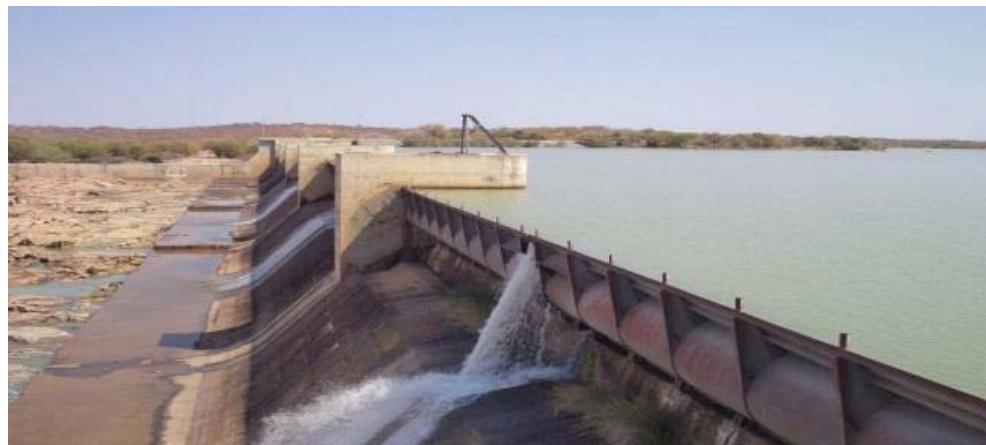 Fonte: Autora, 2014
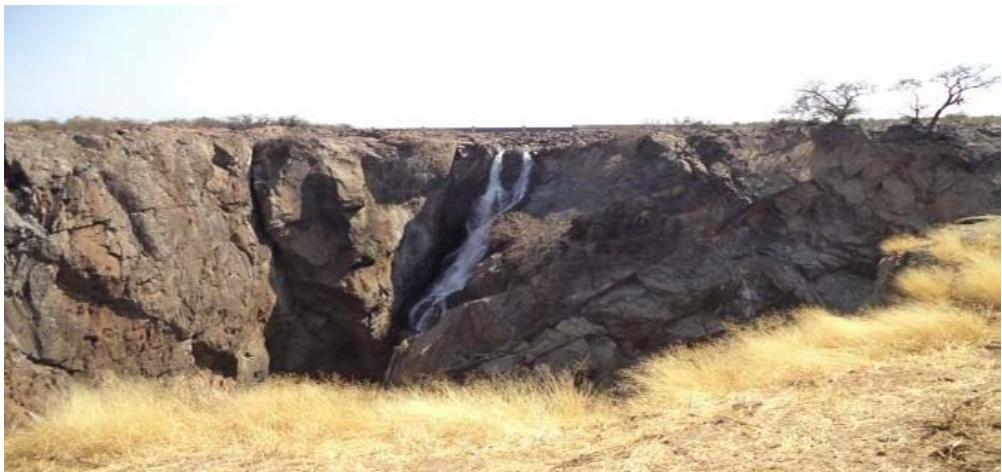 Figura 10: Barragem do Ruacaná fornece energia eléctrica a uma parte do Norte da Namíbia e algumas localidades de Angola Figura 11: Quedas do Ruacaná Fonte: Autora, 2014
A importância do rio para a região fica cada vez mais evidente. O explícito interesse declarado pelos sulafricanos relativamente aos recursos hídricos do Cunene torna patente que "qualquer acordo de delimitação da fronteira que atendesse a solicitação portuguesa, só seria possível mediante um segundo acordo que deveria estabelecer normas para a utilização do rio." (Paula, 2016, p. 158)
Apesar do potencial hídrico da região sul, sobretudo o Cunene, no período colonial ficou marcado por um acentuado recurso a águas subterrâneas. De modo a assegurar o consumo humano e animal, projeto nome do meteorologista geógrafo alemão. Schwarz, consistiria em promover o desvio das águas para norte dos rios Cunene, Cubango e Cuando, com destino à lagoa Etocha, lagos Ngami e Macaricari (todos no Sudoeste Africano), para a formação de planícies de inundações. Foi apresentado pela primeira vez em Joanesburgo, em janeiro de 1918. Para o Cunene o projeto sugeria a construção de uma barragem de 40 pés de altura cuja água seria então desviada para a Ovambolândia (Norte do Sudoeste Africano), onde formaria nova planície de inundação tornando a região mais fértil.
O projeto Schwarz não foi bem visto pelas autoridades científicas e governamentais portuguesas, mas foi aceite na medida em que servia de moeda de troca para a delimitação da fronteira sul. Mariano Feio esclarece que, em função dos estudos efetuados, o maior erro de Schwarz estava em afirmar que a quantidade de evaporação ocorrida na região seria suficiente para promover um aumento significativo no volume das chuvas que iria cair naquele lugar, como se a quantidade de evaporação fosse o único elemento a ditar a quantidade de chuva, ignorando que a pressão atmosférica pode espalhar essa evaporação por outras regiões. Numa nota mais positiva, o estudo levou ao debate os problemas do aproveitamento do rio Cunene. (Cfr Feio,1965, apud Paula, 2016, p. 179).
constroem-se cacimbas com muitos metros de profundidade. Segundo Costa (1906, p. 2) apesar da grandiosidade e volume do caudal de água de alguns rios de Angola, algumas populações viviam numa luta intensa com dificuldades de acesso a água potável para uso doméstico, bem como para o gado e para a agricultura.
O governo português não conseguia fazer chegar água a todas as comunidades, tanto pela dispersão territorial como pelo modo de vida tradicional, nomeadamente pelo que os rios representavam para a sua cultura. As famílias e comunidades, sobretudo as das zonas rurais, tinham que gerir este recurso de forma informal, conforme faziam desde tempos imemoráveis, recorrendo a técnicas e métodos rudimentares e tradicionais, como, por exemplo, a construção de cacimbas e chimpacas. O recurso a métodos tradicionais era mais significativo em locais onde a presença da administração portuguesa era menor.
A sul de Angola a presença e autoridade portuguesa, e europeia no geral, era quase nula até finais do século XIX. O conhecimento do território e dos seus povos era muito restrito, pelo que as comunidades geriam os recursos naturais de forma tradicional.
Entre as comunidades e os rios estabelecia-se uma relação diária. O facto de alguns rios serem de curso intermitente obrigava as populações a um processo de adaptação, consoante os caudais, havendo casos em que eram frequentes as − deslocações massivas a procura de água. Com o fim da época das chuvas o nível da água nos reservatórios, nas cacimbas, vai diminuindo, e aumenta consequentemente o risco de poluição. O tempo de espera para se conseguir encher recipientes para consumo doméstico da água aumenta - uma mulher podia gastar cerca de cinco a seis horas para conseguir água suficiente para consumo diário, sobretudo porque as cacimbas com alguma água ficam sempre muito distanciadas dos centros habitacionais (Neto, 1963). A perfuração de poços para captação de águas subterrâneas, solução preconizada tanto pelo governo colonial como pelas próprias populações locais, não resolveu de todo o problema.
diminuíam o acesso à água das populações locais, o que enfraquecia a sua resistência. Na intervenção da resistência passiva ou armada contra o colonialismo, destaca-se o espírito guerreiro, agressivo e inconformista dos Cuanhamas, que não se escusavam de combater, inclusive os Cuamatos e outros grupos étnicos, para se proverem de recursos (água, pastos e gado). Este facto foi constatado pelos exploradores portugueses Hermenegildo Capelo e Roberto Ivens quando, em 1884, empreenderam uma travessia de África, ligando o Atlântico ao Indico.
Após a independência de Angola e a consequente retirada da presença portuguesa, as consequências da guerra fria intensificaram-se na região". Com a subida ao poder do MPLA e o auxílio prestado por Cuba, o governo sul-africano considera estar perante "uma ameaça comunista aos regimes brancos daquela região e, por consequência uma ameaça ao apartheid", movimentações políticas que desencadearam conflitos armados na região. (Paula, 2016, p. 240).
No decorrer da guerra, as barragens de Calueque e Ruacaná foram durante vinte anos ocupadas por tropas sul-africanas, e o posicionamento de Pretória no pós-independência reitera a ideia de que "o controlo sobre esses recursos era essencial para a manutenção do poder branco na África Austral" (Gonçalves, 2003, p. 60). Mesmo após a conquista da independência total da Namíbia, a região das barragens continuou, até meados do ano 200o, a ser alvo de bombardeamentos efetuados pelas forças sulafricanas.
A província do Cunene, mais concretamente no município de Ombadja, com várias povoações integradas, é o local "onde se situam os empreendimentos hidroelétricos ou exercendo efeitos de proximidade evidentes" (Gonçalves, 2010, p. 259). Comecemos por Naulila, situada na margem esquerda do rio, que no decorrer da Primeira Guerra Mundial, altura da delimitação da fronteira sul de Angola, foi palco de uma batalha entre os exércitos português e alemão, à época os poderes coloniais do sudoeste de África. Hoje tem um edificado de casas de construção definitiva, atingidas por balas de armas automáticas, a requerer manutenção. Naulila alberga muitas famílias e à semelhança do baixo Cunene, é um lugar estratégico para obtenção de alimentos, o que vem a determinar a sua relação com os centros administrativos, estando ligada a Calueque por uma picada de 30 km. (Gonçalves, 2010, p. 259).
Nas águas do Cunene, na província com o mesmo nome, foram construídas duas barragens: Calueque e Ruacaná. A barragem de Calueque, afeta ao município de Ombadja, fornece água à República da Namíbia através da instalação de um canal. Após o tratamento, retorna a território angolano, abastecendo o município de Namacunde, nas povoações de Santa Clara e comuna sede. Calueque é "o centro de maior capacidade promotora de desenvolvimento na região, em virtude da sua barragem e do sistema de adução de água que possui." (Gonçalves, 2010, p. 259)
A política de gestão destes empreendimentos não se alterou significativamente no pósindependência. A barragem do Ruacaná está localizada no território angolano a aproximadamente 200 metros da linha de fronteira, mas os dínamos (máquinas), ou seja, todas as instalações de produção de energia hidroelétrica estão em território namibiano, a cerca de 500 metros da linha de fronteira. Todos os trabalhos de manutenção, de ambos os lados da fronteira, de acordo com os entrevistados e confirmado aqui por Gonçalves (2010, p. 261) são assegurados "pela Nampower, empresa de eletricidade da Namíbia."
Os empreendimentos hidrográficos da bacia do Cunene têm uma gestão integrada, a cargo do Gabinete para a Administração da Bacia Hidrográfica do rio Cunene (GABHIC). As infraestruturas planeadas seguem o Plano Geral da Bacia do rio Cunene que, além de serem concebidas para regularização dos diferentes caudais, concorrem para a prossecução dos múltiplos usos que a água pode ter, ao longo do percurso, da nascente para a foz. O esforço para a regularização dos caudais enquadra-se numa gestão ambientalmente sustentável para a satisfação das necessidades das populações que vivem nas zonas contíguas.22
No campo da produção de eletricidade os empreendimentos instalados e a instalar - em 2010, estavam previstas 24 infraestruturas podem gerar até 1 000 GWh de energia (já garantidos), sendo que o total do seu potencial se eleva a 9 ooo GWh de acordo com os dados do GABHIC.
Efetivamente, o aproveitamento racional das águas do Cunene tem levado a que Angola e a Namíbia considerem válidos acordos vindos das administrações coloniais, a que se juntam diversos novos protocolos. Em 2012 o ministro da Energia e Águas angolano, João Baptista Borges, e o ministro da Agricultura, Água e Floresta namibiano, Jony Mutouwa, assinaram em Windhoek um memorando para o uso partilhado destas águas.23
Quadro 4.1: Acordos para o aproveitamento do rio Cunene (Portugal-União Sul-Africana; República de Angola- Namíbia)
<table><tr><td>Datas</td><td>Portugal – União Sul-Africana</td></tr><tr><td>1926</td><td>Primeiro acordo, para regulamente a utilização das águmas do Cunene, com vista à geração de energia, controlo de cheias e irrigação para os Países ribeirinhos.</td></tr><tr><td>1964 -1969</td><td>Segundo acordo, envolvendo um plano integrado para o rio Cunene.Terceiro acordo, estrutura as bases do Sistema Integrado para o Rio Cunene, e incluiu o delineamento de: · planos de construição de uma barragem no Gove; · um projeto em Calqueque, não conclusão, para bombear água para o Sudoeste Africano e produzir energia elétrica; · Constituição da Comissão Técnica Permanente Conjunta (CTPC), orgão consultivo dos respetivos governos; · Projeto hidroelétrico de Ruacaná, localizo na Namíbia.</td></tr></table>
A República de Angola e a África do Sul respeitam o essencial dos acordos celebrados na época colonial.Angola e a Namibia independente assinaram um acordo em 1990 paraREATVAR os anteriores acordos e para renovar o mandato da CTPC.
<table><tr><td>Datas</td><td>Angola – Namibia</td></tr><tr><td>1975 – 2002</td><td>A Répubrica de Angola e a África do Sul respeitam o essencial dos acordos celebrados na época colonial.Angola e a Namibia independente assinaram um acordo em 1990 paraREATVAR os anteriores acordos e para renovar o mandato da CTPC.</td></tr><tr><td>Finais de1980/anos90 – 2002</td><td>A Namibia considera construção de um novo projetó hidroelétrico a susante de Ruacaná com o objetivo de satisfazer as crescentes necessidades de energia do País, tendo sidoassinados os Quarto e Quinto Acordos de Utilização das Águas entre as nações.Um estudo de viabilidade realizado entre 1995 e 1998 investiga possíveis locais para odesenvolvimento da geração hidroelétrica, tendo sido selecionados Baynes e Epupa comoos locais mais viaveis. O estudo conclusu que Epupa sera tecnicamente preferível devido à sua maior capacidade de armazenamento.Em abril deste anoirma-se um acordo entre o Governo Angolano e a UNITA que põe fim àguerra civil em Angola.Segunda avaliação de um futuro projetó hidroelétrico a susante de Ruacaná, focado emBaynes. O novo estudo de viabilitadade barragem hidroelétrica binacional de Baynes prévoinizio da construcão para 2021 (ANGOP, 2019, 1 de fevereiro).Projeto de abastecimento de água transfronteirço abrange a Sul de Angola e Norte daNamibia, implicando o estabelecimento de infraestrutas necessarias para as comunidadese cidades ao longo da fronteira.</td></tr></table>
### a) O acordo de Baynes
No quadro do aproveitamento internacional da bacia do Cunene, os governos da Namíbia e de Angola têm mantido uma atividade regular, da qual resultou, entre outros, o Projeto Hidroelétrico Binacional de Baynes24. O aproveitamento que levará à construção da barragem de Baynes integra um Comité do Projeto Baynes (BC) que data de 2005 e integra cinco membros de Angola e cinco da Namíbia. Entre outras tarefas está mandatado para supervisionar a atualização dos resultados dos estudos realizados na década de 1990 para avaliação da viabilidade da construção de importantes estruturas hidroelétricas no Baixo Cunene. Deve proceder a revisões das componentes técnicoeconómicas e ambientais do Estudo Baynes (Epupa) de 1998. O BC também aconselha a CTPC na planificação de campanhas públicas de informação e na garantia de que o público é mantido a par dos progressos do estudo. De acordo com o Jornal de Angola (2013), este projeto hidroelétrico de Baynes, ou seja, a barragem, terá uma central com capacidade para gerar 600 megawatts, que serão repartidos em iguais proporções entre Angola e a Namíbia). Integram este projeto técnicos angolanos e namibiano que preconizam a conclusão da construção da barragem, sendo que a produção de energia na central poderá diminuir o défice no fornecimento da energia elétrica às cidades e às indústrias.
O Comité tem ainda a seu cargo o estudo e a análise dos artigos e disposições do Acordo de 1964 e do Acordo de 1969. Cabe-lhe identificar aspetos que se tornaram obsoletos, que precisem de melhor esclarecimento ou que necessitem de atualização. Quanto ao Acordo de 1969, o Comité está também mandatado para apresentar recomendações específicas relativas à conclusão do Sistema Integrado do Rio Cunene25, que integra um Plano Geral da Bacia do Cunene, que por sua vez tem no Comité do Plano Geral (CTPC) o órgão encarregue de operacionalizar as tarefas.
A Barragem Hidroeléctrica Binacional de Baynes projetada para 2021, acerca de 200 km a Sul do Ruacaná, constitui um empreendimento conjunto da Namíbia e de Angola; espera-se que venha a produzir até 600 megawatts de energia, e que sirva para irrigar centenas de hectares de terrenos agricultáveis (ANGOP, 2019, 1 de fevereiro). Os trabalhos estão atualmente em curso.
Em análise conjunta, o ministro de Minas e Energia da Namíbia, Obth Kanjoze, e João Baptista Borges do lado angolano, reconhecem a importância estratégica das atualizações que foram apresentadas sobre o Projeto Baynes, o projeto de reabilitação da barragem de Calueque e os projetos transfronteiriços de abastecimento de água a partir do rio Cunene, bem como a melhoria do canal de água Calueque/Oshakati.
A comissão bilateral instalada teve por objetivo acelerar a implementação da rede de distribuição de água para as aldeias de Santa Clara, Namacunde, Omupanda e Calueque, com a reafirmação do compromisso do governo namibiano relativamente ao fornecimento de água a Santa Clara e Ondjiva, com base na cooperação bilateral. Por isso, consideraram válidosscompromissospreviamenteassumidos incluindo os firmados no passado entre portugueses (lado angolano) e alemães e sul-africanos (lado namibiano, ex-Sudoeste africano).
O aproveitamento do Gove, um dos mais significativos empreendimentos de toda a bacia, de conclusão e uso recente, beneficia de relativa autonomia e, além de servir de regularizador do caudal do Cunene, para jusante, a sua albufeira acumula água para ser utilizada em períodos de grave seca, como tem acontecido regularmente na província do Cunene, também está apta para fornecer energia elétrica à região centro do País (províncias do Huambo e do Bié).
Em suma, a cooperação bilateral no sector da água entre estes dois países vizinhos caracteriza-se pelo desenvolvimento de esforços coordenados para tirar partido do potencial de produção de energia. São evidências desta cooperação o abastecimento em energia elétrica da cidade de Ondjiva e as vilas de Namacunde e Santa Clara, todas em território angolano, a partir da subestação de Onuno, situada em território namibiano.
Outra povoação que se torna importante referir é a de Ondova, situada na rota entre Ondjiva (capital provincial do Cunene) e a província do Cuando Cubango, a 500 metros para o interior da fronteira, com povo maioritariamente de origem Ambó. Em 2018 a povoação de Ondova (sede denominada de Okavenda), embora fisicamente não esteja representada na administração local, regista avanços significativos em matéria de projetos para o desenvolvimento (Mwaikafana, 2018). Para suprir as necessidades de água, o Governo criou reservatórios de água, extraída do subsolo, em tanques plásticos, para distribuição â população. A região de Ondova caracteriza-se pela escassez de recursos hídricos, "as chuvas caiem normalmente de novembro a abril e são, em geral, violentas e de curta duração" (Monteiro,1994, p. 45 apud Mwaikafana, 2018)27.
## IX. REFlexÕes Finais
Assim, dado o potencial de conflitualidade, a gestão de recursos partilhados que ocorre em contexto fronteiriço constitui um tema de reflexão teórica e prática que tem captado a atenção de vários quadrantes. De um modo geral, no continente africano, a União Africana, tal como os modernos Estados africanos individualmente considerados, tem como um dos seus objetivos tratar as questões ligadas a fronteiras num espírito de cooperação, evitando que se resvale para o que Abílio Lousada identifica como sendo uma tendência: "a ânsia de acesso a recursos é óbvia e o carácter místico de posse territorial perene. As fronteiras (...) ou são geridas com parcimónia ou o conflito pode surgir como solução, situação indesejável para África" (2010, p. 127). Reforça ainda a ideia de que muitos destes recursos e a sua exploração, dada a sua localização, colocam questões no âmbito da "gestão transfronteiriça" (Lousada, 2010, p. 71). Daí que sejam vários os assuntos passíveis de serem tratados no âmbito das relações internacionais. As diferentes organizações e conferências internacionais e regionais, como, por exemplo, a Comunidade de Desenvolvimento da África Austral (SADC), constituem oportunidades de concertação e de desenvolvimento sustentado, quantas das vezes permitindo, ou então estimulando, o incremento das relações culturais e comerciais entre populações que partilham, ou não, fronteiras e histórias.
Enfatize-se a ideia de que o caráter artificial das fronteiras territoriais, numa "cristalização de uma visão monolítica de soberania, deveu-se às dinâmicas de dependência política e económica das colónias relativamente à metrópole, bem como à imposição de estruturas políticas diversas e conflituantes com as instituições e formas de governação preexistentes" (Paula, 2016). A delimitação fronteiriça criou condições para um aproveitamento das águas do Cunene que implicou o estabelecimento de acordos bilaterais e para a imposição efetiva da soberania e dominação colonial europeia e, nomeadamente, da circulação sobre as populações africanas de ambos os lados das fronteiras.
- i). O Acordo entre o Governo da República Portuguesa e o Governo da União da África do Sul, respeitante à linha de fronteira entre a província de Angola e o território do Sudoeste de África, sob mandato, feito e assinado na cidade do Cabo, vinte e dois de junho de 1926;
- ii). O Acordo entre o Governo da República Portuguesa o Governo da União da África do Sul para regular o uso da água no rio Cunene e produzir energia hidráulica, inundação e irrigação no território mandatado do Sudoeste Africano, feito e assinado na cidade do Cabo a um de julho de 1926. Estes acordos vigoram permanecem firmes entre os dois países, e a estes foram acrescidos outros no período pós-independência.
Apesar de um pretenso consenso de que a fronteira não constitui problema em si, este resultará sobretudo em matéria de acesso aos recursos. Isto é, determinados grupos étnicos passam, com as fronteiras geográficas, a desprover-se dos recursos antes sua pertença. As novas regras e leis que os Estados impõem no âmbito do direito internacional ao constrangerem identidades assimiladas durante séculos passam a gerar conflitos que são depois atribuídas à multiplicidade étnica. A fronteira é uma instituição convencionada para ordenamento e organização política dos Estados; não é uma instituição universalizável, mas sim contextualizada.
Muitos dos recursos naturais da região e a sua exploração, dada a sua localização, colocam desde essa altura questões no âmbito da gestão transfronteiriça. Daí que sejam vários os assuntos passíveis de serem tratados no âmbito das relações internacionais. As diferentes organizações e conferências internacionais e regionais, como, por exemplo, a Comunidade para o Desenvolvimento da África Austral (SADC), constituem oportunidades de concertação e de desenvolvimento sustentado, quantas das vezes permitindo, ou então estimulando, o incremento das relações culturais e comerciais entre populações que partilham, ou não, fronteiras e histórias.
Apesar de todas as movimentações políticas e diplomáticas, com o posicionamento ocidental face às soberanias africanas, que sustentam a definição das fronteiras africanas, o processo de repartição territorial do continente foi indelevelmente marcado pelos conflitos militares do início do século XX, sobretudo a Primeira Guerra Mundial (1914-1918).
Será com a derrota da Alemanha e o subsequente Tratado de Versalhes, que aquele país, que havia participado da corrida à ocupação de África, perderá os territórios coloniais em África, passando o Sudoeste Africano para a tutela da União Sul-Africana, território que na altura integrava os domínios britânicos na África Austral.
Os territórios do Sudoeste Africano, colónia alemã, e ainda sem fronteiras definidas, foram palco de conflitos e recontros armados entre tropas portuguesas, alemãs e sul-africanas, auxiliadas por tropas britânicas, sendo a posteriori, a partir de 1919, colocados sob domínio britânico por força do Tratado de Versalhes (Coelho, 2014).
Resultando de um conhecimento factual proveniente da penetração, incursões e ocupação colonial e das expedições geográficas de cariz pretensamente científico, Portugal tinha interesses estratégicos e pretendia a hegemonia na região o que passaria pela ligação do Atlântico ao Índico, unindo Angola a Moçambique. Era o sugestivo mapa cor-derosa, que incluía a ocupação das terras situadas além-Cunene, num espaço que se definiria mais tarde como fronteira entre Angola (zona do Cunene e do Cubango) e o Sudoeste Africano. Entretanto, de acordo com Silva,S, (2014), Angola era percorrida por grupos ao serviço da Sociedade de Geografia de Lisboa, com o objetivo de esclarecer/descobrir o verdadeiro percurso do rio Cunene e abrir novas rotas para o interior de África, ignorando os anteriores caminhos percorridos por caravanas comerciais.
Discutidos os dados mediante uma lógica de triangulação entre as abordagens de investigadores precedentes, os conteúdos das entrevistas feitas obtidos (pela pesquisa no terreno,) e a perspetiva de alguns documentos consultados, conclui-se que a gestão dos recursos hídricos no sul de Angola, entre as Repúblicas de Angola e Namíbia, é feita sobretudo ao nível estatal. Mesmo o acordo de 1888, entre portugueses e alemães, base para o acordo para a delimitação da fronteira sul de Angola entre portugueses e sul-africanos (22 de junho de 1926), relacionava-se com a necessidade de gerir os recursos hídricos. O uso das águas do rio Cunene, o seu desvio para a lagoa Etocha, era a condição única para amenizar a aridez na Damaralândia. Estes acordos vigoram até aos nossos dias, complementados por iniciativas posteriores à independência, tendo em vista um melhor aproveitamento das barragens do Calueque e Ruacaná, no rio Cunene, almejando melhorar a vida das populações dos dois países, tanto em termos de abastecimento de água como de energia elétrica.
Foram as dinâmicas sócio - culturais que mesmo apelidando-os de informais pressionaram as decisões do direito positivo a respeitá-las, porque constituam a fonte de perpetuação civilizacional aquém de qualquer determinismo modernista. Estudos geográficos sobre a região apontam a importância dos recursos naturais que são em grande parte, de caráter transfronteiriço (Angola, 2005), a exemplo, da Bacia do Etocha, na Namíbia em que, "grandes rios, como o Cunene têm drenado para esta bacia por períodos que vão de algumas dezenas de milhares de anos a centenas de milhares de anos formando vastos lagos interiores, de que o último exemplo se encontra patente na caldeira de Etocha e que chegou a estender-se desde o sul da atual Owamboland até à fronteira de Angola" (Udelsmann Rodrigues, 2017, p. 26).
No que se refere a Angola e Namíbia, as leis que regulam a gestão da água do rio Cunene são sobretudo regulatórias. A multiplicidade étnica não constitui motivo de conflito como tal, e nem existe uma pressão demográfica que implique desequilíbrio face aos recursos disponíveis. Em suma, a gestão dos recursos na fronteira sul de Angola, numa fase pré- colonial, ou seja, até à chegada dos europeus e à efetiva dominação europeia, a partilha de recursos naturais em África não se submetia a um controlo rigoroso de limites geográficos. permitia um uso de recursos sob formas de regulamentação assentes no costume, na tradição e no direito consuetudinário. Com a instauração do aparelho estatal colonial, os recursos naturais e as formas de desenvolvimento e relacionamento social passaram a ser controladas pelas potências colonizadoras. O colonialismo impôs em África padrões ocidentais (leis, normas, códigos) de gestão dos espaços geopolíticos e dos recursos naturais. Com as independências, os novos Estados passaram a gerir, de forma moldada pelos padrões herdados do período colonial, os seus próprios recursos. Com a independência da Namíbia 21 março de 1990 e de Angola em 11 de novembro 1975 e consequente fim da guerra civil em Angola em 2002, a fronteira volta a ser mais porosa, permitindo um melhor aproveitamento e gestão das águas do rio Cunene, a nível formal e informal, bem como o desenvolvimento de relações transfronteiriças, a nível individual, comunitário e económico pelos dois países.
[^1]: Invasão miltar de Angola pela África do Sul, enquanto parte integrante da estratégia dos EUA em relação a Angola, projetada a partir de 12 de fevereiro de 1975 mediante contactos entre Jonas Savimbi da UNITA e representantes do Governo de Pretória. (Sá, 2011). _(p.10)_
[^2]: A SADC (Southern África Development Community/Comunidade de Desenvolvimento da África Austral), criada a 17 de agosto de 1992, concentra os seus esforços em questões económicas, na cooperação política, de defesa e segurança. É constituída por 15 Estados membros: África do Sul, Angola, Namíbia, Moçambique, Zâmbia, Zimbabué, Botsuana, Lesoto, Suazilândia, República Democrática do Congo, Madagáscar, Malawi, Ilhas Maurícias, Ilhas Seicheles e Tanzânia. Um dos seus objetivos é promover a qualidade de vida dos povos da África Austral através de protocolos de integração regional, desenvolver valores universalmente aceites, instalar e desenvolver sistemas e instituições políticas que sejam defensoras da paz e segurança internacionais. Promove igualmente a eficiência na utilização dos recursos naturais dos Estados, a autossuficiência dos povos e Estados para o desenvolvimento autossustentado, a efetiva cooperação entre os Estados membros. _(p.3)_
[^3]: A República de Angola faz parte da região Austral e Ocidental de África, compreendendo uma superfície estimada em $1. _(p.3)_
[^4]: ica Cuanhama, Curoca, Cuvelai, Namacunde e Ombadja. _(p.4)_
[^5]: Savat é uma comuna do Cuando Cubango que limita-se administrativamente com a comuna de Omilunga washikongo, município de Namacunde pela província do Cunene. _(p.5)_
[^6]: Das dezoito províncias angolanas, a do Cunene é uma das que se localiza mais a sul. É limitada a Norte com a província da Huila, a Sul com a República da Namíbia, a Oeste com a Província do Namibe, e a Leste com a Província do Cuando Cubango. Administrativamente, a província é constituída por seis municípios: Cuanhama (onde se situa a capital ondjiva), Curoca, Cuvelai, Cahama, Namacunde e Ombadja, e por 20 comunas. _(p.6)_
[^7]: A província fronteiriça do Cuando Cubango foi palco da maior e mais demorada batalha ocorrida em território angolano, e quiçá no Continente depois da Segunda Guerra Mundial. A batalha de Cuito Canavale ocorreu entre 15 de novembro de 1987 e 23 de março de 1988. Em confronto estavam as Forças Armadas governamentais (FAPLA), com o auxílio de Cuba, e a UNITA, que contava com apoio sul-africano. _(p.9)_
[^8]: A swAPO (acrónimo de South West African People's Organisation), movimento de libertação da Namíbia, instalou bases em Angola após a independência, em 11 de novembro de 1975. Este movimento lutou contra o regime segregacionista (apartheid) da África do Sul até 1989. Quando a Namíbia finalmente alcançou a independência (21 de março de 1990), o conflito armado em território angolano manteve-se entre o Governo angolano e o partido UNITA até fevereiro de 2002 _(p.9)_
[^9]: Adimensão internacional da guerra civil angolana foi para além da sua vizinhança geográfica. _(p.10)_
[^16]: Declarações do Secretário de Estado das Águas, Luís Filipe da Silva, edição eletrónica do Jornal de Angola, 5 de abril de 2014. _(p.13)_
[^17]: também neste rio que se situam as Quedas do Monte Negro (Epupa). _(p.14)_
[^18]: iSnsibilização oi unen iponíve www.kunene.riverawarenesskit.com/KUNENERAK_COM/PT/DEFAULT.HTM, consultado em 27 de julho de 2018. _(p.16)_
[^19]: eaa qz cic a Cunene) localizada no Município do Cuanhama (entrevistado A, 54 anos, polícia de guarda Fronteira). _(p.17)_
[^20]: A SADC (Southern África Development Community/Comunidade de Desenvolvimento da África Austral), criada a 17 de agosto de 1992, concentra os seus esforços em questões económicas, na cooperação política, de defesa e segurança. É constituída por 15 Estados membros: África do Sul, Angola, Namíbia, Moçambique, Zâmbia, Zimbabué, Botsuana, Lesoto, Suazilândia, República Democrática do Congo, Madagáscar, Malawi, Ilhas Maurícias, Ilhas Seicheles e Tanzânia. Um dos seus objetivos é promover a qualidade de vida dos povos da África Austral através de protocolos de integração regional, desenvolver valores universalmente aceites, instalar e desenvolver sistemas e instituições políticas que sejam defensoras da paz e segurança internacionais. Promove igualmente a eficiência na utilização dos recursos naturais dos Estados, a autossuficiência dos povos e Estados para o desenvolvimento autossustentado, a efetiva cooperação entre os Estados membros. _(p.21)_
[^21]: 2Declarações do Secretário de Estado das Águas, Luís Filipe da Silva, edição eletrónica do Jornal de Angola, 5 de abril de 2014. _(p.24)_
Aniceto Afonso (2009). Guerra Colonial -uma aliança escondida.
Afrika Süd (2016). Relatório de actividades realizadas no Kalueque, Munícipio do Coroca, Província do Cunene.
Vinícius Pinto,Anna Nery,Luciano Lião (2012). FOODÔMICA POR RMN DE 1H PARA MONITORAMENTO DA ESTABILIDADE OXIDATIVA DE MARGARINAS SUBMETIDAS AO TRATAMENTO TÉRMICO.
Anselmo Rodrigues,Eduardo Migon (2015). DO ACORDO TRIPARTIDO (1988) AO ACORDO DE PAZ EM 2002: O PROCESSO DE PAZ CONDUZIDO EM ANGOLA.
(2019). Seca no Cunene força abandono escolar.
Alexandra Aparício (2000). Unknown Title.
Derek Armitage,Rob De Loë,Michelle Morris,Tom Edwards,Andrea Gerlak,Roland Hall,Dave Huitema,Ray Ison,David Livingstone,Glen Macdonald,Naho Mirumachi,Ryan Plummer,Brent Wolfe (2015). Science–policy processes for transboundary water governance.
Prisca Augustoni,Anderson Viana (2010). A identidade do sujeito na fronteira do póscolonialismo em Angola.
T Beidelman (2009). de Bruijn, Miriam, Rijk van Dijk, and Jan-Bart Gewald (eds.): Strength beyond Structure.
José Canêlhas,Luis Gonçalves (1929). A delimitação da fronteira sul de Angola.
Ana Rito,Rafael Cardoso,Inês Portugal,Joana Baleia,Sofia Mendes,Margarida Bica (1997). Evaluation of Portuguese community health projects and initiatives within the European and National Healthy Cities Network.
Adelino Coelho,De Matos (2014). O expansionismo alemão em África.
Eduardo Costa,Da (1906). A questão do Cuanhama (Sul de Angola).
C Coutinho (2016). Metodologia de Investigação em Ciências Sociais e Humanas: Teoria e Prática, 2ª Edição.
Rosália Duarte (2002). Pesquisa qualitativa: reflexões sobre o trabalho de campo.
Carlos Estermann (1983). Etnografia de Angola (sudoeste e centro): coletânea de artigos dispersos.
Ana Correa,Gustavo Garcia Dos Reis Nunes,Larissa Da S. Paiva,Renato Cerceau,Sergio Manuel Serra Da Cruz (2003). FarmaJusta: Dados Abertos Como Suporte à Saúde Pública.
Ana Rito,Rafael Cardoso,Inês Portugal,Joana Baleia,Sofia Mendes,Margarida Bica (2010). Evaluation of Portuguese community health projects and initiatives within the European and National Healthy Cities Network.
Ana Rito,Rafael Cardoso,Inês Portugal,Joana Baleia,Sofia Mendes,Margarida Bica (2010). Evaluation of Portuguese community health projects and initiatives within the European and National Healthy Cities Network.
Alexandre Klemenc (2010). Expografia em palácios de governo: um estudo sobre o Acervo Artístico-Cultural dos Palácios do Governo do Estado de São Paulo.
(2015). A História de Angola.
Governo Provincial,Cunene (2014). Plano de Desenvolvimento Provincial do Cunene.
G Hegel (2010). Preface to the Second Edition.
I Kant (1998). Critique of pure reason.
Alexander Keese (2015). Developmentalist Attitudes and Old Habits: Portuguese Labour Policies, South African Rivalry, and Flight in Southern Angola, 1945–1974.
Jonathan Lautze,Mark Giordano (2005). Transboundary water law in Africa: Development, nature, and geography.
Paula Lopes,Duarte (2009). Água no século XXI: desafios e oportunidades.
Abílio Lousada (2010). As fronteiras africanas (II).
Carlos Maia,Roma Machado De Faria (1941). Na Fronteira Sul de Angola.
Agathe Maupin (2009). Gérer l'eau en Afrique australe : conflits d'usages entre système de gestion régional et pratiques locales (Managing water in Southern Africa : use conflicts between regional management system and local practices).
Ramiro Monteiro,Ladeiro (1994). Os Ambós de Angola Antes da Independência.
César Morais,Madalena Ramos,Adriana Cardoso,Sónia Gonçalves,Rosária Ramos,Rosalina Costa,Joaquim Gonçalves (1994). Plágio no ensino superior: Mensurar o que os alunos fazem, sabem e julgam saber.
Pedro Correia,Inês Jesus,João Bilhim (1994). Comparação de normas de conduta dos trabalhadores da administração pública portuguesa: a tensão entre o tratamento de dados pessoais e os deveres éticos.
Abraão Mwaikafana,Ndeufekelua (2018). Políticas Públicas e Desafios no Meio Rural Angolano, promoção do Desenvolvimento Sustentável na Aldeia de Ondava.
) Kunene Unknown Title.
Abraão Mwaikafana,Ndeufekelua (2018). Políticas Públicas e Desafios no Meio Rural Angolano, promoção do Desenvolvimento Sustentável na Aldeia de Ondava.
) Kunene Unknown Title.
José Neto,Pereira (1963). The Kwanhama partitioned by the border and the Angolan perspective of cross-border identity.
José Neto,Pereira (1963). O baixo Cunene, Subsídios para o seu Desenvolvimento.
José Neves,Luís (1996). Pesquisa qualitativa: características, usos e possibilidades.
Joaquim Oliveira,Dias Marques,De (2010). Os caminhos históricos das fronteiras de Angola.
No ethics committee approval was required for this article type.
Data Availability
Not applicable for this article.
How to Cite This Article
Sónia Cristina Cardoso dos Santos Silva. 2026. \u201cThe Cunene River a Cross-Border Resource: Reflections on its use in South Angola (Angola-Namibia) and the Role of SADC\u201d. Global Journal of Human-Social Science - B: Geography, Environmental Science & Disaster Management GJHSS-B Volume 23 (GJHSS Volume 23 Issue B6).
Explore published articles in an immersive Augmented Reality environment. Our platform converts research papers into interactive 3D books, allowing readers to view and interact with content using AR and VR compatible devices.
Your published article is automatically converted into a realistic 3D book. Flip through pages and read research papers in a more engaging and interactive format.
Our website is actively being updated, and changes may occur frequently. Please clear your browser cache if needed. For feedback or error reporting, please email [email protected]
Thank you for connecting with us. We will respond to you shortly.