
Different Models for MANET Routing Attacks

Article ID

G39P9

Different Models for MANET Routing Attacks

Yuvaraj Kawale
Yuvaraj Kawale
A.Raghavendra Rao
A.Raghavendra Rao
DOI

Abstract

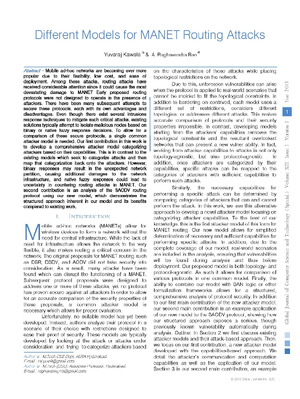
Mobile ad-hoc networks are becoming ever more popular due to their flexibility, low cost, and ease of deployment. Among these attacks, routing attacks have received considerable attention since it could cause the most devastating damage to MANET Early proposed routing protocols were not designed to operate in the presence of attackers. There have been many subsequent attempts to secure these protocols, each with its own advantages and disadvantages. Even though there exist several intrusions response techniques to mitigate such critical attacks, existing solutions typically attempt to isolate malicious nodes based on binary or native fuzzy response decisions. To allow for a comparison of these secure protocols, a single common attacker model is needed. Our first contribution in this work is to develop a comprehensive attacker model categorizing attackers based on their capabilities. This is in contrast to the existing models which seek to categorize attacks and then map that categorization back onto the attackers. However, binary responses may result in the unexpected network partition, causing additional damages to the network infrastructure, and native fuzzy responses could lead to uncertainty in countering routing attacks in MANET. Our second contribution is an analysis of the SAODV routing protocol using our new model, which demonstrates the structured approach inherent in our model and its benefits compared to existing work.

Different Models for MANET Routing Attacks

Mobile ad-hoc networks are becoming ever more popular due to their flexibility, low cost, and ease of deployment. Among these attacks, routing attacks have received considerable attention since it could cause the most devastating damage to MANET Early proposed routing protocols were not designed to operate in the presence of attackers. There have been many subsequent attempts to secure these protocols, each with its own advantages and disadvantages. Even though there exist several intrusions response techniques to mitigate such critical attacks, existing solutions typically attempt to isolate malicious nodes based on binary or native fuzzy response decisions. To allow for a comparison of these secure protocols, a single common attacker model is needed. Our first contribution in this work is to develop a comprehensive attacker model categorizing attackers based on their capabilities. This is in contrast to the existing models which seek to categorize attacks and then map that categorization back onto the attackers. However, binary responses may result in the unexpected network partition, causing additional damages to the network infrastructure, and native fuzzy responses could lead to uncertainty in countering routing attacks in MANET. Our second contribution is an analysis of the SAODV routing protocol using our new model, which demonstrates the structured approach inherent in our model and its benefits compared to existing work.

Yuvaraj Kawale
Yuvaraj Kawale
A.Raghavendra Rao
A.Raghavendra Rao

No Figures found in article.

info.icomtechnologies. 2013. “. Unknown Journal GJCST-SPECIAL Volume 13 (GJCST Volume 13 Issue Special1): .

Download Citation

Journal Specifications
Issue Cover
GJCST Volume 13 Issue Special1
Pg. 1- 7
Classification
Not Found
Keywords
Article Matrices
Total Views: 4876
Total Downloads: 2526
2026 Trends
Research Identity (RIN)
Related Research
Our website is actively being updated, and changes may occur frequently. Please clear your browser cache if needed. For feedback or error reporting, please email [email protected]

Request Access

Please fill out the form below to request access to this research paper. Your request will be reviewed by the editorial or author team.
X

Quote and Order Details

Contact Person

Invoice Address

Notes or Comments

This is the heading

Lorem ipsum dolor sit amet, consectetur adipiscing elit. Ut elit tellus, luctus nec ullamcorper mattis, pulvinar dapibus leo.


High-quality academic research articles on global topics and journals.

Different Models for MANET Routing Attacks

Yuvaraj Kawale
Yuvaraj Kawale
A.Raghavendra Rao
A.Raghavendra Rao

Research Journals