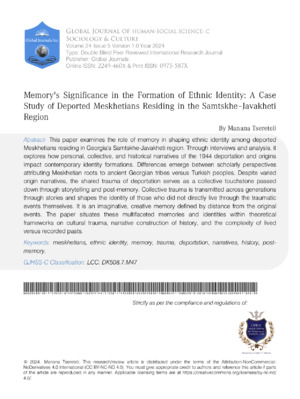
Memorys Significance in the Formation of Ethnic Identity: A Case Study of Deported Meskhetians Residing in the Samtskhe–Javakheti Region

Article ID

QYA3V

Memory, ethnic identity, sense of history, memory trace, deportation, narratives, history, past memory, cultural identity.

Memorys Significance in the Formation of Ethnic Identity: A Case Study of Deported Meskhetians Residing in the Samtskhe–Javakheti Region

Manana Tseretel
Manana Tseretel
DOI

Abstract

This paper examines the role of memory in shaping ethnic identity among deported Meskhetians residing in Georgia’s Samtskhe-Javakheti region. Through interviews and analysis, it explores how personal, collective, and historical narratives of the 1944 deportation and origins impact contemporary identity formations. Differences emerge between scholarly perspectives attributing Meskhetian roots to ancient Georgian tribes versus Turkish peoples. Despite varied origin narratives, the shared trauma of deportation serves as a collective touchstone passed down through storytelling and post-memory. Collective trauma is transmitted across generations through stories and shapes the identity of those who did not directly live through the traumatic events themselves. It is an imaginative, creative memory defined by distance from the original events. The paper situates these multifaceted memories and identities within theoretical frameworks on cultural trauma, narrative construction of history, and the complexity of lived versus recorded pasts.

Memorys Significance in the Formation of Ethnic Identity: A Case Study of Deported Meskhetians Residing in the Samtskhe–Javakheti Region

This paper examines the role of memory in shaping ethnic identity among deported Meskhetians residing in Georgia’s Samtskhe-Javakheti region. Through interviews and analysis, it explores how personal, collective, and historical narratives of the 1944 deportation and origins impact contemporary identity formations. Differences emerge between scholarly perspectives attributing Meskhetian roots to ancient Georgian tribes versus Turkish peoples. Despite varied origin narratives, the shared trauma of deportation serves as a collective touchstone passed down through storytelling and post-memory. Collective trauma is transmitted across generations through stories and shapes the identity of those who did not directly live through the traumatic events themselves. It is an imaginative, creative memory defined by distance from the original events. The paper situates these multifaceted memories and identities within theoretical frameworks on cultural trauma, narrative construction of history, and the complexity of lived versus recorded pasts.

Manana Tseretel
Manana Tseretel

No Figures found in article.

Manana Tseretel. 2026. “. Unknown Journal GJHSS-C Volume 24 (GJHSS Volume 24 Issue C5): .

Download Citation

Journal Specifications
Issue Cover
GJHSS Volume 24 Issue C5
Pg. 53- 60
Classification
Not Found
Keywords
Article Matrices
Total Views: 871
Total Downloads: 26
2026 Trends
Research Identity (RIN)
Related Research
Our website is actively being updated, and changes may occur frequently. Please clear your browser cache if needed. For feedback or error reporting, please email [email protected]

Request Access

Please fill out the form below to request access to this research paper. Your request will be reviewed by the editorial or author team.
X

Quote and Order Details

Contact Person

Invoice Address

Notes or Comments

This is the heading

Lorem ipsum dolor sit amet, consectetur adipiscing elit. Ut elit tellus, luctus nec ullamcorper mattis, pulvinar dapibus leo.

High-quality academic research articles on global topics and journals.

Memorys Significance in the Formation of Ethnic Identity: A Case Study of Deported Meskhetians Residing in the Samtskhe–Javakheti Region

Manana Tseretel
Manana Tseretel

Research Journals