
A Case of GM 1 Gangliosidosis Type 2 Mimicking Zellweger Syndrome

1
Narendranath Reddy Ganampet
2
Poornima Jaiswal Charpuria
3
Praver Chandan Chemudupati Parven
4
Shresta Mary K
Shresta Mary K
5
Dirgha Upendrabhai Patel
6
Smaran Kasireddy
Smaran Kasireddy
7
Vishal Venugopal
Vishal Venugopal
1 JJM Medical College, Davangere, India

Send Message

To: Author

GJMR Volume 23 Issue A3

Article Fingerprint

ReserarchID

OH46L

A Case of GM 1 Gangliosidosis Type 2 Mimicking Zellweger Syndrome Banner
  • English
  • Afrikaans
  • Albanian
  • Amharic
  • Arabic
  • Armenian
  • Azerbaijani
  • Basque
  • Belarusian
  • Bengali
  • Bosnian
  • Bulgarian
  • Catalan
  • Cebuano
  • Chichewa
  • Chinese (Simplified)
  • Chinese (Traditional)
  • Corsican
  • Croatian
  • Czech
  • Danish
  • Dutch
  • Esperanto
  • Estonian
  • Filipino
  • Finnish
  • French
  • Frisian
  • Galician
  • Georgian
  • German
  • Greek
  • Gujarati
  • Haitian Creole
  • Hausa
  • Hawaiian
  • Hebrew
  • Hindi
  • Hmong
  • Hungarian
  • Icelandic
  • Igbo
  • Indonesian
  • Irish
  • Italian
  • Japanese
  • Javanese
  • Kannada
  • Kazakh
  • Khmer
  • Korean
  • Kurdish (Kurmanji)
  • Kyrgyz
  • Lao
  • Latin
  • Latvian
  • Lithuanian
  • Luxembourgish
  • Macedonian
  • Malagasy
  • Malay
  • Malayalam
  • Maltese
  • Maori
  • Marathi
  • Mongolian
  • Myanmar (Burmese)
  • Nepali
  • Norwegian
  • Pashto
  • Persian
  • Polish
  • Portuguese
  • Punjabi
  • Romanian
  • Russian
  • Samoan
  • Scots Gaelic
  • Serbian
  • Sesotho
  • Shona
  • Sindhi
  • Sinhala
  • Slovak
  • Slovenian
  • Somali
  • Spanish
  • Sundanese
  • Swahili
  • Swedish
  • Tajik
  • Tamil
  • Telugu
  • Thai
  • Turkish
  • Ukrainian
  • Urdu
  • Uzbek
  • Vietnamese
  • Welsh
  • Xhosa
  • Yiddish
  • Yoruba
  • Zulu

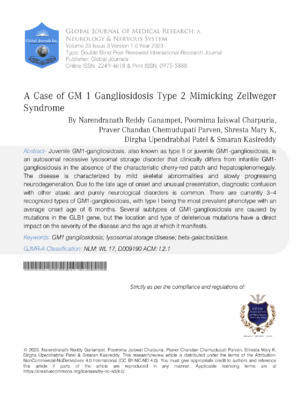
Juvenile GM1-gangliosidosis, also known as type II or juvenile GM1-gangliosidosis, is an autosomal recessive lysosomal storage disorder that clinically differs from infantile GM1gangliosidosis in the absence of the characteristic cherry-red patch and hepatosplenomegaly. The disease is characterized by mild skeletal abnormalities and slowly progressing neurodegeneration. Due to the late age of onset and unusual presentation, diagnostic confusion with other ataxic and purely neurological disorders is common. There are currently 3-4 recognized types of GM1-gangliosidosis, with type I being the most prevalent phenotype with an average onset age of 6 months. Several subtypes of GM1-gangliosidosis are caused by mutations in the GLB1 gene, but the location and type of deleterious mutations have a direct impact on the severity of the disease and the age at which it manifests.

Funding

No external funding was declared for this work.

Conflict of Interest

The authors declare no conflict of interest.

Ethical Approval

No ethics committee approval was required for this article type.

Data Availability

Not applicable for this article.

Narendranath Reddy Ganampet. 2026. \u201cA Case of GM 1 Gangliosidosis Type 2 Mimicking Zellweger Syndrome\u201d. Global Journal of Medical Research - A: Neurology & Nervous System GJMR-A Volume 23 (GJMR Volume 23 Issue A3): .

Download Citation

Juvenile G1-gangliosidosis case report overview.
Journal Specifications

Crossref Journal DOI 10.17406/gjmra

Print ISSN 0975-5888

e-ISSN 2249-4618

Keywords
Classification
GJMR-A Classification: NLM: WL 17, D009190 ACM: I.2.1
Version of record

v1.2

Issue date

August 2, 2023

Language

English

Experiance in AR

The methods for personal identification and authentication are no exception.

Read in 3D

The methods for personal identification and authentication are no exception.

Article Matrices
Total Views: 1173
Total Downloads: 26
2026 Trends
Research Identity (RIN)
Related Research

Published Article

Juvenile GM1-gangliosidosis, also known as type II or juvenile GM1-gangliosidosis, is an autosomal recessive lysosomal storage disorder that clinically differs from infantile GM1gangliosidosis in the absence of the characteristic cherry-red patch and hepatosplenomegaly. The disease is characterized by mild skeletal abnormalities and slowly progressing neurodegeneration. Due to the late age of onset and unusual presentation, diagnostic confusion with other ataxic and purely neurological disorders is common. There are currently 3-4 recognized types of GM1-gangliosidosis, with type I being the most prevalent phenotype with an average onset age of 6 months. Several subtypes of GM1-gangliosidosis are caused by mutations in the GLB1 gene, but the location and type of deleterious mutations have a direct impact on the severity of the disease and the age at which it manifests.

Our website is actively being updated, and changes may occur frequently. Please clear your browser cache if needed. For feedback or error reporting, please email [email protected]
×

This Page is Under Development

We are currently updating this article page for a better experience.

Request Access

Please fill out the form below to request access to this research paper. Your request will be reviewed by the editorial or author team.
X

Quote and Order Details

Contact Person

Invoice Address

Notes or Comments

This is the heading

Lorem ipsum dolor sit amet, consectetur adipiscing elit. Ut elit tellus, luctus nec ullamcorper mattis, pulvinar dapibus leo.


High-quality academic research articles on global topics and journals.

A Case of GM 1 Gangliosidosis Type 2 Mimicking Zellweger Syndrome

Narendranath Reddy Ganampet
Narendranath Reddy Ganampet JJM Medical College, Davangere, India
Poornima Jaiswal Charpuria
Praver Chandan Chemudupati Parven
Shresta Mary K
Shresta Mary K
Dirgha Upendrabhai Patel
Smaran Kasireddy
Smaran Kasireddy
Vishal Venugopal
Vishal Venugopal

Research Journals





























































