
I. INTRODUCTION
Today, with the ever-evolving digital landscape, social media has become a powerful force for brands to transform their business and accelerate growth. Customers are increasingly active on social media, spend countless hours, and consume tons of content. Therefore, social media channels have become indispensable tools for brands to acquire, engage, convert, and drive loyalty. Let us dive deeper into the key pillars of a social media strategy and measurement and look at critical insights by analyzing some of the leading brand's social media performance.
II. CONCEPTS
a) Goals Aligned with Business and Marketing Objectives
Setting a clear goal is highly crucial for the success of the campaign. Focusing on defining clear goals and a plan to achieve and measure the goals provides the utmost clarity in direction to the teams in executing the strategy. In addition, a brand should take additional steps to make sure that the goals tie back to the overall business and marketing objectives, such as increasing traffic to the site, generating leads, or increasing customer engagement, etc.
Following are examples of a few of the metrics mapped to the overall business objectives.
| Sample Social Media Metrics | Sample Business Objectives |
| • Reach (#of users who saw the content) • Impressions (#of times the content was viewed) | • Brand/Product Awareness • Acquisition • Customer Engagement |
| • Followers/Mentions/Shares | • Brand/Product Awareness • Customer Engagement • Loyalty |
| • Traffic | • Customer Engagement • Lead Generation • Acquisition |
| • Conversion | • Revenue • Customer Growth • Loyalty |
Smart Goals: when setting goals, teams must follow the SMART technique - specific, measurable, attainable, realistic, and time specific goals for easier tracking and measurement.
Specific: Goal is clear and well-defined e.g., Acquire 200 new e-mail subscribers through a Twitter campaign.
Measurable: Goal is quantifiable and can be measured e.g., acquire 200 new email subscribers.
Attainable: The goal should not be chosen at random or based on gut but should be based on data, e.g., historical data, industry benchmarks, competitive analysis, resource, and budget constraints, etc. The goal should be attainable and adjusted accordingly.
Relevant: As stated above, the goals should be aligned with the broader business objective.
Time specific: Time frame helps prioritize and secure resources and budget, e.g. acquire 200 new email subscribers in three months.
b) Cross-Functional Agile Team
Social media constantly evolves with new platforms, features, or even regulations increasing complexity. Therefore, it requires a team with specific skills, ability, and agility to execute a successful social media campaign across multiple platforms.
Below are sample roles you need in a team to run an effective social media campaign.
| Social Media Team Role | Responsibility | Example Skills |
| Social media manager/lead | ·Overall Strategy & Targets ·Planning and organizing ·Goals & Metrics | ·Digital Marketing ·Communication ·Leadership |
| Content Specialist | ·Trends/Competitive Research ·Content creation, manage, publish. | ·Creative/Copy ·Research & Analysis ·SEO |
| Paid Media Specialist | ·Planning & Budgeting ·Ads testing & publishing. ·Audience Segmentation & Targeting | ·Media management ·Budgeting ·Buying/Bidding |
| Community/Event Manager | ·Engage with users. ·Build Brand visibility & credibility. ·Manage Brand advocates | ·Interpersonal & Relationship building ·Social media monitoring |
| Measurement & Performance Analyst | ·Set up tracking & tagging. ·Create and share reports ·Analyze data & metrics | ·Analytical/Statistical skills ·Platform Reporting knowledge |
c) Audience Targeting
Defining audiences and creating content aligned to the audience's preferences and needs enhances the targeting and effectiveness of ads and campaigns. This is a challenging task and requires a lot of data and careful planning. The audience should be aligned with the campaign's goals, reach, and brand values. It also should be rooted in research, data, and analysis. Following best practices will help in defining a target audience.
Data and insights leveraging 0P/1P/2P/3P data sources can help define broader and granular segments.
Competitive research, industry trends, and other social media tools can provide understanding and insights into the target audience.
Further, refine the audiences using additional data
Demographic (e.g., age, gender, income, etc.)
Psychographic (e.g., lifestyle, values, interests, etc.)
Behavioral (e.g., browse, intent, purchase, etc.)
Geographic (e.g., location, climate, language, etc.)
d) Content Needs
Create compelling content that aligns with the needs and preferences of the audience. Also, the content should be published regularly and at an asset cadence to achieve maximum impact. Below are a few best practices for creating compelling social media content.
Create content tied to the needs and preferences of the audience and should align with the campaign strategy. The content should highlight the critical message the brands want to deliver to the audience. It is best to follow the rule of thirds of social media content strategy.
One-third of the content should be promotional type, focusing on business, products, or services.
One-third on thought leadership to share ideas.
One-third should be to share personal interactions and build relationships with the customers.
Create content of various types, including User-generated content (UGC), videos, live streams, infographics, etc.
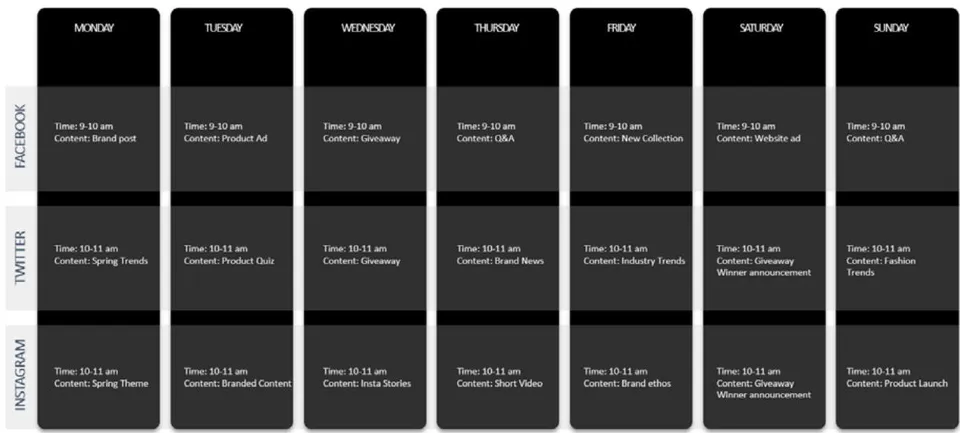
Create a social media calendar to help with timing the content creation and publishing process and drive automation in the content process. A typical simple calendar will consist of content topics by day or week and the platform where it will be published as demonstrated below.
e) Performance Measurement
Measure how social media campaigns are performing to understand the impact of the social media strategy. It can be achieved by defining the right metrics, setting up detailed tracking, and capturing and analyzing data regularly. Moreover, it is essential to measure the performance against overall business and marketing goals. Below are key metrics that are a good starting point:
- Reach: # of users who see content in a specified time
- Click-through Rate (CTR): # of users who see the content end up clicking on it
- Engagement Rate: # of followers interacting with the content (e.g., likes, shares, comments, retweets, etc.)
- Subscribers/Followers:# of subscribers on a platform
III. RESEARCH METHOD
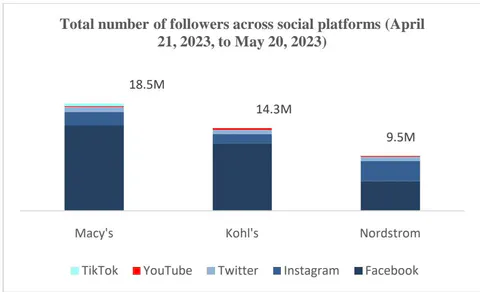
The report analyzes social media strategy and performance of three leading department stores in the US – Macy's, Nordstrom, and Kohl's. The data captured using RivallQ includes information on various metrics (posts, likes, tweets, comments, etc.) across five social media – Facebook, Instagram, Twitter, Youtube, and TikTok from April 21, 2023, to May 20, 2023. One thing to note is that all three brands don't have Twitter performance data other than the number of followers. Below is sample data collected to analyze how the brands approach their social media strategy and their performance reflected through total followers and how they engage with social media posts.
| Total Number of Followers | ||||||
| YouTube | TikTok | Total | ||||
| Macy's | 14.7M | 2.3M | .9M | .1M | .5M | 18.5M |
| Kohl's | 11.6M | 1.5M | .8M | .3M | .1M | 14.3M |
| Nordstrom | 5.1M | 3.5M | .7M | .2M | .M | 9.5M |
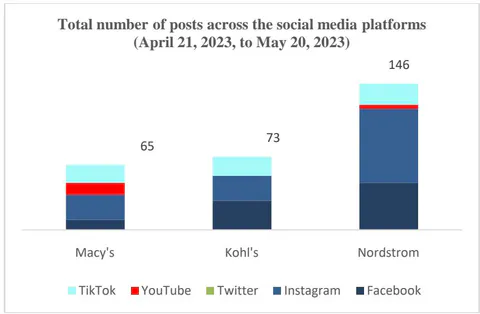
| Total Number of Posts | ||||||
| YouTube | TikTok | Total | ||||
| Macy's | 10 | 25 | 0 | 12 | 18 | 65 |
| Kohl's | 29 | 25 | 0 | 0 | 19 | 73 |
| Nordstrom | 47 | 74 | 0 | 4 | 21 | 146 |
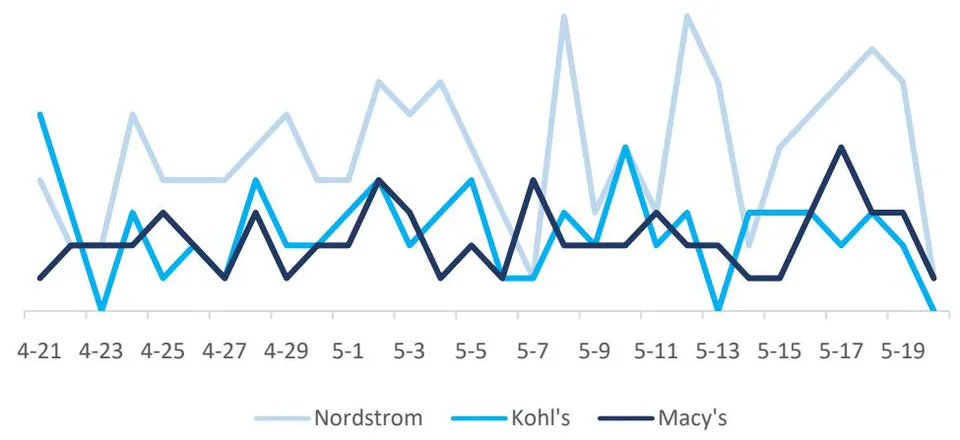
| Brand | Date | Twitter Tweets | YouTube Posts | Instagram Posts | TikTok Posts | Facebook Posts | Total |
| Nordstrom | 4/21 | 0 | 0 | 2 | 0 | 2 | 4 |
| Nordstrom | 4/22 | 0 | 0 | 1 | 0 | 1 | 2 |
| Nordstrom | 4/23 | 0 | 0 | 1 | 0 | 1 | 2 |
| Nordstrom | 4/24 | 0 | 0 | 3 | 1 | 2 | 6 |
| Nordstrom | 4/25 | 0 | 0 | 3 | 0 | 1 | 4 |
| Nordstrom | 4/26 | 0 | 0 | 1 | 1 | 2 | 4 |
| Nordstrom | 4/27 | 0 | 0 | 2 | 0 | 2 | 4 |
| Nordstrom | 4/28 | 0 | 0 | 2 | 1 | 2 | 5 |
| Nordstrom | 4/29 | 0 | 0 | 4 | 0 | 2 | 6 |
| Nordstrom | 4/30 | 0 | 0 | 3 | 0 | 1 | 4 |
| Nordstrom | 5/1 | 0 | 0 | 3 | 0 | 1 | 4 |
| Nordstrom | 5/2 | 0 | 0 | 4 | 1 | 2 | 7 |
| Nordstrom | 5/3 | 0 | 0 | 2 | 0 | 4 | 6 |
| Nordstrom | 5/4 | 0 | 0 | 4 | 1 | 2 | 7 |
| Nordstrom | 5/5 | 0 | 0 | 3 | 0 | 2 | 5 |
| Nordstrom | 5/6 | 0 | 0 | 2 | 0 | 1 | 3 |
| Nordstrom | 5/7 | 0 | 0 | 1 | 0 | 0 | 1 |
| Nordstrom | 5/8 | 0 | 0 | 3 | 3 | 3 | 9 |
| Nordstrom | 5/9 | 0 | 0 | 1 | 1 | 1 | 3 |
| Nordstrom | 5/10 | 0 | 1 | 1 | 2 | 1 | 5 |
| Nordstrom | 5/11 | 0 | 0 | 3 | 0 | 0 | 3 |
| Nordstrom | 5/12 | 0 | 0 | 3 | 4 | 2 | 9 |
| Nordstrom | 5/13 | 0 | 1 | 3 | 1 | 2 | 7 |
| Nordstrom | 5/14 | 0 | 0 | 2 | 0 | 0 | 2 |
| Nordstrom | 5/15 | 0 | 0 | 3 | 0 | 2 | 5 |
| Nordstrom | 5/16 | 0 | 0 | 3 | 1 | 2 | 6 |
| Nordstrom | 5/17 | 0 | 0 | 3 | 1 | 3 | 7 |
| Nordstrom | 5/18 | 0 | 0 | 4 | 3 | 1 | 8 |
| Nordstrom | 5/19 | 0 | 1 | 4 | 0 | 2 | 7 |
| Nordstrom | 5/20 | 0 | 1 | 0 | 0 | 0 | 1 |
| Kohl's | 4/21 | 0 | 0 | 1 | 2 | 3 | 6 |
| Kohl's | 4/22 | 0 | 0 | 1 | 1 | 1 | 3 |
| Kohl's | 4/23 | 0 | 0 | 0 | 0 | 0 | 0 |
| Kohl's | 4/24 | 0 | 0 | 1 | 1 | 1 | 3 |
| Kohl's | 4/25 | 0 | 0 | 0 | 1 | 0 | 1 |
| Kohl's | 4/26 | 0 | 0 | 1 | 0 | 1 | 2 |
| Kohl's | 4/27 | 0 | 0 | 0 | 1 | 0 | 1 |
| Kohl's | 4/28 | 0 | 0 | 1 | 1 | 2 | 4 |
| Kohl's | 4/29 | 0 | 0 | 1 | 1 | 0 | 2 |
| Kohl's | 4/30 | 0 | 0 | 1 | 1 | 0 | 2 |
| Kohl's | 5/1 | 0 | 0 | 1 | 1 | 1 | 3 |
| Kohl's | 5/2 | 0 | 0 | 2 | 1 | 1 | 4 |
| Kohl's | 5/3 | 0 | 0 | 1 | 0 | 1 | 2 |
| Kohl's | 5/4 | 0 | 0 | 1 | 0 | 2 | 3 |
| Kohl's | 5/5 | 0 | 0 | 1 | 1 | 2 | 4 |
| Kohl's | 5/6 | 0 | 0 | 1 | 0 | 0 | 1 |
| Kohl's | 5/7 | 0 | 0 | 1 | 0 | 0 | 1 |
| Kohl's | 5/8 | 0 | 0 | 1 | 1 | 1 | 3 |
| Kohl's | 5/9 | 0 | 0 | 1 | 1 | 0 | 2 |
| Kohl's | 5/10 | 0 | 0 | 1 | 2 | 2 | 5 |
| Kohl's | 5/11 | 0 | 0 | 1 | 0 | 1 | 2 |
| Kohl's | 5/12 | 0 | 0 | 1 | 0 | 2 | 3 |
| Kohl's | 5/13 | 0 | 0 | 0 | 0 | 0 | 0 |
| Kohl's | 5/14 | 0 | 0 | 1 | 1 | 1 | 3 |
| Kohl's | 5/15 | 0 | 0 | 1 | 0 | 2 | 3 |
| Kohl's | 5/16 | 0 | 0 | 1 | 1 | 1 | 3 |
| Kohl's | 5/17 | 0 | 0 | 1 | 0 | 1 | 2 |
| Kohl's | 5/18 | 0 | 0 | 1 | 0 | 2 | 3 |
| Kohl's | 5/19 | 0 | 0 | 0 | 1 | 1 | 2 |
| Kohl's | 5/20 | 0 | 0 | 0 | 0 | 0 | 0 |
| Macy's | 4/21 | 0 | 0 | 0 | 0 | 1 | 1 |
| Macy's | 4/22 | 0 | 0 | 1 | 1 | 0 | 2 |
| Macy's | 4/23 | 0 | 0 | 1 | 1 | 0 | 2 |
| Macy's | 4/24 | 0 | 0 | 1 | 0 | 1 | 2 |
| Macy's | 4/25 | 0 | 0 | 1 | 1 | 1 | 3 |
| Macy's | 4/26 | 0 | 0 | 1 | 1 | 0 | 2 |
| Macy's | 4/27 | 0 | 0 | 1 | 0 | 0 | 1 |
| Macy's | 4/28 | 0 | 1 | 1 | 0 | 1 | 3 |
| Macy's | 4/29 | 0 | 0 | 0 | 1 | 0 | 1 |
| Macy's | 4/30 | 0 | 0 | 1 | 1 | 0 | 2 |
| Macy's | 5/1 | 0 | 1 | 1 | 0 | 0 | 2 |
| Macy's | 5/2 | 0 | 1 | 1 | 1 | 1 | 4 |
| Macy's | 5/3 | 0 | 1 | 1 | 0 | 1 | 3 |
| Macy's | 5/4 | 0 | 1 | 0 | 0 | 0 | 1 |
| Macy's | 5/5 | 0 | 0 | 1 | 0 | 1 | 2 |
| Macy's | 5/6 | 0 | 0 | 0 | 1 | 0 | 1 |
| Macy's | 5/7 | 0 | 1 | 1 | 1 | 1 | 4 |
| Macy's | 5/8 | 0 | 1 | 1 | 0 | 0 | 2 |
| Macy's | 5/9 | 0 | 0 | 1 | 1 | 0 | 2 |
| Macy's | 5/10 | 0 | 0 | 1 | 1 | 0 | 2 |
| Macy's | 5/11 | 0 | 1 | 1 | 1 | 0 | 3 |
| Macy's | 5/12 | 0 | 0 | 1 | 1 | 0 | 2 |
| Macy's | 5/13 | 0 | 0 | 0 | 1 | 1 | 2 |
| Macy's | 5/14 | 0 | 0 | 1 | 0 | 0 | 1 |
| Macy's | 5/15 | 0 | 0 | 1 | 0 | 0 | 1 |
| Macy's | 5/16 | 0 | 1 | 1 | 1 | 0 | 3 |
| Macy's | 5/17 | 0 | 1 | 2 | 2 | 0 | 5 |
| Macy's | 5/18 | 0 | 1 | 1 | 0 | 1 | 3 |
| Macy's | 5/19 | 0 | 1 | 1 | 1 | 0 | 3 |
| Macy's | 5/20 | 0 | 0 | 0 | 0 | 1 | 1 |
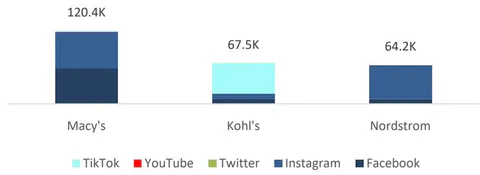
Total Engagement Across Platforms Facebook Instagram Twitter YouTube TikTok Total Macy's 58399 60596 0 252 1139 120.4K Kohl's 7674 9308 0 0 50491 67.5K Nordstrom 7776 56077 0 68 234 64.2K
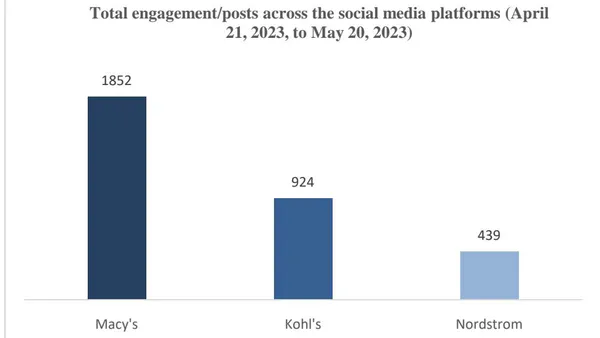
Total Engagement/Posts Total Posts Total Engagement Engagement/Posts Macy's 65 120.4K 1852 Kohl's 73 67.5K 924 Nordstrom 146 64.2K 439 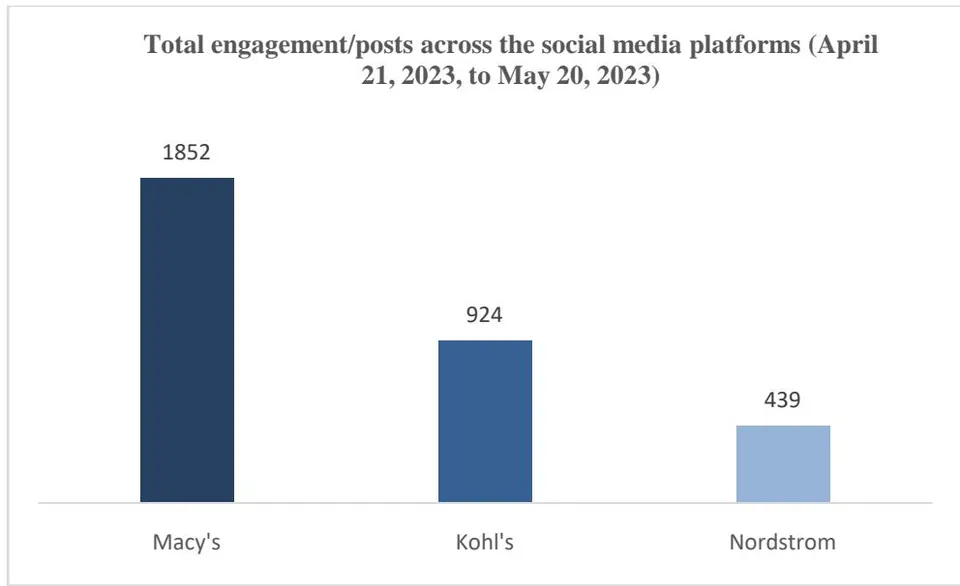
IV. FINDING AND DISCUSSION
The data shows that the three brands have taken a very different approach to their social media strategy. When looking at the results closely, it is evident that the three brands engage with the users very differently and are also seeing varied results in terms of performance. Below are a few key takeaways based on the analysis that other brands can learn from.
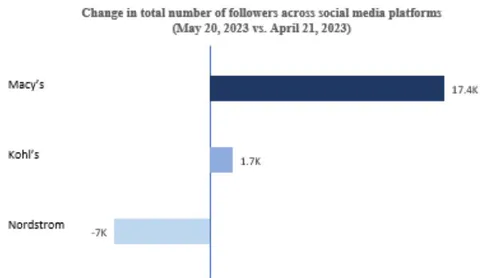
Macy's is leading the competitors in the total number of followers and has seen tremendous growth in followers despite not posting as frequently as peers, as shown in Figures 2, 3 and 4. Nordstrom, on the other hand, has lost approx. 7K followers across the platforms, and Kohl's has slightly grown. The analysis indicates that Macy's is doing an impressive job of acquiring followers while optimizing their content publishing cadence.
A higher number of posts or publishing multiple posts per day does not result in a higher follower count or higher engagement from users. Figures 4, 5, 6 and 7 indicate that Macy's has the lowest number of posts during the analyzed time (less than half of that of Nordstrom's total posts) but enjoys twice the engagement (likes, comments, shares, etc.) compared to both Nordstrom and Kohl's. It is clear that Macy's has optimized its social media strategy and is creating high quality content that is sufficient for them to garner higher engagement from their users.
The proliferation of social media channels provides an opportunity to engage users uniquely and can form the base for content strategy. Figure 6 indicates that each brand can target effectively on specific channels. For example, Macy's is doing equally well on Facebook and Instagram, whereas Kohl's sees higher engagement on TikTok, and Nordstrom sees
higher engagement on Instagram but not on other channels.
- Brands should take a data-driven approach and continuously iterate and change course based on performance results. Table 1 and Figure 4 show that brands are not getting the same engagement from Facebook as they are getting from Instagram and TikTok. For example, Kohl's has more followers on Facebook and posts relatively more on Facebook vs. other channels but has significantly higher engagement on TikTok vs. Facebook. We see similar insights from data for Macy's and Nordstrom. Therefore, brands should re-evaluate their strategy on Facebook and emerging channels such as TikTok to increase followers and engagement. They should analyze their target audiences across these channels and refine their content strategy to ensure they are creating content for the right audience and allocate resources and campaigns across the channels based on performance.
V. CONCLUSION
The analysis has highlighted the need for brands to consider various aspects of social media strategy, from target audience to content, and leveraging data to refine and iterate on their strategy continuously. This will help the brands to optimize their strategy, save costs, and drive higher engagement from the users. For a social media strategy to have successful outcomes, marketing teams should be able to adapt quickly, be agile and nimble to respond quickly to ever-changing market dynamics. While the above will help brands and practitioners with the foundational skills, metrics, and tools to create a social media strategy successfully, it is essential to review and continuously monitor and refine the strategy throughout the year to ensure that it is meets the business objectives.
a) Limitations and Scope for Future Research
This study highlights excellent theoretical and conceptual frameworks, skills, and tools that Brands and practitioners can implement. However, researchers can explore additional topics in this area to further expand the insights in this study.
The measurement techniques and metrics covered in this paper are not comprehensive, and future studies can build upon those mentioned in this paper.
Further studies can also dive into the details of the type of content these brands publish across the platforms and understand the type of contents perform better in terms of engagement across these platforms.
Author's Note: The opinions expressed in this publication are those of the authors and do not necessarily reflect the views of the Company.