
I. INTRODUCTION
To put things in perspective, let us explain on what we actually mean by a conventional approach. Let's start with a simple equation such as . So the conventional, rather the natural way might be trying to remove the square-root and then solve for x without even paying attention to the fact that, the value of left hand side (referred as LHS henceforth) cannot even exceed 2 for any real values of x but why? Because, LHS is defined for . Hence, even without any calculation whatsoever, it can be concluded that there is no real x for which the equation is satisfied. It is worth mentioning that any effort towards removing the square-root will only make the problem complex eventually leading to nowhere near conclusion. Similarly let us consider another problem: what are all real non zero solutions of the equation ? The first thing that may appear in the mind of many readers is how to solve for two unknown real variables with only one equation having no other constraints available. But on the other hand the absence of no additional constraints gives rise to the possibility of existence of multiple solutions. Now what should be the approach? Without any loss of generality, let us think completely out of the box and explore possibility of intersection of the straight line with the curve . Why are we doing this? We shall see the logic as we move along. The equation becomes, that gives value of in terms of and the set of all real solutions are since we are only interested in non-zero solutions. So, for all real values of (except, ), we can obtain all non zero real solutions of the equation .
So a simple substitution was adequate to solve the equation. However, what does it signify geometrically? Why does the substitution make lot of sense, let us explore in the graph below:
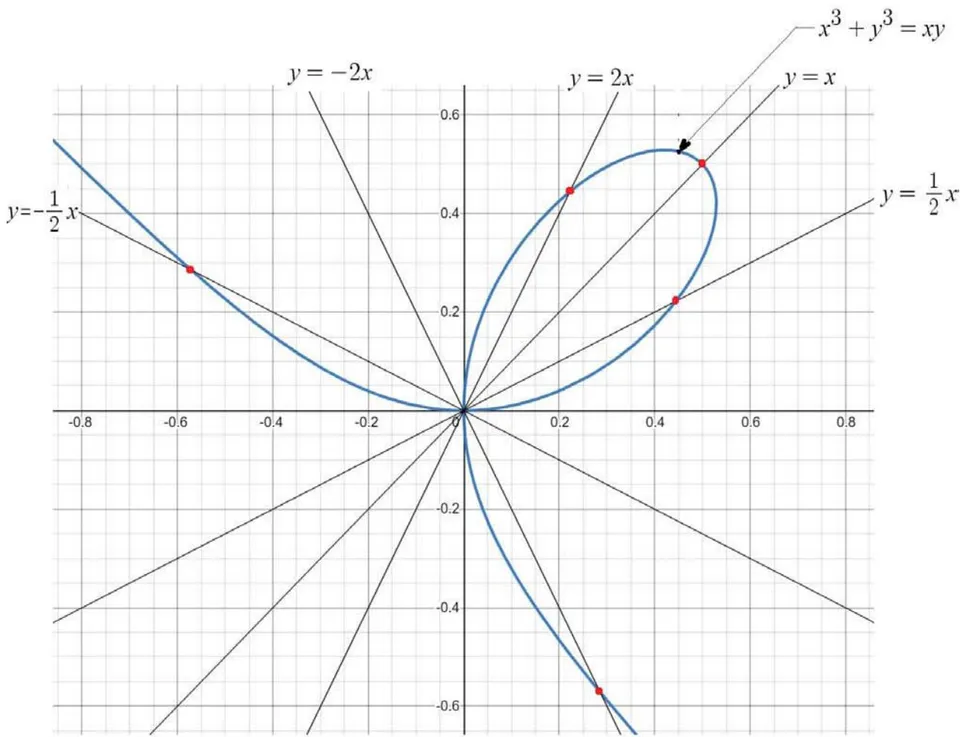
Fig. 1
It can be observed that for various values of , we get different straight line and an intersection point which is nothing but a solution of the equation . For illustration, let's' put, yields a solution of . In fact, is the parametric representation of the curve .
Prior moving to the next section we shall leave one interesting problem for the readers to explore. How many real solutions does the equation
Notes
have? Where, denotes the fractional part of integer and denotes the greatest integer function. In the next section, efforts have been made to throw some light on this kind of problem.
In the subsequent section, we shall see few more examples with detailed solutions that essentially focus on various basic yet interesting approaches for equation solving.
II. EXAMPLES
Notes
Example-1: Solve: , where real numbers.
Solution:
It is to be noted that nos. of variables exceed the nos. of equations provided. However, it is not very difficult to see that a = b = c = 1/3 is a solution since it satisfies both equations but, the question still remains what are the other solutions? Or whether there are any other solutions at all?
Using the m-th power Inequality, implies that . So, , However given that hence, it is possible if (and only if) a=b=c. Substituting this we get that, a=b=c=1/3 which is the only solution.
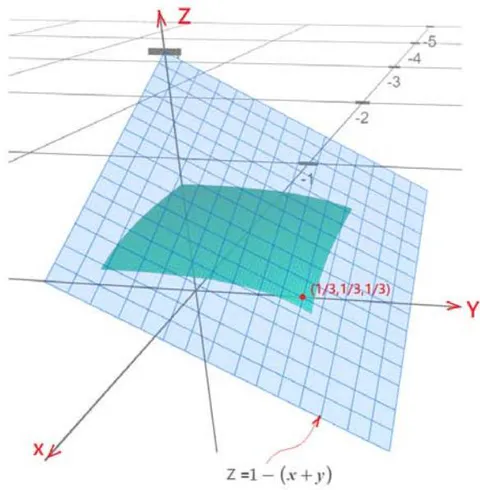
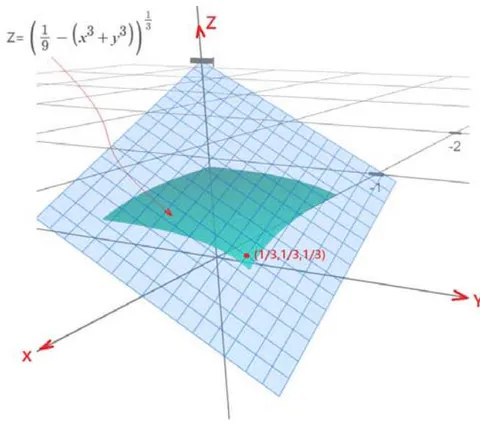
Geometrically, if x, y & z represents the variables a, b & c respectively then, the solution indicates the point of tangency of the plane and the three-dimensional curve, . VIEW-1 and VIEW-2 shows the 3D-plot of the curve and plane on the first quadrant since, , .
Example-2: Solve: where x, y, z, t, w > 0 real numbers
Solution:
Notes
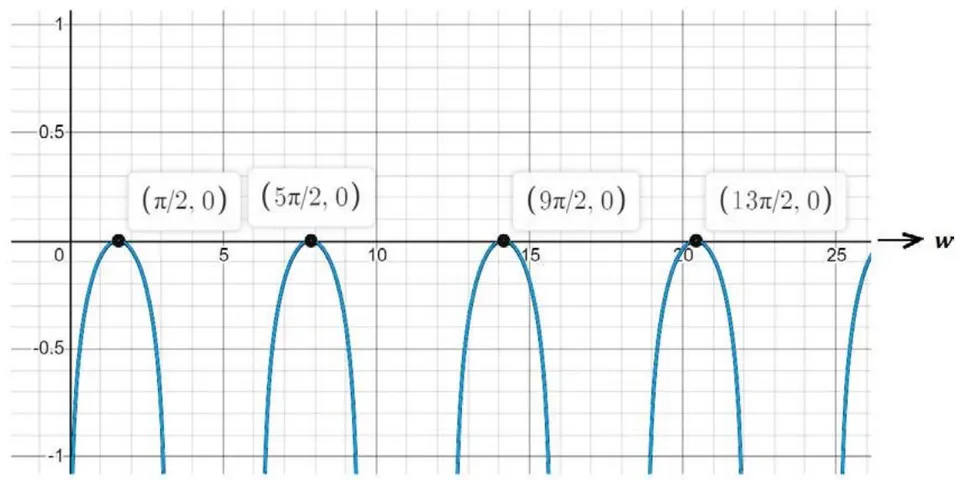
Now, LHS is non-negative for all real x, y, z, and t while the function in the RHS is always negative since , except at , the maximum value of RHS is zero. So, the equation to hold true for all real variables then RHS must be equal to zero.
, which yields the solution
Example-3: Solve: where x, y are positive integers
Solution:
By rearranging we can write,
Now we know since, x is a positive integer.
So, but because for all real x, Hence, combining these two conditions we can write that, so, the expression lies between two consecutive perfect cubes hence, it is clear that, cannot be a perfect cube. But LHS is a perfect cube i.e while RHS cannot be a perfect cube hence; the given equation does not yield any solutions in positive integers.
Example-4: Solve:
Solution:
It is obvious that x=0 satisfies the given equation. Let us investigate whether there are any non-trivial real solutions?
Let us consider
Since, and
Similarly, , hence, , and
Hence for all real x,
Hence, is a deceasing function from to (in the entire domain of definition) and the function is continuous in its entire domain. So, it will intersect the X-axis only once indicating that there is only one real solution. So, x = 0 is the only (trivial) solution.
Example-5: Solve: and for all non-zero real and , where [] denotes the greatest integer function
Solution:
real
is omitted as we shall see later that does not satisfy the equations.
Negative values of are not admissible since, LHS of the first equation i.e is non-negative. Hence, only two values of the greatest integer function possible as mentioned below:
Then the first equation becomes,
. Then the first equation becomes, .
However, is not possible since only non-trivial solutions are intended.
Hence, the set of equations required to be solved becomes, and
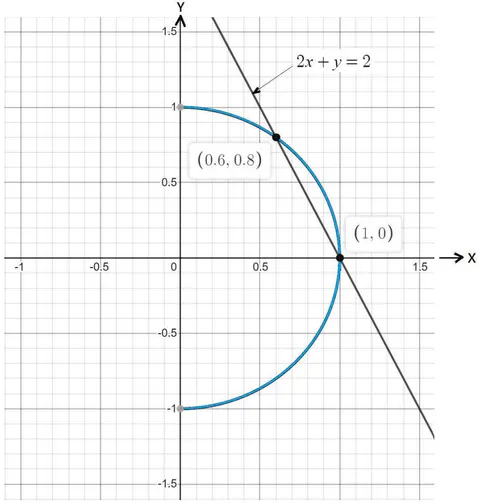
These equations can now be solved with usual approach and the solutions are and .
It is an interesting aspect that the graph of should be a full circle however it is shown as half-circle in the Fig-3 below, why? There is a valid reason to this which is left for readers to explore.
Solution:
is a non-linear algebraic equation which at the first look appears to be complicated to certain extent but with simple rearrangement, it can be shown that there is no such real and that satisfy the equation. Let us re-arrange the terms and re-write the equation as follows:
Since a, b and c are integers hence, a and are consecutive integers hence, is an even number, hence, , and are all even numbers hence, each of , and are even hence, LHS is an even number for all real a, b, c while RHS is an odd number hence, there does not exist any integer solutions.
Example-7: For what real values of parameter 'a' the equation will have positive solutions?
It is clear that, since, x > 0 for solution to be positive. The given equation can be written by expressing the variable 'a' as a function of 'x' like ( )
Applying the inequality AM GM,
So, the minimum value of the parameter 'a' for which real solution exist =
Notes
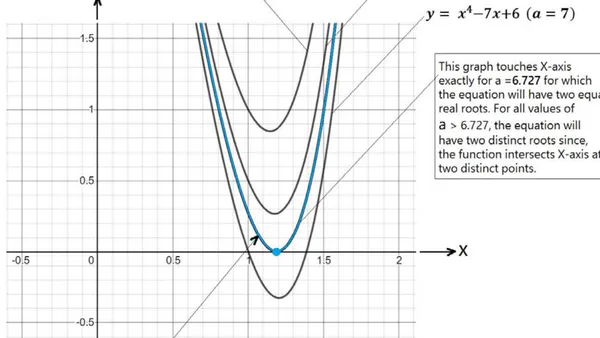
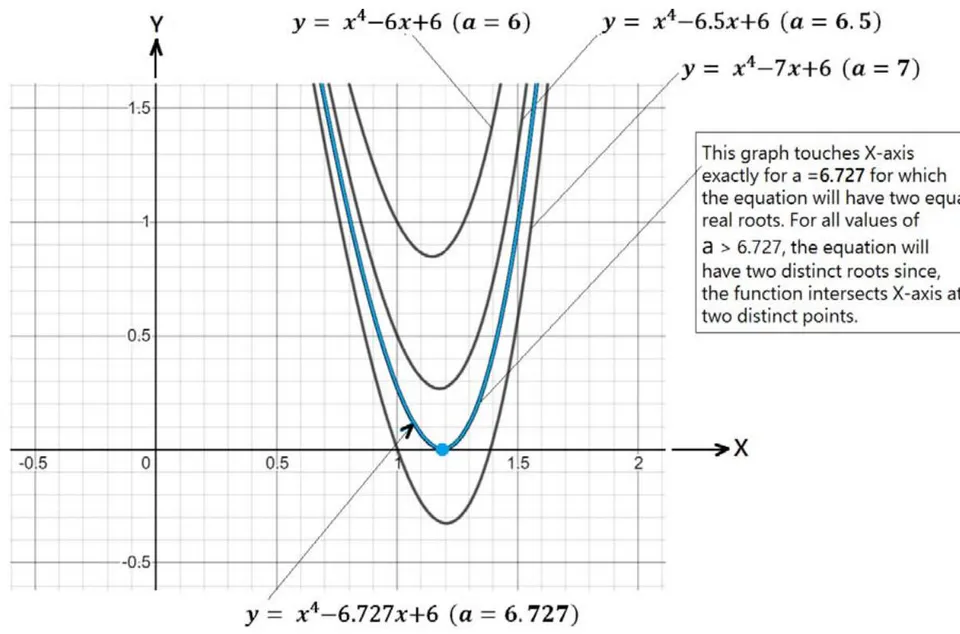
Hence, only for all real 'a' satisfying (approx) real solutions exist.
This is clearly manifested in the graph below. For different representative values of a, series of graphs are drawn to demonstrate the mathematical logic as stated above.
Example-8: How many real solutions of , Where denotes the fractional part of integer.
Let us say, where hence, the equation gets transformed to which can be re-written as which represents a circle.
Now the number of points of intersections between the function, y = {\lvert\sin x\rvert + \lvert\cos x\rvert} and the circle will provide the nos. of solutions.
Hence, to find exact nos. of real solutions, it is important to draw graph of . This can be done several ways but we chose to do it using the concept of calculus. The function is periodic with period of so, it repeats itself at every interval.
Differentiating both sides with respect to and simplifying we get,
Notes
It can be shown that the function has local minima at and local maxima at . By substituting these values of , the maximum and minimum for can be evaluated as
For 0\leq x\leq the function f(x) is increasing while for \leq x\leq, f(x) is decreasing and this repeats itself for all n=\pm1,\pm2,\pm3,\ldots since the function is periodic. So, the graph of {\left|\sin x\right| + \left|\cos x\right|} should look as indicated below in fig-5. So, \left(x-\right)^2 + \left(y-\right)^2 = \left(\frac{1}{\sqrt{2}}\right)^2 and y={\left|\sin x\right| + \left|\cos x\right|} has two real zeros and only one of them is non-trivial as indicated in the fig-5 below.
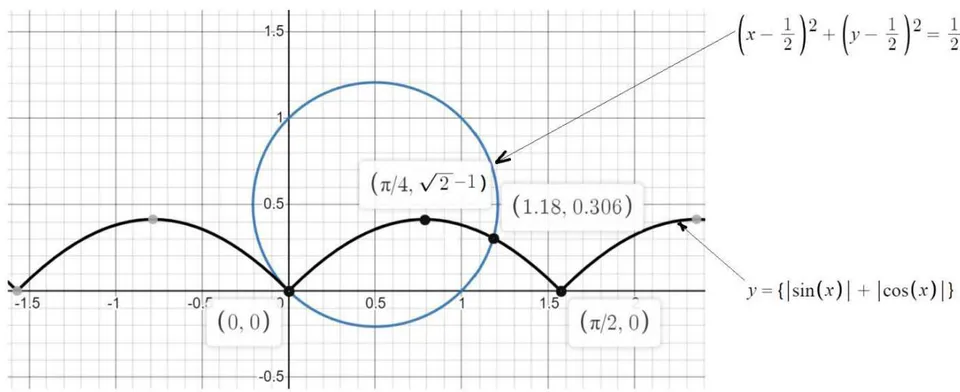
Two important things to note in the above example:
a) As intended in the question, the above method shows how to find the nos. of real zeros (trivial and non-trivial) but it does not specify how to solve the equation to get exact roots. But if graphs are drawn properly then it will provide an approximate idea on the range values of x close to the actual root.
b) While it is easy to conclude that the function has local maxima at but it is relatively difficult to show that has local minima at , even though it is quite clear from the graph. Readers are requested to explore this analytically.
III. CONCLUSION
On the backdrop of all examples and explanations, a pertinent question that may however arise that how one will anticipate the best possible approach to be adopted? It is indeed a tough question to answer since there is no definitive rule. The objective of this paper is to highlight about various approaches to solve an equation but exploring the most relevant one depends on individual intuitiveness coupled with relentless effort. The intention of this paper is to provide the readers with few basic tools and conceptions which can effectively be used and rigorously inculcated to extend the domain of mathematical understanding.
Even though the application of number theory and modular arithmetic was not addressed in this paper, it is worth mentioning that number theory plays a vital role in determining solutions various types of algebraic equations.