
A Precision Medicine Approach to the Treatment of Psychiatric Disorders

1
Michael Raymond Binder, M.D
2
Michael Raymond Binder
3
M.D
M.D

Send Message

To: Author

GJMR Volume 23 Issue A3

Article Fingerprint

ReserarchID

0EA70

A Precision Medicine Approach to the Treatment of  Psychiatric Disorders Banner
  • English
  • Afrikaans
  • Albanian
  • Amharic
  • Arabic
  • Armenian
  • Azerbaijani
  • Basque
  • Belarusian
  • Bengali
  • Bosnian
  • Bulgarian
  • Catalan
  • Cebuano
  • Chichewa
  • Chinese (Simplified)
  • Chinese (Traditional)
  • Corsican
  • Croatian
  • Czech
  • Danish
  • Dutch
  • Esperanto
  • Estonian
  • Filipino
  • Finnish
  • French
  • Frisian
  • Galician
  • Georgian
  • German
  • Greek
  • Gujarati
  • Haitian Creole
  • Hausa
  • Hawaiian
  • Hebrew
  • Hindi
  • Hmong
  • Hungarian
  • Icelandic
  • Igbo
  • Indonesian
  • Irish
  • Italian
  • Japanese
  • Javanese
  • Kannada
  • Kazakh
  • Khmer
  • Korean
  • Kurdish (Kurmanji)
  • Kyrgyz
  • Lao
  • Latin
  • Latvian
  • Lithuanian
  • Luxembourgish
  • Macedonian
  • Malagasy
  • Malay
  • Malayalam
  • Maltese
  • Maori
  • Marathi
  • Mongolian
  • Myanmar (Burmese)
  • Nepali
  • Norwegian
  • Pashto
  • Persian
  • Polish
  • Portuguese
  • Punjabi
  • Romanian
  • Russian
  • Samoan
  • Scots Gaelic
  • Serbian
  • Sesotho
  • Shona
  • Sindhi
  • Sinhala
  • Slovak
  • Slovenian
  • Somali
  • Spanish
  • Sundanese
  • Swahili
  • Swedish
  • Tajik
  • Tamil
  • Telugu
  • Thai
  • Turkish
  • Ukrainian
  • Urdu
  • Uzbek
  • Vietnamese
  • Welsh
  • Xhosa
  • Yiddish
  • Yoruba
  • Zulu

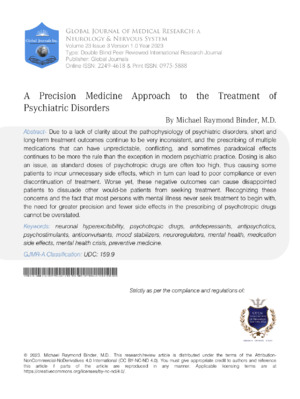
Due to a lack of clarity about the pathophysiology of psychiatric disorders, short and long-term treatment outcomes continue to be very inconsistent, and the prescribing of multiple medications that can have unpredictable, conflicting, and sometimes paradoxical effects continues to be more the rule than the exception in modern psychiatric practice. Dosing is also an issue, as standard doses of psychotropic drugs are often too high, thus causing some patients to incur unnecessary side effects, which in turn can lead to poor compliance or even discontinuation of treatment. Worse yet, these negative outcomes can cause disappointed patients to dissuade other would-be patients from seeking treatment. Recognizing these concerns and the fact that most persons with mental illness never seek treatment to begin with, the need for greater precision and fewer side effects in the prescribing of psychotropic drugs cannot be overstated.

Funding

No external funding was declared for this work.

Conflict of Interest

The authors declare no conflict of interest.

Ethical Approval

No ethics committee approval was required for this article type.

Data Availability

Not applicable for this article.

Michael Raymond Binder, M.D. 2026. \u201cA Precision Medicine Approach to the Treatment of Psychiatric Disorders\u201d. Global Journal of Medical Research - A: Neurology & Nervous System GJMR-A Volume 23 (GJMR Volume 23 Issue A3): .

Download Citation

A detailed look at innovative approaches to diagnosing and treating psychiatric disorders, emphasizing precision medicine.
Journal Specifications

Crossref Journal DOI 10.17406/gjmra

Print ISSN 0975-5888

e-ISSN 2249-4618

Keywords
Classification
GJMR-A Classification: (UDC): 159.9
Version of record

v1.2

Issue date

August 2, 2023

Language

English

Experiance in AR

The methods for personal identification and authentication are no exception.

Read in 3D

The methods for personal identification and authentication are no exception.

Article Matrices
Total Views: 1186
Total Downloads: 29
2026 Trends
Research Identity (RIN)
Related Research

Published Article

Due to a lack of clarity about the pathophysiology of psychiatric disorders, short and long-term treatment outcomes continue to be very inconsistent, and the prescribing of multiple medications that can have unpredictable, conflicting, and sometimes paradoxical effects continues to be more the rule than the exception in modern psychiatric practice. Dosing is also an issue, as standard doses of psychotropic drugs are often too high, thus causing some patients to incur unnecessary side effects, which in turn can lead to poor compliance or even discontinuation of treatment. Worse yet, these negative outcomes can cause disappointed patients to dissuade other would-be patients from seeking treatment. Recognizing these concerns and the fact that most persons with mental illness never seek treatment to begin with, the need for greater precision and fewer side effects in the prescribing of psychotropic drugs cannot be overstated.

Our website is actively being updated, and changes may occur frequently. Please clear your browser cache if needed. For feedback or error reporting, please email [email protected]
×

This Page is Under Development

We are currently updating this article page for a better experience.

Request Access

Please fill out the form below to request access to this research paper. Your request will be reviewed by the editorial or author team.
X

Quote and Order Details

Contact Person

Invoice Address

Notes or Comments

This is the heading

Lorem ipsum dolor sit amet, consectetur adipiscing elit. Ut elit tellus, luctus nec ullamcorper mattis, pulvinar dapibus leo.


High-quality academic research articles on global topics and journals.

A Precision Medicine Approach to the Treatment of Psychiatric Disorders

Michael Raymond Binder
M.D
M.D

Research Journals





























































