## INTRODUCTION
It is a well-known fact that the in- radius of a Pythagorean triangle (A right-triangle whose sides form a Pythagorean triple) is always an integer [1]. The purpose of this note is to extent this result in the following sense.
If in any Pythagorean triangle a string of a finite number (say, $\mathbf{k}$ ) of equal circles, inside the triangle, are so taken that i. each of the k circles touches a given side (other than the hypotenuse) ii. each of the (k-2) non-extreme circles also touch the two neighbouring circles. iii. the extreme two circles touch the nearest other side also.
We claim that these circles will have a rational radius for all $\mathbf{k}$. We also work out the value of $r$ explicitly.
Before proceeding for the proof, we need to use the following facts a. A special category of Pythagorean triples is that of primitive
- Pythagorean triples which are merely Pythagorean triples having no common factors. b. Every Pythagorean triple is of the form $2ab$, $a^2 - b^2$, $a^2 + b^2$, where $a$ and $b$ are positive coprime integers and $a > b$ [2].
Proof:
Let $\Delta ABC$ be right angled at B.
Without loss of generality, we can assume that the sides of $\Delta ABC$ form a primitive pythagorean triple. Let $AB = 2ab$, $BC = a^2 - b^2$ and $AC = a^2 + b^2$, where $a$ and $b$ are coprime with $a > b$.
We need to consider two cases depending on whether the strings of circles are taken on BC or on AB. Accordingly, we have to prove our assertion considering both the cases.
Case 1: String of circles lying along $BC$
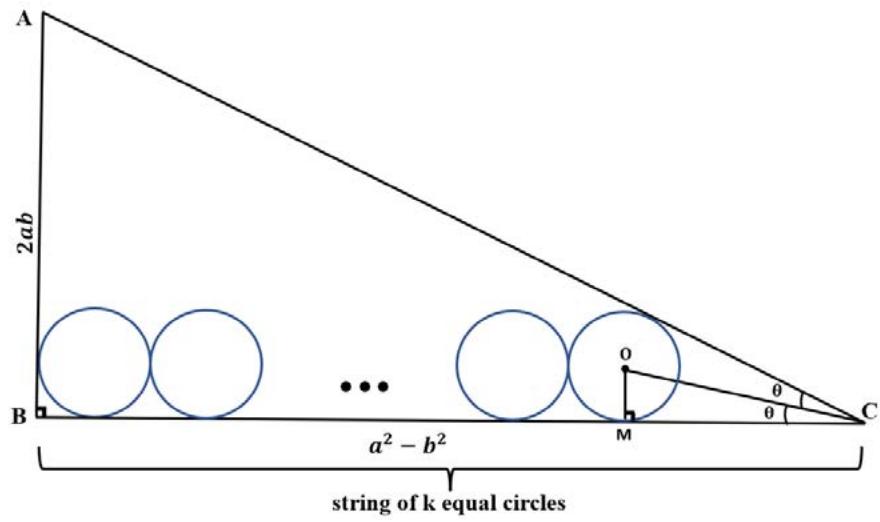
It may be noted here that in this case $(2k - 1)r < (a^2 - b^2)$ (1)
Let $\mathrm{O}$ be the centre of the circle (nearest to AC) and $\mathrm{OM} \perp \mathrm{BC}$.
Let $r$ be the radius of each of these circles.
Clearly, OC bisects $\angle ACB$. Let $\angle ACB = 2\theta$ so that $\angle OCB = \theta$.
We have,
$$
\tan \theta = \frac {\mathrm {O M}}{\mathrm {M C}} = \frac {r}{a ^ {2} - b ^ {2} - (2 k - 1) r}
$$
Also,
$$
\tan 2 \theta = \frac {\mathrm {A B}}{\mathrm {B C}} = \frac {2 a b}{a ^ {2} - b ^ {2}}
$$
$\Rightarrow \frac{2ab}{a^2 - b^2} = \frac{\frac{2r}{(a^2 - b^2) - (2k - 1)r}}{1 - \frac{r^2}{[(a^2 - b^2) - (2k - 1)r]^2}}$ (By the duplication formula for tangent function)
$$
\Rightarrow \{4 a b k ^ {2} + 2 (a ^ {2} - b ^ {2} - 2 a b) k - (a ^ {2} - b ^ {2}) \} r ^ {2} - (a ^ {2} - b ^ {2}) (4 a b k + a ^ {2} - b ^ {2} - 2 a b) r + a b (a ^ {2} - b ^ {2}) ^ {2} = 0
$$
i.e, $Ar^2 - Br + C = 0$
where,
$$
A = 4 a b k ^ {2} + 2 \left(a ^ {2} - b ^ {2} - 2 a b\right) k - \left(a ^ {2} - b ^ {2}\right)
$$
$$
B = \left(a ^ {2} - b ^ {2}\right) \left(4 a b k + a ^ {2} - b ^ {2} - 2 a b\right)
$$
$$
C = a b \left(a ^ {2} - b ^ {2}\right) ^ {2}
$$
we have,
$$
B^{2} - 4AC = \left(a^{2} - b^{2}\right)^{2} \left(4abk + a^{2} - b^{2} - 2ab\right)^{2} - 4ab \left(a^{2} - b^{2}\right)^{2} \left\{4abk^{2} + 2 \left(a^{2} - b^{2} - 2ab\right)k - \left(a^{2} - b^{2}\right)\right\} \end{array}
$$
which clearly asserts that $r$ must be rational now,
$$
r = \frac{B \pm \sqrt{B^{2} - 4AC}}{2A} \\= \frac{(a^{2} - b^{2})(4abk + a^{2} - b^{2} - 2ab) \pm (a^{4} - b^{4})}{2\{4abk^{2} + 2(a^{2} - b^{2} - 2ab)k - (a^{2} - b^{2})\}} \\= \frac{(a^{2} - b^{2})(4abk + a^{2} - b^{2} - 2ab) \pm (a^{4} - b^{4})}{2(2ak - b - a)(2bk - b + a)}
$$
Here we claim that we have to discard the plus sign.
Because if we take plus sign then $r$ becomes
$$
\begin{array}{l} \frac {\left(a ^ {2} - b ^ {2}\right) \left\{\left(4 a b k + a ^ {2} - b ^ {2} - 2 a b\right) + \left(a ^ {2} + b ^ {2}\right) \right\}}{2 (2 a k - b - a) (2 b k - b + a)} \\= \frac {a \left(a ^ {2} - b ^ {2}\right) \left(2 b k - b + a\right)}{\left(2 a k - b - a\right) \left(2 b k - b + a\right)} \\= \frac {a \left(a ^ {2} - b ^ {2}\right)}{\left(2 a k - b - a\right)} \\\end{array}
$$
By the condition (1), we have
$$
\frac {a ^ {2} - b ^ {2}}{r} > 2 k - 1
$$
$$
\begin{array}{l} \Rightarrow \frac {2 a k - b - a}{a} > 2 k - 1 \\\Rightarrow - b > 0 \\\end{array}
$$
Which is absurd. This justifies our claim If we take minus sign $r$ becomes
$$
\begin{array}{l} \frac {(a ^ {2} - b ^ {2}) \{(4 a b k + a ^ {2} - b ^ {2} - 2 a b) - (a ^ {2} + b ^ {2}) \}}{2 (2 a k - b - a) (2 b k - b + a)} \\= \frac {b (a ^ {2} - b ^ {2}) (2 a k - b - a)}{(2 b k - b + a) (2 a k - b - a)} \\= \frac {b \left(a ^ {2} - b ^ {2}\right)}{(2 k - 1) b + a} \\\end{array}
$$
Clearly, this option satisfies the condition (1)
Case 2: String of circles lying along $BC$
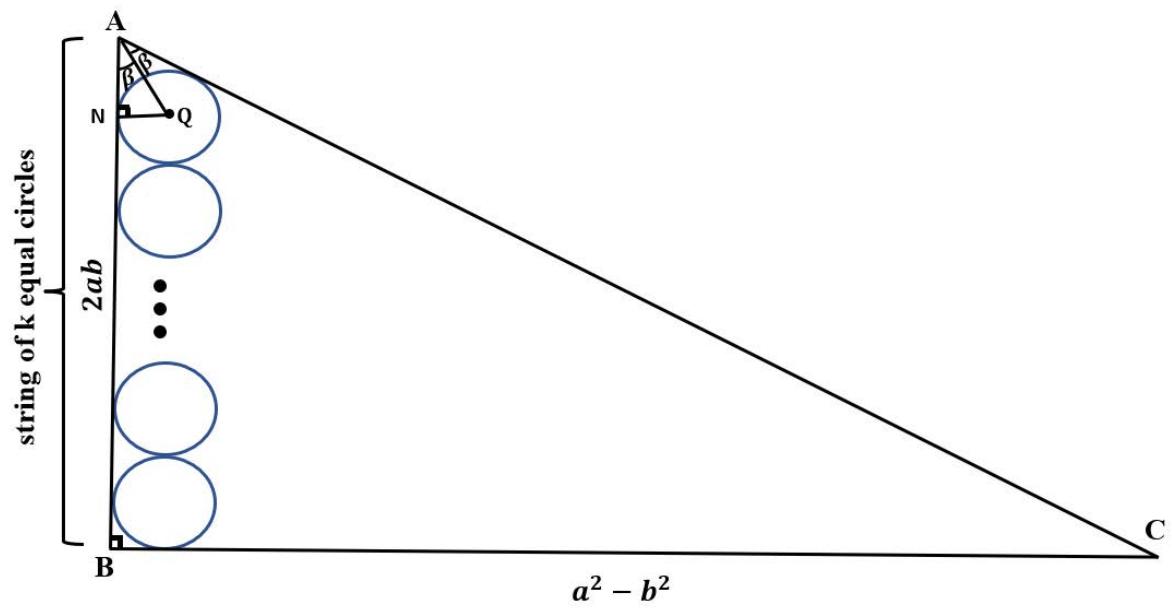
It may be noted here that $(2k - 1)r < 2ab$ (2)
Let $Q$ be the centre of the circle (nearest to AC) and QN $\perp$ AB.
Clearly, QA bisects $\angle BAC$. Let $\angle BAC = 2\beta$ so that $\angle QAB = \beta$.
We have,
$$
\tan \beta = \frac {Q N}{N A} = \frac {r}{2 a b - (2 k - 1) r}
$$
Also,
$$
\begin{array}{l} \tan 2\beta = \frac{BC}{AB} = \frac{a^2 - b^2}{2ab} \\\Rightarrow \frac{a^2 - b^2}{2ab} = \frac{\frac{2r}{2ab - (2k - 1)r}}{1 - \frac{r^2}{\left\{2ab - (2k - 1)r \right\}^2}} \quad (\text{By}) \\\Rightarrow \{(a^2 - b^2)(k^2 - k) + ab(2k - 1)\} r^2 - (ab) \{(a^2 - b^2)(2k - 1) + 2(ab)\} r + (a^2 - b^2)(ab)^2 = 0 \\\end{array}
$$
i.e, $Ar^2 - Br + C = 0$, where
$$
A = \left(a ^ {2} - b ^ {2}\right) \left(k ^ {2} - k\right) + a b (2 k - 1)
$$
$$
B = (a b) \left\{\left(a ^ {2} - b ^ {2}\right) (2 k - 1) + 2 (a b) \right\}
$$
$$
C = \left(a ^ {2} - b ^ {2}\right) (a b) ^ {2}
$$
$$
B^{2} - 4AC = (ab)^{2} \{ (a^{2} - b^{2}) (2k - 1) + 2 (ab) \}^{2} - 4 \{ (a^{2} - b^{2}) (k^{2} - k) + ab (2k - 1) \} (a^{2} - b^{2}) (ab)^{2} = (ab)^{2} (a^{2} + b^{2})^{2}
$$
which clearly asserts that $r$ must be rational
$$
\begin{array}{l} r = \frac {B \pm \sqrt {B ^ {2} - 4 A C}}{2 A} \\= \frac {(a b) \left\{\left(a ^ {2} - b ^ {2}\right) (2 k - 1) + 2 (a b) \right\} \pm a b \left(a ^ {2} + b ^ {2}\right)}{2 \left\{\left(a ^ {2} - b ^ {2}\right) \left(k ^ {2} - k\right) + a b (2 k - 1) \right\}} \\\end{array}
$$
$$
= \frac {(a b) \left\{\left(a ^ {2} - b ^ {2}\right) (2 k - 1) + 2 (a b) \right\} \pm a b \left(a ^ {2} + b ^ {2}\right)}{2 (k a - k b + b) (k a + k b - a)}
$$
Here we claim that we have to discard the plus sign.
Because if we take plus sign then $r$ becomes
$$
\begin{array}{l} \frac {(a b) \{(a ^ {2} - b ^ {2}) (2 k - 1) + 2 (a b) \} + a b (a ^ {2} + b ^ {2})}{2 (k a - k b + b) (k a + k b - a)} \\= \frac {2 (a b) (a + b) (k a - k b + b)}{2 (k a - k b + b) (k a + k b - a)} \\= \frac {(a b) (a + b)}{(k a + k b - a)} \\\end{array}
$$
By the condition (2), we have
$$
\begin{array}{l} \frac {(2 k - 1) r}{2} < a b \\\Rightarrow \frac {r (k a + k b - a)}{(a + b)} > \frac {(2 k - 1) r}{2} \\\Rightarrow k < \frac {b}{a + b} \\\end{array}
$$
Which is absurd (as $k$ is an integer). This justifies our claim. If we take minus sign $r$ becomes
$$
\begin{array}{l} \frac {(a b) \{(a ^ {2} - b ^ {2}) (2 k - 1) + 2 (a b) \} - a b (a ^ {2} + b ^ {2})}{2 (k a - k b + b) (k a + k b - a)} \\= \frac {a b (a - b) (k a + k b - a)}{(k a - k b + b) (k a + k b - a)} \\= \frac {a b (a - b)}{k (a - b) + b} \\\end{array}
$$
Clearly, this option satisfies the condition (2)
### Remark
Interestingly, the values of $r$ in both the cases are free from $k$ in the numerator.
Generating HTML Viewer...
References
2 Cites in Article
David Burton (2011). Elementary Number Theory, -7th ed.
David Burton (2011). Elementary Number Theory, -7th ed.
Explore published articles in an immersive Augmented Reality environment. Our platform converts research papers into interactive 3D books, allowing readers to view and interact with content using AR and VR compatible devices.
Your published article is automatically converted into a realistic 3D book. Flip through pages and read research papers in a more engaging and interactive format.
Our website is actively being updated, and changes may occur frequently. Please clear your browser cache if needed. For feedback or error reporting, please email [email protected]
Thank you for connecting with us. We will respond to you shortly.