An Extension of ‘in-Radius Property’ of Pythagorean Triangles

Send Message

To: Author

An Extension of ‘in-Radius Property’ of Pythagorean Triangles

Article Fingerprint

ReserarchID

30NN8

An Extension of ‘in-Radius Property’ of Pythagorean Triangles Banner

AI TAKEAWAY

Connecting with the Eternal Ground
  • English
  • Afrikaans
  • Albanian
  • Amharic
  • Arabic
  • Armenian
  • Azerbaijani
  • Basque
  • Belarusian
  • Bengali
  • Bosnian
  • Bulgarian
  • Catalan
  • Cebuano
  • Chichewa
  • Chinese (Simplified)
  • Chinese (Traditional)
  • Corsican
  • Croatian
  • Czech
  • Danish
  • Dutch
  • Esperanto
  • Estonian
  • Filipino
  • Finnish
  • French
  • Frisian
  • Galician
  • Georgian
  • German
  • Greek
  • Gujarati
  • Haitian Creole
  • Hausa
  • Hawaiian
  • Hebrew
  • Hindi
  • Hmong
  • Hungarian
  • Icelandic
  • Igbo
  • Indonesian
  • Irish
  • Italian
  • Japanese
  • Javanese
  • Kannada
  • Kazakh
  • Khmer
  • Korean
  • Kurdish (Kurmanji)
  • Kyrgyz
  • Lao
  • Latin
  • Latvian
  • Lithuanian
  • Luxembourgish
  • Macedonian
  • Malagasy
  • Malay
  • Malayalam
  • Maltese
  • Maori
  • Marathi
  • Mongolian
  • Myanmar (Burmese)
  • Nepali
  • Norwegian
  • Pashto
  • Persian
  • Polish
  • Portuguese
  • Punjabi
  • Romanian
  • Russian
  • Samoan
  • Scots Gaelic
  • Serbian
  • Sesotho
  • Shona
  • Sindhi
  • Sinhala
  • Slovak
  • Slovenian
  • Somali
  • Spanish
  • Sundanese
  • Swahili
  • Swedish
  • Tajik
  • Tamil
  • Telugu
  • Thai
  • Turkish
  • Ukrainian
  • Urdu
  • Uzbek
  • Vietnamese
  • Welsh
  • Xhosa
  • Yiddish
  • Yoruba
  • Zulu
Font Type
Font Size
Font Size
Bedground

INTRODUCTION

It is a well-known fact that the in- radius of a Pythagorean triangle (A right-triangle whose sides form a Pythagorean triple) is always an integer [1]. The purpose of this note is to extent this result in the following sense.

If in any Pythagorean triangle a string of a finite number (say, k ) of equal circles, inside the triangle, are so taken that i. each of the k circles touches a given side (other than the hypotenuse) ii. each of the (k-2) non-extreme circles also touch the two neighbouring circles. iii. the extreme two circles touch the nearest other side also.

We claim that these circles will have a rational radius for all k . We also work out the value of r explicitly.

Before proceeding for the proof, we need to use the following facts a. A special category of Pythagorean triples is that of primitive

  • Pythagorean triples which are merely Pythagorean triples having no common factors. b. Every Pythagorean triple is of the form 2 a b , a 2 b 2 , a 2 + b 2 , where a and b are positive coprime integers and a > b [2].

Proof:

Let Δ A B C be right angled at B.

Without loss of generality, we can assume that the sides of Δ A B C form a primitive pythagorean triple. Let A B = 2 a b , B C = a 2 b 2 and A C = a 2 + b 2 , where a and b are coprime with a > b .

We need to consider two cases depending on whether the strings of circles are taken on BC or on AB. Accordingly, we have to prove our assertion considering both the cases.

Case 1: String of circles lying along B C

It may be noted here that in this case ( 2 k 1 ) r < ( a 2 b 2 ) (1)

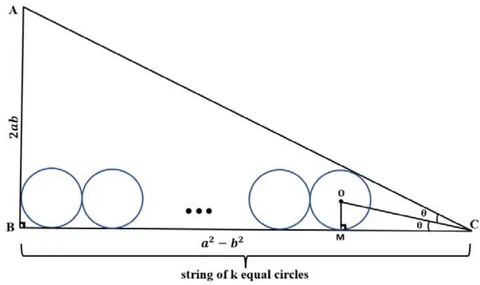
Let O be the centre of the circle (nearest to AC) and OM BC .

Let r be the radius of each of these circles.

Clearly, OC bisects A C B . Let A C B = 2 θ so that O C B = θ .

We have,

tan θ = O M M C = r a 2 b 2 ( 2 k 1 ) r

Also,

tan 2 θ = A B B C = 2 a b a 2 b 2

2 a b a 2 b 2 = 2 r ( a 2 b 2 ) ( 2 k 1 ) r 1 r 2 [ ( a 2 b 2 ) ( 2 k 1 ) r ] 2 (By the duplication formula for tangent function)

{ 4 a b k 2 + 2 ( a 2 b 2 2 a b ) k ( a 2 b 2 ) } r 2 ( a 2 b 2 ) ( 4 a b k + a 2 b 2 2 a b ) r + a b ( a 2 b 2 ) 2 = 0

i.e, A r 2 B r + C = 0

where,

A = 4 a b k 2 + 2 ( a 2 b 2 2 a b ) k ( a 2 b 2 )
B = ( a 2 b 2 ) ( 4 a b k + a 2 b 2 2 a b )
C = a b ( a 2 b 2 ) 2

we have,

B^{2} - 4AC = \left(a^{2} - b^{2}\right)^{2} \left(4abk + a^{2} - b^{2} - 2ab\right)^{2} - 4ab \left(a^{2} - b^{2}\right)^{2} \left\{4abk^{2} + 2 \left(a^{2} - b^{2} - 2ab\right)k - \left(a^{2} - b^{2}\right)\right\} \end{array}

which clearly asserts that r must be rational now,

r = B ± B 2 4 A C 2 A = ( a 2 b 2 ) ( 4 a b k + a 2 b 2 2 a b ) ± ( a 4 b 4 ) 2 { 4 a b k 2 + 2 ( a 2 b 2 2 a b ) k ( a 2 b 2 ) } = ( a 2 b 2 ) ( 4 a b k + a 2 b 2 2 a b ) ± ( a 4 b 4 ) 2 ( 2 a k b a ) ( 2 b k b + a )

Here we claim that we have to discard the plus sign.

Because if we take plus sign then r becomes

( a 2 b 2 ) { ( 4 a b k + a 2 b 2 2 a b ) + ( a 2 + b 2 ) } 2 ( 2 a k b a ) ( 2 b k b + a ) = a ( a 2 b 2 ) ( 2 b k b + a ) ( 2 a k b a ) ( 2 b k b + a ) = a ( a 2 b 2 ) ( 2 a k b a )

By the condition (1), we have

a 2 b 2 r > 2 k 1
2 a k b a a > 2 k 1 b > 0

Which is absurd. This justifies our claim If we take minus sign r becomes

( a 2 b 2 ) { ( 4 a b k + a 2 b 2 2 a b ) ( a 2 + b 2 ) } 2 ( 2 a k b a ) ( 2 b k b + a ) = b ( a 2 b 2 ) ( 2 a k b a ) ( 2 b k b + a ) ( 2 a k b a ) = b ( a 2 b 2 ) ( 2 k 1 ) b + a

Clearly, this option satisfies the condition (1)

Case 2: String of circles lying along B C

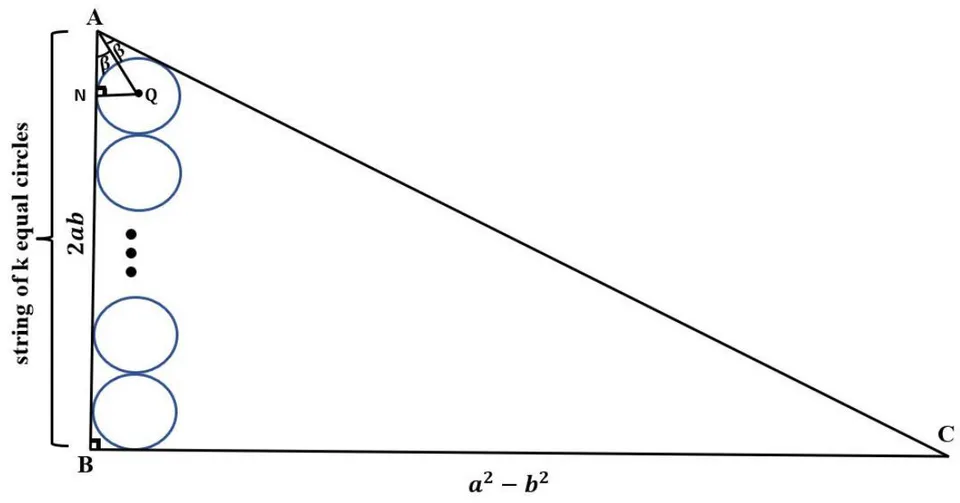
It may be noted here that ( 2 k 1 ) r < 2 a b (2)

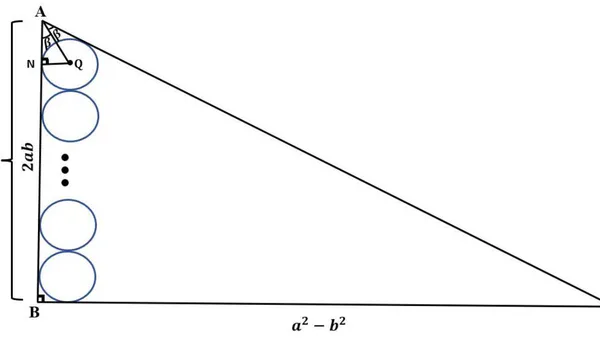
Let Q be the centre of the circle (nearest to AC) and QN AB.

Clearly, QA bisects B A C . Let B A C = 2 β so that Q A B = β .

We have,

tan β = Q N N A = r 2 a b ( 2 k 1 ) r

Also,

tan 2 β = B C A B = a 2 b 2 2 a b a 2 b 2 2 a b = 2 r 2 a b ( 2 k 1 ) r 1 r 2 { 2 a b ( 2 k 1 ) r } 2 ( By ) { ( a 2 b 2 ) ( k 2 k ) + a b ( 2 k 1 ) } r 2 ( a b ) { ( a 2 b 2 ) ( 2 k 1 ) + 2 ( a b ) } r + ( a 2 b 2 ) ( a b ) 2 = 0

i.e, A r 2 B r + C = 0 , where

A = ( a 2 b 2 ) ( k 2 k ) + a b ( 2 k 1 )
B = ( a b ) { ( a 2 b 2 ) ( 2 k 1 ) + 2 ( a b ) }
C = ( a 2 b 2 ) ( a b ) 2
B 2 4 A C = ( a b ) 2 { ( a 2 b 2 ) ( 2 k 1 ) + 2 ( a b ) } 2 4 { ( a 2 b 2 ) ( k 2 k ) + a b ( 2 k 1 ) } ( a 2 b 2 ) ( a b ) 2 = ( a b ) 2 ( a 2 + b 2 ) 2

which clearly asserts that r must be rational

r = B ± B 2 4 A C 2 A = ( a b ) { ( a 2 b 2 ) ( 2 k 1 ) + 2 ( a b ) } ± a b ( a 2 + b 2 ) 2 { ( a 2 b 2 ) ( k 2 k ) + a b ( 2 k 1 ) }
= ( a b ) { ( a 2 b 2 ) ( 2 k 1 ) + 2 ( a b ) } ± a b ( a 2 + b 2 ) 2 ( k a k b + b ) ( k a + k b a )

Here we claim that we have to discard the plus sign.

Because if we take plus sign then r becomes

( a b ) { ( a 2 b 2 ) ( 2 k 1 ) + 2 ( a b ) } + a b ( a 2 + b 2 ) 2 ( k a k b + b ) ( k a + k b a ) = 2 ( a b ) ( a + b ) ( k a k b + b ) 2 ( k a k b + b ) ( k a + k b a ) = ( a b ) ( a + b ) ( k a + k b a )

By the condition (2), we have

( 2 k 1 ) r 2 < a b r ( k a + k b a ) ( a + b ) > ( 2 k 1 ) r 2 k < b a + b

Which is absurd (as k is an integer). This justifies our claim. If we take minus sign r becomes

( a b ) { ( a 2 b 2 ) ( 2 k 1 ) + 2 ( a b ) } a b ( a 2 + b 2 ) 2 ( k a k b + b ) ( k a + k b a ) = a b ( a b ) ( k a + k b a ) ( k a k b + b ) ( k a + k b a ) = a b ( a b ) k ( a b ) + b

Clearly, this option satisfies the condition (2)

Remark

Interestingly, the values of r in both the cases are free from k in the numerator.

References

2 Cites in Article
  1. David Burton (2011). Elementary Number Theory, -7th ed.
  2. David Burton (2011). Elementary Number Theory, -7th ed.

Funding

No external funding was declared for this work.

Conflict of Interest

The authors declare no conflict of interest.

Ethical Approval

No ethics committee approval was required for this article type.

Data Availability

Not applicable for this article.

How to Cite This Article

Kb Subramaniam. 2026. "An Extension of ‘in-Radius Property’ of Pythagorean Triangles". Global Journal of Science Frontier Research - F: Mathematics & Decision GJSFR-F Volume 23 (GJSFR Volume 23 Issue F3).

Download Citation

Diagonal circle inscribed within a Pythagorean triangle.
Journal Specifications

Crossref Journal DOI 10.17406/GJSFR

Print ISSN 0975-5896

e-ISSN 2249-4626

Keywords
Classification
GJSFR-F Classification DDC Code: 182.2 LCC Code: B243
Version of record

v1.2

Issue date
May 23, 2023

Language
English
Experiance in AR

Explore published articles in an immersive Augmented Reality environment. Our platform converts research papers into interactive 3D books, allowing readers to view and interact with content using AR and VR compatible devices.

Read in 3D

Your published article is automatically converted into a realistic 3D book. Flip through pages and read research papers in a more engaging and interactive format.

Article Matrices
Total Views: 593
Total Downloads: 40
All Trends

Request Access

Please fill out the form below to request access to this research paper. Your request will be reviewed by the editorial or author team.
X

This is the heading

Lorem ipsum dolor sit amet, consectetur adipiscing elit. Ut elit tellus, luctus nec ullamcorper mattis, pulvinar dapibus leo.

High-quality academic research articles on global topics and journals.

An Extension of ‘in-Radius Property’ of Pythagorean Triangles

Kb Subramaniam
Kb Subramaniam