I. DEFINITION OF ARTIFICIAL EXCELLENCE FIELD
The basic entities in Particle Swarm Optimization, Artificial Soul Optimization and Artificial God Optimization are Artificial Birds, Artificial Souls and Artificial Gods respectively. Similarly, the basic entities in Artificial Human Optimization field algorithms are Artificial Humans. "Artificial Excellence (AE)" is a sub-field of Artificial Human Optimization field. Hence the basic entities in AE field are also Artificial Humans only. But there is a difference. Artificial Human Optimization is about imitating Humans in general. There is no concept of imitating particular Human beings. AE is based on imitating particular Human beings. The basic entities in AE field algorithms are particular Human beings. Every Human is different. Hence imitating Humans in general (Artificial Human Optimization) and imitating particular Human beings (Artificial Excellence) will yield different results. If we take particular Human being (Say Ankush Mittal) then we can design algorithm "Artificial Ankush Mittal Algorithm" where the search space consists of Artificial Ankush Mittals and this Ankush Mittal Algorithm belongs to Artificial Excellence (AE) field. Section 5 of this article designs and describes world's first AE field algorithm. This algorithm is named as "Artificial Satish Gajawada and Durga Toshniwal Algorithm (ASGDTA Algorithm)". The basic entities in ASGDTA Algorithm are Artificial Satish Gajawadas and Artificial Durga Toshniwals. Just like Satish Gajawada and Durga Toshniwal move in real world and solves problems. Similarly, Artificial Satish Gajawadas and Artificial Durga Toshniwals move in search space and solves optimization problems.
II. OPPORTUNITIES IN THE NEW ARTIFICIAL EXCELLENCE FIELD
There are many opportunities in the new Artificial Excellence field. Some of them are shown below:
International Institute of Artificial Excellence, Hyderabad, INDIA
Indian Institute of Technology Roorkee Artificial Excellence Labs, IIT Roorkee
Foundation of Artificial Excellence, New York, USA.
4. IEEE Artificial Excellence Society
5. ELSEVIER journals in Artificial Excellence
Applied Artificial Excellence – A New Subject
Advanced Artificial Excellence – A New Course
8. Invited Speech on "Artificial Excellence" in world-class Artificial Intelligence Conferences
9. A Special Issue on "Artificial Excellence" in a Springer published Journal
10. A Seminar on "Recent Advances in Artificial Excellence" at Technical Festivals in colleges
11. International Association of Artificial Excellence
12. Transactions on Artificial Excellence
13. International Journal of Artificial Excellence
14. International Conference on Artificial Excellence
15. www.ArtificialExcellence.com
16. B.Tech in Artificial Excellence
17. M.Tech in Artificial Excellence
18. Ph.D. in Artificial Excellence
19. PostDoc in Artificial Excellence
20. IBM the Artificial Excellence Labs 21. To become "Father of Artificial Excellence" field
III. ARTIFICIAL INTELLIGENCE
The following is the definition of Artificial Intelligence according to Investopedia shown in double quotes as it is:
"Artificial intelligence (AI) refers to the simulation of human intelligence in machines that are programmed to think like humans and mimic their actions. The term may also be applied to any machine that exhibits traits associated with a human mind such as learning and problem-solving" (Investopedia, 2020).
IV. LITERATURE REVIEW
Lot of research was done in Artificial Intelligence field till date. But Artificial Excellence (AE) field invented in this article is not yet explored. The world's first AE algorithm is "Artificial Satish Gajawada and Durga Toshniwal Algorithm" which is designed and developed in this article. For the sake of completeness, articles (Al-Awami, A.T.; Zerguine, A.; Cheded, L.; Zidouri, A.; Saif, W., 2011), (Al-Shaikhi, A.A., Khan, A.H., Al-Awami, A.T. et al, 2019), (Anita, Yadav A., Kumar N., 2020), (C. Ciliberto, M. Herbster, A.D. Ialongo, M. Pontil, A. Rocchetto, S. Severini, L. Wossnig, 2018), (Deep, Kusum; Mebrahtu, Hadush, 2011), (Dileep, M. V., & Kamath, S., 2015), (Gajawada, S., 2016), (Gajawada, S., and Hassan Mustafa, 2019a), (Gajawada, S., & Hassan Mustafa., 2019b), (Gajawada, S., & Hassan Mustafa., 2020), (H Singh, MM Gupta, T Meitzler, ZG Hou, KK Garg, AMG Solo, LA Zadeh, 2013), (Imma Ribas, Ramon Companys, Xavier Tort-Martorell, 2015), (Kumar, S., Durga Toshniwal, 2016), (Martínek, J., Lenc, L. & Král, P., 2020), (M. Mitchell, 1998), (P Kumar, A Mittal, P Kumar, 2006), (S Chopra, R Mitra, V Kumar, 2007), (S Das, A Abraham, UK Chakraborty, A Konar, 2009), (S Dey, S Bhattacharyya, U Maulik, 2014), (Whitley, D, 1994), (W. Hong, K. Tang, A. Zhou, H. Ishibuchi, X. Yao, 2018) and (Zhang, L., Pang, Y., Su, Y. et al, 2008) show research articles under Artificial Intelligence field. For the sake of simplicity we are showing same articles under Artificial Intelligence as shown in article "Artificial Satisfaction - The Brother of Artificial Intelligence" published by Satish Gajawada et al in 2020 year. The focus of this paper is on designing AE field and describing AE field algorithms rather than on showing Artificial Intelligence literature. Hence we saved time by showing Artificial Intelligence field literature from a previous paper by Satish Gajawada et al.
V. THE ARTIFICIAL SATISH GAJAWADA AND DURGA TOSHNIWAL ALGORITHM
This section explains Artificial Satish Gajawada and Durga Toshniwal Algorithm (ASGDTA). Figure 1 shows ASGDTA. All Artificial Satish Gajawadas and Artificial Durga Toshniwals are initialized in line number 1. The iterations count is set to zero in line number 2. The local best and global best of all particles are found in line number 3 and line number 4 respectively. In line number 6, if the random number generated is less than Durga Toshniwal Probability then the Artificial Human is identified as Artificial Durga Toshniwal and hence Velocity and Position of Artificial Durga Toshniwal are updated in line number 7 and line number 8 respectively. On the other hand if the random number generated in line number 6 is greater than Durga Toshniwal Probability then the Artificial Human is identified as Artificial Satish Gajawada. Artificial Satish Gajawada has two possibilities. Either Artificial Satish Gajawada receives help from Artificial Durga Toshniwal or not. This is decided by Help of Durga Toshniwal Probability. In line number 10, if the random number generated is less than Help of Durga Toshniwal Probability then Artificial Satish Gajawada receives help from Artificial Durga Toshniwal and hence Artificial Satish Gajawada updates Velocity and Position in line number 11 and line number 12 respectively. On the other hand if the random number generated in line number 10 is greater than Help of Durga Toshniwal Probability then Artificial Satish Gajawada doesn't receive help from Artificial Durga Toshniwal and hence Artificial Satish Gajawada doesn't update Velocity and Position in line number 14. The generations or iterations count is incremented by 1 in line number 18. If termination condition reached is not true in line number 19 then the control goes back to line number 3 and the algorithm continues. If the termination condition reached is true in line number 19 then the algorithm terminates.
1) All Artificial Satish Gajawadas and Artificial Durga Toshniwals are initialized
2) Set iterations or generations count to zero
3) Find local best of all Artificial Satish Gajawadas and Artificial Durga Toshniwals
4) Find global best of all Artificial Satish Gajawadas and Artificial Durga Toshniwals
- for each particle i do
9) else // Satish Gajawada
12) Update Position of Artificial Satish Gajawada
end if
16) end if
17) end for
18) generations (iterations) = generations (iterations) + 1
19) while (termination_condition not reached is true)
Figure 1: Artificial Satish Gajawada and Durga Toshniwal Algorithm (ASGDTA)
VI. RESULTS
The benchmark functions are taken from article (Gajawada, S., and Hassan Mustafa, 2019a). The ASGDTA and PSO are applied on 5 benchmark functions shown in figure 2 to figure 6.
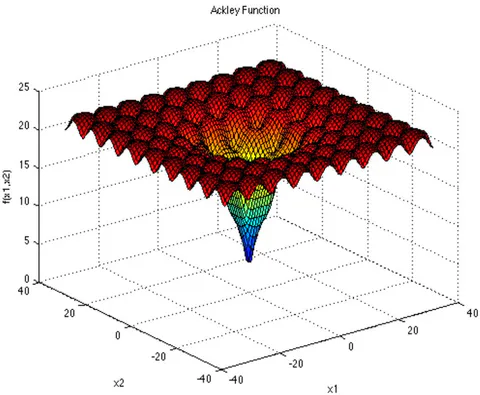
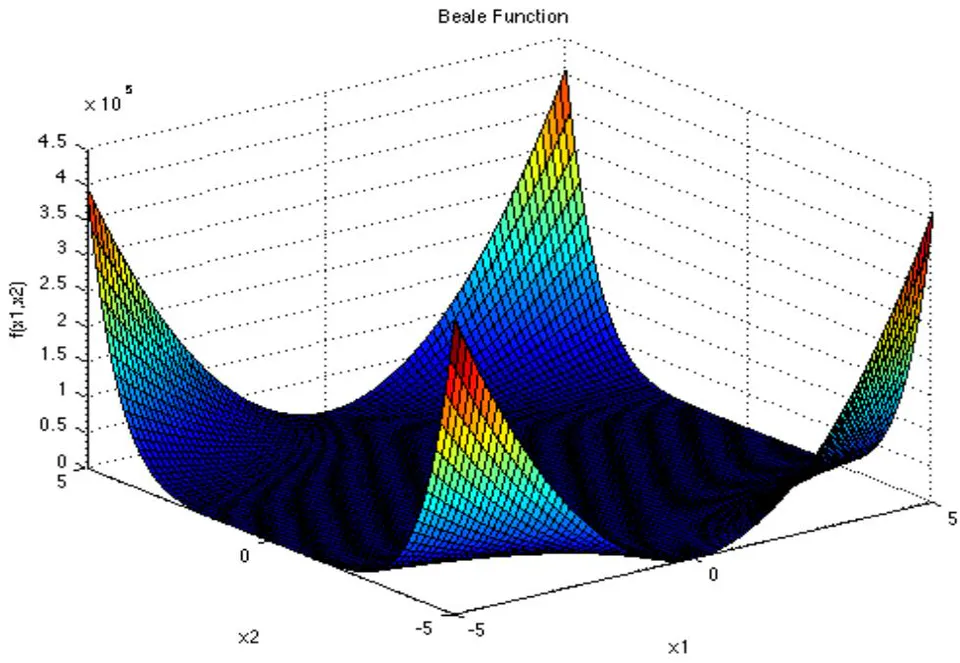
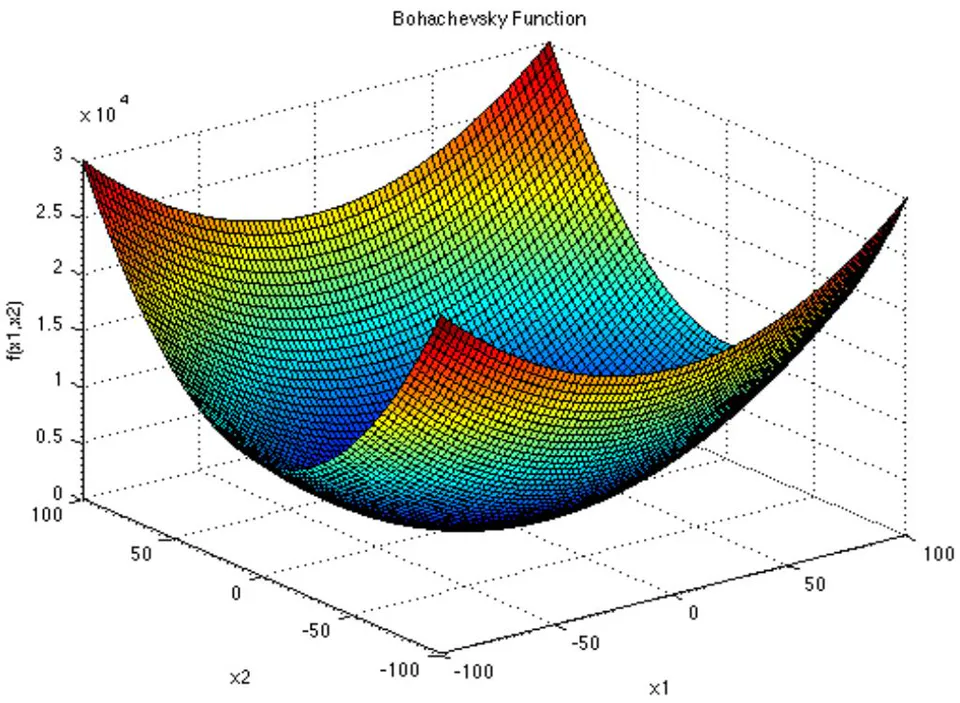
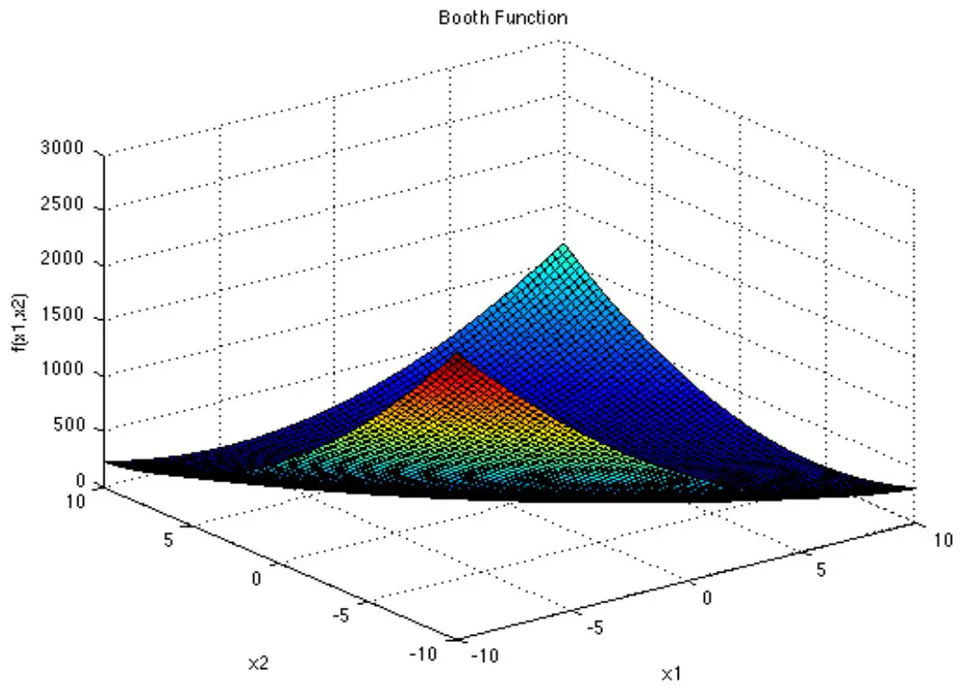
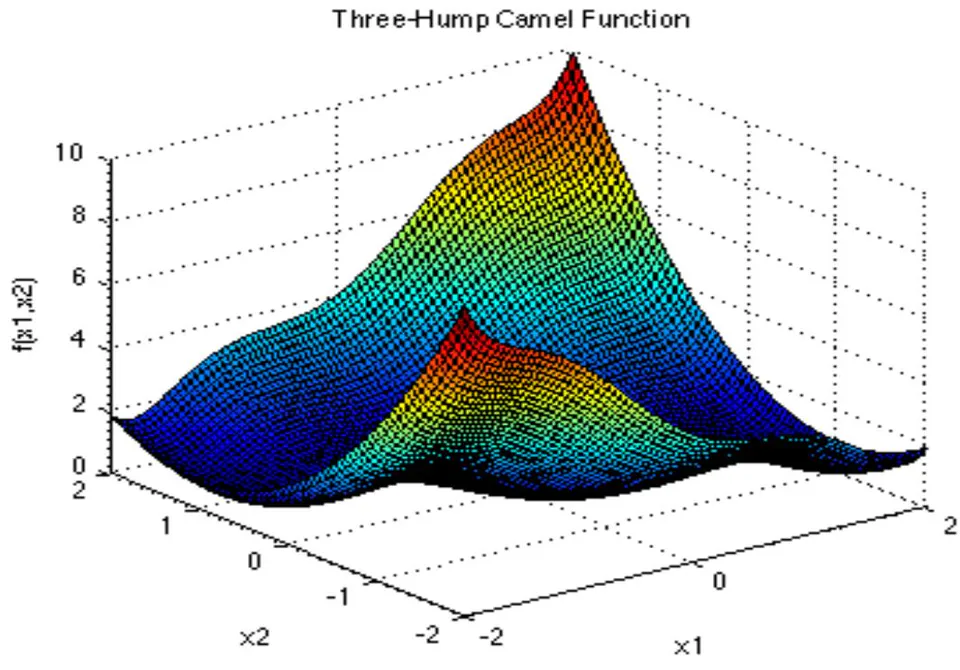
Table 1 shows the results obtained. Green represents performed well. Red represents not performed well. Blue represents performed between well and not well. From Table 1, we can see that all cells are green in color which means the PSO algorithm and developed ASGDTA performed well on all benchmark functions.
| Benchmark Function/Algorithm | Artificial Satish Gajawada and Durga Toshniwal Algorithm (ASGDTA) | PSO Algorithm |
| Ackley Function | ||
| Beale Function | ||
| Bohachevsky Function | ||
| Booth Function | ||
| Three-Hump Camel Function |
VII. CONCLUSIONS
A new field titled "Artificial Excellence (AE)" is invented and defined in this work. Researchers in Artificial Intelligence field can follow the path shown in this paper and create algorithms like "Artificial Narendra Modi Algorithm", "Artificial Abdul Kalam Algorithm", "Artificial Mahatma Gandhi Algorithm", "Artificial Mother Teresa Algorithm" and "Artificial Raju Algorithm" by imitating particular humans like Narendra Modi, Abdul Kalam, Mahatma Gandhi, Mother Teresa and Raju respectively. If there are 100 crores population then we can imitate all these population and create more than 100 crores algorithms. If there are 20 people in a project solving real world problems. Then we can create a AE field algorithm imitating these particular 20 people. If we have particular Humans Raju and Rani in real world and AE field algorithm size is 20 then there will be multiple particular Artificial Humans in search space like 10 Artificial Rajus and 10 Artificial Ranis. Hence from this article it is clear that there are INFINITE articles and INFINITE opportunities possible in the new AE field invented in this work.
ACKNOWLEDGMENTS
Thanks to everyone (and everything) who directly or indirectly helped me to reach the stage where I am now today. Thanks to EXCELLENT Editorial Team and Reviewers for accepting my new invention titled "Artificial Excellence field".