
I. INTRODUCTION
Over the years, more and more emphasis is being given to environmental issues which have evolved from pollution and the depletion of natural resources towards global issues such as climate change. The most crucial milestones have so far been the identifications of chlorinated pesticides as major pollutants in "Silent spring" (Carson, 1962), the notion that non-renewable natural resources can become depleted (Meadows, 1962), the introduction of the sustainability concept in the 'Bruntland report' (World Commission on Environment and Development, 1987) and the Marrakech Climate Change Conference (UN, 2016), among other initiatives by world leaders. The last conference was identified as the next crucial step for governments looming at ope the Worldwide population has grown to more than 7 billion today, from about 5 billion people in 1990's and it is estimated that the population will hike more than 9 billion by 2050 (OECD, 2016). Global CO2 emissions accounts about 3.6 billion tonnes in 2014 which contributes to global warming (PBL, 2015) thus causing environmental degradation such as climate change, ocean acidification, loss of biodiversity, scarcity of fresh water, ozone depletion amongst others. If the current trend of human activities continues, the planet would not be able to support the continuously growing world population. In addition, human population and economic growth have amplified demand on natural resources, which is becoming scarce. It is obvious that business as usual is not adequate as the world is presently consuming the equivalent of 1.5 planets to back human activities (WWF, 2014). Therefore, at this unsustainable rate, it would require the equivalent of two planets by 2050 (Randers, 2012).
The international agreements impose strict environmental regulations on the human activities in order to push industries to find ways to mitigate greenhouse gas emissions, utilise raw materials efficiently and move towards renewable energies. The rapid development in telecommunication technologies invigorated global sensitisation about the upcoming global crisis, thus, encouraging the mass for demanding green product and services. Therefore, there needs to be a radical change in the ways most industries operate in order to meet demand, abide by regulations and even have a competitive edge amongst competitors. Therefore, eco-efficiency, that is, the practice of lean, cleaner production and eco-design is becoming a major trend in industries. Under these circumstances, it is highly important to develop new business concepts whereby value creation from waste through recycling or reuse forms part of the new wave. The new practices will consume less raw materials, be less dependent on fossils, use more renewable energies, be more eco friendly, also economically and socially equitable. The emergence of the increasing middle class population in the coming years will prove to be detrimental to the current production and consumption pattern, thus, emphasis must be laid on sustainable practices by industries to cope with the upcoming challenges. Svensson (2007) posits that the expectations on adopting and improving sustainability practice were constantly increasing and that both public and private institutions would impose such practices on different business sectors.
One of the sectors where significant questions were raised about sustainability practices was the agricultural food industry. There is no doubt that ten years after this acclamation, stakeholders of the industry have worked towards this endeavour, by incorporating social and environmental measures in addition to economic ones. But how far has this initiative been successful, even more so for a country like Mauritius, where the food industry is one of the economic pillars. This research aims to bring answers by assessing the sustainability performance of food processing industries in Mauritius and propose sustainable practices for food processing industries. In addition, the interactions and relationships between the important parameters of the sustainability dimensions, through system dynamics modelling are also probed.
II. LITERATURE REVIEW
a) What Is Sustainability?
Sustainability has become an important issue in all spheres of life. This will be the case for many years to come, or at least until an as yet unknown solution is developed. Sustainability is and will be very crucial for the present generations. How do we define Sustainability? Sustainability remains an elusive concept. It means different things to different people and is difficult to define. Elkington (1998) developed the concept of Triple Bottom Line, which simultaneously considers and balances economic, environmental and social issues from a micro economic point of view. The triple bottom line suggests that firms not only need to engage in socially and environmentally responsible behavior, but also that positive gains can be made in the process (Gimenez et al., 2012).
Sustainability is a widely accepted idea with little guidance about its practical implementation. Semantically, sustainability is a quality that allows preserving, keeping, or maintaining something. In fact, when something is sustainable, it is able to endure or to be kept. It is a common mistake made by many people who believe that the term sustainability is more oriented towards the environment. Sustainability focuses on safeguarding natural resources against exploitation, in the name of productivity and competitiveness in the industrial world. It is a major concern in many countries and is leading to strict regulations regarding the impact of products during their manufacture, use and end of life (Gunasekaran & Spalanzani, 2012).
This is indicative of the attitude of businessmen towards sustainability at that time. For most of the business executives, even though they know how sustainability issues can affect business risk, reputation, sales and efficiency, they still believe money is their number one priority. In other words, as long as their customers are happy, they see no meaningful way how sustainability can help achieve and exceeds those ends. Since the 1980's, Sustainable Development - concerned with economic, social and environmental development was considered to be very important and also contemplated as the goal of a desired new industrial revolution, involving advanced as well as new emerging countries (Jovane et al.,2008). Although some people mind-set towards Sustainable Development and the triple bottom line might have changed, there is still probably a big portion of the world's population that today are not bothered about this concept. Clearly many people still have a long way to go in grasping the value of this illusive concept to their organisations and their day to day lives. Hence there is a need to come up with a proper definition of the term Sustainable Development so that the frame of mind of those not yet convinced and still thinking that the term is just a fad, can be shuffled.
Over the years, researchers in the field of sustainability and sustainable development have come up with various connotations to the term as shown in Table 1 below. However each of the definitions of sustainability referred in the table are debatable and can be seen to have often been contextualized, based on the situation where it was used.
| Author(s) | Sustainability Definitions and Sustainable Development |
| Bruntland G.H (1987) | The development that meets the needs of the present, without compromising the ability of the future generations to meet their own needs. |
| U.S. National Research Council (1999) | "The level of human consumption and activity, which can continue into the foreseeable future, so that the system that provides goods and services to the humans persists indefinitely." |
| Diesendorf (2000) | The goal of sustainable development and this is described as "types of economic and social development that protect and enhance the natural environment and social equity" |
| Hanley et al.(2001) | A requirement to our generation to manage the resourcebase such that the average quality of life we ensure ourselves can potentially be shared by all future generations. |
| McMicheal, et al., 2003 | "Transforming ways of living to maximize the chances that environmental and social conditions will indefinitely support human security, well-being and health." |
| Ehrenfeld (2005) | Possibility that all forms of life will flourish forever. |
| Faber et al.(2005) | "Semantically, sustainability indicates a relationship between an (sustainable) artifact and its environment that exists indefinitely. In other words, sustainability refers to equilibrium between an artifact and its supporting environment, where they interact with each other without mutual detrimental effects. Sustainability explicitly refers to this equilibrium (p. 5)". |
| Labuschagne and Brent, 2005; MSA, 2008). | Sustainability aims to satisfy economic, environmental, and social goals. |
| Seliger et al.(2008) | Sustainability is directed at enhancing human living standards while improving the availability of natural resources and ecosystems for future generations. |
| Johnston (2007) | "It seems clear that sustainability can mean a number of things to a variety of constituencies and, while there may be no objection to the sentiments expressed in the respective definitions, they are far from holistic." |
| Duque Ciceri, et al.(2009) | A quality that permits to preserve, to keep, to maintain something: when something is sustainable, it is able to be kept. |
| Feng et al.(2010) | "Sustainability in development as "an organization's ability to advance its economic state without compromising he environment and the social equity that provide the quality of life for all community residents, present or future." |
| Do (2010) | "The development concept and approach that realize social justice, maintain natural environment, and pursue economic prosperity" with 3P People, Planet, and Profit and 3E (Equity, Environment/Earth, and Economy). |
| Ahmed, Deif M.(2011) | "A concept and a paradigm that has its different implementation and interpretation at different fields." |
Complex systems can be better understood with the use of Systems thinking, as acknowledged by Arnold & Wade (2015) who also believed that SD can be of great help in looking at the intricacy that the earth will be in front of in the near future. This methodology helps to provide a holistic view (Maani and Maharaj, 2004). Understanding that the elements of a system do not act in isolation, and that overall outcome would be the result of the various interactions among a system's elements, allows us to have a broader perspective of the problem and potentially find solutions that would benefit the system as a whole. Many researchers have come up with different definitions over the years, following the one coined by Barry Richmond, who is believed to be the originator of systems thinking, in 1987, and is defined as follows:
"As interdependency increases, we must learn to learn in a new way. It's not good enough simply to get smarter and smarter about our particular "piece of the rock." We must have a common language and framework for sharing our specialized knowledge, expertise and experience with "local experts" from other parts of the web. We need a systems Esperanto. Only then will we be equipped to act responsibly. In short, interdependency demands Systems Thinking. Without it, the evolutionary trajectory that we've been following since we emerged from the primordial soup will become increasingly less viable."
Since then, scholars have come up with different definitions of systems thinking - from Checkland (1981) to Arnold and Wade (2015).
III. METHODOLOGY
This research was conducted over two phases. First, through a thorough literature review of academic journal articles on sustainability related to system dynamics. Moreover, best practices of sustainability were also obtained from 14 food processing companies surveyed through a devised sustainability performance questionnaire. The Dow Jones Sustainability Index (DJSI) criteria were mainly used to develop the questionnaire.
For data to be collected effectively and efficiently, the design of the questionnaire was a very important task. Since, survey needed to be carried out in food processing companies and the top management representatives were highly busy, thus, having limited time for survey response. Therefore, the questions in the questionnaire were made short, concise and precise.
The second method was the use of causal loop diagrams to map out the interactions of the sustainability practices in real life situations. Therefore, the sustainability practices effects on the system as a whole can be seen and appropriate measures can be taken to cater for the outliers effects. The effects could be of balancing or reinforcing loops, thus, tailored measures can be implemented with proper KPIs to monitor improvements.
Based on publications related to systems thinking and sustainability, a soft systems methodology, in particular, system dynamics appear to offer a possible way forward for achieving the aims of this research work. The different dimensions of sustainability in the food industry was modelled using the 'VENSIM' software.
IV. RESULTS AND DISCUSSIONS
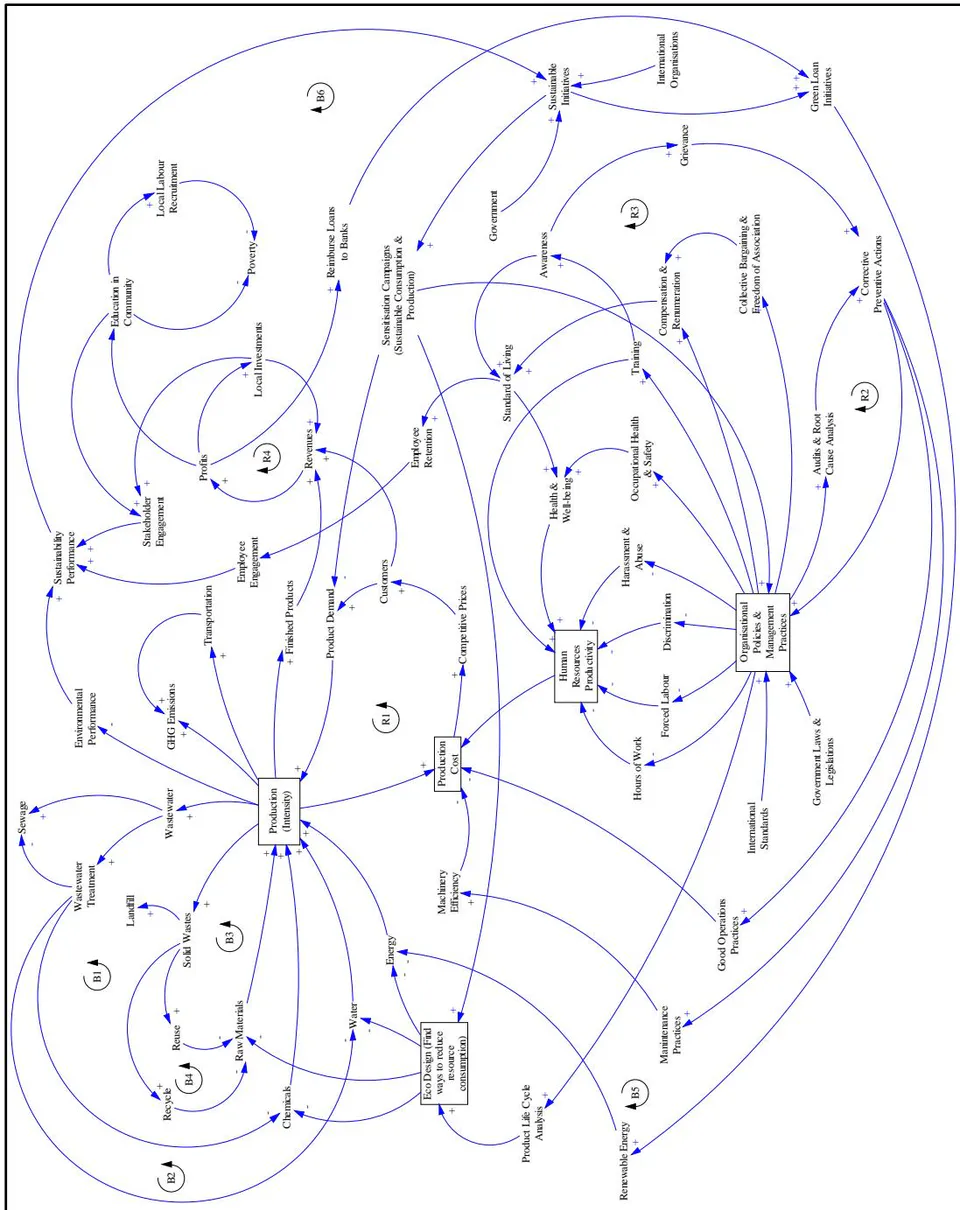
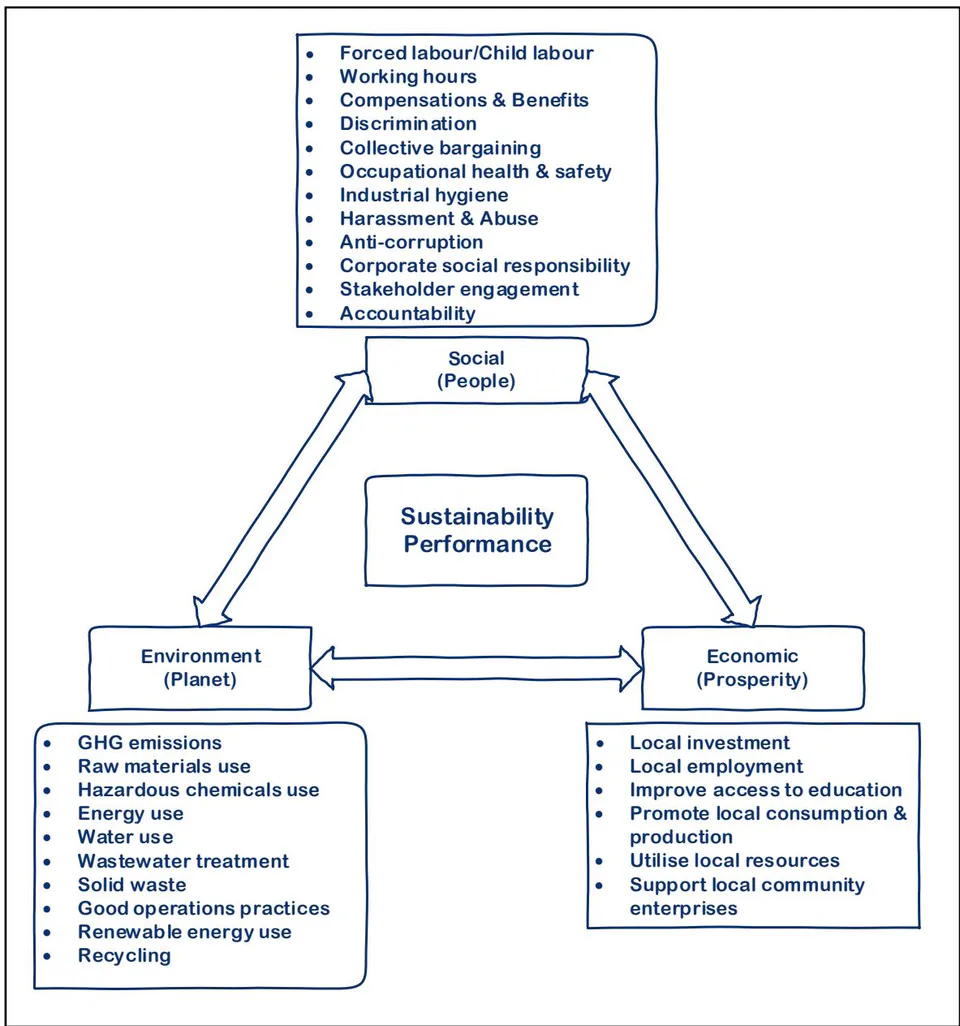
The interactions among the three sustainable dimensions as shown in figure 1 enable to relate the cause and effect that the sustainable practices pertain before and after implementation. The environmental, social and economic dimensions are not three separate entities while implementing sustainable practices, in fact, social factors could also affect environmental performance. For example, social issues such as long working hours or unsafe workplace would affect labour productivity. The workers will defect from good operations practices, which in turn would increase resource consumption. Following that the causal loop for each dimensions: Environmental, Social and Economic were worked out.
a) Environmental Dimension
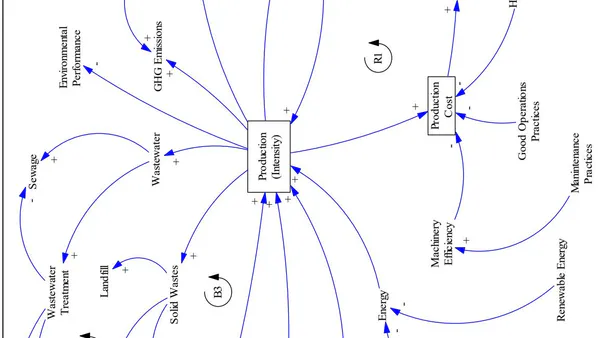
The causal loop diagram (CLD) for the sustainable environmental practices are shown in figure 2 on the following page. The model demonstrated the challenges faced by organisations in order to achieve a sustainable environmental performance.
The production of food products is intensified due to increase in product demand, which consequently, increase the inputs of raw materials, chemicals, water and energy denoted by plus (+) sign. Moreover, there is increase of outputs such as solid waste, wastewater, GHG emissions, finished products and transportation denoted by plus (+) sign.
However, more solid waste would increase dumping to landfill as well as wastewater to sewage. Wastewater treatment could reduce the amount of wastewater discharged as sewage. Thus, reduction in utility bills of organisations.
However, production intensity would causes production cost to increase and consequently, decreasing the environmental performance. Transportation also causes increase in GHG emissions. Production cost can be reduced by increasing machine efficiency, through good operations practices and human resources productivity.
Moreover, the practice of eco-design during product development enable to reduce consumption of raw materials, chemicals, water and energy. Sensitisation campaigns on sustainable consumption and production could increase development of green products. The use of renewable energy can also reduce dependence on fossils energy.
Additionally, maintenance practices increase the machinery efficiency in order to decrease the production cost. Revenues and profits of organisations are increased because of more customers and finished products. The decrease of production cost would increase the competitiveness of prices.
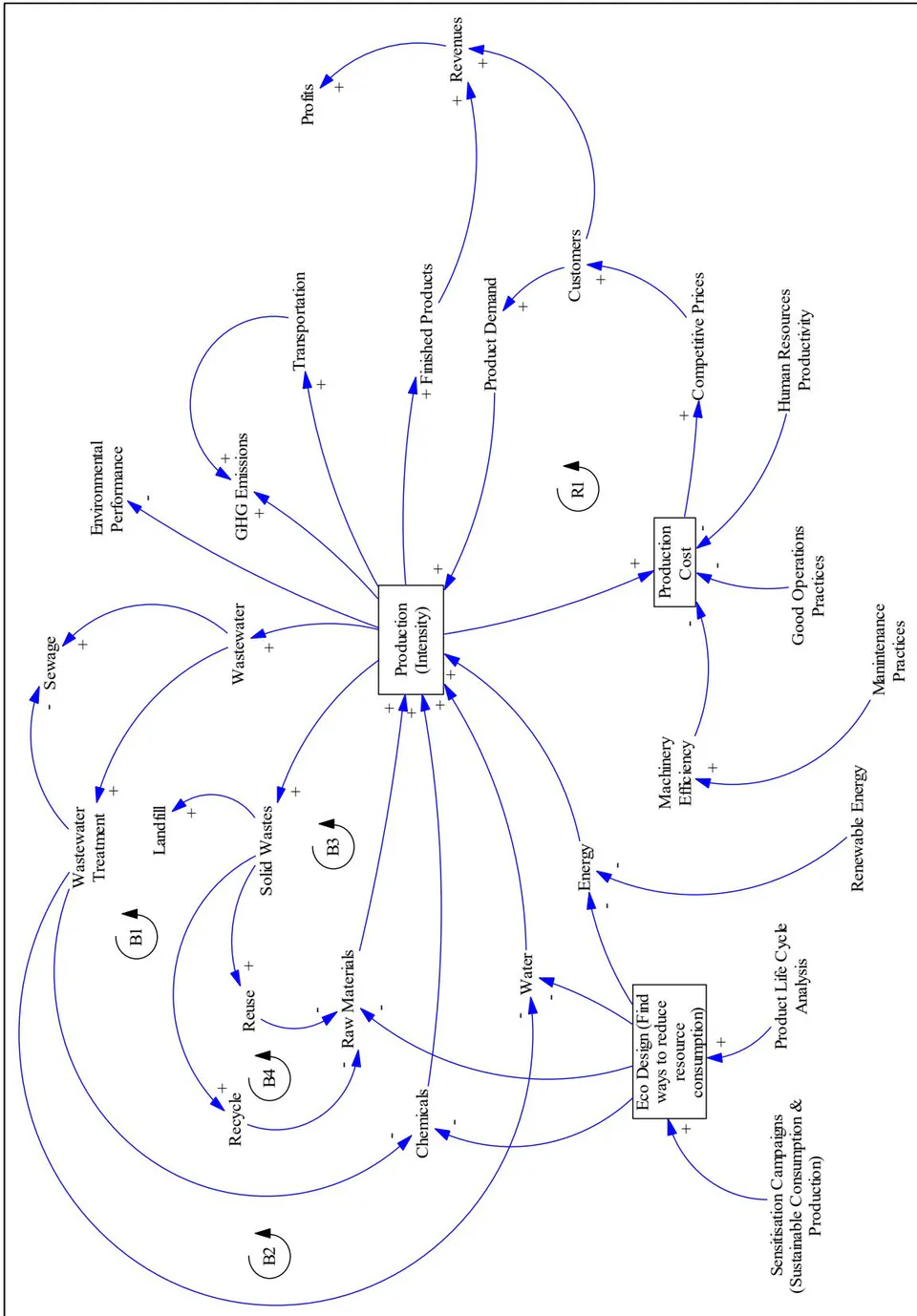
Furthermore, the environmental CLD consist of five loops, of which four demonstrating balancing (B) behaviour and one reinforcing (R) behaviour detailed in table 2 below.
| Loops | Description of loops |
| B1 | production intensity (+) → wastewater (+) → wastewater treatment (+) → chemicals (-) → production intensity |
| B2 | production intensity (+) → wastewater (+) → wastewater treatment (+) → water (-) → production intensity |
| B3 | production intensity (+) → solid waste (+) → reuse (+) → raw material (-) → production intensity |
| B4 | production intensity (+) → solid waste (+) → recycle (+) → raw material (-) → production intensity |
| R1 | production intensity (+) → production cost (+) → competitive prices (+) → customers (+) → product demand (+) → production intensity |
The balancing loops B1 and B2 demonstrate that proper wastewater treatment can recover chemicals and water which can be reused as input, thus reducing water and chemical cost. Additionally, balancing loops B3 and B4 demonstrate that reuse and recycling practices of solid waste can reduce intake raw materials and decrease cost of production.
Likewise, reinforcing loop R1 demonstrate that competitive prices depends on production cost. Competitive prices increase customers which in turn increase product demand, thus, growing the product intensity.
However, reinforcing loop R1 has a rebound effect where competitive price would increase product demand, which would intensify production whereby more resources will be needed during production. Thus, affecting environmental performance and defeats the purpose of good operations practices, human resources productivity and machinery efficiency to decrease cost of production.
b) Social Dimension
The causal loop diagram (CLD) for the sustainable social practices are shown in figure 3 on the following page. The model demonstrated the challenges faced by organisations in order to achieve a sustainable social and governance performance.
Organisational policies and practices are improved by enforcement of government laws and international standards. Long working hours, forced labour, discrimination, harassment and abuse in workplace is reduced which have negative effect on human resources productivity. Moreover, occupational health and safety cause increase health and well-being, which affects productivity positively.
Likewise, collective bargaining increase compensation, which cause improvement in standard of living, which also have a positive effect on well-being thus, improving productivity. Training increases both awareness which improves standard of living and productivity.
Health and well-being cause rise employee retention, which improve employee engagement. Sustainability performance is improved by both stakeholder engagement and employee engagement. However, the social CLD consists of two loops of reinforcing behaviour as shown in table 3 below.
| Loops | Description of loops |
| R2 | organisational policies (+) → training (+) → awareness (+) → grievance (+) → corrective preventive actions (+) → organisational policies |
| R3 | organisational policies (+) → audits & root cause analysis (+) → corrective preventive actions (+) → organisational policies |
Reinforcing loop R2 demonstrate that through policies, training can be delivered to employees which would increase their awareness. Thus, employees would participate in grievance where corrective or preventive actions will be taken upon investigation, also would update and improve the organisational policies and practices.
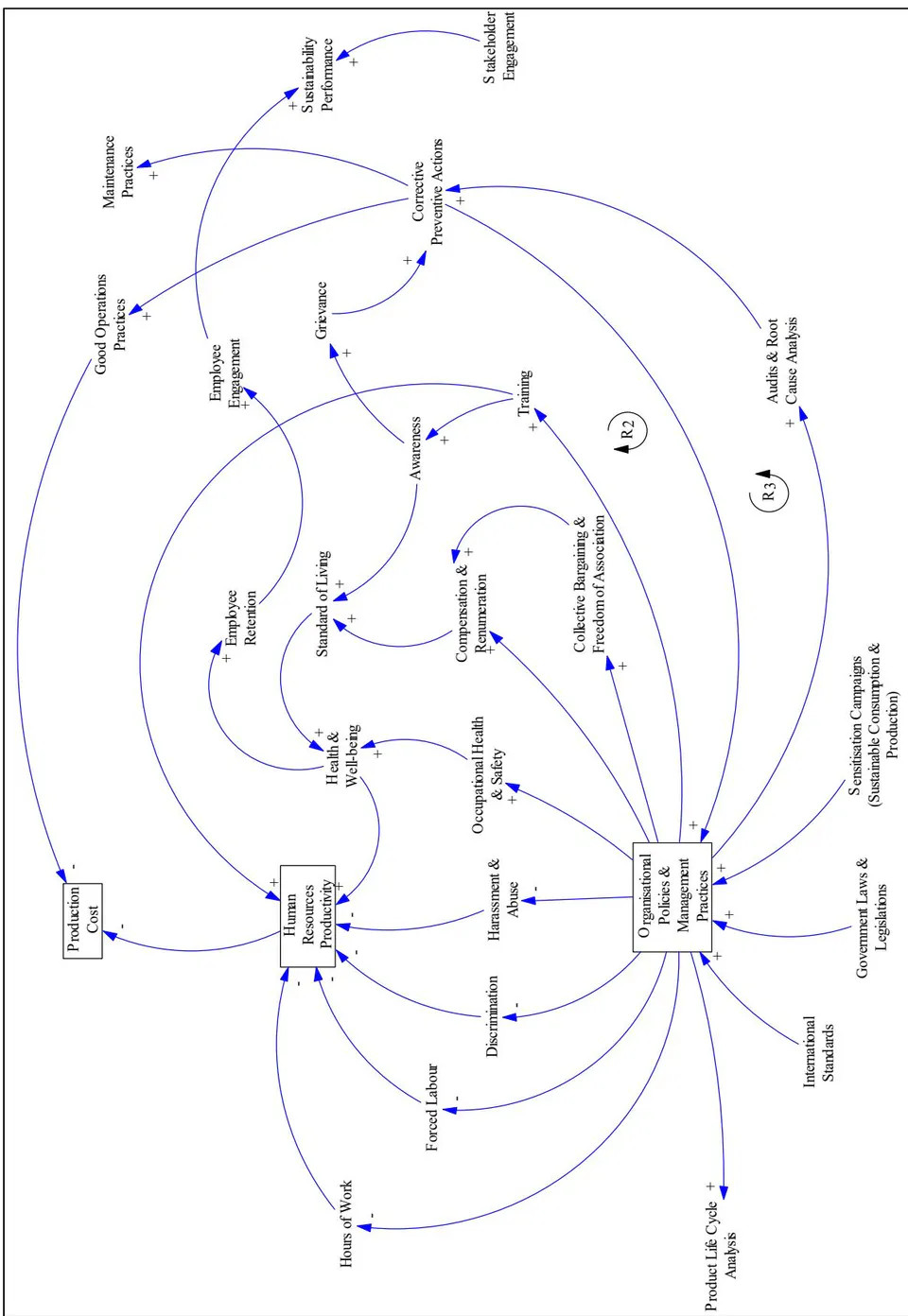
Besides, reinforcing loop R3 demonstrate almost same interaction as loop R1, instead audits and root cause analysis (RCA) would be frequent, thus, continuous improvement of management practices.
c) Economic Dimension
The causal loop diagram (CLD) for the sustainable social practices are shown in figure 4 on the following page. The model demonstrated the challenges faced by organisations in order to achieve a sustainable economic performance.
The increase in revenue would cause increase in profits which could be invested in education or sponsorship children of poor families for education and training. Thus, it would help to reduce poverty at the root cause. Also, this would increase local labour employment over the long run.
Moreover, government initiatives and international initiatives have increased the sustainability opportunities for organisations. Sustainable performance is increased by employee engagement, stakeholder engagement and environmental performance.
Furthermore, the economic CLD consist of three loops, of which two demonstrating balancing (B) behaviour and one reinforcing (R) behaviour detailed in table 4 below.
| Loops | Description of loops |
| B5 | production intensity (+) → production cost (+) → competitive price (+) → customers (+) → revenues (+) → profits (+) → reimburse loans (+) → greenloan initiatives (+) → renewable energy (-) → energy (+) → production intensity |
| B6 | Sustainable initiative (+) → sensitisation campaigns (-) → product demand(+) → production intensity (-) → environmental performance (+) → sustainable performance (+) → sustainable initiatives |
| R4 | revenues (+) → profits (+) → local investment (+) → revenues |
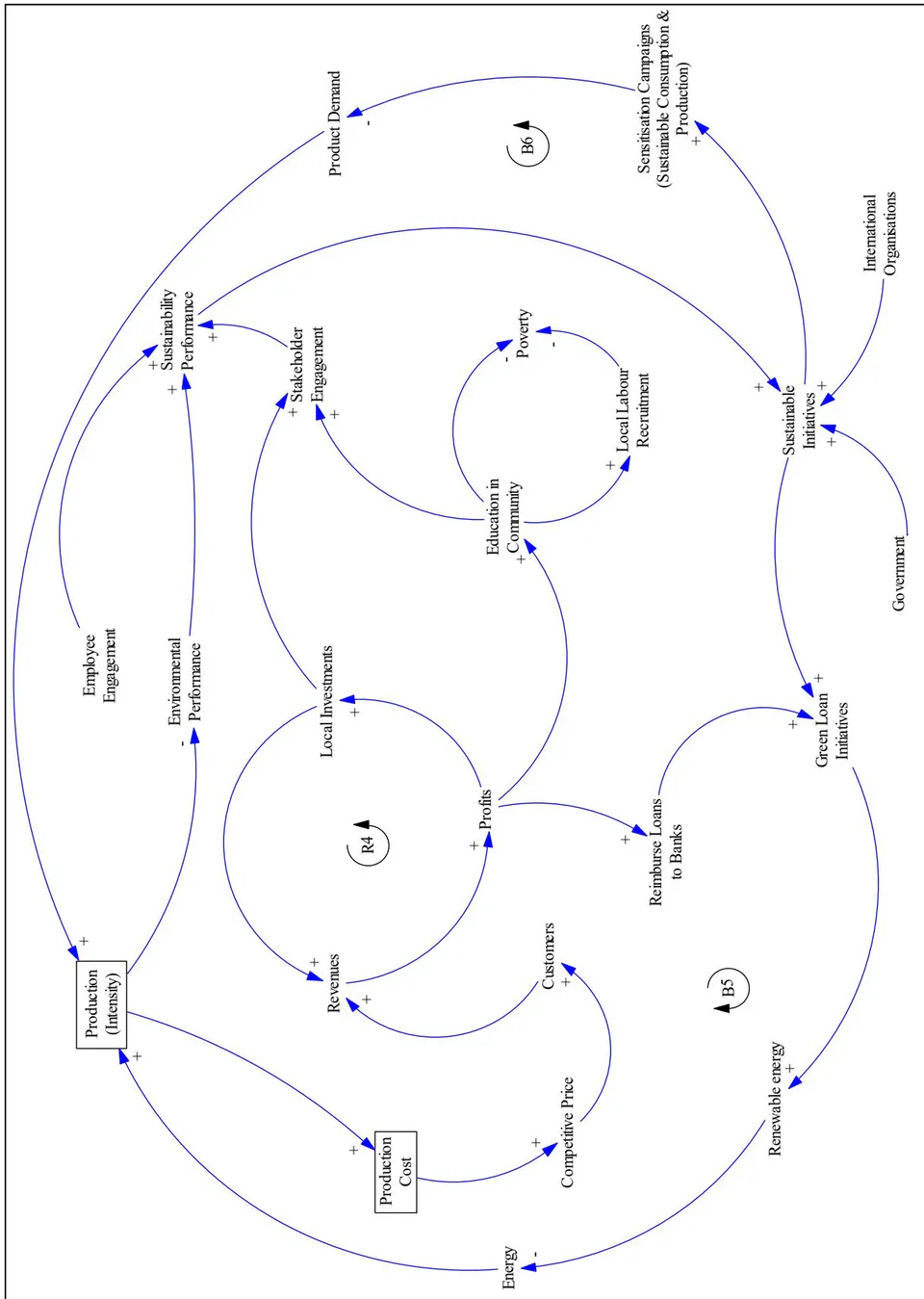
Reinforcing loop R4 demonstrate that by investing the profits locally either by vertical or horizontal integration strategies could cause increase in revenues over the long run. Thus, investing locally can also encourage other business or employment opportunities which would support the Mauritian market and economy.
Besides, balancing loop B5 demonstrate that the profits obtained from the revenues can be used to reimburse loans to banks, which took part on the sustainability initiatives to provide green loan at low interest rates. The reimbursement of the loans would enable the banks to again fund loans and would enable more companies to seize the initiative to invest in renewable energy to decrease dependence on fossil energy and decrease production cost over the long run.
Additionally, balancing loop B6 demonstrate that sensitisations campaigns on sustainable consumption and production from the sustainable initiatives would decrease the product dem and which would also cause decrease in production intensity. Thus, enabling less resource use and consequently solve the rebound effect of reinforcing loop R1 in figure 6.2 of environmental CLD.
V. RECOMMENDATIONS AND CONCLUSIONS
The sustainable environmental targets and practices that need to be implemented are detailed in table 5.
| Target | Practices | Assessments |
| Improve management practices | ■ Implement environmental, quality orfood safety management systems | ■ ISO 14001 ■ ISO 9001 ■ HACCP |
| Reduce GHG emissions and improve air quality | ■ Equip facilities with pollution prevention devices ■ Monitor emissions | ■ Perform regular airtest emissions |
| Reduce energy consumption | ■ Optimise lighting systems with energy efficient technologies ■ Install energy efficient cooling andheating systems ■ Maintenance practices to optimise machine efficiency and detect steamor compressed air leakages ■ Install heat recovery and condensaterecycling for boilers ■ Invest in VSD for compressor control | ■ Perform energyaudit ■ Document every maintenance practices for redundancy check ■ ISO 50001 |
| Reduce water consumption | ■ Implement water conservation technologies ■ Maintenance practices to detect waterleakages | ■ Perform water audit |
| Reduce material consumption | ■ Implement proper inventory management system | ■ Perform resource audit |
| ■ Substitute to recycled materials ■ Implement lean production to reduwastes | ||
| Hazardous chemical use | ■ Maintain proper inventory of allchemicals ■ Maintain up-to-date MSDS ■ Proper disposal of hazardous waste | ■ Comply to OSHA ■ Perform chemical hazard assessment |
| Reduce solid waste | □ Improves processes through lean □ Reuse possibilities □ Recycling program (outsouror orinternal) | ■ Perform waste audit |
| Reduce effluent | ■ Wastewater treatment to recover water and chemicals ■ Wastewater treatment prior to off-site discharge | ■ Perform wastewater audit |
| Increase employee awareness on environmental concern | ■ Training in good operations practices, use of hazardous chemicals, water and energy use, air emissions, water and effluent management ■ Environmental policies and practices should be communicated in appropriate languages | ■ Training needs analysis |
| Eco-product design | ■ Carry out design for sustainability in product development | ■ Product life cycle analysis |
| Packaging | ■ Aim to reduce or reuse packaging ■ Collect packaging for recycling | ■ Perform audit |
| Environmental compliance | ■ Complaints received should be investigated and resolved ■ Participate in Government or other sustainable initiatives ■ Review environment performanceannually ■ Select a team of skilled employees to address environmental concerns and to develop tailor made solutions | ■ Comply to EPA ■ Perform Audits and Root cause analysis |
| Sustainable supply chain to reduce carbon footprint | ■ Documented policies to deal with sustainability compliant suppliers orsub-contractors ■ Proper management of transportation in logistics | ■ Perform life cycle assessment |
The sustainable social targets and practices that need to be implemented are detailed in table 6 below.
| Target | Practices | Assessments |
| Improve workplace conditions | All labour, health & safety policies and practices should be communicated to all employeesAll toilets should have running water, ventilated, clean and lighted | Comply to ERAPerform audits |
| Improve health & safety at work | Machinery should be equipped with appropriate safety devicesProper PPE should be provided to employeesNoise level should be regularly checkedEmergency drills should be conducted atleast twice a yearEmergency exits should always remain unobstructed and unlockedEvery production site should have unlocked | Comply toOSHAOHSAS 18001 |
| Prevent child or forced labour | ·Have anti-child labour policy ·Workers should be free to resign at anytime without penalty giving a notice ·Young workers employed should work under proper supervision and guidance | ·Comply to ERA and OSHA ·Comply to ILO |
| Prevent discrimination | ·Have procedures in place for hiring do not discriminate age, gender, disability or religion ·Have procedures in place for equal pay for doing equal amount of work ·Employees are permitted to perform religious obligations ·Female applicants should not be asked about pregnancy status in interview | ·Comply to ERA ·Comply to ILO |
| Improve collective bargaining | ·Workers should be free to join or formtrade unions ·Representatives of trade unions should be voted democratically | ·Comply to ERA ·Comply to ILO |
| Prevent harassment and abuse | ·Have procedures in place for workplace to be free from physical and verbal abuse or harassment ·Have procedures in place for workplace to be free from sexual harassment ·Have proper procedures for to deal with complaints related to harassment and abuse | ·Comply to ERA ·Comply to ILO |
| Improve compensation | ·Procedures in place to ensure all employees are paid legal minimum wage and legal overtime rate | ·Comply to ERA ·Comply to ILO |
| ·Procedures in place to ensure no illegal deductions ·Procedures in place to ensure leave are provided which they are entitled | ||
| Reduce long working hours | ·Procedures in place to ensure legal working and overtime hours ·Procedures in place to give at least one dayoff in seven ·Procedures in place all overtime performed are voluntary | ·Comply to ERA ·Comply to ILO |
| Increase accountability | ·Procedure in place to conduct audits for labour and health & safety ·Corrective actions identified should be implemented ·Procedures to evaluate and update organisational policies and practices ·Procedures in place to disclose corruption ·Sustainability reporting | ·SA 8000 ·Root cause analysis ·Perform audits |
| Grievance | ·Procedures to bring work related violations in an anonymous manner | ·KPIs |
| Increase stakeholder engagement | ·Engage NGO's, community and employees in its sustainability strategies | ·KPIs |
Finally, the sustainable economic targets and practices that need to be implemented are detailed in table 7.
| Target | Practices | Assessments |
| Invest in localmarkets | ■ Utilise local materials ■ Support development of existing or new local enterprises ■ Encourage local production andconsumption | ■ Financial Indicators |
| Improves Mauritian economy | ■ Provide permanent employment opportunities to Mauritians ■ Provide local employment and training | ■ Economic Indicators |
| Combat poverty | ■ Participate in government Marshall plan toinvest in targeted community areas ■ Improve access to education and training | ■ Indicators |
VI. CONCLUSION
Sustainability can be defined as the development that meets the needs of the present without compromising the ability of future generations to meet their own needs and is prevalent in all areas of business today. The triple bottom line of sustainability need to be implemented in companies if they want to survive in today's market. We have reached a point where companies need to adapt their strategies (operations, processes etc) to the meet the sustainable development goals, else they will not be able to survive.
Proper environmental practices would endow the reduction of water use, energy use, resource use, chemical use, wastewater and solid waste generation which will lead to having better environmental performance. Social practices would enable to inculcate sustainable culture at workplace, improve working conditions, increase safety at work, discontinue harassment, anti discrimination, prevent long working hours, improve compensations and encourage collective bargaining, thus, having better social performance. Decent economic practices such as local investments, support local economy, improve access to education and training would enable to having better social performance. Governance practices such as sustainability reporting and stakeholder engagement would enable to have better sustainability performance. As it is, the business models currently being used by the food industry needs to be rethought and redesigned, taking into consideration the key sustainability elements, as discussed in this paper. The proposed practices in this research work should be used a support to industry practitioners within the food industry to integrate sustainability practices in their day to day operations.