Assessment of Scientific Payload Carrying Spirulina Onboard Blue Origin’s New Shepard Vehicle

1
Pedro J. Llanos
Pedro J. Llanos
2
Morgan Shilling
Morgan Shilling
3
Kristina Andrijauskaite
4
Kody Kidder
Kody Kidder
5
Vijay V. Duraisamy
Vijay V. Duraisamy
6
Dr. Pedro Llanos
Dr. Pedro Llanos

Send Message

To: Author

GJRE Volume 22 Issue B1

Article Fingerprint

ReserarchID

GX26W

Assessment of Scientific Payload Carrying Spirulina Onboard Blue Origin’s New Shepard Vehicle Banner
  • English
  • Afrikaans
  • Albanian
  • Amharic
  • Arabic
  • Armenian
  • Azerbaijani
  • Basque
  • Belarusian
  • Bengali
  • Bosnian
  • Bulgarian
  • Catalan
  • Cebuano
  • Chichewa
  • Chinese (Simplified)
  • Chinese (Traditional)
  • Corsican
  • Croatian
  • Czech
  • Danish
  • Dutch
  • Esperanto
  • Estonian
  • Filipino
  • Finnish
  • French
  • Frisian
  • Galician
  • Georgian
  • German
  • Greek
  • Gujarati
  • Haitian Creole
  • Hausa
  • Hawaiian
  • Hebrew
  • Hindi
  • Hmong
  • Hungarian
  • Icelandic
  • Igbo
  • Indonesian
  • Irish
  • Italian
  • Japanese
  • Javanese
  • Kannada
  • Kazakh
  • Khmer
  • Korean
  • Kurdish (Kurmanji)
  • Kyrgyz
  • Lao
  • Latin
  • Latvian
  • Lithuanian
  • Luxembourgish
  • Macedonian
  • Malagasy
  • Malay
  • Malayalam
  • Maltese
  • Maori
  • Marathi
  • Mongolian
  • Myanmar (Burmese)
  • Nepali
  • Norwegian
  • Pashto
  • Persian
  • Polish
  • Portuguese
  • Punjabi
  • Romanian
  • Russian
  • Samoan
  • Scots Gaelic
  • Serbian
  • Sesotho
  • Shona
  • Sindhi
  • Sinhala
  • Slovak
  • Slovenian
  • Somali
  • Spanish
  • Sundanese
  • Swahili
  • Swedish
  • Tajik
  • Tamil
  • Telugu
  • Thai
  • Turkish
  • Ukrainian
  • Urdu
  • Uzbek
  • Vietnamese
  • Welsh
  • Xhosa
  • Yiddish
  • Yoruba
  • Zulu

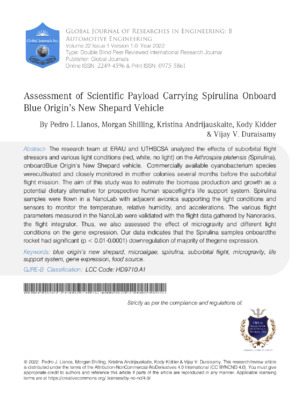
The research team at ERAU and UTHSCSA analyzed the effects of suborbital flight stressors and various light conditions (red, white, no light) on the Arthrospira platensis (Spirulina), onboardBlue Origin’s New Shepard vehicle. Commercially available cyanobacterium species werecultivated and closely monitored in mother colonies several months before the suborbital flight mission. The aim of this study was to estimate the biomass production and growth as a potential dietary alternative for prospective human spaceflight’s life support system. Spirulina samples were flown in a NanoLab with adjacent avionics supporting the light conditions and sensors to monitor the temperature, relative humidity, and accelerations. The various flight parameters measured in the NanoLab were validated with the flight data gathered by Nanoracks, the flight integrator. Thus, we also assessed the effect of microgravity and different light conditions on the gene expression. Our data indicates that the Spirulina samples onboardthe rocket had significant (p < 0.01-0.0001) downregulation of majority of thegene expression.

Funding

No external funding was declared for this work.

Conflict of Interest

The authors declare no conflict of interest.

Ethical Approval

No ethics committee approval was required for this article type.

Data Availability

Not applicable for this article.

Pedro J. Llanos. 2026. \u201cAssessment of Scientific Payload Carrying Spirulina Onboard Blue Origin’s New Shepard Vehicle\u201d. Global Journal of Research in Engineering - B: Automotive Engineering GJRE-B Volume 22 (GJRE Volume 22 Issue B1): .

Download Citation

Onboard Spinal Cord Study.
Journal Specifications

Crossref Journal DOI 10.17406/gjre

Print ISSN 0975-5861

e-ISSN 2249-4596

Keywords
Classification
GJRE-B Classification: LCC Code: HD9710.A1
Version of record

v1.2

Issue date

July 6, 2022

Language

English

Experiance in AR

The methods for personal identification and authentication are no exception.

Read in 3D

The methods for personal identification and authentication are no exception.

Article Matrices
Total Views: 1735
Total Downloads: 13
2026 Trends
Research Identity (RIN)
Related Research

Published Article

The research team at ERAU and UTHSCSA analyzed the effects of suborbital flight stressors and various light conditions (red, white, no light) on the Arthrospira platensis (Spirulina), onboardBlue Origin’s New Shepard vehicle. Commercially available cyanobacterium species werecultivated and closely monitored in mother colonies several months before the suborbital flight mission. The aim of this study was to estimate the biomass production and growth as a potential dietary alternative for prospective human spaceflight’s life support system. Spirulina samples were flown in a NanoLab with adjacent avionics supporting the light conditions and sensors to monitor the temperature, relative humidity, and accelerations. The various flight parameters measured in the NanoLab were validated with the flight data gathered by Nanoracks, the flight integrator. Thus, we also assessed the effect of microgravity and different light conditions on the gene expression. Our data indicates that the Spirulina samples onboardthe rocket had significant (p < 0.01-0.0001) downregulation of majority of thegene expression.

Our website is actively being updated, and changes may occur frequently. Please clear your browser cache if needed. For feedback or error reporting, please email [email protected]
×

This Page is Under Development

We are currently updating this article page for a better experience.

Request Access

Please fill out the form below to request access to this research paper. Your request will be reviewed by the editorial or author team.
X

Quote and Order Details

Contact Person

Invoice Address

Notes or Comments

This is the heading

Lorem ipsum dolor sit amet, consectetur adipiscing elit. Ut elit tellus, luctus nec ullamcorper mattis, pulvinar dapibus leo.

High-quality academic research articles on global topics and journals.

Assessment of Scientific Payload Carrying Spirulina Onboard Blue Origin’s New Shepard Vehicle

Pedro J. Llanos
Pedro J. Llanos
Morgan Shilling
Morgan Shilling
Kristina Andrijauskaite
Kody Kidder
Kody Kidder
Vijay V. Duraisamy
Vijay V. Duraisamy
Dr. Pedro Llanos
Dr. Pedro Llanos
Dr. Pedro Llanos
Dr. Pedro Llanos

Research Journals