
I. RESULT
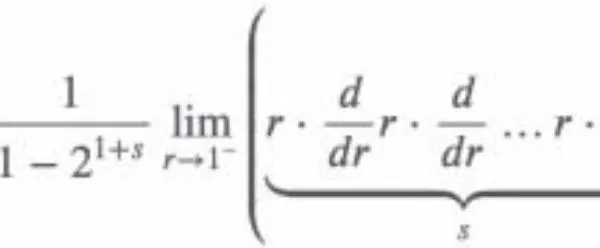
The Sum of all multiples combined of every natural number upto infinity is 1/120. The series looks this:
In other words, the sum of infinite terms of a series, each of whose terms is further an infinite sum - the first term being the sum of all natural multiples of 1, second term being the sum of all natural multiple of 2, the third term being the sum of all natural multiple of 3, and so on - is 1/120.
To solve such kind of series and observe patterns in them bi-directional infinity boxes can be used.
To understand this particular series, first, we need to understand the concept of bi-directional infinity box.
(Col 1)

- Row 1: 1, 2, 3, 4, 5, 6, 7, 8, 9, 10,..., infinity Row 2: 2, 4, 6, 8, 10, 12,..., infinity 3, 6,,9, 12, 15, 18,..., infinity 4, 8, 12, 16, 20, 24, 28,..., infinity 5, 10, 15, 20, 25, 30, 35,..., infinity 6, 12, 18, 24, 30, 36,..., infinity
Infinity
Row 1 contains multiples of 1 upto infinity Row 2 contains multiples of 2 upto infinity And so on, neither the number of rows ends because we have to take multiple of each natural number up to infinity into consideration, nor the terms in a row ends because we have to take every multiple that exists(infinite) of each natural number into consideration. Thus, if considered as a box, and row 1 and column 1 as its sides, then we can call it a bi-directional infinity box(both sides extending to infinity).
In this way, we have organised all the multiples up to infinity of each natural number up to infinity.
This bi-directional infinity box can be rearranged into a triangle in 2 ways, one of which will help us to get our result.
(Col 1)
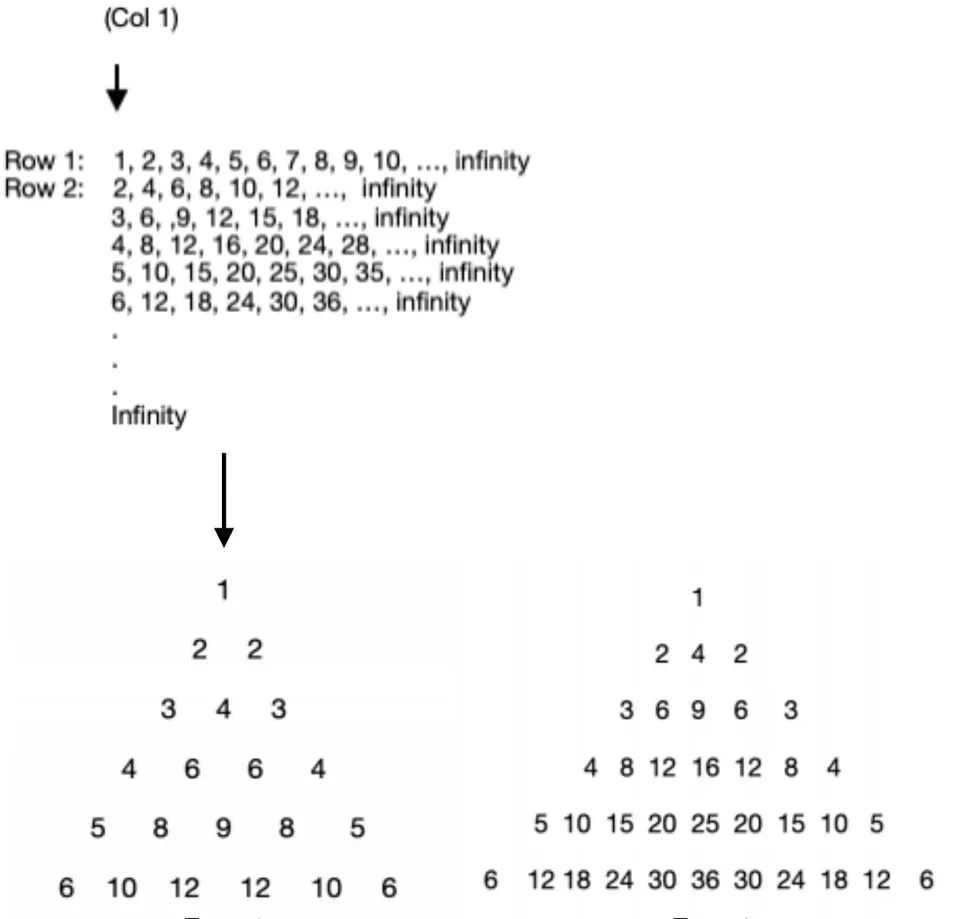
Form 2.
Here, the diagonal of the bi-directional box is transitioned into perpendicular height form: where the terms at the diagonal of initial box are kept adjacent while conversion, and the terms to the finite ends from a particular diagonal term are symmetrically arranged on both sides parallel to the base of triangle in straight line. In the other form of conversion, the diagonal terms are not adjacent, and they are
| Sum of Numbers In a row | |||
| 1 | = 1 | = 1^3 | |
| 2 4 2 | = 8 | = 2^3 | |
| 3 6 9 6 3 | = 27 | = 3^3 | |
| 4 8 12 16 12 8 4 | = 64 | = 4^3 | |
| 5 10 15 20 25 20 15 10 5 | = 125 | = 5^3 | |
| 6 | 12 18 24 30 36 30 24 18 12 6 | = 216 | = 6^3 |
Proof:
Sn = Sum of numbers in nth row
To get the sum of all the terms of this triangle, we will now add the sum of all rows. According to the proof above:
Sum of terms in nth row = n^3
Sum of row
Sum of row
And so on.
On adding all the rows, we get:
We have now reduced the initial Bi-directional box into this(1^3 + 2^3 + 3^3 +...)
We know that the result of this series is 1/120(initially stated by Ramanujan, and later it was proved in many ways). Some of the proofs can be found here:
https://math.stackexchange.com/questions/2052233/how-does-one-get-that-13233343-cdots frac1120/2052282 From one of the given proofs, we end up with the following form for the Zeta function whenever , s > 0:
Notes
Below are some worked out values; however, for our purpose, we will go with s = 3
For , we get
Thus, we can say that:
The sum of all multiples upto infinity of each natural number upto infinity is 1/120
OR
Sum of all multiples combined of every natural number up to infinity is 1/120.
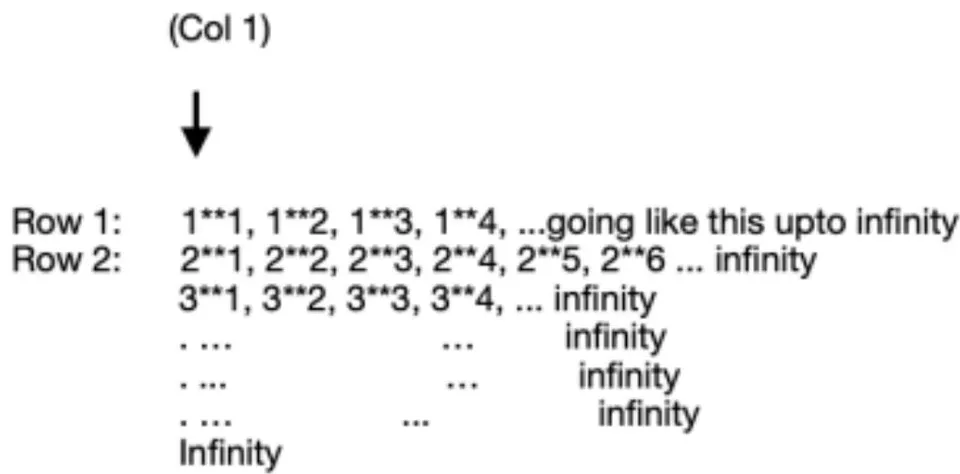
The terms in a bi-directional infinity box can be different according to the series which we are dealing with and the patterns we are trying to observe. The one we discussed above is the standard bi-directional infinity box. Another example with of series converted into bi-directional infinity box is
II. CONCLUSION
Such conversions can be helpful in organising multiple infinite series or for even doing an organised study of patterns and results when multiple series/sequences are combined. Along with it, the article helps us in understanding in a new form of numerical distribution(Bi-directional Infinite Boxes) and its two forms of triangle, on which further development can be done.