In this paper, we developed Oberhettinger’s integral formulas containing the product of general polynomials and incomplete H-functions. These integral formulas are very useful to obtain the Mellin transform of various simpler special functions. The Mellin transform of special functions find their applications in mathematical statistics, number theory and the theory of asymptotic expansions. The main findings of the present work are very useful in solving the problems arising in digital signals, image processing, finance and ship target recognition by sonar system and radar signals.
## I. INTRODUCTION
Several integral formulas containing generalized special functions have been explored by many authors [15]. These integrals play a focal role in solving scientific and engineering problems. Here we develop Oberhettinger's integral formulas containing the product of general polynomials and incomplete H- functions. Many authors established several unified integral formulas containing a various kind of special functions [6-8]. The findings of this work are general in nature and very useful in science, engineering and finance. Here we find some special cases by specializing the parameters of general polynomials and incomplete H-functions (for example, Fox's H-function, Incomplete Fox-Wright functions, Fox-Wright functions and incomplete generalized hypergeometric functions) and also listed few known results. The main results of this work are very useful in solving the problems arising in digital signals, image processing, finance and ship target recognition by sonar system and radar signals [9-12].
The incomplete Gamma functions $\Gamma (\xi,z)$ and $\Upsilon$ $(\xi,z)$ are defined as following:
$$
\Upsilon (\xi , z) = \int_{0}^{z} t^{\xi - 1} e^{-t} \, dt \quad (\mathbb{R}(\xi) > 0; z \geq 0) \tag{1}
$$
And
$$
\Gamma (\xi , z) = \int_ {z} ^ {\infty} t ^ {\xi - 1} e ^ {- t} d t \qquad (z \geq 0; \mathsf {R} (\xi) > 0 w h e n z = 0) \qquad \ldots (2)
$$
Respectively, satisfy the decomposition formula given by:
$$
\Gamma (\xi , z) + Y (\xi , z) = \Gamma (\xi) \quad (R (\xi) > 0) \tag {3}
$$
The condition which we have used on the parameter $z$ in and anywhere else in this paper is unrestricted of $R(x)$ ( $x \in C$ ).
The incomplete generalized hypergeometric functions $_{e}\Gamma_{f}$ and $_{e}\gamma_{f}$ are defined by Srivastava et al. [13] in terms of incomplete Gamma functions $\Gamma (\mathbf{s},\mathbf{z})$ and $\Upsilon (s,z)$ as following:
$$
\begin{array}{l} { } _ { e } \Gamma _ { f } \left[ \begin{array} { c } ( u _ { 1 } , z ) , u _ { 2 } , \dots . , u _ { e } ; \\v _ { 1 } , \dots , v _ { f } ; \end{array} \right] = \frac { \prod _ { j = 1 } ^ { f } \Gamma ( v _ { j } ) } { \prod _ { j = 1 } ^ { e } \Gamma ( u _ { j } ) } \sum _ { \ell = 0 } ^ { \infty } \frac { \Gamma ( u _ { 1 } + \ell , z ) \prod _ { j = 2 } ^ { e } \Gamma ( u _ { j } + \ell ) } { \prod _ { j = 1 } ^ { f } \Gamma ( v _ { j } + \ell ) } \frac { x ^ { \ell } } { \ell ! } \\= \frac {1}{2 \pi \iota} \frac {\prod_ {j = 1} ^ {f} \Gamma \left(\mathrm {v} _ {\mathrm {j}}\right)}{\prod_ {j = 1} ^ {e} \Gamma \left(\mathrm {u} _ {\mathrm {j}}\right) ^ {t}} \int_ {\varepsilon} ^ {\Gamma \left(\mathrm {u} _ {1} + s, z\right) \prod_ {j = 2} ^ {e} \Gamma \left(\mathrm {u} _ {\mathrm {j}} + s\right)} \Gamma (- \mathrm {s}) (- x) ^ {s} d s \tag {4} \\\end{array}
$$
$$
(| \arg (- x) | < \pi ,
$$
And
$$
\begin{array}{l} { } _ { e } \gamma _ { f } \left[ \begin{array} { c } ( u _ { 1 } , z ) , u _ { 2 } , \dots . , u _ { e } ; \\v _ { 1 } , \dots , v _ { f } ; \end{array} \right] = \frac { \prod _ { j = 1 } ^ { f } \Gamma ( v _ { j } ) } { \prod _ { j = 1 } ^ { e } \Gamma ( u _ { j } ) } \sum _ { \ell = 0 } ^ { \infty } \frac { \gamma ( u _ { 1 } + \ell , z ) \prod _ { j = 2 } ^ { e } \Gamma ( u _ { j } + \ell ) } { \prod _ { j = 1 } ^ { f } \Gamma ( v _ { j } + \ell ) } \frac { x ^ { \ell } } { \ell ! } \\= \frac {1}{2 \pi t} \frac {\prod_ {j = 1} ^ {f} \Gamma \left(\mathrm {v} _ {\mathrm {j}}\right)}{\prod_ {j = 1} ^ {e} \Gamma \left(\mathrm {u} _ {\mathrm {j}}\right) ^ {t}} \int_ {\varepsilon} ^ {\gamma \left(\mathrm {u} _ {1} + s, z\right) \prod_ {j = 2} ^ {e} \Gamma \left(\mathrm {u} _ {\mathrm {j}} + s\right)} \frac {\Gamma (- s) (- x) ^ {s} d s \quad \dots (5)}{\prod_ {j = 1} ^ {f} \Gamma \left(\mathrm {v} _ {\mathrm {j}} + s\right)} \\\end{array}
$$
$$
(| \arg (- x) | < \pi ,
$$
- Where $\mathcal{L}$ is the Mellin-Barnes type contour having $\tau - i\infty$ as the starting point and $\tau + i\infty$ ( $\tau \in \mathbb{R}$ ) as
- the end point with the usual indentations to separate a set of poles from another of the integrand
- in each and every case.
The incomplete H- function $\gamma_{e,f}^{c,d}(x)$ and $\Gamma_{e,f}^{c,d}(x)$ are introduced by Srivastava et. Al. [14] as following:
$$
\begin{array}{l} \Gamma_ {e, f} ^ {c, d} (x) = \Gamma_ {e, f} ^ {c, d} \left[ x \middle | \begin{array}{c} (u _ {1}, U _ {1}, z), (u _ {j}, U _ {j}) _ {2, e} \\(v _ {j}, V _ {j}) _ {1, f} \end{array} \right] = \Gamma_ {e, f} ^ {c, d} \left[ x \middle | \begin{array}{c} (u _ {1}, U _ {1}, z), (u _ {2}, U _ {2}),..., (u _ {e}, U _ {e}) \\(v _ {1}, V _ {1}), (v _ {2}, V _ {2}),..., (v _ {f}, V _ {f}) \end{array} \right] \\= \frac {1}{2 \pi \iota} \int_ {\varepsilon} f (s, z) x ^ {- s} d s \tag {6} \\\end{array}
$$
Where $f(s,z) = \frac{\Gamma(1 - \mathbf{u}_1 - U_1s,z)\prod_{j = 1}^{c}\Gamma(\mathbf{v}_j + V_js)\prod_{j = 2}^{d}\Gamma(1 - \mathbf{u}_j - U_js)}{\prod_{j = c + 1}^{f}\Gamma(1 - \mathbf{v}_j - V_js)\prod_{j = d + 1}^{e}\Gamma(\mathbf{u}_j + U_js)}$
And
$$
\begin{array}{l} \gamma_ {e, f} ^ {c, d} (x) = \gamma_ {e, f} ^ {c, d} \left[ x \left| \begin{array}{c} \left(u _ {1}, U _ {1}, z\right), \left(u _ {j}, U _ {j}\right) _ {2, e} \\\left(v _ {j}, V _ {j}\right) _ {1, f} \end{array} \right] = \gamma_ {e, f} ^ {c, d} \left[ x \left| \begin{array}{c} \left(u _ {1}, U _ {1}, z\right), \left(u _ {2}, U _ {2}\right), \dots , \left(u _ {e}, U _ {e}\right) \\\left(v _ {1}, V _ {1}\right), \left(v _ {2}, V _ {2}\right), \dots , \left(v _ {f}, V _ {f}\right) \end{array} \right] \\= \frac{1}{2 \pi \iota} \int_ {\varepsilon} F (s, z) x ^ {- s} d s \tag{7} \\\end{array}
$$
Where
$$
F (s, z) = \frac {\gamma (1 - \mathrm {u} _ {1} - U _ {1} s , z) \prod_ {\mathrm {j} = 1} ^ {\mathrm {c}} \Gamma (\mathrm {v} _ {\mathrm {j}} + V _ {j} s) \prod_ {\mathrm {j} = 2} ^ {\mathrm {d}} \Gamma (1 - \mathrm {u} _ {\mathrm {j}} - U _ {j} s)}{\prod_ {\mathrm {j} = c + 1} ^ {\mathrm {f}} \Gamma (1 - \mathrm {v} _ {\mathrm {j}} - V _ {j} s) \prod_ {\mathrm {j} = d + 1} ^ {\mathrm {e}} \Gamma (\mathrm {u} _ {\mathrm {j}} + U _ {j} s)}
$$
The incomplete H- functions $\gamma_{e,f}^{c,d}(x)$ and $\Gamma_{e,f}^{c,d}(x)$ in (6) and (7) respectively exist for all $z\geq 0$ under the same set of conditions and same set of contour stated in the articles presented by Kilbas et al. [15], Mathai and Saxena [16] and Mathai et al. [17].
Some special cases of incomplete H-function are as following:
(i)
If we take $z = 0$ in (6), then the incomplete H-function $\Gamma_{e,f}^{c,d}(x)$ reduces to Fox's H-function [18].
$$
\Gamma_ {e, f} ^ {c, d} \left[ x \left|\begin{array}{l}\left(u _ {1}, U _ {1}, 0\right), \left(u _ {2}, U _ {2}\right), \dots , \left(u _ {e}, U _ {e}\right)\\\left(v _ {1}, V _ {1}\right), \left(v _ {2}, V _ {2}\right), \dots , \left(v _ {f}, V _ {f}\right)\end{array}\right.\right] = H _ {e, f} ^ {c, d} \left[ \right. x \left| \right.\begin{array}{l}\left(u _ {1}, U _ {1}\right), \left(u _ {2}, U _ {2}\right), \dots , \left(u _ {e}, U _ {e}\right)\\\left(v _ {1}, V _ {1}\right), \left(v _ {2}, V _ {2}\right), \dots , \left(v _ {f}, V _ {f}\right)\end{array}\left. \right] \quad \dots (8)
$$
(ii) If we take $c = 1$, $d = e$ and replace $f$ by $f + 1$ and take suitable parameter, then the function (6) and (7) reduces to incomplete Fox-Wright function $_{e}\Psi_{f}^{(\Gamma)}$ and $_{e}\Psi_{f}^{(\gamma)}$ (for details see [14]).
$$
\Gamma_ {e, f + 1} ^ {1, e} \left[ - x \left| \begin{array}{c} (1 - u _ {1}, U _ {1}, z), (1 - u _ {j}, U _ {j}) _ {2, e} \\(0, 1), (1 - v _ {j}, V _ {j}) _ {1, f} \end{array} \right] = _ {e} \Psi_ {f} ^ {(\Gamma)} \left[ \begin{array}{c} (u _ {1}, U _ {1}, z), (u _ {j}, U _ {j}) _ {2, e}; \\(v _ {j}, V _ {J}) _ {1, f}; \end{array} x \right] \quad \dots \tag{9}
$$
And
$$
\gamma_{e,f+1}^{1,e} \left[ - x \left| \begin{array}{c} (1 - u_{1}, U_{1}, z), (1 - u_{j}, U_{j})_{2,e} \\(0, 1), (1 - v_{j}, V_{j})_{1,f} \end{array} \right] = _{e} \Psi_{f}^{(\gamma)} \left[ \begin{array}{c} (u_{1}, U_{1}, z), (u_{j}, U_{j})_{2,e}; \\(v_{j}, V_{J})_{1,f}; \end{array} x \right] \quad \dots \tag{10}
$$
(iii)
If we take $z = 0$ in (9), then incomplete Fox-Wright function $_{e}\Psi_{f}^{(\Gamma)}$ reduces to well-known Fox-Wright function $_{e}\Psi_{f}$ (for details see [18]).
$$
_{e}\Psi_{f}^{(\Gamma)}\left[\begin{array}{c}(u_{1},U_{1},0),(u_{j},U_{j})_{2,e};\\(v_{j},V_{j})_{1,f};\end{array}\right]=_{e}\Psi_{f}\left[\begin{array}{c}(u_{1},U_{1}),(u_{j},U_{ j})_{2,e};\\(v_{j},V_{j})_{1,f};\end{array}\right]
$$
(iv) If we take $\mathrm{U_j = V_k = 1}$ $(\mathrm{j} = 1,\dots,\mathrm{e},\mathrm{k} = 1,\dots,\mathrm{f})$ in (9) and (10), then incomplete Fox-Wright function reduces to the incomplete generalized hypergeometric functions ${}_{e}\gamma_{f}$ and ${}_{e}\Gamma_{f}$ (see [13]).
$$
{ } _ { e } \Psi _ { f } ^ { ( \Gamma ) } \left[ \begin{array} { c } ( u _ { 1 } , 1 , z ) , ( u _ { j } , 1 ) _ { 2 , e } ; \\( v _ { j } , 1 ) _ { 1 , f } ; \end{array} ; x \right] = _ { e } \Gamma _ { f } \left[ \begin{array} { c } ( u _ { 1 } , z ) , u _ { 2 } , \dots , u _ { e } ; \\v _ { 1 } , \dots v _ { f } ; \end{array} x \right] \tag {12}
$$
And
$$
{ } _ { e } \Psi _ { f } ^ { ( \gamma ) } \left[ \begin{array} { c } ( u _ { 1 } , 1 , z ) , ( u _ { j } , 1 ) _ { 2 , e } ; \\( v _ { j } , 1 ) _ { 1 , f } ; \end{array} x \right] = _ { e } \gamma _ { f } \left[ \begin{array} { c } ( u _ { 1 } , z ) , u _ { 2 } , \dots , u _ { e } ; \\v _ { 1 } , \dots v _ { f } ; \end{array} x \right] \tag {13}
$$
The general polynomials are defined by Srivastava [19] as following:
$$
S _ {n _ {1}, \dots , n _ {s}} ^ {m _ {1}, \dots , m _ {s}} \left[ t _ {1}, \dots , t _ {s} \right] = \sum_ {\alpha_ {1} = 0} ^ {[ n _ {1} / m _ {1} ]} \dots \sum_ {\alpha_ {s} = 0} ^ {[ n _ {s} / m _ {s} ]} \frac {\left(- n _ {1}\right) _ {m _ {1} \alpha_ {1}}}{\alpha_ {1} !} \dots \frac {\left(- n _ {s}\right) _ {m _ {s} \alpha_ {s}}}{\alpha_ {s} !}. A [ n _ {1}, \alpha_ {1}; \dots ; n _ {s}, \alpha_ {s} ] t _ {1} ^ {\alpha_ {1}} \dots t _ {s} ^ {\alpha_ {s}} \tag {14}
$$
Where $\mathrm{n_i} = 0,1,2 \dots \forall \mathrm{i} = (1, \dots, \mathrm{s})$; $m_1, \dots, m_s$ are arbitrary positive integers and the coefficients $A[\mathrm{n}_1, \alpha_1, \dots; \mathrm{n}_s, \alpha_s]$ are arbitrary constants, real or complex.
In this paper we use the following integral formula [20],
$$
\int_{0}^{\infty} y^{\delta - 1} \left(y + k + \sqrt{y^{2} + 2 k y}\right)^{-\tau} dy = 2 \pi k^{-\tau} \left(\frac{k}{2}\right)^{\delta} \frac{\Gamma(2 \delta) \Gamma(\tau - \delta)}{\Gamma(1 + \tau + \delta)} \tag{15}
$$
## II. THE MAIN INTEGRAL FORMULA
In this section we obtain Oberhettinger's integral formulas containing product of incomplete H-function and general polynomials. These integral formulas are very useful to obtain the Mellin transform of several simpler special functions.
Theorem 1: If $\mathfrak{c}, \delta \in \mathbb{C}$ with $0 \leq \mathrm{R}(\delta) < \mathrm{R}(\mathfrak{c})$ and $y > 0$, then the following integral formula holds:
$$
\begin{array}{l} \int_ {0} ^ {\infty} \mathrm {y} ^ {\delta - 1} \left(y + k + \sqrt {y ^ {2} + 2 k y}\right) ^ {- \tau}. S _ {n _ {1}, \dots , n _ {s}} ^ {m _ {1}, \dots , m _ {s}} \left[ \frac {t _ {1}}{\left(y + k + \sqrt {y ^ {2} + 2 k y}\right)}, \dots , \frac {t _ {s}}{\left(y + k + \sqrt {y ^ {2} + 2 k y}\right)} \right] \\\Gamma_ {e, f} ^ {c, d} \left[ \frac {x}{\left(y + k + \sqrt {y ^ {2} + 2 k y}\right)} \right| _ {\binom {u _ {1}, U _ {1}, z, \left(u _ {j}, U _ {j}\right) _ {2, e}} {v _ {j}, V _ {j}) _ {1, f}}} d y = 2 ^ {1 - \delta} k ^ {\delta - \tau - \sum_ {i = 1} ^ {s} \alpha_ {i}} \Gamma (2 \delta) \\\cdot \sum_ {\alpha_ {1} = 0} ^ {[ n _ {\mathrm {s}} / m _ {1} ]} \dots \sum_ {\alpha_ {\mathrm {s}} = 0} ^ {[ n _ {\mathrm {s}} / m _ {\mathrm {s}} ]} \frac {(- n _ {1}) _ {m _ {1} \alpha_ {1}}}{\alpha_ {1} !} \dots \frac {(- n _ {\mathrm {s}}) _ {m _ {\mathrm {s}} \alpha_ {\mathrm {s}}}}{\alpha_ {\mathrm {s}} !}. A [ n _ {1}, \alpha_ {1}; \dots ; n _ {\mathrm {s}}, \alpha_ {\mathrm {s}} ] t _ {1} ^ {\alpha_ {1}} \dots t _ {\mathrm {s}} ^ {\alpha_ {\mathrm {s}}} \\\Gamma_ {e + 2, f + 2} ^ {c, d + 2} \left[ \right. \frac {x}{k} \left| \right.\begin{array}{l}\left(u _ {1}, U _ {1}, z\right), \left(u _ {j}, U _ {j}\right) _ {2, e}, \left(- \tau - \sum_ {i = 1} ^ {s} \alpha_ {i}, 1\right), \left(1 - \tau - \sum_ {i = 1} ^ {s} \alpha_ {i} + \delta , 1\right)\\\left(v _ {j}, V _ {j}\right) _ {1, f}, \left(1 - \tau - \sum_ {i = 1} ^ {s} \alpha_ {i}, 1\right), \left(- \tau - \sum_ {i = 1} ^ {s} \alpha_ {i} - \delta , 1\right)\end{array}\left. \right] \quad \dots \tag {16} \\\end{array}
$$
All the conditions of incomplete H- function $\Gamma_{e,f}^{c,d}(x)$ in (6) are satisfied.
Proof: Let the left hand side of the assertion (16) is denoted by $\Delta$ and using (6) and (14) in the left hand side of (16), we get
$$
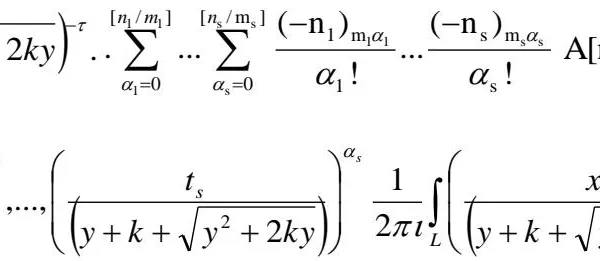
\begin{array}{l} \Delta = \int_ {0} ^ {\infty} y ^ {\delta - 1} \left(y + k + \sqrt {y ^ {2} + 2 k y}\right) ^ {- \tau}.. \sum_ {\alpha_ {1} = 0} ^ {[ n _ {1} / m _ {1} ]} \dots \sum_ {\alpha_ {s} = 0} ^ {[ n _ {s} / m _ {s} ]} \frac {(- n _ {1}) _ {m _ {1} \alpha_ {1}}}{\alpha_ {1} !} \dots \frac {(- n _ {s}) _ {m _ {s} \alpha_ {s}}}{\alpha_ {s} !} A [ n _ {1}, \alpha_ {1}; \dots ; n _ {s}, \alpha_ {s} ] \\\cdot \left(\frac {t _ {1}}{\left(y + k + \sqrt {y ^ {2} + 2 k y}\right)}\right) ^ {\alpha_ {1}}, \dots , \left(\frac {t _ {s}}{\left(y + k + \sqrt {y ^ {2} + 2 k y}\right)}\right) ^ {\alpha_ {s}} \frac {1}{2 \pi \imath} \int_ {L} \left(\frac {x}{\left(y + k + \sqrt {y ^ {2} + 2 k y}\right)}\right) ^ {- \xi} f (\xi , z) d \xi d y \\\end{array}
$$
Where $f(\xi, z)$ is defined in (6).
$$
\begin{array}{l} \Delta = \sum_ {\alpha_ {1} = 0} ^ {[ n _ {1} / m _ {1} ]} \dots \sum_ {\alpha_ {s} = 0} ^ {[ n _ {s} / m _ {s} ]} \frac {(- n _ {1}) _ {m _ {1} \alpha_ {1}}}{\alpha_ {1} !} \dots \frac {(- n _ {s}) _ {m _ {s} \alpha_ {s}}}{\alpha_ {s} !} A [ n _ {1}, \alpha_ {1}; \dots ; n _ {s}, \alpha_ {s} ]. t _ {1} ^ {\alpha_ {1}} \dots t _ {s} ^ {\alpha_ {s}}. \frac {1}{2 \pi \imath} \int_ {L} f (\xi , z) x ^ {- \xi} \\\int_ {0} ^ {\infty} \mathrm {y} ^ {\delta - 1} \left(y + k + \sqrt {y ^ {2} + 2 k y}\right) ^ {- (\tau + \alpha_ {1} + \dots + \alpha_ {s} - \xi)} d y d \xi \\\end{array}
$$
Now by using (15) in above integral and reinterpreting it in the form of incomplete H-function $\Gamma_{e,f}^{c,d}(x)$, we get the result (16).
Theorem- 2
If $\mathfrak{c},\delta \in \mathbb{C}$ with $0 < \mathrm{R}(\delta) < \mathrm{R}(\mathfrak{c})$ and $\mathbf{y} > 0$, then the following integral formula holds:
$$
\begin{array}{l} \int_ {0} ^ {\infty} y ^ {\delta - 1} \left(y + k + \sqrt {y ^ {2} + 2 k y}\right) ^ {- \tau}. S _ {n _ {1}, \dots , n _ {s}} ^ {m _ {1}, \dots , m _ {s}} \left[ \frac {t _ {1}}{\left(y + k + \sqrt {y ^ {2} + 2 k y}\right)}, \dots , \frac {t _ {s}}{\left(y + k + \sqrt {y ^ {2} + 2 k y}\right)} \right]. \\\mathcal {Y} _ {e, f} ^ {c, d} \left[ \frac {x}{\left(y + k + \sqrt {y ^ {2} + 2 k y}\right)} \right| _ {\binom {v _ {j}, V _ {j}} {1, f}} ^ {\left(u _ {1}, U _ {1}, z\right), \left(u _ {j}, U _ {j}\right) _ {2, e}} ] d y = 2 ^ {1 - \delta} k ^ {\delta - \tau - \sum_ {i = 1} ^ {s} \alpha_ {i}} \Gamma (2 \delta) \\\cdot \sum_ {\alpha_ {1} = 0} ^ {[ n _ {1} / m _ {1} ]} \dots \sum_ {\alpha_ {s} = 0} ^ {[ n _ {s} / m _ {s} ]} \frac {(- n _ {1}) _ {m _ {1} \alpha_ {1}}}{\alpha_ {1} !} \dots \frac {(- n _ {s}) _ {m _ {s} \alpha_ {s}}}{\alpha_ {s} !}. A [ n _ {1}, \alpha_ {1}; \dots ; n _ {s}, \alpha_ {s} ] t _ {1} ^ {\alpha_ {1}} \dots t _ {s} ^ {\alpha_ {s}} \\\cdot \gamma_ {e + 2, f + 2} ^ {c, d + 2} \left[ \frac {x}{k} \left| \begin{array}{l} \left(u _ {1}, U _ {1}, z\right), \left(u _ {j}, U _ {j}\right) _ {2, e}, \left(- \tau - \sum_ {i = 1} ^ {s} \alpha_ {i}, 1\right), \left(1 - \tau - \sum_ {i = 1} ^ {s} \alpha_ {i} + \delta , 1\right) \\\left(v _ {j}, V _ {j}\right) _ {1, f}, \left(1 - \tau - \sum_ {i = 1} ^ {s} \alpha_ {i}, 1\right), \left(- \tau - \sum_ {i = 1} ^ {s} \alpha_ {i} - \delta , 1\right) \end{array} \right] \right. \tag {17} \\\end{array}
$$
All the conditions of incomplete H- function $\gamma_{e,f}^{c,d}(x)$ in (7) are satisfied.
Proof: Let the left hand side of the assertion (17) is denoted by $\Delta$ and using (7) and (14) in the left hand side of (17), we get
$$
\begin{array}{l} \Delta = \int_ {0} ^ {\infty} y ^ {\delta - 1} \left(y + k + \sqrt {y ^ {2} + 2 k y}\right) ^ {- \tau} \dots \sum_ {\alpha_ {1} = 0} ^ {[ n _ {1} / m _ {1} ]} \dots \sum_ {\alpha_ {s} = 0} ^ {[ n _ {s} / m _ {s} ]} \frac {(- n _ {1}) _ {m _ {1} \alpha_ {1}}}{\alpha_ {1} !} \dots \frac {(- n _ {s}) _ {m _ {s} \alpha_ {s}}}{\alpha_ {s} !} A [ n _ {1}, \alpha_ {1}; \dots ; n _ {s}, \alpha_ {s} ] \\\cdot \left(\frac {t _ {1}}{\left(y + k + \sqrt {y ^ {2} + 2 k y}\right)}\right) ^ {\alpha_ {1}}, \dots , \left(\frac {t _ {s}}{\left(y + k + \sqrt {y ^ {2} + 2 k y}\right)}\right) ^ {\alpha_ {s}} \frac {1}{2 \pi \iota} \int_ {L} \left(\frac {x}{\left(y + k + \sqrt {y ^ {2} + 2 k y}\right)}\right) ^ {- \xi} F (\xi , z) d \xi d y \\\end{array}
$$
Where $F(\xi, z)$ is defined in (7)
Now changing the order of summation, integration and contour integral involved therein (which is permissible under the stated conditions), we get
$$
\begin{array}{l} \Delta = \sum_ {\alpha_ {1} = 0} ^ {[ n _ {1} / m _ {1} ]} \dots \sum_ {\alpha_ {s} = 0} ^ {[ n _ {s} / m _ {s} ]} \frac {(- n _ {1}) _ {m _ {1} \alpha_ {1}}}{\alpha_ {1} !} \dots \frac {(- n _ {s}) _ {m _ {s} \alpha_ {s}}}{\alpha_ {s} !} A [ n _ {1}, \alpha_ {1}; \dots ; n _ {s}, \alpha_ {s} ]. t _ {1} ^ {\alpha_ {1}} \dots t _ {s} ^ {\alpha_ {s}}. \frac {1}{2 \pi \imath} \int_ {L} F (\xi , z) x ^ {- \xi} \\\int_ {0} ^ {\infty} y ^ {\delta - 1} \left(y + k + \sqrt {y ^ {2} + 2 k y}\right) ^ {- (\tau + \alpha_ {1} + \dots + \alpha_ {s} - \xi)} d y d \xi \\\end{array}
$$
Now by using (15) in above integral and reinterpreting it in the form of incomplete H-function $\gamma_{e,f}^{c,d}(x)$, we get the result (17).
## III. SPECIAL CASES
In this section, we obtain some interesting special cases of main results (16) and (17).
(i) If $\tau, \delta \in C$ with $0 < R(\delta) < R(\tau)$ and $y > 0$ and incomplete H-function reduces into incomplete hypergeometric function with the help of (12) and (13), then the following integral formula occurs:
$$
\begin{array}{l} \int_ {0} ^ {\infty} y ^ {\delta - 1} \left(y + k + \sqrt {y ^ {2} + 2 k y}\right) ^ {- \tau}. S _ {n _ {1}, \dots , n _ {s}} ^ {m _ {1}, \dots , m _ {s}} \left[ \frac {t _ {1}}{\left(y + k + \sqrt {y ^ {2} + 2 k y}\right)}, \dots , \frac {t _ {s}}{\left(y + k + \sqrt {y ^ {2} + 2 k y}\right)} \right] \\\cdot_ {e} \Gamma_ {f} \left[ \binom {(u _ {1}, z), u _ {2}, \dots , u _ {e};} {v _ {1}, \dots , v _ {f};} \frac {x}{(y + k + \sqrt {y ^ {2} + 2 k y})} \right] d y = 2 ^ {1 - \delta} k ^ {\delta - \tau - \sum_ {i = 1} ^ {s} \alpha_ {i}} \Gamma (2 \delta) \\\cdot \sum_ {\alpha_ {1} = 0} ^ {[ n _ {1} / m _ {1} ]} \dots \sum_ {\alpha_ {s} = 0} ^ {[ n _ {s} / m _ {s} ]} \frac {(- n _ {1}) _ {m _ {1} \alpha_ {1}}}{\alpha_ {1} !} \dots \frac {(- n _ {s}) _ {m _ {s} \alpha_ {s}}}{\alpha_ {s} !}. A [ n _ {1}, \alpha_ {1}; \dots ; n _ {s}, \alpha_ {s} ] t _ {1} ^ {\alpha_ {1}} \dots t _ {s} ^ {\alpha_ {s}} \\\cdot_ {e + 2} \Gamma_ {f + 2} \left[ \frac {x}{k} \left| \begin{array}{c} (u _ {1}, z), u _ {2}, \dots , u _ {e}, - \tau - \sum_ {i = 1} ^ {s} \alpha_ {i}, 1 - \tau - \sum_ {i = 1} ^ {s} \alpha_ {i} + \delta \\v _ {1}, \dots , v _ {f}, 1 - \tau - \sum_ {i = 1} ^ {s} \alpha_ {i}, - \tau - \sum_ {i = 1} ^ {s} \alpha_ {i} - \delta \end{array} \right. \right] \tag {18} \\\end{array}
$$
$$
\int_ {0} ^ {\infty} \mathrm {y} ^ {\delta - 1} \left(y + k + \sqrt {y ^ {2} + 2 k y}\right) ^ {- \tau}. S _ {n _ {1}, \dots , n _ {s}} ^ {m _ {1}, \dots , m _ {s}} \left[ \frac {t _ {1}}{\left(y + k + \sqrt {y ^ {2} + 2 k y}\right)}, \dots , \frac {t _ {s}}{\left(y + k + \sqrt {y ^ {2} + 2 k y}\right)} \right]
$$
$$
\cdot_{e} \gamma_{f} \left[ \binom{u_{1}, z, u_{2}, \dots, u_{e};}{v_{1}, \dots, v_{f};} \frac{x}{\left(y + k + \sqrt{y^{2} + 2 k y}\right)} \right] dy = 2^{1 - \delta} k^{\delta - \tau - \sum_{i = 1}^{s} \alpha_{i}} \Gamma(2 \delta)
$$
$$
\cdot \sum_ {\alpha_ {1} = 0} ^ {[ n _ {1} / m _ {1} ]} \dots \sum_ {\alpha_ {s} = 0} ^ {[ n _ {s} / m _ {s} ]} \frac {(- n _ {1}) _ {m _ {1} \alpha_ {1}}}{\alpha_ {1} !} \dots \frac {(- n _ {s}) _ {m _ {s} \alpha_ {s}}}{\alpha_ {s} !}. A [ n _ {1}, \alpha_ {1}; \dots ; n _ {s}, \alpha_ {s} ] t _ {1} ^ {\alpha_ {1}} \dots t _ {s} ^ {\alpha_ {s}}
$$
$$
\cdot_ {e + 2} \gamma_ {f + 2} \left[ \frac {x}{k} \left| \begin{array}{c} (u _ {1}, z), u _ {2}, \dots , u _ {e}, - \tau - \sum_ {i = 1} ^ {s} \alpha_ {i}, 1 - \tau - \sum_ {i = 1} ^ {s} \alpha_ {i} + \delta \\v _ {1}, \dots , v _ {f}, 1 - \tau - \sum_ {i = 1} ^ {s} \alpha_ {i}, - \tau - \sum_ {i = 1} ^ {s} \alpha_ {i} - \delta \end{array} \right. \right] \tag {19}
$$
Given that both integrals exist.
Proof: Again if we take $\mathrm{U_j = V_j = 1}$ in (16) and (17), we get the required results.
(ii) If $\tau, \delta \in C$ with $0 < R(\delta) < R(\tau)$ and $y > 0$ and incomplete H-function reduces into incomplete Wright functions, then the following integral formula occurs:
$$
\int_ {0} ^ {\infty} \mathrm {y} ^ {\delta - 1} \left(y + k + \sqrt {y ^ {2} + 2 k y}\right) ^ {- \tau}. S _ {n _ {1}, \dots , n _ {s}} ^ {m _ {1}, \dots , m _ {s}} \left[ \frac {t _ {1}}{\left(y + k + \sqrt {y ^ {2} + 2 k y}\right)}, \dots , \frac {t _ {s}}{\left(y + k + \sqrt {y ^ {2} + 2 k y}\right)} \right]
$$
$$
\cdot_{e} \Psi_{f}^{(\Gamma)} \left[ \begin{array}{c} (u_{1},U_{1},z), (u_{j},U_{j})_{2,e}; \\(v_{j},V_{j})_{1,f}; \end{array} \frac{x}{(y + k + \sqrt{y^{2} + 2 k y})} \right] dy = 2^{1 - \delta} k^{\delta - \tau - \sum_{i = 1}^{s} \alpha_{i}} \Gamma(2 \delta)
$$
$$
\cdot \sum_ {\alpha_ {1} = 0} ^ {[ n _ {1} / m _ {1} ]} \dots \sum_ {\alpha_ {s} = 0} ^ {[ n _ {s} / m _ {s} ]} \frac {(- n _ {1}) _ {m _ {1} \alpha_ {1}}}{\alpha_ {1} !} \dots \frac {(- n _ {s}) _ {m _ {s} \alpha_ {s}}}{\alpha_ {s} !}. A [ n _ {1}, \alpha_ {1}; \dots ; n _ {s}, \alpha_ {s} ] t _ {1} ^ {\alpha_ {1}} \dots t _ {s} ^ {\alpha_ {s}}
$$
$$
\cdot_{e+2} \Psi_{f+2}^{(\Gamma)} \left[ \frac{x}{k} \left| \begin{array}{c} (u_{1},U_{1},z),(u_{j},U_{j})_{2,e},(1+\tau+\sum_{i=1}^{s}\alpha_{i},1),(\tau+\sum_{i=1}^{s}\alpha_{i}-\delta,1) \\(v_{j},V_{j})_{1,f},(\tau+\sum_{i=1}^{s}\alpha_{i},1),(1+\tau+\sum_{i=1}^{s}\alpha_{i}+\delta,1) \end{array} \right] \quad \dots \tag{20}
$$
$$
\int_ {0} ^ {\infty} \mathrm {y} ^ {\delta - 1} \left(y + k + \sqrt {y ^ {2} + 2 k y}\right) ^ {- \tau}. S _ {n _ {1}, \dots , n _ {s}} ^ {m _ {1}, \dots , m _ {s}} \left[ \frac {t _ {1}}{\left(y + k + \sqrt {y ^ {2} + 2 k y}\right)}, \dots , \frac {t _ {s}}{\left(y + k + \sqrt {y ^ {2} + 2 k y}\right)} \right]
$$
$$
\cdot_{e} \Psi_{f}^{(\gamma)} \left[ \binom{u_{1}, U_{1}, z, (u_{j}, U_{j})_{2,e}}{(v_{j}, V_{j})_{1,f}}; \frac{x}{(y + k + \sqrt{y^{2} + 2ky})} \right] dy = 2^{1-\delta} k^{\delta-\tau-\sum_{i=1}^{s} \alpha_{i}} \Gamma(2\delta)
$$
$$
\cdot \sum_ {\alpha_ {1} = 0} ^ {[ n _ {1} / m _ {1} ]} \dots \sum_ {\alpha_ {s} = 0} ^ {[ n _ {s} / m _ {s} ]} \frac {(- n _ {1}) _ {m _ {1} \alpha_ {1}}}{\alpha_ {1} !} \dots \frac {(- n _ {s}) _ {m _ {s} \alpha_ {s}}}{\alpha_ {s} !}. A [ n _ {1}, \alpha_ {1}; \dots ; n _ {s}, \alpha_ {s} ] t _ {1} ^ {\alpha_ {1}} \dots t _ {s} ^ {\alpha_ {s}}
$$
$$
\cdot_{e+2} \Psi_{f+2}^{(\gamma)} \left[ \frac{x}{k} \left| \begin{array}{c} (u_{1},U_{1},z),(u_{j},U_{j})_{2,e},(1+\tau+\sum_{i=1}^{s}\alpha_{i},1), (\tau+\sum_{i=1}^{s}\alpha_{i}-\delta,1) \\(v_{j},V_{j})_{1,f},(\tau+\sum_{i=1}^{s}\alpha_{i},1),(1+\tau+\sum_{i=1}^{s}\alpha_{i}+\delta,1) \end{array} \right] \tag{21}
$$
Given that each member of assertion (20) and (21) are exist.
Proof: with the help of (9) and (10), we get the above results.
(iii) If $\tau, \delta \in \mathbb{C}$ with $0 < \mathrm{R}(\delta) < \mathrm{R}(\tau)$, $y > 0$ and incomplete H-function reduces into Fox-Wright generalized hypergeometric function and general polynomials reduces into unity, then the following integral formula holds:
$$
\begin{array}{l} \int_{0}^{\infty} \mathrm{y}^{\delta - 1} \left(y + k + \sqrt{y^{2} + 2 k y}\right)^{-\tau} \cdot _{e} \Psi_{f} \left[ \binom{u_{j}, U_{j}}{v_{j}, V_{j}}_{1, e}; \frac{x}{\left(y + k + \sqrt{y^{2} + 2 k y}\right)} \right] dy = 2^{1 - \delta} k^{\delta - \tau} \Gamma(2 \delta) \\\cdot _{e + 2} \Psi_{f + 2} \left[ \frac{x}{k} \left| \left(u_{j}, U_{j}\right)_{1, e}, (1 + \tau, 1), (\tau - \delta, 1) \right] \tag{22} \end{array}
$$
Given that each member of assertion (22) is exist.
Proof: Let general polynomials reduce into unity and with the help of (11), we get the above result.
## IV. CONCLUSIONS
In this paper, we obtained some engrossing integrals containing the product of incomplete H-function and general polynomials, which are expressed in terms of incomplete H-functions. We have also given some special cases by specializing the parameters of general polynomials and incomplete H-functions (Incomplete Fox-Wright functions, incomplete hypergeometric functions, Fox-Wright generalized hypergeometric functions). These results are general in nature and very useful in science, engineering and finance.
Generating HTML Viewer...
References
21 Cites in Article
M Bansal,J Choi (2019). A Note on Pathway Fractional Integral Formulas Associated with the Incomplete H-Functions.
M Bansal,N Jolly,R Jain,D Kumar (2019). An integral operator involving generalized Mittag-Leffler function and associated fractional calculus results.
V Chaurasia,Vijay Singhal (2010). Fractional integration of certain special functions.
V Chaurasia,J Singh (2010). Certain integral properties pertaining to special functions.
Dinesh Kumar,Frédéric Ayant,Devendra Kumar (2020). A New Class of Integrals Involving Generalized Hypergeometric Function and Multivariable Aleph-Function.
Yury Brychkov (2008). Handbook of Special Functions.
Mridula Garg,Shweta Mittal (2004). On a new unified integral.
H Srivastava,H Exton (1979). A generalization of the Weber-Schafheitlin integral..
Benjamin Epstein (1948). Some Applications of the Mellin Transform in Statistics.
K Yao Spherically Invariant Random Processes, Theory and Applications.
V Bhagava,H Poor,V Tarokh,S Yoon (2003). Communications, Information and Network Security.
K Yao,M Simon,E Bigileri (2004). Unified theory on wireless communication fading statistics based on SIRP.
V Chaurasia,D Kumar (2010). Applications of special functions, and SIRP in Wireless Communication Fading statistics.
H Srivastava,M Chaudhary,R Agarwal (2012). The Incomplete Pochhamer symbols and Their Applications to Hypergeometric and Related Functions.
H Srivastava,R Saxena,R Parmar (2018). Some Families of the Incomplete H-Functions and the Incomplete $$\overline H $$ H ¯ -Functions and Associated Integral Transforms and Operators of Fractional Calculus with Applications.
A Kilbas,H Srivastava,J Trujillo (2006). Theory and Applications of Fractional Differential Equations.
A Mathai,R Saxena (1978). The H function with Applications in Statistics other Disciplines.
A Mathai,R Saxena,H Haubold (2009). The H Function: Theory and Applications.
H Srivastava,K Gupta,S Goyal (1982). The H-Functions of One and Two Variables with Applications.
H Srivastava (1985). A multilinear generating function for the Konhauser sets of biorthogonal polynomials suggested by the Laguerre polynomials.
Fritz Oberhettinger (1974). Inverse Mellin Transforms.
No ethics committee approval was required for this article type.
Data Availability
Not applicable for this article.
How to Cite This Article
Harshita Garg. 2026. \u201cCertain Oberhettinger’s Integrals Associated with Product of General Polynomials and Incomplete H- Function\u201d. Global Journal of Science Frontier Research - F: Mathematics & Decision GJSFR-F Volume 22 (GJSFR Volume 22 Issue F1).
Explore published articles in an immersive Augmented Reality environment. Our platform converts research papers into interactive 3D books, allowing readers to view and interact with content using AR and VR compatible devices.
Your published article is automatically converted into a realistic 3D book. Flip through pages and read research papers in a more engaging and interactive format.

Our website is actively being updated, and changes may occur frequently. Please clear your browser cache if needed. For feedback or error reporting, please email [email protected]
Thank you for connecting with us. We will respond to you shortly.