Chemical, Mineralogical and Physical Characteristics of a Material Accumulated on the River Margin from Mud Flowing from the Collapse of the Iron Ore Tailings Dam in Bento Rodrigues, Minas Gerais, Brazil
The rupture of an itabirito mining tailings dam at the headwaters of the Doce River Basin (Minas Gerais and Espírito Santo, Brazil) caused the greatest environmental catastrophe of the planet Earth related to this activity. The tailings were deposited both in the bottom and on the riverside terrace of the rivers, causing silting and deep changes in the water quality and burial of the main agricultural areas of this basin. For these areas to return to predisaster levels, it is imperative that the material deposited on the river terraces be thoroughly characterized. The objective of this work was to characterize the material from the rupture of the Fundão dam, deposited on the river terrace of the Carmo River, a tributary of the Doce River. The material was collected at a depth of 0 to 30 cm from a tail layer about 3 meters thick deposited on the river terrace on the right bank of the Carmo River in the urban area of Barra Longa, Minas Gerais.
## I. INTRODUCTION
The rupture, on 5 November, 2015, of the dam containing an aqueous suspension of mining tailings from iron ores of an itabirite rock (a metamorphic rock used for the exploitation of iron ore) deposit caused the largest documented environmental catastrophe of the planet Earth related to this activity. The disruption of the Fundão dam, located at the headwaters of the Gualaxo do Norte River, a tributary of the upper reaches of the Doce River, released more than 60 million $\mathrm{m}^3$ of sandy and clayey rejects as muds. By moving downstream, the muddestroyed two districts of the municipality of Mariana, state of Minas Gerais, namely Bento Rodrigues and Paracatu de Baixo, impacted thousands of hectares of agricultural areas, and has left several cities in the states of Minas Gerais and Espírito Santo virtually devastated ever since. The rejects carried by the water flux reached the mouth of the Doce River and dramatically affected the fauna and flora, as in mangroves, ofits ecosystem. More than one million people were affected and nineteen persons died. The overall losses were estimated as being about five billion dollars (Milanez and Losekann 2016).
The mineral rejects were deposited both in the bottom and on the riverside terrace of the Gualaxo do Norte, Carmo and Doce rivers, causing siltation and profound changes in the water quality and covered the main agricultural areas of the valleys, in irreversible environmental impacts. In the first $90\mathrm{km}$, following the Gualaxo do Norte and Carmo Riverflows, and along with a small part of the Doce River, the tailing streams descended rapidly, and materials of varying chemical composition and granulometry were deposited both on the bottom and on the river banks. A flood was generated by mudflows and severely affected the fluvial plain with deposits of various thicknesses (Milanez and Losekann 2016), as in the municipality of Barra Longa, destroying much of its agriculture-based economy. Upon reaching the dam of the Risoleta Neves Hydroelectric Plant, the coarser material was barred; only materials of predominantly finer granulometry were and are transported downstream from that point.
Agriculture and livestock are two of the main economic activities of populations in the Doce River valley. The riverine areas are the most suitable and have been the most intensely used for farming and pasture. Any effort to gradually return to pre-disaster quality levels necessarily imply a better knowledge and require thorough investigations regarding the mineralogical nature of the deposited materials on the river terraces.
## II. MATERIALS AND METHODS
### a) Sample collection point description
The material from the rupture of the Fundação dam was collected on November 20, 2015, at a depth between 0 to $30~\mathrm{cm}$ from the surface of a mud mantle about $3\mathrm{m}$ thick deposited onthe right margin terrace of the Carmo River, in the urban area of the municipality of
Barra Longa, in the state of Minas Gerais. The sampling site is located at 385 m above sea level, at UTM coordinates (23K) 704623 South and 7756199 West, in an anthropic area previously used for the raising of domestic animals and fruit trees. The geographical location of the sampling point, along with those of the dams of mining tailings, the city of Barra Longa and the county of Bento Rodrigues, before and after the rupture of the Fundão dam are shown in Figure 1.
### b) Physical Analyses
All granulometric analyses (to assess the proportions of sand, silt and clay) were made in the triplicate: clay was determined by the pipette method, whereas the sand content was obtained by sieving. The soil density (Ds) was determined by the volumetric ring method, where as the particle density (Dp) was assessed by the volumetric flask method, according to the method described by Embrapa (2011). The total pore volume (VTP) was calculated by Erro! Fonte de referencia encañanão encontrarada.
$$
VTP = 1 - \left(\frac{D_s}{D_p}\right) \times 100
$$
Erro! Fonte de referencia não encontrar.
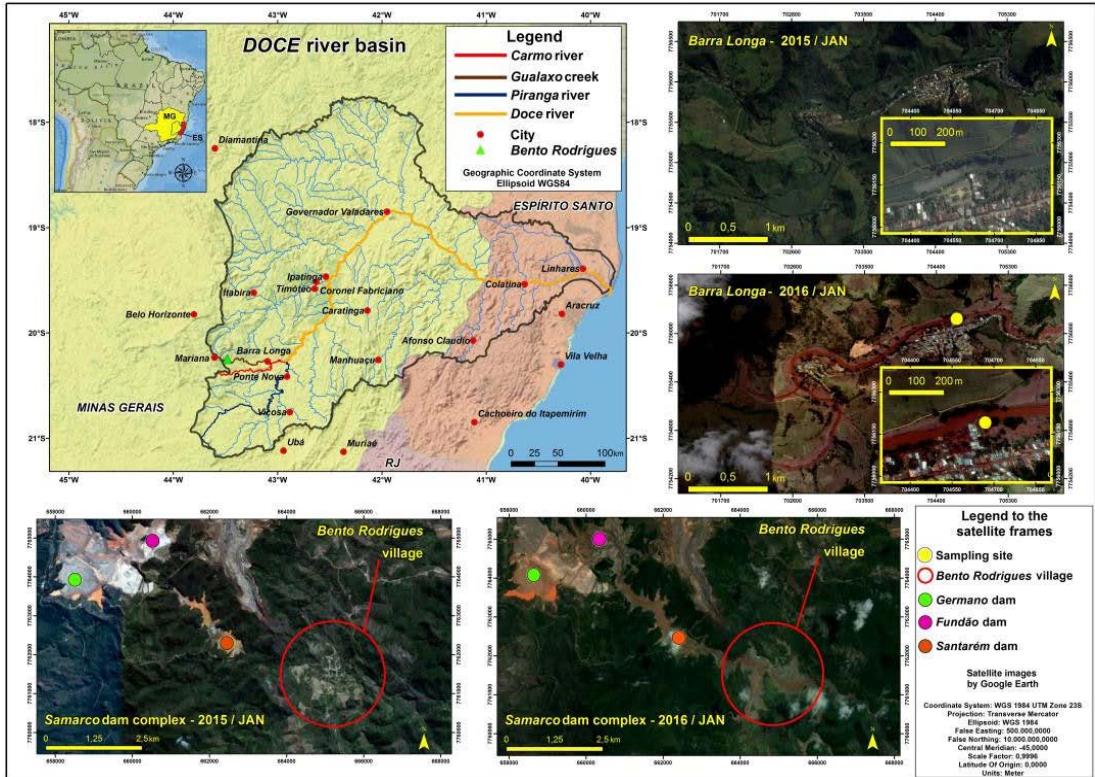 Figure 1: Upper left: the geographical context of the Doce River basin. The two pictures at the right show the sampling site in Barra Longa (just before the dam rupture, in 2015, and several months after, in 2016). The bottom pictures show the Samarco dam complex and the Bento Rodrigues county (also, in 2015 and in 2016).
### c) Chemical Analyses
Routine chemical analyses for soils and sediments (pH in water, organic matter, available P, $\mathrm{Ca^{2+}}$, $\mathrm{Mg^{2+}}$, $\mathrm{K}^+$, $\mathrm{Na}^+$, $\mathrm{Al}^{3+}$, $\mathrm{H} + \mathrm{Al}$ ) and for the Fe, Zn, Mn, Cd, Pb and Ni contents were performed in triplicate, according to methods described in Embrapa (2011). The sum of bases (SB), the effective cation exchange capacity (t), the cation exchange capacity at pH 7 (T), the saturation by base (V) and the saturation by aluminum (m) were obtained.
The determination of the C, H and N contents in the sample was performed in triplicate, with a LECO TruSpec Micro elemental analyzer equipped with an infrared detector. The samples were burned at $1075^{\circ}\mathrm{C}$ in a quartz tube to quantify the C, H, and N contents.
The X-ray fluorescence analysis of the sample was performed with a Shimadzu EDX-720 energy dispersive X-ray fluorescence spectrometer, with a rhodium tube and silicon-lithium detector. Data were collected under vacuum of 40 Pa with a 10-mm collimator.
### d) Mineralogical Analyses
The powder X-ray diffraction (XRD) pattern for the sample was collected in a Rigaku model D/Max Ultima Plus diffractometer set to a current of $30\mathrm{mA}$ and a voltage of $40\mathrm{kV}$, with $\mathrm{CuK}\alpha$ ( $\lambda = 1.541838\AA$ ) radiation, at a scan rate of $1^{\circ}2\theta\mathrm{min}^{-1}$, from $4^{\circ}$ to $100^{\circ}2\theta$. Silicon was used as the external
### e) Mössbauer spectroscopy
The Mössbauer spectra were collected at room temperature $(\sim 298~\mathrm{K})$, $80~\mathrm{K}$ and $25~\mathrm{K}$ in a conventional transmission spectrometer at a constant acceleration configuration with a $^{57}\mathrm{Co} / \mathrm{Rh}$ gamma-ray source and nominal activity of about $\sim 25~\mathrm{mCi}$. Doppler velocities were approximately $\pm 11.6~\mathrm{mm~s^{-1}}$. Mössbauer isomer shifts are quoted relative to an $\alpha$ -Fe foil at room temperature. The experimental data were fitted with Lorentzian functions by least-square fitting with a NORMOSTM- 90 computer program. Magnetization measurements were performed with a vibrating sample magnetometer (Lake Shore7404; with a noise base of 5 x $10^{-5}$ emu, a time constant of 100 ms at room temperature, and a maximum magnetic field of 2 T).
## III. RESULTS AND DISCUSSION
The mine reject was found to have a sandy loam size distribution (Embrapa 2013) and low clay content. Shaefer et al. (2016) found similar granulometric compositions in samples collected at several points close to the sampling of this study. The bulk density (Ds) of the tailings was relatively high, as was the particle density (Dp). These characteristics explain their very low porosity (Table 1). Shaefer et al. (2016) obtained Ds values between 0.94 and $2.38\mathrm{gcm}^{-3}$ and mean Dp values between 2.75 and $2.80\mathrm{gcm}^{-3}$. These reported data corroborate the results of this study. All these attributes make it difficult to re-establish the vegetation covering on the terraces, which are the areas with the best agricultural capacity, being most intensively used for agricultural crops and raising of livestock.
Shaefer et al. (2016) also pointed out that the settlement of the tailings progressively led to the hardening of the surface, In addition, the slow reestablishment of the vegetation covering in these terraces tends to favor the transport of the deposited waste by the waterways during the annual flood periods, making it a cyclical event.
Table 1: Grain size composition, soil density (Ds), particle density (Dp) and total pore volume (VTP) for the sample of mine tailings. The number in parentheses represents the uncertainty with respect to the last significant digit, as obtained from standard deviations of the mean, estimated from the measurements in triplicate.
<table><tr><td>Sand</td><td>Silt</td><td>Clay</td><td>Ds</td><td>Dp</td><td>VTP</td></tr><tr><td>58(2)</td><td>%36(2)</td><td>6(1)</td><td>t m-32.12(1)</td><td>2.85(8)</td><td>%25.6</td></tr></table>
The mining reject is alkaline and very poor in nutrients, presenting only moderate Ca contents (CFSEMG, 1999). According to Shaefer et al. (2016), the high pH value can be due to the use of NaOH in the beneficiation of the ore. The CEC value is very low because of the low clay and organic matter contents (Tables 1 and 2) and the highly oxidized nature of the
2016). Soils and petroplintites from the region of this study (Quadrilátero Ferríbero) also present a low CEC (Sahafer et al. 2015). CHN analysis yielded approximately 0.50 mass% of C, 0.06 mass% of N and 0.07 mass% of H, corroborating the small content of organic matter in the sample (Table 2).
Table 2: Chemical attributes and contents of metallic elements of the sample of mine tailings. OM: organic matter; BS: sum of bases; CEC: cation exchange capacity at pH 7; V: saturation by bases; m: aluminum saturation; nd: not detected.
<table><tr><td>pH (water)</td><td>P</td><td>K</td><td>Ca</td><td>Mg</td><td>Al</td><td>H+Al</td><td>BS</td><td>CEC</td><td>m</td><td>V</td><td>OM</td><td>Na</td><td>Fe</td><td>Zn</td><td>Cu</td><td>Mn</td><td>Cd</td><td>Pb</td><td>Ni</td></tr><tr><td>1:1</td><td colspan="3">mg dm-3</td><td colspan="9">- - - - - - - - - - - - - - - - - - - - - - - - - - - - - - - - - - - - - - - - - - - - - - - - - - - - - - - - - - - - - - - - - - - - - - - - - - - - - - - - - - - - - - - - - - - - - - - - - - - - -</td><td colspan="5">- - - - - - - - - - - - - - - - - - - - - - - - - - - - - - - - - - - - - - - - - - - - - - - - - - - - - - - - - - - - - - - - - - - - - - - - - - - - - - - - - - - - - - - - - - - - - - - -</td><td></td><td></td></tr><tr><td>8.24</td><td>3.58</td><td>1.44</td><td>1.76</td><td>0.02</td><td>nd</td><td>0.95</td><td>1.79</td><td>2.74</td><td>nd</td><td>65.20</td><td>0.71</td><td>1.67</td><td>409.2</td><td>1.5</td><td>2.4</td><td>441.4</td><td>nd</td><td>1.9</td><td>0.9</td></tr></table>
The percentages of heavy metals encountered — Cu, Cd, Pb and Ni in the form available for the plant use — are small or not detected, except for Fe and Mn, which are high (Table 2). Shaefer et al. (2016) found mean Fe and Pb levels of 499.2 and $0.41 \, \text{mg dm}^{-3}$, respectively, in samples of tailings from the same region, similar to those found in this study (Table 2).
Although Mn and Fe are plant micronutrients, high levels such as those found in the tailings (Table 2) can be toxic to plants (CFSEMG, 1999). The Mn and Fe contents in the waters of the Carmo River and the Doce River, respectively, were greater than the levels allowed for class 2 water (waters that can be destined for human consumption, after conventional treatment to protect aquatic communities and recreation), according to CONAMA Resolution 357 (Milanez and Losekann, 2016). The chemical attributes in the set do not favor the establishment of a vegetal cover.
A predominance of Si and Fe was observed by the X-ray fluorescence analysis (Table 3). Brant Meio Ambiente (2005) found similar Si and Fe values in the material deposited at the Fundão dam, 62.39 and 40.43 mass% (weighted average between clayey tailings and sandy tailings), respectively. Si predominates in both the sand fraction and the silt fraction (Table 1), which are the main wastes from the itabirite mine. The high Fe contents, both in oxide form and in the exchangeable form (Tables 3 and 2), indicate that the ore beneficiation process was not very efficient.
Table 3: Chemical composition of the sample as determined by X-ray fluorescence spectroscopy. The numbers in parentheses are uncertainties with respect to the last significant digit, as provided by the spectrometer.
<table><tr><td></td><td>Oxides
Content/Mass%</td></tr><tr><td>SiO2</td><td>53.2(1)</td></tr><tr><td>Fe2O3</td><td>37.33(3)</td></tr><tr><td>Al2O3</td><td>8.45(5)</td></tr><tr><td>SO3</td><td>0.47(1)</td></tr><tr><td>K2O</td><td>0.250(1)</td></tr><tr><td>MnO</td><td>0.127(1)</td></tr><tr><td>CaO</td><td>0.083(1)</td></tr><tr><td>P2O5</td><td>0.07(2)</td></tr><tr><td>CuO</td><td>0.017(1)</td></tr><tr><td>ZnO</td><td>0.002(1)</td></tr><tr><td>NiO</td><td>0.001(2)</td></tr></table>
Al was not detected in the exchangeable form, but its contents were significant in the oxide form (Tables 2 and 3). Brant Meio Ambiente (2005) also found significant levels of total Al. The Mn concentrations are low in the oxide form (Table 3) and similar to those found by Brant Meio Ambiente (2005), but they are high in the exchangeable form (Table 2). The Cu, Zn, Pb and Ni concentrations are low both in the oxide form and in the exchangeable form (Tables 3 and 2). The levels of these heavy metals in the waters of the Carmo River and the Doce River were lower than the levels allowed for class 2 water, according to resolution CONAMA 357 (Milanez and Losekann 2016).
The results of the mineralogical analysis (Figure 2) are in line with the results from the physical and chemical analyses. Characteristic reflections of the crystallographic phases for quartz SiO2 (JCPDS card # 46-1045), hematite, $\alpha$ Fe2O3 (JCPDS card # 33-664), goethite, $\alpha$ FeOOH (JCPDS card # 29-713), muscovite, KAl2Si3AlO10(OH)2 (JCPDS card # 7-25) and kaolinite,
Al2Si2O5(OH)4 (JCPDS card # 58-2001) were observed in the X-ray diffraction pattern. Schaefer et al. (2016) found quartz, goethite, hematite, and kaolinite in the tailings of the Germano and Santarem dams near the Fundão dam.
Si predominates in the sand and silt fractions, which together correspond to 94 mass% of all the material (Table 1). The kaolinite and Muscovite (Figure 2) correspond to minerals present in the silt and clay fractions. All the minerals identified have low CEC, corroborating the results of the chemical analyses (Table 2).
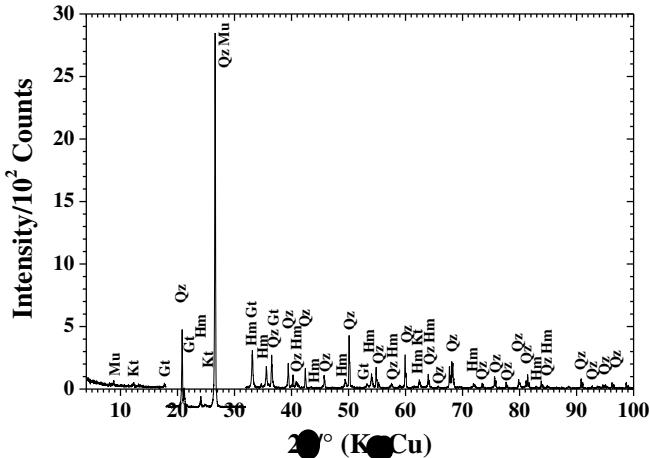 Figure 2: Powder X-ray diffraction pattern of the sample. Qz = quartz, Hm = hematite, Gt = goethite, Mu = muscovite, Kt = kaolinite.
From the Mössbauer measurements (spectra in Figure 3 and corresponding hyperfine data in Table 4), hematite $(\alpha \mathrm{Fe}2\mathrm{O}3)$, in greater proportion, and goethite $(\alpha \mathrm{FeOOH})$ were identified, corroborating the results of the mineralogical analysis by X-ray diffraction (Figure 2). The predominant portion of this hematite was found to undergo the Morin transition (characteristic temperature, $TM \sim 260~\mathrm{K}$ ), with a quadrupole shift from 0.485(2) mm s $^{-1}$ (at 80 K). This fraction is likely to be composed of larger particles of less isomorphically substituted and better crystallized hematite than that not undergoing the Morin transition. In addition to these Fe minerals, a small proportion of maghemite $(\gamma \mathrm{Fe}2\mathrm{O}3)$, a magnetic mineral usually associated with hematite and found in highly weathered materials of tropical and subtropical regions, was also identified (Breemen and Buurman, 2002).
Table 4: Mössbauer parameters corresponding to spectrum recorded at $80\mathrm{K}$. $\delta =$ isomer shift relative to $\alpha\text{Fe}$; $2\varepsilon =$ quadrupole shift; $\Gamma =$ line width; Bhf = magnetic hyperfine field; RA = relative subspectral area. (\*) Fixed parameter during the fitting procedure. $(^{**})$ Constrained parameter during least-squares fitting convergence. The number in parentheses are uncertainties over the last significant digit, as was estimated from the least squares fitting algorithm.
<table><tr><td>Temperature/K</td><td>Fe site</td><td>δ/mm s-1</td><td>2ε/mm</td><td>Γ/mm s-</td><td>BhfT</td><td>AP/%</td></tr><tr><td rowspan="4">80</td><td>αFe2O3</td><td>0.485(2)</td><td>0.385(5)</td><td>0.354(9)**</td><td>53.75(2)</td><td>51(1)</td></tr><tr><td>αFe2O3</td><td>0.48(1)</td><td>-0.18*</td><td>0.354(9)**</td><td>53.2(1)</td><td>9(1)</td></tr><tr><td>γFe2O3</td><td>0.59(3)</td><td>0*</td><td>0.354(9)**</td><td>48.9(2)</td><td>4(3)</td></tr><tr><td>αFeOOH</td><td>0.435(7)</td><td>-0.22(4)</td><td>0.49(3)</td><td>49.4(5)</td><td>36(5)</td></tr></table>
To minimize this degradation, some measures were experimentally tested by a team from the Federal University of Viçosa (Shaefer et al. 2016). The characterization of the material with a view to its use as a substrate for plants, including those to be used in the restoration of riparian forests, or its use as a raw material for civil construction are among the contributions of soil science proposed by Viana and Costa (2016) for the recovery of areas affected by the disaster. This is the main contribution of this work.
Figure 4 shows the magnetization hysteresis curve for the mine tailings sample. The saturation magnetization, Ms, is of 0.66(3) emu g-1; the remnant magnetization, Mr, is of 0.11(3) emu g-1 and the coercivity, Hc, is of 238.38(4) Oe.
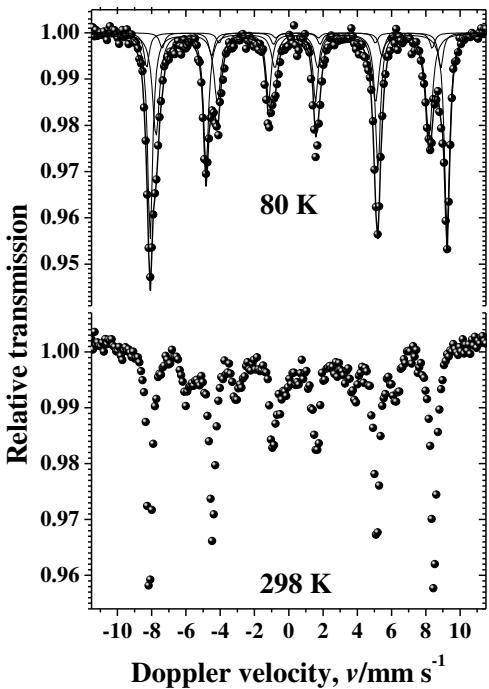 Figure 3: $^{57}\mathrm{Fe}$ Mössbauer spectra for the sample registered at 298 K and 80 K.
Figure 4 shows the magnetization hysteresis curve for the mine tailings sample. The saturation magnetization, Ms, is of 0.66(3) emu g-1; the remnant magnetization, Mr, is of 0.11(3) emu g-1 and the coercivity, Hc, is of 238.38(4) Oe.
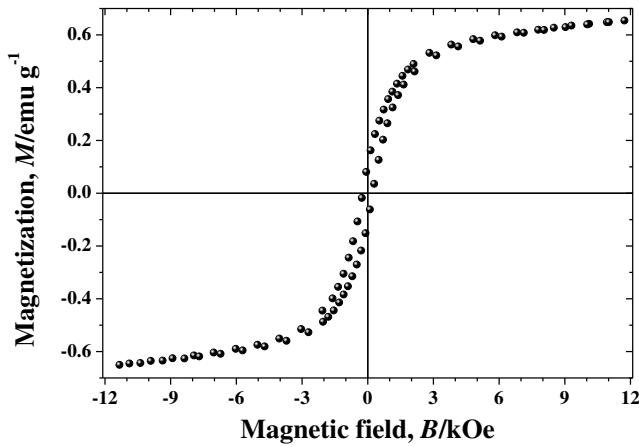 Figure 4: Magnetization curve for the sample at room temperature.
Both the physical, chemical and mineralogical attributes of mine tailings deposited on river terraces of the Gualaxo do Norte River restrict the restoration of native vegetation cover or agricultural activities. The main limiting factors are the high density and low porosity and the high exchangeable Mn contents. The exposed soil favors erosion on these terraces, making it even more difficult to restore vegetation and causing the silting of the river bed and contamination of its waters with Mn. The erosion-assortion-contamination cycle will be repeated annually, especially during rainy periods, to further degrade natural resources.
To minimize this degradation, some measures were experimentally tested by a team from the Federal University of Vicosa (Shaefer et al. 2016). The characterization of the material with a view to its use as a substrate for plants, including those to be used in the restoration of riparian forests, or its use as a raw material for civil construction are among the contributions of soil science proposed by Viana and Costa (2016) for the recovery of areas affected by the disaster. This is the main contribution of this work.
## IV. CONCLUSIONS
- The reject has high levels of sand and silt and a small clay content. Its densities of soil and particles are high, and the porosity is low.
- The pH is alkaline ante the contents of organic matter; plant nutrients and CEC are very low.
- The concentrations of exchangeable heavy metals Zn, Cd, Cu, Pb and Ni are very low and the exchangeable Mn contents of the tailings are large.
- The predominant total oxides of the tailings are SiO2 and Fe2O3.
- The most abundant minerals of the tailings are quartz and hematite.
- The physical, chemical and mineralogical attributes of mine tailings restrict the restoration of native vegetation or the agricultural use of the river terraces on which it was deposited.
### ACKNOWLEDGMENTS
We thank the Universidade Federal dos Vales do Jequitinhonha e Mucuri (UFVJM) for institutional support, the CNPq (Grants No. 305755-2013-7 and No. 305721/2015-1), Fapemig (Grants No. CEX - PPM-00412-15 and No. CAG - PPM-00568-16) and Capes (PNPD 2606/2011, process No. 2338007759/2011-52) for financial support and scholarships. JDF thanks CAPES for the PVNS grant in effect at the Universidade Federal dos Vales do Jequitinhonha e Mucuri (Diamantina, MG). The authors are indebted to professor David Lee Nelson (UFVJM) for kindly reading the manuscript and for all the suggestions presented, particularly those concerning the English language.
Generating HTML Viewer...
References
12 Cites in Article
Heitor Palma (2005). Recuperação variável dos tecnossolos do rejeito da barragem de fundão sob diferentes coberturas vegetais.
N Breemen,P Buurman (2002). Soil Formation.
Roberto Souza Silva,Mônica Rocha Ferreira De Oliveira,Graziela Siebert,Igor Andrade Moraes,Priscila Queiroz Messias,Milton Miranda Neto (1999). PROJEÇÃO DE UM AMBIENTE VIRTUAL PARA TRATAMENTO DE CLAUSTROFOBIA.
A Ribeiro,Ptg Guimarães,V Alvarez,Editores (null). Unknown Title.
Giselle De Assis,Cacilda Do Valle,Carlos De Andrade,Judson Valentim (2011). Selecting new Brachiaria humidicola hybrids for western Brazilian Amazon.
Eduardo Costa,Jalusa Kich,Marcelo Miele,Nelson Morés,Armando Amaral,Arlei Coldebella,Marisa Cardoso,Luis Corbellini (2013). Evaluation of two strategies for reducing the spread of Salmonella in commercial swine herds during the finishing phase and their incremental cost-effectiveness ratios.
J Fabris,Jhm Viana,Cegr Schaefer,F Wypych,J Stucki (2009). Métodos Físicos de Análises em Mineralogia do Solo.
B Milanez,C ; Losekann (2016). Desastre no Vale do Rio Doce: antecedentes, impactos e ações sobre a destruição.
Cegr Schafer,G Correa,A Pereira,J Nunes,Off Souza,A Marins,E Fernandes Filho,J Ker (2015). Solos desenvolvidos sobre canga ferruginosa no Brasil: uma revisão crítica e papel ecológico dos formigueiros.
Cegr Schafer,E Santos,E Fernandes Filho,I Assis (2016). Paisagens de lama: os tecnossolos para recuperação ambiental de áreas afetadas pelo desastre da barragem ambiental, em Mariana.
A Theisen,M Harward (1962). A Paste Method for Preparation of Slides for Clay Mineral Identification by X‐ray Diffraction.
Raquel Lacerda (2016). O uso do PSA como instrumento econômico na recuperação ambiental da bacia do Rio Doce.
No ethics committee approval was required for this article type.
Data Availability
Not applicable for this article.
How to Cite This Article
Krati Shukla. 2026. \u201cChemical, Mineralogical and Physical Characteristics of a Material Accumulated on the River Margin from Mud Flowing from the Collapse of the Iron Ore Tailings Dam in Bento Rodrigues, Minas Gerais, Brazil\u201d. Global Journal of Human-Social Science - B: Geography, Environmental Science & Disaster Management GJHSS-B Volume 23 (GJHSS Volume 23 Issue B1): .
Explore published articles in an immersive Augmented Reality environment. Our platform converts research papers into interactive 3D books, allowing readers to view and interact with content using AR and VR compatible devices.
Your published article is automatically converted into a realistic 3D book. Flip through pages and read research papers in a more engaging and interactive format.
The rupture of an itabirito mining tailings dam at the headwaters of the Doce River Basin (Minas Gerais and Espírito Santo, Brazil) caused the greatest environmental catastrophe of the planet Earth related to this activity. The tailings were deposited both in the bottom and on the riverside terrace of the rivers, causing silting and deep changes in the water quality and burial of the main agricultural areas of this basin. For these areas to return to predisaster levels, it is imperative that the material deposited on the river terraces be thoroughly characterized. The objective of this work was to characterize the material from the rupture of the Fundão dam, deposited on the river terrace of the Carmo River, a tributary of the Doce River. The material was collected at a depth of 0 to 30 cm from a tail layer about 3 meters thick deposited on the river terrace on the right bank of the Carmo River in the urban area of Barra Longa, Minas Gerais.
Our website is actively being updated, and changes may occur frequently. Please clear your browser cache if needed. For feedback or error reporting, please email [email protected]
Thank you for connecting with us. We will respond to you shortly.
Lorem ipsum dolor sit amet, consectetur adipiscing elit. Ut elit tellus, luctus nec ullamcorper mattis, pulvinar dapibus leo.
Chemical, Mineralogical and Physical Characteristics of a Material Accumulated on the River Margin from Mud Flowing from the Collapse of the Iron Ore Tailings Dam in Bento Rodrigues, Minas Gerais, Brazil