
I. INTRODUCTION
The Paris Climate Agreement and the 2030 Agenda on Sustainable Development, encompassing the 17 Sustainable Development Goals (SDGs), were both adopted in 2015. The objective of these global schemas has been to have a global system that has low-carbon imperatives as well as being climate-resilient in its quest to attain sustainable development. Despite these ratifications and agreements, many countries have been extremely slow as they still are engulfed with serious challenges in their effort to embark on measures and interventions to enforce these agreements (UN, 2019). Another factor that has led to the snail-paced progress has been the pussy-footing posture by countries who although have proposed commitments in
Nationally Determined Contributions but have not close to the goal of global temperature to less than (H"ohne et al., 2020; Climate Action Tracker, 2021). The main challenge that affects Parties in their determination to enforce some of these interventions and NDCs has been the issue of finance and inadequate resources. McDonald et al. (2021) report a statement by the President of the COP26, the 26th UN Climate Change Conference who averred "Unless we get finance flowing, we cannot and will not see the action we need, to reduce emissions, to adapt, and to rise to the growing challenges of loss and damage" (p.1). Climate finance has been the missing link affecting transitions towards climate resilience, low carbon, and enforcement of Nationally Determined Contributions (NDCs) of Parties, especially those in the developing world. According to Yeo (2019), such a transition to climate-resilient because such transition would require huge sums of dollars to transform these aspirations into actionable programmes. For example, the IPCC has projected that at least US$ 830 billion in investments would be required between 2016 and 2050 to plummet the incidence of global warming to 1.5 OC by the year 2100 (Masson-Delmotte et al., 2018).
Despite the centrality of finance in meeting objectives of climate resilience, ownership of climate resilient actions calls for alignment between donor countries' finance and recipient countries' priorities, including their focus on mitigation versus adaptation (e.g., UNFCCC, 2017; Bouy'e, Harmeling & Schulz, 2018). As a recent example, it is worth quoting the COP26 President, who, in the aforementioned conference, stated, "Finally, a major concern on [climate] finance is improving accessibility. An indicator of the current state of affairs is the low level of finance making its way to the most vulnerable nations" (Mott McDonald et al., 2021, p.7). There has been particular attention to the developing world because these people are vulnerable and their poverty levels affect the adaptation to climate change, coping mechanisms, and efforts at deploying climate-resilient interventions (Brown, 2011).
Although developing countries are the worst hit by climate change impacts, mitigation, and adaptation measures tend to be hampered by inadequate financial resources (Islam, 2020; Brandstedt, 2019). Meanwhile,
the general flow of global climate finance tends to find its way to those areas that are not relatively in dire need and vulnerable positions which raises the question of distributional equity (Islaim, 2020). Even within countries, the fewer available resources may end up not finding their way to the vulnerable and susceptible areas or groups of people but to other places or perhaps for other administrative purposes other than the real interventions thereof (Adger et al., 2006; Barnett & O'Neill, 2013). Even in those circumstances where resources get committed, it is possible to have situations where these climate interventions do not get enforced and monitored effectively which brings about a gap between expectations and actual results (Boyd et al, 2021; Chakraborty et al, 2020). The notion of 'climate justice' is increasingly being used in framing debates and discussions on these questions, underpinned by an expectation that such a justice-based approach would improve the legitimacy of the international climate finance regime, promote consensus and collective action and thus make international climate policies more successful (Baatz, 2018; Gifford & Knudson, 2020; Khan et al., 2020).
Because of the complexity of climate risk challenges that confront developing countries coupled with poor resources, they are likely to result in maladaptation. According to Schipper (2020) maladaptation refers to "when adaptation to climate change goes very wrong," (p. 409) and it involves those occasions when attempts to adapt and mitigate climate change through interventions do not go as planned because they failed to see the bigger picture.
Although the literature has attempted to explore the involvement approaches and justice perspectives of varying non-state actors including NGOs in the environmental sector (Chatterton et al., 2013, Derman, 2014), religious actors (Glaab, 2017) and farmers (Sova et al., 2015), what seems to be a guiding framework which will drum home how donors and policymakers would go about climate financing to promote justice to reduce vulnerability has not been given the needed attention. What occurs is that at the supra level resources get distributed but how best these resources meet the vulnerable groups and spaces to indeed help in adaptation and mitigation interventions remains quintessential. The main objective of this study has been to assess the extant literature to examine the key constraints that affect climate financing; notions of climate justice and injustice and how best global climate finance can effectively be deployed to meet the coping requirements of the vulnerable ones. The study sought to design a comprehensive framework that will guide stakeholders in the climate finance and climate justice space to help in their research and practice.
II. LITERATURE REVIEW
a) Concept of Vulnerability
The IPCC conceptualizes vulnerability to mean the tendency or susceptibility of an entity to be undesirably plagued by climatic forces, which also takes account of its sensitivity or susceptibility to harm, and the unavailability of the wherewithal and capacity to deal with and adapt (IPCC 2014, IPCC, 2007). By way of the equation, vulnerability (V) denotes a body or region's exposure (E) to climatic variabilities including the entity's sensitivity (S) to such variabilities and the adaptive capacity of the said entity to the said climatic changes successfully. This is expressed as (Islam & Al Mamun, 2020). Vulnerability thus is an interdisciplinary construct, incorporating both natural (e.g., climatic processes and events) and social dimensions (e.g., adaptive capacity) of climate change impacts. It posits that an entity, despite its exposure to climatic changes, may remain unharmed if it has the requisite adaptive capacity. At the country level, such capacity may include a country's assets and infrastructure, governance quality and effectiveness, scientific robustness, and the educational level of the population (Hughes et al., 2012).
b) Adaptation and Social Justice
In the realms of climate adaptation, and climate-resilient interventions, Adger et al., (2006) argue that a vulnerability analysis avers "all adaptation decisions, such as fiascos and debacles to act, tend to espouse justice implications, both distributive and procedural (p. 15). Arguing from the distributive justice perspective, the vulnerability framework focuses on "the social, economic and institutional forces which affect the degree of vulnerability within a particular space or jurisdiction thereby enhancing or worsening choices or alternatives for adaptation" (Kelly & Adger, 2000 p.326). The foregoing on distributional justice reiterates the need to pay peculiar attention to the imbalanced access that different people and farmers have to relevant forces of production such as land, capital, technology, and markets.
The literature (McDonald et al., 2021; Yeo, 2019) has consistently made a case that resources for climate change adaptation have remained extremely lower than mitigation finance even though the general transfer of finance has improved over the years. There are many cases where poor countries that are susceptible to climate vulnerabilities despite their chronological struggles for greater adaptation funding, tend to rather be saddled with growing mitigation funding. This is a clear case of distributive justice.
There has been copious treatise on factors that bring about the flow or distribution of adaptation finance (Doshi & Garschagen, 2020; Mori et al., 2019; Weiler & Klock, 2021), yet only a few of these had focused on the
vulnerability aspect of these allocations (Doshi & Garschagen, 2020; Weiler et al., 2018). These growing studies have resulted in variegated conclusions. Whilst one school of thought observed vulnerability to be associated with a positive impact on adaptation funding ((Betzold & Weiler, 2017; Weiler et al., 2018) reporting; another school of thought observed no impact (Persson & Remling, 2014; Robertsen et al., 2015); a third school of thought observed an insignificant or a negligible impact (Doshi & Garschagen, 2020). Consequently, the quantified impact of these studies has not been consistent; for example, whether the most vulnerable countries receive more or less adaptation funding (Weiler et al., 2018).
There is a growing body of research that focus on distributive justice concerns agitated by in nation-states vis-a-vis other states (Morgan & Was kow, 2014, Okereke, 2010). These studies tend to put a spotlight on the growing disparity in terms of the participation of state actors and NSAs in the UNFCCC activities and the implications for procedural justice and legitimacy. NSAs do not have the same access to formal mechanisms of participation: they can't directly participate in the negotiations and don't experience participatory parity with state actors. However, they can play a role in shaping invisible rules and discourse by engaging with formal participatory mechanisms facilitated by the UNFCCC for the nine recognized NSA constituencies.
i. Climate Justice
The climate justice argument assesses compensatory efforts that emanate from advanced industrialized states to vulnerable but developing states to address inequalities in climate actions (Ciplet et al., 2013; Clark, 2012; Hulme, O'Neill, & Dessai, 2011). In other words, adaptation finance initiatives serve as recompense for the disparities of climate change (Barrett, 2014); this involves sums of money available for alternative livelihood programmes in those areas susceptible to drought, sums of money for water conservation and alternative sources, sums of money for flood mitigation, as well as climate-related disaster management
III. METHODS
This study is essentially qualitative and deploys the critical stage review by synthesizing from secondary sources of data. Data were derived from the extant literature (both theoretical and empirical studies), essentially sourced from journal articles and scholarly books to examine the notion of climate justice and the challenges developing countries face in their efforts at adaptation and mitigation to climate change. More importantly, the study assessed literature relevant to enhancing climate justice and funding for NDCs of the developing world especially those with vulnerabilities.
The literature search covered all terms and terminologies as approximately related to climate vulnerability, climate justice, and financing. In the process, we combined adjectives related to common obstacles faced by vulnerable countries in meeting their nationally determined contributions (NDCs). The particular words involved, inter alia 'challenges', 'constraints', 'problems', 'setbacks' and 'hindrances'.
Afterward, the study added some words that are relevant to measures for improving the process of climate justice and resource allocation. The words included 'value' 'enhancing' 'promoting' 'successful' and 'effective'.
The different adjectives and the concept of climate justice, finance, and vulnerability were combined variously to derive a pool of critical literature on the study. These three main domains were adopted due to their relevance to the topic and availability to the researchers: Science Direct, T and F online, and Google Scholar. The large pool of resources was primarily sorted for applicability, this we did by flicking through their synopses. After this exploratory procedure, each of the researchers read the synopses independently and thoroughly. At the end of the process, authors convened to exclude duplicates after which narrowed down the list of abstracts required for in-depth analysis. Through these processes and steps, the study has come out with widespread cataloguing of forces that come together to make for climate justice, the flow of climate funds to relevant vulnerable spaces and groups for their adaptation and mitigation purposes. With the aid of tables, we catalogued all the relevant indicators or factors required for enhancing climate justice and climate financing to help vulnerable entities to cope well with climate change. These different indicators which were originally in their raw or unclassified form were subsequently organized or classified into three main themes: Systems approach; Verification; and Equity philosophy. This has been developed into the SAVE framework (see figure 1) which has been discussed in section 4.2.
IV. ANALYSIS AND DISCUSSION
This section discusses key challenges associated with climate funds, vulnerabilities, and inequalities involved in the allocation of climate funds. The section does this as a way of demonstrating the inequities and injustice in climate change adaptation and mitigation efforts. More importantly, the study discusses relevant pointers or signposts to ensure effective climate targeting and financing to make for a more just process.
a) Vulnerabilities and Inequality in Climate Financing
i. Vulnerable Yet Inadequate Receipts of Climate Funds
There have been reports of disproportionate allocation of climate funds in which those that are mainly susceptible to climate change impacts tend to receive less funding for their adaptation and mitigation efforts. Deploying the expression or equation of climate vulnerability as illustrated by Islam and Al Manun (2020), this study contends that those regions and people who have greater exposure to climatic changes, with greater sensitivity to such changes tend to have the least adaptive capacity and mechanisms. In other words, the social dimensions of climate change tend to make poorer countries and vulnerable very more susceptible to climate change and variability despite the ecological milieu already making them worse off. Empirical studies (Betzold & Weiler, 2017; Weiler et al., 2018) have observed significant positive impacts of Gross Domestic Product per capita on adaptation aid amounts (see also Islam, 2022). However, other works such as (Bagchi et al., 2016; Mori et al.2019) have discovered a negative effect of Gross Domestic Product per capita on both mitigation and adaptation aid amounts.
ii. Variables and Access to Climate Finance
Population
The population size of recipient countries has been a useful indicator that has been extensively regarded in research on both adaptation and mitigation funding disbursement. The rationale is that larger countries require extra support and research provides the positive relationship between this variable and climate funding allocation for mitigation and adaptation purposes (see Halimanjaya, 2016; Weiler et al., 2018).
Regional Location
A different indicator incorporated in the literature is the regional location of recipient countries. For example, states in Sub-Saharan Africa and South Asia are considered to be more vulnerable to climatic changes, and hence, in need of more adaptation funding, yet results are mixed regarding whether these regions receive proportionate amounts of climate funds or not. Whilst others (Weiler et al., 2018; Weiler & Klock, 2021) observed that states in that Africa were positioned to obtain adaptation finance more than their non-African compatriots, other empirical works failed to observe the possibility or probability (Betzold & Weiler, 2017; Robinson & Dornan, 2017).
Social Indicators
On the social front, some climate-vulnerable countries may lack the requisite human resources, skills, and infrastructure to be able to access climate funds. For example, to receive funding, a vulnerable country must be able to articulate and provide evidence of its vulnerability to funders. This may be quite challenging
because of a lack of country-specific historical climate data, skilled human resources, and IT infrastructure (Chase et al., 2020; Fiala et al., 2019), as well as considerable ambiguities surrounding the terms 'climate finance', 'vulnerability', 'mitigation', 'adaptation', and 'development' (Chandler et al., 2002; Hall, 2017;
iii. Poor Detection Due to Disaggregation Problems
An empirical study by Islam (2022) made some key observations that were very revealing. He noted that less adaptation and overlap climate funds found themselves in South Asia and Sub-Saharan Africa which were curiously the spatial locations in the world with regions that are very susceptible to climate risks. Ordinarily, those regions (spatial locations) with the greatest vulnerabilities and incidence ought to have the corresponding flow of resources yet the human (social indicators) factor to ensure this flow has been the missing link that tends to affect overall adaptation and mitigation efforts of these poor and vulnerable countries. The empirical study through quantitative computations revealed that although these South Asia and Sub-Saharan Africa were the regions with significant correlations with vulnerability, the same were the regions with the least global climate funds flowing to (Islam, 2022). The author observed significant correlation coefficients for vulnerability and South Asia with Sub-Saharan Africa recording (p. 13).
This latest empirical work (Islam, 2022) has come to contradict or refute earlier studies (Robinson & Dornan 2017; Weiler & Klock 2021) which had reported insignificant impacts or positive impacts. One may be tempted to make a similar mistake if they lump all countries and sub-regions together as one such as "Africa" or a supra region without necessarily disaggregating to observe the patterns and trends. It is crucial for those respective sub-regions that are most vulnerable and susceptible to be disaggregated and delineated to know the respective interventions and support required to make them effectively adapt and mitigate climate change impacts.
iv. Poor Detection Due to Disaggregation Problems
Due to this tendency, Fussell and Klein (2006) contend that developing countries tend to encounter a 'double inequality'; this is because this region has contributed insignificant pollutants and global warming (human-induced climate change), that notwithstanding, this is the region where poor resources and low adaptive capacity tends to make them unable to cope, withstand, make progress and surmount the adverse effects when compared to more developed nation-states.
v. Injustice Emanating from Processes and Procedures
This has got to do with those institutions, processes, mechanisms, and procedures used in the decision-making processes of climate change issues.
Procedural justice examines the extent to which these institutions and procedures are fair and demonstrates equity and involvement of all relevant groups and voices (Barrett, 2013; Paavola & Adger, 2006). It is very common to various vulnerable groups, especially the youth whose interests may be left unattended or whose voices are not given much-desired attention.
vi. Injustice Emanating from the Allocation and Distribution of Climate Resources
There have been many situations where resources for climate change adaptation, mitigation, and coping strategies tend to be skewed in favour of those who may already be well-to-do or not very much adversely affected in relative terms. This may suggest that those regions and groups who may be very vulnerable and worse hit by climate change may be at the backburner of the flow of climate funds (Agyeman et al., 2016) which obviously will affect their coping abilities, mitigation, and adaptation mechanisms. The idea of distributive justice is concerned with the equitable or even-handed distribution of climate funds and other positive related resources or services which may include, inter alia recovery aid, social programs, and greenways. Additionally, distributive justice contends that those negative consequences which may include inter alia, dumping sites, and toxicity emanating from global production needs to be equitably distributed dumping sites and toxicity in society (Agyeman et al., 2016; Schlosberg, 2009).
What has become the norm is that developed countries, which are blameable for most of the global emissions, tend to have and wallop in the high standard of living that has been necessitated by their history of development from mass production and global emission
and pollution (Schlosberg, 2012). Meanwhile, third-world countries with low historical emissions are rather undergoing severe impacts of climate change, which include incensed precipitation incidence, prolonged droughts, temperature variations and wildfires, and inundations from increasingly severe storm-related flooding and/or sea level rise (Barrett, 2013; Posner and Weisbach, 2014). Disproportions in carbon emissions illustrate a specific case of climate justice (Schlosberg, 2009; Hayward, 2006).
Recognition as justice addresses how a community's reputation or disparaging views held by a government in power that is representative of a demographic majority affect marginalized populations, their challenges, and the outcomes of their claims for equity (Schlosberg, 2009).
b) Signpost to Promote Climate Justice and Financing to Reduce Vulnerability
The study has detected the key constraints that affect vulnerable countries and groups concerning climate finance. This section assesses and discusses key measures that will help in framing vulnerability assessment and how best to put in place mechanisms to make effective interventions to optimize the coping, adaptation, and mitigation of vulnerable entities. Gleaning through the extant literature, the following key themes have been elicited from both the theoretical and empirical works to design the framework below. From the extant literature, we observed different indicators or forces which add up to ensure climate justice and climate financing to reduce its impact on vulnerable people. Table 1 below highlights the relevant factors in an uncategorized format.
| Factors/indicators | Source/references | |
| Total system: socio-ecological | Nelson et al 2007 | |
| General system is key to individual success | Eriksen et al, 2021 | |
| A focus on individual households not enough | Goulden et al., 2013; Alves and Mariano (2018) | |
| continuous monitoring and reevaluation | Fiala et al., 2019; Chase et al., 2020; Doshi | |
| Power dynamics and relationships | Fraser, 2007; Fraser, 2014 | |
| Commitment of pledges and NDCs | Caney, 2010; Moellendorf, 2012; Schlosberg, 2012; Schlosberg and Collins, 2014; Hayward, 2006; Paavola and Adger, 2006 | |
| Systems Approach | Verification | Equity Philosophy |
| Total system: socio-ecological | Continuous monitoring and re-evaluation | Distributional justice |
| General system is key to individual success | Follow up and ensure compliance on implementation of interventions | Intergenerational equity and justice |
| A focus on individual households is not enough | Inter-sectoral equity: Diversity | |
| Power dynamics and relationships | ||
| Commitment of pledges and NDCs |
From the raw indicators or factors, the table below attempts at classifying or grouping the indicators under broader three themes.
The classified or categorized indicators in table 2 have been used to design the SAVE model (figure 1) which has been discussed in section 4.2.
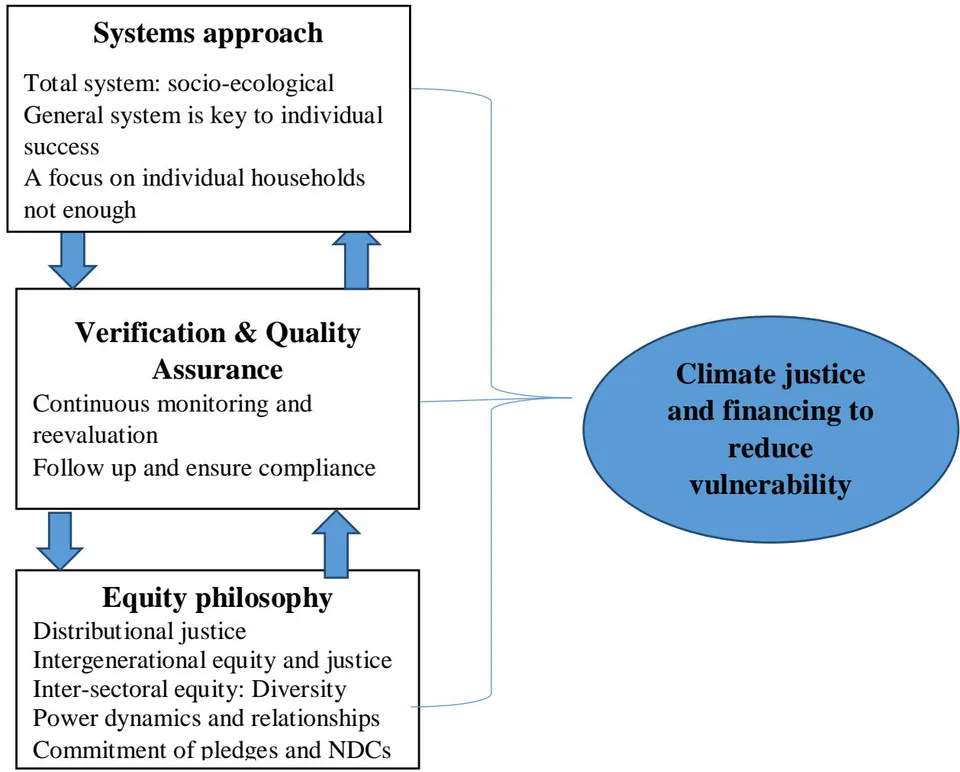
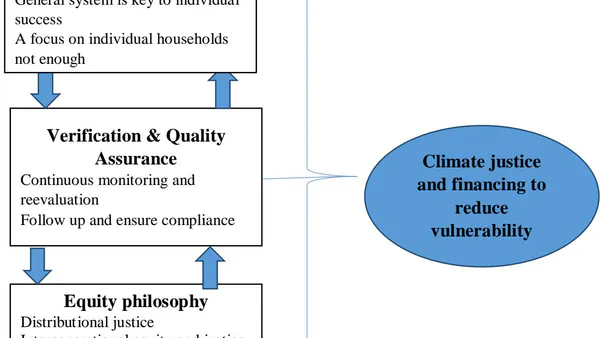
The SAVE model (figure 1) contends that ensuring climate justice and equity in climate financing reduces the plight of vulnerable groups and regions. When done effectively, it will help optimize the coping strategies, adaptation, and mitigation to the impact of climate change. The model entails ten (10) main
indicators which are crucial in climate financing to ensure equity. These 10 indicators have been classified or organized into three main themes. Consequently, the three main themes give form and nomenclature to the framework: SAVE model;
Expressed in the equation: ; explained as Systems approach, Verification, and Equity philosophy respectively.
Systems approach (Total system; General system is key to individual success; A focus on individual households not enough)
i. Total System: Socio-Ecological
To ensure effective climate fund transfer for proportionate coping, adaptation, and mitigation activities, the framing and analysis of the total system remain very critical. There is a tendency to conceptualize the phenomenon in a less coordinated manner. In other words, there are moments where attention is paid to human actions only and not the whole system or interaction of the social and climatic forces that produce synergy whose outcome could be dire or have far-reaching implications. We contend that 'resilience thinking' needs to regard a "vulnerable spatial unit" as an integrated social-ecological system, where we do not only lay emphasis on social (human processes) but on the system as a whole unit, whilst paying more attention to the interaction of its component units. The foregoing has been observed by Nelson et al (2007) who contend such tendency and approach points to a recognition that "the ability to adapt is a function of system components" (p. 400)
ii. A Focus on Individual Households Not Enough
More related to the above, the framework contends that those adaptation and mitigation efforts need not only target the individual households but attempts should be made to build the robustness of the system. Once the resilience of the macro system is enhanced, the ability of individuals to cope with their micro issues such as alternative livelihoods can be optimized. Goulden et al (2013) observe "adaptive actions that increase the resilience of households and their livelihoods do not always increase the resilience of the system" (p. 921). This tends to render the former not very efficacious. Consequently, Alves and Mariano (2018) admonish that climate justice needs to be conceptualized as an appreciable complementation or consideration of human development programmes and climate actions. The point is that climate actions have the potential to augment the attainment of human development programmes whilst human development policies tend to augment the effective operationalization of climate actions.
iii. General System is Key to Individual Success
Following from the point above, the framework contends that a resilience viewpoint recognizes the inevitability of dynamics in the environment and argues for fixing the resilience and coping ability of the system which can accommodate individual households' welfare. There is a need to have an adaptation system that
stimulates the capability and resilience of the system to support the new dimensions and change.
Verification and Quality Assurance (Continuous monitoring and re-evaluation; Follow up and ensure compliance)
By verification and quality assurance, the framework posits that all procedures and actions are to be enforced tactically taking into account sound technical and implementation models. More importantly, it requires monitoring to verify if stated action plans and programmes are followed keenly and should be given key prominence. It goes without saying that if donors or consultants provide climate funds and put in place no proper mechanisms for formative evaluation which requires regular monitoring and compliance, the intended outcome may not be achieved.
In other words, there is a need to follow up and ensure compliance on the implementation of interventions.
According to Barrett (2013), by ensuring strict monitoring of how climate funds get deployed or utilized at the local level, funders and those with policy oversight can detect the distribution pathways and trails to the most vulnerable states, districts, communities, and real targets. International climate finance transfers disclose whether these resources indeed flow to indeed vulnerable countries; local climate finance undertakings should also control to verify if indeed climate funds are allotted to those regions and districts or communities that are very susceptible to climate change impacts. With these varying and overlapping verification structures and mechanisms, at all points, climate finance will indeed be deployed to those areas where the resources are indeed needed for adaptation and mitigation purposes. According to Paavola & Adger, (2006); the notion of climate justice has been to detect if indeed vulnerability is the chief criterion for distributing climate finance. This point has been corroborated by Ayers (2009) that climate justice suggests vulnerable stakeholders indeed become beneficiaries of climate finance whilst Bird et al (2011) call for equitable apportionment to those countries that are very susceptible or open to climate change impacts. To promote these notions of climate justice requires effective verification at multi-governance levels and to follow-up to the local implementation levels.
Meanwhile, there have been reports of structural capacity constraints which affect climate justice. For example, Fiala et al (2019) in assessing the project documents of about 93 Global Climate Fund-supported projects found that were not underpinned by a precise conceptualization of "transformation" whilst failed to incorporate the procedures for evaluating "transformation" whilst only a maximum of approximately had in them quantifiable pointers or procedures for appraising transformation. The foregoing is an indication that most projects on climate finance
tend to be overly focused on the money but the processes and quality assurance measures to ensure the resources lead to an improved change in the lives of vulnerable groups and societies tend to be at the backburner. This point has been corroborated by Chase et al (2020) who observed that many of these projects do not have the relevant capacity to put in place effective project proposals whilst others fail to incorporate chronological data on the climate of the respective data, inadequate or poorly trained personnel and poor technical backgrounds of these individuals. More problematic was poor know-how in monitoring and evaluation of the projects which cumulatively affected the efficacy of their bids to access climate funds and even the outcomes of such projects if they became successful.
Observing the above, Doshi and Garschagen (2020) contend that these structural constraints do not give adequate assurance to donor countries and groups that recipient entities or states would efficiently and effectively enforce and lead interventions that genuinely help vulnerable people and areas to adapt and mitigate climate change which continues to plummet the possibility of accessing such funds.
Receiving countries or states need to demonstrate technical prowess and assure donors of the necessary quality assurances put in place to effectively police or enforce climate funds efficiently and effectively. If reports of corruption are high coupled with conflicts and violence as occur in many of these third worlds, developed countries or funders will not be convinced to release funds as they may regard such as a high risk to their funds or investment (see Betzold & Weiler, 2017; Halimanjaya, 2016). To give the required assurance, there is the need for adaptive governance which places value on intricate knowledge of ecological issues, incessant monitoring, and reviews as the projects kick start, agility, and dynamic learning which can anticipate and navigate through any happenings in the environment to ensure project success (Folke et al., 2005).
Equity Philosophy
The whole notion of climate justice has been centred on doing the right thing and providing resources to those who are indeed vulnerable and susceptible to global climate impacts. Barrett (2013) contends that the distribution of climate finance to the utmost vulnerable spatial locations and groups signifies the preponderance of climate justice as a multi-scalar process and should essentially use vulnerability as an indicator. The above notwithstanding, the extant local literature tends to drum home that other forces determine fund allocation. Particularly, political convenience, interests of policy and political elites, interests of government officials as well as identity benefaction, unfortunately, tend to underpin resource
allocations (Reinikka & Svensson, 2004; Azam, 2001; Posner, 2005).
Barrett (2014) observes cases where instead of funds being channelled to substantially vulnerable districts to address droughts and floods; weside-step those societies and groups undergoing the extreme climate hazards. Rather, the well-to-do areas tend to be given these resources that protect against climate variability and change whilst those communities which are at the bottommost economic, social, and political are at the backburner and these undergo the maximum hostile impacts of climate change which involves inter alia: deteriorating farm harvests, fleeting dislodgment, disease epidemic, and deteriorating living condition. He puts it succinctly that "the provision of proportionately fewer funds to those with the highest climate risk indicates the most eligible are given the least resources to address the inequalities of climate change" (ibid p 139).
iv. Distributional Justice
Distributional justice connotes ecological consequences and denotes the degree to which environmental resources, or contrariwise ecological threats or hazards, can be said to be distributed equitably. The notion of climate justice has got to do with intricate virtuous and ethical issues with the adoption of climate coping mechanisms (Adger et al., 2017; Sovacool, 2013).
Other non-state adaptation processes are undertaken by persons and groups with the skillset, interest, capacity as well as resources to engage in these. These are mostly not predominantly susceptible to climate change variability. Cumulatively, the impact of climate finance flowing to private adaptation [resources that go into hands or groups that are not vulnerable but except they find beneficial] tends to compound the inequality argument (Adger et al., 2006). With their connections and sophistication, these private adaptation entities tend to receive climate funds though they themselves are not vulnerable whilst the vulnerable groups may not have access.
v. Inter-Generational Equity and Justice
Intergenerational justice addresses issues of temporal allocation of wealth and tasks between generations. In other words, whilst disbursing the positive aspects or resources, we need to also take into account the needs of generations to come whilst also considering the prevalent fledgling cohorts or population (Norton, 2002).
Intra-generational justice on the other hand has to do with the spatial distribution of resources and consequences between various geographical locations and among varying groups (Norton, 2002). The latter tends side-stepping the varying experiences of various community groups and groups within the country (Fraser, 2010).
It is therefore crucial to take into account the needs of varying groups, minorities, and those that are very vulnerable to climate change impacts when planning the distribution of climate finance. Additionally, in the planning process, the needs and future requirements of the younger generations is to be accounted for.
vi. Inter-Sectoral Equity: Diversity
From the foregoing, it goes without saying that there is a need for recognition of different social groups as a precursor to maldistribution (Honneth, 1996, Taylor, 1994, Young, 1990). A justice perspective poses key questions related to who those groups are to adapt to and under what circumstances. In other words, to what extent are the adaption process and mechanisms fair to the bigger society and respective groups and communities? Is there a commitment to demonstrate fairness, or it is underpinned by a rule of thumb that only corroborates the existing structural, economic, and political order where resources flow to the rich and those connected?
Fraser (1995) contends that recognition should be considered alongside distribution, exploring who is included and excluded in decision-making processes. This framework argues for the need to account for the various identity groups and spatial locations as well as minorities who are affected by climate risks to ensure equity in the process.
vii. Power Dynamics and Relationships
Fraser highlights the prominence of power in influencing justice (Fraser, 2014). The need to allow various groups and individuals to participate in decision-making processes. The ability to influence decisions and resource flow depends on the extent to which people are made to participate in the process. This point has been observed Fraser (2007) that "the capacity to influence public debate and authoritative decision-making depends not just on rational decision structures but also on power relations engrained in the economic order and social standing" (p.31).
viii. Commitment of Pledges and Ndcs
Caney (2010) contends that social justice approaches to mitigation generally put a premium on the 'polluter pays' approach as well as the 'common but differentiated responsibilities' norm. These principles reckon the remarkable responsibility as well as the distinct ability of states to honour some payments using their positioning in the global economic order.
Climate justice research views climate change impacts vis-a-vis those countries, sectors, communities, or individuals that are responsible for the greatest and greenhouse gas emissions (Schlosberg & Collins, 2014; Hayward, 2006). Climate justice considers three forms of equity whose violation would constitute injustice that limits the capabilities of an individual or group to maintain a high quality of life in the face of climate change (Agyeman et al., 2016). A major rationale put forward to explain why advanced countries make available or ought to arrange for climate finance to developing countries involve arguments such as addressing moral imperatives to atone for historical responsibility or culpability in global emissions (Meyer, 2013).
V. CONCLUSIONS AND POLICY IMPLICATIONS
From the framework and discussion, the study makes the following key conclusions and proffers the following policy implications.
Firstly, the study concludes that climate financing has not been adequately used as a tool or mechanism to demonstrate justice and fairness in the global distribution of climate resources. The extant literature could not provide uniform evidence to demonstrate a positive relationship between vulnerability, poor coping mechanisms, and receipt of climate finance. More worrisome is more recent literature even points to negative relationships as sub-Saharan Africa and South Asia which are more vulnerable have been called out due to poor relative receipts.
The study concludes that other factors other than vulnerability underpin the distribution of global climate finance because more vulnerable spatial locations and groups have not been the greatest recipients. This study argues for the need to disaggregate spatial entities to unpack those regions and sub-regions as well as groups that are greatly susceptible to climate impacts to receiving greater flows of climate finance. There is a need to conceptualize vulnerability more effectively. This study agrees with the extant literature that "how vulnerability is defined and measured is key to climate justice as it subsequently affects the types of actions taken to respond to climate change and determines who will benefit and how from these actions (see Burnham et al. 2013 p. 242). This position has been given support by O'Brien et al. (2007) that a localized operationalization of vulnerability emerged as a moral response to observed social inequities in the impacts of social and environmental change" (Eakin et al., 2009: 214).
Secondly, the study concludes that the inability of most groups and entities to access global climate finance has been inadequate technical details and lapses in the application process as well as capacity challenges of the recipient entities.
Additionally, this study concludes that promoting justice in climate financing requires a systems approach that entails a need to focus on both the social and ecological aspects of climate actions and interventions. We put forward that in as much as targeting individuals to be able to adapt and mitigate remains crucial, it becomes more effective if there are efforts to stabilize the system or macro environment as well. There should not be an attempt to delink the individual households from the general system as this will derail the particular intervention processes.
Moreover, this study makes a case for a commitment from stakeholders across the scale to demonstrate political commitment in their attempts to identify and target vulnerable people and spaces for the purpose of climate adaptation and mitigation. Without this, resources get to those who do not need it most and the disparity and vulnerability exacerbate for poor and vulnerable people (see also O'Brien et al., 2004 p.5). To address such constraint, the study argues for an equity philosophy and calls on policymakers and funders to demonstrate distributional justice and intra-generational justice, and inter-sectoral justice. Conscious efforts should be made to promote the well-being of socially disadvantaged areas and people by increasing their access to decision-making processes which will make their voices heard and concerns addressed.
Finally, the study contends that the implementation of climate actions (mitigation and adaptation interventions) requires sound technical skills deploying optimal implementation models lest well-intended policies and interventions may fail to achieve their objectives. This even calls for continuous monitoring and evaluation to access the extent to which the implementation process is going according to plan. This "follow-up" and quality assurance should be done at multiple scales to police the climate finance from the top to the local level implementation phase. We conclude that finances flowing from the rich economies to poor and vulnerable regions are only a starting point for effective climate actions, the efficacy of the process depends on the commitment to identify the real vulnerable people and areas; commitment to expend the requisite resources appropriately; the technical capacity to effectively enforce interventions followed by quality assurance measures through sound evaluation and corrective measures.
Statements and Declaration
Funding
The authors did not receive support from any organization for the submitted work.
Competing Interests
The authors have no relevant financial or non-financial interests to disclose.
The authors have no conflicts of interest to declare that are relevant to the content of this article.
Consent to participate
Informed consent was obtained from all individual participants included in the study
Data availability
The datasets generated during and/or analyzed during the current study are available from the corresponding author on reasonable request