
I. INTRODUCTION
In the past few decades, most of the new teaching curricula in the Western world from primary school up through university have advocated the use of interdisciplinarity as a mean to promote the learning of "21st century skills", such as problem solving and critical thinking (Lenoir & Hasni, 2016). As interdisciplinarity becomes more and more common, it calls for a new view on teachers' knowledge and knowledge growth. Such teaching is inherently different from the traditional schooling as content areas are blended, and goals shift from knowledge transmission to knowledge creation and skills building. Hence it requires new kinds of teachers' knowledge.
In the research reported herein we studied the knowledge expansion processes of teachers, as they participated in a school-initiated pedagogical endeavour: skills-centered interdisciplinary teaching, led by interdisciplinary teams of teachers. Specifically, we followed interdisciplinary teams of teachers for two school years, each of which implemented a different interdisciplinary model.
Our findings show that although teachers had mono-discipline roots, both their contentknowledge and pedagogical knowledge expanded beyond their core disciplines. Furthermore, we detected another type of knowledge, which revolves around the connections between the disciplines, the development of a holistic point of view, and making this new knowledge teachable, i.e., the pedagogical knowledge of how to foster students' integrative thinking skills. This knowledge at times directly affects one's teaching, and at other times affects teacher's general knowledge and understanding of the subjects and teaching tasks.
The teachers in this study faced unfamiliar situations in their everyday practice. They needed to develop the ability to continuously construct new meaningful knowledge and apply this knowledge creatively both within and outside their discipline. We view this dynamic as demonstrative of ever-evolving schooling: a school context in which teachers encounter unfamiliar situations frequently and intensively. Clearly, school life is vibrant and raises new challenges for teachers on a daily and even hourly basis. Yet ever-evolving schooling refers to changes in the "grammar of schooling", the organizational and pedagogical core forms of schooling (Tyack and Tobin, 1994), that present teachers with meaningful unfamiliarity.
The data we collected through non-participant observations of knowledge-rich teachers' curriculum development meetings provided us with access to in-action knowledge (Ball, 2008), and with an opportunity to articulate an empirically-based conceptual framework that emphasize knowledge growth in the interaction between teachers. We therefore suggest a new theoretical framework, which we call knowledge for integrative teaching (KIT). This framework reflects the complexity of the interdisciplinary teaching and is more sensitive to knowledge components which develop in a more dynamic teaching and learning context. As such, it can be used in other attempts to articulate teachers' knowledge in ever-evolving schoolcontexts.
II. LITERATURE REVIEW
To discuss teachers' knowledge in an interdisciplinary ever-evolving school context, we first describe the relevant literature about teachers' knowledge in general, and then turn to describe the specific context of interdisciplinary teaching model.
a) Teachers' knowledge
The most common framework for teacher's knowledge is Pedagogical Content Knowledge (PCK) by Shulman (1986; 1987; 2015) - the professional knowledge specific to teaching and learning about a topic. Shulman argued that teacher's knowledge is a distinct knowledge which differs from the knowledge of other content experts. It is the specific knowledge which is resulted from the unique context in which the teacher works to makediscipline content teachable.
According to Shulman (1986; 1987; 2015), pedagogical content knowledge is what allows for the meaningful blending of content and pedagogy for teaching. Emphasizing the need to examine the interaction between, and the blending of, content and pedagogy as both come together to educate, Shulman (1987, 2015) created the following seven categories to describe teacher knowledge: (a) content knowledge; (b) low pedagogical knowledge, with special reference to those broad principles and strategies of classroom management and organization that appear to transcend subject matter; (c) curriculum knowledge, with particular grasp of the materials and programs that serve as "tools of the trade" for teachers; (d) PCK, that special amalgam of content and pedagogy that is uniquely the province of teachers – their own special form of professional understanding; (e) knowledge of learners and their characteristics; (f) knowledge of educational contexts, ranging from the workings of the group or classroom and the governance and financing of school districts to the character of communities and cultures; and finally, (g) knowledge of educational ends, purposes, and values and their philosophical and historical grounds.
Since it was originally introduced, PCK has been defined, translated, and extended in different ways (Doyle et al., 2018; Author, 2019) and several conceptions have been put forward over the years (e.g., Cochran et al., 1993; Gess-Newsome, 2015; Loughran et al., 2006; Park & Chen, 2012; Park & Oliver, 2008). PCK has also been critiqued for being static, amorphic and therefore insufficient for describing different educational settings (Park & Oliver, 2008). Yet, it is widely agreed that teachers' knowledge is unique, as Shulman says, that there is a difference between any subject-domain expert and a teacher, with teachers knowing how to make the subject teachable.
Vast efforts has been made to articulate this particular teacher knowledge, PCK. Many models were developed to modify the constituent components or to add new components based on empirical evidence or researchers' beliefs (Kind, 2009). Relevant for this research is the work of Ball and her colleagues (2008). Their work was done in the context of mathematics education, in which PCK "has lacked definition and empirical foundation, limiting its usefulness" (p. 389). They suggested an empirically-based alternative framework through which they mapped in-action knowledge, resulting in specific knowledge components which are unique to this particular context.
Nonetheless, as the field of education goes through many change processes, the need to revisit the term PCK in specific contexts based on empirical data becomes more vital. As we explain below, interdisciplinarity changes the traditional, disciplinary-oriented view about what is sufficient knowledge and who is a knowledge expert. Teaching within a discipline differs from teaching across disciplines. When the topic expands beyond one discipline, it creates not only a new way of teaching but a new content area altogether. As a result, the professional knowledge specific to teaching and learning about a topic change as well to develop beyond the traditional PCK.
b) Interdisciplinary pedagogy
Interdisciplinarity is defined as an integration of information, data, techniques, tools perspectives, concepts and theories from multiple bodies of specialized knowledge to advance fundamental understanding or solve problems whose solutions are beyond the scope of a single discipline. Teaching that crosses disciplines within lessons and across lessons (Heimer & Winokur, 2015) challenges traditional schooling by breaking the walls between subject-matters, teachers and ways of thinking.
As such, traditional schooling and interdisciplinary do not harmonize (Boix Mansilla, 2016). Interdisciplinary learning has been linked to sophisticated conceptions of knowledge, learning and inquiry (Baxter Magolda, & King 2004). When the focus of education shifts to foster 21st century skills and problems solving, interdisciplinarity can address today's complex social reality and develop students' critical thinking process (Lenoir & Hasni, 2016; Klein, 2002).
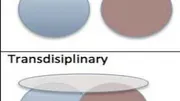
The first major interdisciplinary typology was published in 1972 and other labels soon followed, producing a sometimes confusing array of jargon. In this study we use the OECD typology, to distinguish between 'multidisciplinary', 'interdisciplinary', and 'transdisciplinary' models of teaching (Klein, 2010). This distinction is necessary to understand the nature of interaction that was observed in each team of teachers and the knowledge that emerged within each team. Figure 1 illustrates this typology and the way disciplines interact with one another in each model.
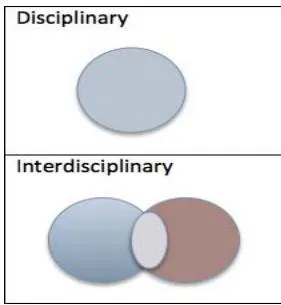
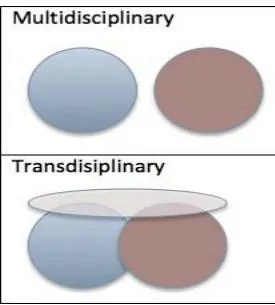
Multidisciplinarity is defined as an approach that juxtaposes disciplines. Juxtaposition fosters wider knowledge, information, and methods. Yet, disciplines remain separate, disciplinary elements retain their original identity, and the existing structure of knowledge is not questioned. A multidisciplinary team may come together at the end to tell a synthesized story of their individualized results; however, the narrow perspectives through which questions are examined throughout the project make it a modest attempt at collaboration.
Interdisciplinarity is defined as restructuring existing approaches through explicit transfer of knowledge across disciplines. It is about linking issues and questions that are not specific to individual disciplines to achieve a more holistic understanding of a cross-cutting question or problem. This process may lead to the creation of an entirely new discipline or area of scientific inquiry. The members of an interdisciplinary team contribute to the process while still grounded in their root disciplines.
Transdisciplinarity is defined as stepping outside the boundaries of known areas of inquiry. The goal of this mode is to truly blend different perspectives so as to understand scientific questions and problems in their complexity rather than just addressing pieces of them. Although members of the transdisciplinary team may be informed by their core discipline this approach allows them to transcend and operate outside the boundaries and cultures of those disciplines to capture new realities (Klein, 2010, Boix Mansilla, 2016; Schmalz, Janke & Payne, 2019; Lenoir, & Hasni, 2016).
It is common to use the term "interdisciplinarity" to describe any kind of learning model which aims to link and blend disciplines. In this work, the specific learning model that teachers plan by has a key role in understanding the processes they undergo. Hence, from this point forward we will use the terms "integrative teaching" and "integrative learning" to describe the learning processes that took place in the school and include all three models described above. The terms "interdisciplinary teaching" and "interdisciplinary learning" will be used to describe the specific integrative model as portrayed in Figure 1.
In the heart of all integrative models is the integrative mode of thinking - the knowledge to make connections between disciplines, themes, big ideas and topics. Integration is above all a cognitive process that must be performed by the learners themselves and not from above, where the integration process itself has already been established from outside, by the designers of the curriculum, textbook or activity (Leonir and Hasni, 2016). This viewpoint adds a new component to teachers' knowledge - the knowledge and ability of connections making and of teaching for connection making. We refer to this component as connectedness knowledge. As integrative learning expands beyond the traditional fragmented learning which most schools still practice, it is safe to assume an expansion in teachers' knowledge as well.
III. OUR CASE STUDY: INTERDISCIPLINARY SKILLS-CENTERED MODEL LED BY TEACHERS
Our research takes place in a public high school in Israel which is part of the centralized education system, as the majority of Israelis schools are. The regulatory functions of the Ministry of Education (MOE) operate in many areas, and are carried out by several of the Ministry's units. The MOE also regulates the k-12 curriculum. The central national curricula are implemented and supervised in the school system through a group of National Subjects Supervisors and matriculation examinations. These factors form the mechanism by which the MOE directs and controls teaching and learning in schools (Nir et al., 2016). Given this background, it is of a special value to examine a school which claims (at least partial) autonomy by initiating and implementing innovative learning while still being a part of a traditional and central exams-oriented system.
The school's management initiated this endeavor as part of its "ongoing quest for a pedagogy suitable to the 21st century," as the principal told us at our first meeting. Interestingly, this quest started a few years ago with digitalizing the school, a course which led to asking pedagogical questions. Specifically, they pondered on how to improve students' ability to handle new problems, to "transfer" their knowledge from one context to another, and to improve their ability to be adaptive learners. As described on the school's website, the aim was to "change the perception of the term "knowledge", from a fixed body of information to an evolving learning outcome."
To meet this vision, the school has been developing a skills-centered interdisciplinary pedagogy, in which certain disciplines would be taught under one cluster: sciences, social studies, and humanities. The shift has been gradual and every year more grades and teachers join the model, creating more interdisciplinary clusters and changing more norms and practices, and slowly the culture of the school as a whole.
When the school leadership first introduced the concept, they only presented the teachers with the interdisciplinary idea and expectation, without laying out a working model and without offering in-service or expert mentoring to accompany the change process. The school built a new space within the old building, designated to the new learning. The new space offers flexible sitting areas, mobile furniture, group work areas and open spaces.
The school leadership encouraged each cluster team to work closely together to pave its own path, exploring and developing the model that is right for them, based on their characteristics (viewpoints, knowledge, skills, barriers and ambitions) as well as their subject area requirements and bureaucratic limits. The name that was given for this kind of team was a catchy phrase in Hebrew whose initials are D.T. - development teams. Designated weekly planning hours were given to each team, and at times to a few teams together for peer learning.
As a result, teachers re-organized their disciplinary curricula (contents and skills required by the Ministry of Education) into interdisciplinary units, each of which usually focuses on a project, a long-term assignment to be solved by the students, relevant to the reality of the 21st century. On "cluster day", students study 4-6 consecutive hours at the newdesignated space and science labs, while teachers co-teach the integrative units.
IV. RESEARCH RATIONALE, GOAL, AND QUESTIONS
In this setting teachers are positioned as learning designers, collaboratively crafting their knowledge through teams of teachers from different disciplines. In this position, teachers are potentially involved in the sense-making of the change process rather than just implementing policies or reforms. They can create meaning that is relevant to them and to their students, which in turn orients their decisions and actions (Marz & Kelchtermans, 2013). Nonetheless, they still work within the macro context of a (rather centric) education system, which generates an inherent tension between old and new schoolings. Moreover, every year, mainly due to the school's regulations teachers find themselves working in different clusters with different colleagues, sometimes in a different grade level and with different curricula than they did the year before. Namely, in this model uncertainty and instability of the changeprocess seem to be not just a stage but a trait of new schooling.
Hence, this setting serves as an opportunity to shed light on teachers' knowledge growth in a skill-centered non-fragmented schooling, which is the goal of this study. As opposed to common discussions about teachers' knowledge, which is still centered within each discipline, we suspect that teachers who work together continuously across disciplines develop a different kind of knowledge. Our research questions were as follows:
- (a) What is the required knowledge for teachers to design and teach in an interdisciplinary teaching model?
- (b) How does this knowledge emerge and expand?
V. METHODOLOGY
a) Data collection
Creswell and Poth (2017) defined a case study as a qualitative approach in which the researcher inquiries into a real life, current bounded system, or multiple bounded systems over time using multiple in-depth sources of data and report a case description or case themes. The present study is an intrinsic case study (Stake 2005; Creswell & Poth 2017), namely a case that provokes researchers to examine what is imperative about the case. This approach aims to develop an understanding about the case's own issues and contexts, to achieve "thick description" about the researched phenomena, and to examine what can be learned from it for broader contexts.
We followed all seven of the school's cluster teams throughout two school years, 2018-2019 and 2019-2020 (data described in this article do not include the end of the 2019-2020 school year when the school shifted to distance learning due to the coronavirus). The first year of the research was the second year of implementing the model in the school. In that year there were three integrative clusters: sciences, social studies, and humanities, which were taught across three grade levels – eighth, ninth and tenth grade. Overall, there were 21 teachers divided into seven integrative teams. For most of the teachers, this was their first year teaching in the clusters. In the second year of research, more clusters teams were added to include a total of 27 teachers.
Our goal was to capture teachers' knowledge expansion. For this purpose, we adopted the view that teachers' knowledge appears in an interactive planning of teaching(Hashweh, 2005; Park and Chen, 2012). Hence, the main data resource was non-participantobservations of the weekly curriculum-development interdisciplinary teams' meetings.
Overall, we observed 42 team meetings across all the integrative clusters during the two years of the research. Each meeting duration was between 45-90 minutes. All these meetings were audiotaped and transcribed, accompanied by field notes taken during the observations. Additionally, we conducted semi-structured interviews, administered surveys to the teachers and school's management, conducted lesson observations and collected school documentation, including lesson plans, handouts, students' work samples and final projects, and a students' reflection questionnaire about the learning process. We used these data resources to heighten our understanding of occurrences and discourses in the development team meetings.
b) Data analysis
We approach this qualitative case study from an interpretive perspective, as we aimed to understand the process at hand and conceptualize it. Data analysis was conducted in stages, according to Creswell's (2013) model of spiral data analysis: managing and organizing data, reading and looking for emergent ideas, describing and classifying codes into themes, developing and assessing interpretations, and representing and visualizing the data.
At the first round of analysis all transcripts and fieldnotes from all 42 team meeting observations were organized and read to get a general understanding of the design process. We scribed emerging topics alongside the fieldnotes and the meetings transcripts. This initial reading revealed that different teams followed different integrative models in their design process (as we will explain further in the findings).
We then chose to focus on three clusters teams so we could gain in-depth insight into the process that each team underwent. We aimed to follow varied teams in terms of subject areas, team structure (i.e., the number of sub-teams and the number of teachers in the cluster), and the integrative model by which the cluster taught (see research findings for explanation on this point). Table 1 describes the three teams we comprehensively followed:
| Integrative Cluster | Social studies | Science | Humanities | |
| Subject areas | Civic StudiesHistoryGeography | BiologyChemistryPhysics | literaturehistorylanguage arts | |
| Grade | 9 | 9 | 10 | |
| Learning model | transdisciplinary | interdisciplinary | multidisciplinary | |
| Cluster structure | ||||
| Number of classes | 3 | 3 | 6 | |
| Number of teams | 1 | 2 | 3 | |
| Number of teachers | 3 | 6 | 9 | |
This led us to the second round of analysis, in which we aimed to identify repetitive conversation topics. Simply put, the question we asked was what teachers talk about during the development meetings (Horn & Little, 2010). The result was the emergence of teachers' knowledge as a repetitive theme - its strengths or its limitations, its presence or lack. We then followed Cohen et al. (2007), who stressed that purposive sampling should be used to get access to relevant data. Hence, we chose 12 knowledge-rich curriculum development meetings wherein teachers' knowledge was explicit, i.e., PCK or one of its components were present in the conversation (Park & Oliver, 2008; Park & Chen, 2012). Then, we created a series of codes to map out the different knowledge components that we identified in the transcripts. The codes were created in agreement with teachers' knowledge literature described earlier and with our observations. We conducted a few rounds of coding using the Atlas.ti software, and in each round we refined the codes and narrowed them down. Other data resources such as teachers' interviews and lesson observations were used to clarify transcripts when clarification was needed.
Next, we wanted to know if all the knowledge components we coded were equally present or if there were components that were more dominant than others. We believed that this would help us address the second resource question about how knowledge emerges since it would examine the components in the context they emerge. Hence, we divided each of the 12 transcripts into "segments" (Oliver & Park, 2012), parts in the conversation. We limited a segment to five conversation turns about the same topic, as our impression from the earlier analysis stages was that five conversation turns were sufficient to create a meaningful exchange between the teachers. We counted the number of segments in which each knowledgecomponent appears. For example, if a certain component appeared for five conversation turnswe counted it as one segment, and if it appeared for ten conversation turns we counted it as two segments (we rounded down the counting, so 12 conversation turns would be considered as two segments). Lastly, we interpreted the data based on the coding process.
VI. FINDINGS
The data analysis process revealed two related findings: (1) each cluster team developed its teaching and learning process using a different integrative model (i.e., context and conditions), and (2) there are different knowledge components that all together comprise teachers' knowledge for integrative teaching.
a) Three different integrative models
As we stated in the description of the case study, teachers were given a general vision and framework and vast autonomy to plan according to their sense making of the learning design process. Teachers were not given formal training about integrative teaching and learning, and they were not familiar with the academic typology of the different integrative models. Interestingly, each cluster team created a model that worked for them. The three teams we chose, came up with three different models which fell into one of the integrative models described in the integrative typology: the humanities cluster planned and taught by a multidisciplinary model, the science cluster planned and taught by an interdisciplinary model, and the social studies cluster planned and taught by a transdisciplinary model. It should be kept in mind that these different
implementations were not "by the book", simply because teachers did not read 'the book'. Yet, we observed practices and design decisions that we could organize under the common integrative typology.
The differences between the clusters teaching and learning models are described in Table 2.
| Cluster | Humanities | Science | Social Studies |
| Integrative Model | Multidisciplinary | Interdisciplinary | Transdisciplinary |
| Example unit | "Identity" as a common theme. | Integrated understanding of radiation's effects. | Driving question: Was modernism good for mankind? |
| Teaching method | Each teacher teaches his own discipline.Students rotate between teachers. | "Jigsaw": Each teacher teaches both his discipline and final project related topics. | The curriculum is broken down to topics. All teachers teach all topics. |
| Assignments | Separate for each discipline. | Cluster's final project, and separate assignments for each discipline. | Cluster's assignments and final project. |
Multidisciplinary model-humanities cluster: Teachers' planning process aimed to identify common themes and address them in all three disciplines. For example, in one of the meetings teachers recognized the common theme of identity across the different curriculum. In history lessons identity was taught through the topic of Jewish emancipation. In literature identity was discussed through the play "A Doll's House" by Henrik Ibsen (which considered to be one of the first feminist plays). In language arts lessons students wrote essays on the topic "my choices." Students rotated between the teachers throughout the cluster day, while each teacher taught his own discipline and assigned his own assignments.
Interdisciplinary model - science cluster: Teachers' planning process aimed to achieve an integrated understanding grounded in the three taught disciplines. For example, students were assigned a joint final project to present the effects of radiation in everyday life, synthesizing information from all three disciplines. To achieve this, a "Jigsaw" method was applied: each student chooses a specialty for the semester (biology, physics, or chemistry), which he or she studies with the disciplinary teacher for half of the cluster day. In the second half of the day, students work with their project group of three students, assembled from one student from each specialty. While in their work-groups, teachers mentor them and guide through project-related topics and skills. At times, teachers taught skills such as critical information gathering, and sometimes teachers taught topics from another discipline.
Alongside the joint final project, students were assigned disciplinary assignments in their specialty lessons.
Transdisciplinary model-social studies cluster: Teachers' planning process aimed to teach themes and big ideas by eliminating boundaries between disciplines. For example, the driving question of the semester was whether modernism was good for mankind. Each cluster day was devoted to a different topic related to the driving question, such as colonialism, world wars and democracy. For the most part, all three teachers taught all topics, regardless of their discipline. Assignments were given for each topic taught in the cluster. At the end of the semester, students presented their final project in relation to the driving question.
b) Knowledge components for integrative teaching
Through the analysis process we found two distinctions that influenced the way we defined and divided the knowledge components we recognized. The first distinction that the data revealed was teacher's knowledge in his/her discipline vs. his/her knowledge in other disciplines. The second distinction was about the level of knowledge teacher demonstrated inthe different disciplines, high knowledge vs. low knowledge, as we turn to explain below.
My Discipline (MD) refers to the subject-area I (the teacher) teach in the cluster. It is my field of training and expertise that I am used to teaching.
Other Discipline(s) (OD) refers to the other subject-matter(s) that are taught in the cluster. Sometimes the teacher needed to actually teach those other subject-areas (for example, in the transdisciplinary model and in parts of the interdisciplinary model), and sometimes the teacher only teaches his own subject-area (for example, in the multi-disciplinary model).
Low Knowledge (LK) refers to knowledge for the purpose of being aware of it, not for using it or teaching it. For example, in the humanities cluster, when the history teacher read the play that is being taught by the literature teacher, she gained knowledge of a different discipline in her cluster, although she did not teach this content directly. Sometimes, LK had a more substantial role than just "knowing", and it shaded a light on teacher's own teaching (for example, what does this play tell me about my understanding of the topic that I teach).
High Knowledge (HK) refers to knowledge that the teacher used in her own teaching or in her dialogue with other teachers. For example, the knowledge required for the chemistry teacher when she conducted a physics experiment in her class.
With these distinctions in mind, we identified knowledge components in three different areas - content knowledge, pedagogical knowledge, and connectedness knowledge. In each area, teacher's knowledge expanded to include new components. Hence, we expanded the terms and call them expanded content knowledge (ECK), expanded pedagogical knowledge (EPK), and expanded connectedness knowledge (ECNK).
We broke down each area to its expression for the two implications, my discipline or other discipline(s) and for the level of depth it appeared - high or low. Table 3 summarizes the identified knowledge components. Below the table we explain each of the components and provide examples from different cluster teams.
| Expanded Content knowledge (ECK) | Expanded Pedagogy knowledge (EPK) | Expanded Connectedness knowledge (ECNK) |
| Low my content knowledge (LMCK) | Low my pedagogical knowledge (LMPK) | High connectedness knowledge (HCNK) |
| High my content knowledge (HMCK) | High my pedagogical knowledge (HMPK) | High pedagogical connectedness knowledge (HPCNK) |
| Low other content knowledge (LOCK) | Low other pedagogical knowledge (LOPK) | |
| High other content knowledge (HOCK) | High other pedagogical knowledge (HOPK) |
i. Expanded Content Knowledge
This category includes understanding of the content of teaching. It includes both "common knowledge" and "specialized content knowledge" (Ball, 2008). Common knowledge is subject-matter knowledge that not only teachers hold but rather knowledge that is used in other settings as well. Specialized content knowledge is the subject-matter knowledge that is required for teaching this particular subject. In this category, we found expressions of the three following knowledge components:
High my content knowledge (HMCK): Teacher's content knowledge in his/her own discipline that is mentioned in the conversation with the purpose of using it further in the actual teaching. In the following excerpt from the social-studies team, both the civil-studies teacher and the history teacher use their own content knowledge as they plan the unit about World Wars – the civil-studies teacher suggests a book that he uses in his disciplinary lessons and the history teacher links it to main concept from the history curriculum:
Civic-studies teacher: We can bring the book, All Quiet on the Western Front. The soldiers talk among themselves and don't understand why they're fighting.
- Geography teacher: Yes
- Civic-studies teacher:...and then they talk like they are captives... and they talk with the enemy. It's awesome.
- History teacher: Of course, because it's a war without a purpose. And then we can talk about liberalism and pacifism.
Low other content knowledge (LOCK): Content knowledge in other discipline(s) that is mentioned by the teachers without the purpose of using it further in their actual teaching.
In the following excerpt from humanistic team, the language art teacher shares with the team that she read the play that was taught by the literature teacher because she felt it affects her understanding of her own teaching in relation to the overall theme of the cluster, that of identity. Although none of the other teachers taught the play directly, they decided that they will all read it:
Language art teacher: I really recommend that everybody would read the play.
History teacher A: Ok
Language art teacher: Because last year we didn't read it and later we saw that nothingwe taught was related to the play.
History teacher B: I will read it this weekend.
High other content knowledge (HOCK): content knowledge in other discipline(s) that is mentioned by the teacher with the purpose of using it further in the actual teaching.
In the following excerpt from the science team, the biology teacher explains to the physics teacher how to conduct the blood sugar experiment, which is part of the curriculum in biology but it is not part of her content knowledge as a physics teacher:
- Biology teacher: The Benedict's and the glucose sticks identify the sugar.
- Physics teacher: The Benedict's and the glucose sticks...ok.
- Biology teacher: And the iodine identifies the starch...and now you start to drip this on this (demonstrating).
- Physics teacher: Identifies means that it changes the color, right?
- Biology teacher: Right.
ii. Expanded Pedagogical Knowledge
This category includes the knowledge of how to make content teachable. It contains knowledge about teaching strategy, curriculum knowledge, knowledge of learners and their characteristics, knowledge about educational ends and educational context (Shulman, 1986). In this category, we found expressions of the three following knowledge components:
High my pedagogical knowledge (HMPK): Teacher's pedagogical knowledge in his own discipline that is mentioned in the conversation with the purpose of using it further in the actual teaching.
In the following excerpt from the science team, the discussion focused on students' difficulties in formulating a research question. Both the biology teacher and the chemistry teacher use their disciplinary pedagogical knowledge in the discussion:
- Chemistry teacher: This [what students wrote] is not a research question.
- Biology teacher: They didn't understand that a research question should [revolvearound]...
- Chemistry teacher: something that influences something.
- Biology teacher:... a question that should lead you to actual research.
- Chemistry teacher: They didn't get that.
- Biology teacher: OK, so we have to devote the time so they will understand. We need to sit down with each group, and we should have our comments written before that.
Low other pedagogical knowledge (LOPK): Pedagogical knowledge in other discipline(s) that is mentioned by the teacher without the purpose of using it further in the actual teaching.
In the following excerpt from the humanistic team, the language art teacher inquires the literature teacher about the method that the later chose for teaching the new play, even though in practice this method does not influence her own teaching:
- Language art teacher: When do you start the play?
- Literature teacher: Next lesson
- Language art teacher: And your introduction is this exercise about relationships?
- Literature teacher: Yes, relationships
- Language art teacher: And after that do you let them read?
- Literature teacher: They are going to read the rest at home.
High other pedagogical knowledge (HOPK): Pedagogical knowledge in other discipline(s) that is mentioned by the teacher with the purpose of using it further in the actual teaching.
In the following excerpt from the science team, the teachers discuss an experiment in biology they need to conduct with the students. The physics teacher, for whom it is the first time to teach this biology topic, struggles with the way the experiment's protocol is written and raisesa non-expert's questions about it:
- Chemistry teacher:...the enzyme loses its uniqueness and therefore stops working.
- Physics teacher: I don't know. I don't understand chemistry or biology.
- Biology teacher: Ok, but...
- Physics teacher: When you ask me, when you bring me to the conclusion that in the digestive system something similar happens, so I tell myself – OK, my digestive system is warmer than my mouth and 37 degrees is enough. But like this, I don't understand it.
- Biology teacher: Ok, so we need to...how can we write it differently?
As a result of this discussion, the team reexamined the protocol and made adjustments.
iii. Expanded Connectedness knowledge
This category includes teachers' understanding of the way other disciplines are connected to their own field and to their ability to recognize main themes that cross subject areas. It also includes teachers' ability to facilitate students' understanding of relationships and connections between contents, themes, and ideas. In this category, we found expressions of high connectedness knowledge (HCNK) and high connectedness pedagogical knowledge (HPCNK), as we explain below:
High connectedness knowledge (HCNK): Refers to teachers' ability to recognize and create meaningful connections between the different disciplines that are taught in the cluster, and to recognize common themes and big ideas.
In the following excerpt from the humanistic team, the teachers try to find a common theme across the different topics they have to teach. The discussion starts when the literature teacher shares that literature teachers are about to teach a poem by Bialik (one of the pioneers of Modern Hebrew poetry). To that the language art teacher responded with a suggestion to collaborate on the topic and the history teacher suggests that in history lessons they would discuss the Kishinev Pogrom that influenced the poet prior to writing this poem. All three teachers participate in the cognitive and practical effort to connect between their three different curricula:
- Literature teacher: Next is Bialik. I love Bialik.
- Language art teacher: I thought maybe language art and literature can work on it together.
- History teacher A: Yes, you can do it together, and we...
- History teacher B: This can actually be something we all connect to...because if you take the Kishinev Pogrom, it affected Bialik a lot.
High pedagogical connectedness knowledge (HPCNK): Refers to teachers' knowledge in facilitating students' understanding of relationships and connections between contents, themes and ideas and knowledge of advancing students' integrative thinking skills.
In the following excerpt from the social studies team, teachers were engaged in finding the most effective way to summarize the topic of imperialism as a main theme of the day. They aimed to put together an assignment that would help students recapitulate the topic from all three angles: civil studies, geography and history.
- Civil studies teacher: But what would be the connection to history?
- History teacher: Why did the European conquer Africa? I want them to answer that it's because of nationalism, because of natural resources....
- Geography teacher: Wait, let's write it – what were the European motives to conquer Africa....Now, let's each try to answer it from our own point of view. What would you say?
- History teacher: I would talk about the Industrial Revolution.
- Geography teacher: I would emphasize natural resources.
- Civil studies teacher: I would talk about expanding the territory of the country.
iv. Knowledge components across the clusters
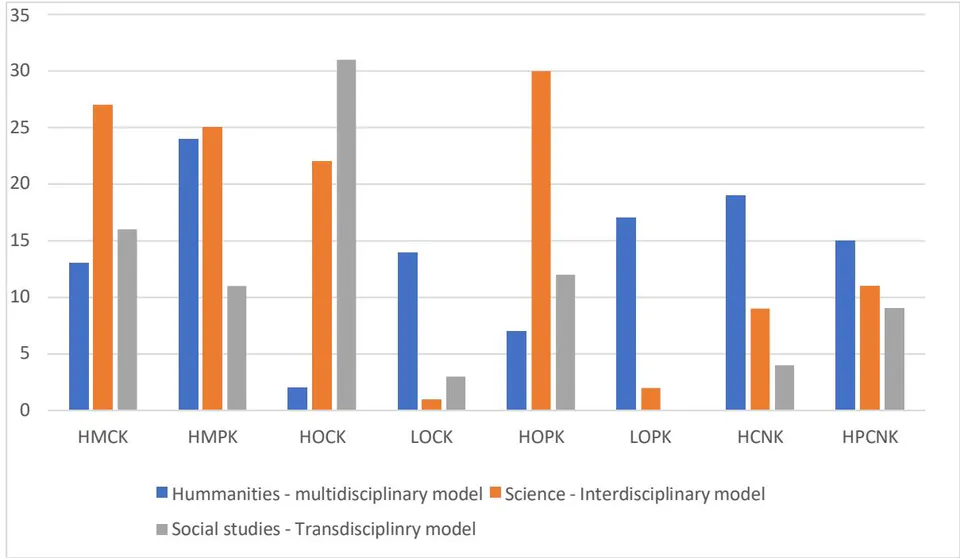
When counting the number of times that each component was evident during the development meetings, we found that different components were more or less evident in different clusters, as illustrated in Figure 2.
For example, HMCK (high my content knowledge) was most evident in the science cluster (interdisciplinary model) as teachers spend significant amount of time explaining one another core concepts of their own discipline, so other teachers can use this knowledge in their own teaching or to emphasize their own disciplinary contribution to the joint integrative understanding. HMCK was the least evident in the humanities cluster (multidisciplinary model) as teachers did not need to go in depth about their own disciplinary content, since the other teachers just used it for their general knowledge.
HOCK (high other content knowledge) was the most evident in the social studies cluster (transdisciplinary model) as teachers constantly taught content that was outside of their discipline. HOCK was the least evident in the humanities cluster since teachers did not teach content outside of their discipline.
HCNK (high connectedness knowledge) was most evident in the humanities cluster since teachers constantly looked for common themes for each topic in their different disciplinary curricula. HCNK was the least evident in the social studies cluster since the connectedness was already inherent in the choice to teach big ideas and not subject matter.
VII. DISCUSSION
We found that teachers' knowledge expanded beyond the traditional disciplinary knowledge and included other components that better capture this unique educational setting. We also found that the knowledge expansion was related to the teaching models, i.e., the specific task at hand. This highlights the importance of the context when discussing teachers' knowledge in a dynamic environment. In this particular case study, the context appeared on two levels: First, the context of a progressive integrative teaching model while still being a part of centric and rather traditional education system. Second, the specific situation in which the teachers work with the integrated curricula, the team members and the teaching models.
In regard to the first research question, what is the required knowledge for teachers to teach in an interdisciplinary teaching model, our findings show that teachers need content knowledge and pedagogical knowledge in their own discipline as well as in other disciplines. Additionally, teachers need knowledge in making connections across and between disciplines (connectedness knowledge), and knowledge in making these connections teachable (pedagogical connectedness knowledge). Each of these knowledge components can appear in high level or in low level.
Our findings imply that in regard to the second research question, how does this new knowledge emerge and expand, there was a relation between the integrative model and the kind of knowledge it evoked. The three clusters we followed implemented three different integrative models: interdisciplinary (science cluster), multidisciplinary (humanities cluster) and transdisciplinary (social studies cluster). Although the same knowledge components were observed in all three clusters, they were not equally present: in each cluster some components were more potent than others. While there could be numerous explanations for this, such as teachers' experience, disciplinary knowledge, team dynamic, core beliefs about teaching and learning, or how much teachers identify with the integrative teaching idea, we suggest that the differences can also be attributed to the different tasks each learning model presented to the teachers. In other words, the level of each knowledge component, high or low, and its expression for the two implications, my discipline or other discipline(s) could be connected tothe integrative model and the kind of connectedness it calls for. The tighter the links, the higher the content knowledge, the pedagogical knowledge, and the connectedness knowledgethese links require. Future research is needed to examine this hypothesis and other factors that stimulate or hinder teachers' knowledge development.
Alongside the differences, the commonality between the three clusters was that each integrative model challenged teachers' knowledge and created various learning opportunities. While teachers relied heavily on their own PCK, they realized that their PCK was insufficient for the task at hand. The findings show high knowledge level was needed in my discipline together with high or low knowledge level in another discipline (even a low level of knowledge is still additional knowledge). The multiple perspectives and the mutually dependent relations with peers created a knowledge-rich environment. In this environment, teachers needed to use their previous knowledge to facilitate their own learning as well as the collaborative learning process, resulting in the creation of new knowledge to mediate the integrative content to students.
Hence, conceptual frameworks that describe merely content knowledge, pedagogical knowledge, or their intersection do not sufficiently capture the complexity of integrative teaching. Therefore, we propose a framework for Knowledge for Integrative Teaching (KIT), which outlines the necessary knowledge.
for teaching in integrative model when implemented in an ever-evolving schooling. The framework portrays three knowledge components - Expanded Content Knowledge (ECK), Expanded Pedagogy Knowledge (EPK) and Expanded Connectedness Knowledge (ECNK). It also suggests two distinctions - between my discipline and other disciplines, and between high level of knowledge and low level of knowledge (see Table 4: Teachers' KIT framework - teachers' knowledge for interdisciplinary teaching).
| Expanded Content Knowledge (ECK) | Expanded Pedagogy Knowledge (EPK) | Expanded Connectedness Knowledge (ECNK) |
| High/Low my content knowledge | High/Low my pedagogical knowledge | High/Low connectedness knowledge |
| High/Low other content knowledge | High/Low other pedagogical knowledge | High/Low connectedness pedagogical knowledge |
The framework can be used as an analytical tool and as a way to think about learning design. It can be utilized to analyze lessons plans and lessons observations, to highlight areas of strengths and weaknesses in teachers' practice and knowledge. It offers concepts to identify and verbalize missing components in teachers' knowledge, for instance when observing students' difficulties or misconceptions, one can look at the pedagogical connectedness knowledge of teachers and the way it influences the support, or lack of, that teachers provide the students during the integrative learning process. This does not and should not diminish other reasons for students' difficulties, such as lack of motivation or group-work skills, but it provides a reasonable explanation when looking for a better understanding of the challenges in implanting integrative teaching and learning models in schools.
The framework can be also used as a planning tool for both in-service and pre-service teachers. It can help in-service teachers to map the necessary knowledge for their new task. As our findings show, teaching in an integrative model is complex. To simplify the complexity and to work with it, it is useful to keep in mind that not every model and not every task require the same knowledge or the same depth of knowledge. Mapping the necessary knowledge for the team or for the individual teacher can help focus professional learning and planning efforts where needed. The framework can also be used in settings of teacher training programs which aim for interdisciplinary teaching. As the framework sheds light on the required teachers' knowledge, it can scaffold the design of such programs to include the important knowledge aspects.
As stated above, we define an ever-evolving schooling as a context in which teachers face unfamiliar situation frequently and intensively, and this case study captures a comprehensive kind of ever-evolving schooling since the unfamiliarity happens beyond teacher's disciplinary knowledge and practice. The KIT framework describes the knowledge expansion in this particular context, and can be viewed as an example for other contexts in which the pedagogical change calls for a meaningful expansion in teachers' knowledge. As schooling shifts so that we no longer assume static knowledge to be transmitted from authoritative teachers to passive students, a framework that is sensitive to dynamic knowledge is necessary. The KIT framework provides a ground for discussing teachers' knowledge in a changing world and articulates the necessary knowledge components to not only survive changes, but to lead them and strive through them. Additional examinations of teachers' knowledge in other dynamic and progressive environments can further contribute to broaden the traditional view of teachers' knowledge.
Finally, the context of ever-evolving schooling creates "unstable" environment for teachers. Our research shows an expansion in teachers' knowledge in the context of ever- evolving schooling, and as such it suggests that similar contexts should be viewed as a catalyst for teachers' growth. In this sense, instability is in fact a feature (characteristic that promotes change) and not a bug (that should be prevented or fixed). This viewpoint is of particular importance in today's fragile reality of constant changes, in which teachers' knowledge will be challenged relentlessly, as a way of life.
VIII. CONCLUSIONS
This empirical research examined the expansion of teachers' knowledge in the context of integrative teaching. It aimed to understand what knowledge evoked under the new conditions and how this knowledge emerged. It showed that teachers' knowledge expanded to include content knowledge and pedagogical knowledge from other disciplines, as well knowledge in connections making and knowledge in teaching for connections making. This knowledge emerged through teachers' engagement in hands-on integrative planning process and in relation to the specific task and teaching model.
The research supports the relevance of examining teachers' knowledge, which should be viewed as a dynamic concept that expands in conditions of ever-evolving schooling. Particularly, it offers a framework for teachers' knowledge in integrative teaching (KIT) to analyze and to think with interdisciplinary teaching which has been adopted by many educational settings in the last decades. The research sees the instability of ever-evolving schooling as a catalyst for teachers' knowledge expansion. This viewpoint can be useful to articulate teachers' knowledge in other dynamic teaching and learning contexts.