## I. INTRODUCTION
One of the most common procedures used to repair mandibular abnormalities is the bilateral sagittal split osteotomy (BSSO) (1), which can also be used to correct obstructive sleep apnea as well as musculoskeletal disorders (1). Nonetheless, it includes a wide range of postsurgical challenges, ranging from the more typical ones, such as an unfavorable or a "bad" split or inferior alveolar nerve injury, to the less common infections and bleeding (1). A "bad" split can be attributed to a number of causes that can include limited surgical experience, a faulty surgical technique, or even patient-related factors like old age (1). It has been discussed in the literature, however, that a major factor in this complication can be due to the concomitant extraction of third molars at the time of the surgery (1). The timely extraction of third molars when performing a sagittal split osteotomy has been a source of debate (2). Several studies in favor of extracting wisdom teeth at the time of surgery suggest that patients end up with fewer postoperative complications and financial burdens (2). Opponents of this suggestion claim that the decreased instances of "bad" splits outweigh the increased intraoperative technical difficulties as well as the surgical operating time (2). The typical approach was the extraction of wisdom teeth at least 6 months prior to surgery, so the introduction of such a methodology has raised questions regarding more postoperative complications associated with it (1). Some of these include infections, problems in soft tissue healing and relapse as well. But more recently, the concomitant extraction of wisdom teeth at the time of the BSSO procedure has been preferred since patients will not have to undergo a second surgical procedure with its associated diminished quality of life after (1). A study done by Verweij et al. concludes that doing so ultimately depends on the surgeon's discretion and the patient's preference (3). The authors present a series of nine patients who underwent a BSSO along with extracting their third molars +/- upper third molars. In some cases, patients had to undergo an additional LeFort 1 procedure or genioplasty when necessary.
## II. MATERIALS AND METHODS
A retrospective analysis of eight patients who were subjected to BSSO with/without another surgical procedure such as Le Fort1 or genioplasty along with the extraction of their wisdom teeth at the time of surgery. All patients were recruited at follow-up appointments which were categorized into short-term (up to 4 weeks), medium-term (up to 8 weeks), and long-term (more than 8 weeks). Patients were examined regarding the presence of postoperative complications at each follow-up visit, including pain, nerve damage, swelling and infection). Our inclusion criteria was: patients who under went extraction of wisdom teeth at the time of the BSSO procedure.
## III. RESULTS
Below is a review of our eight patients in terms of any postoperative complications at their postoperative follow-up appointments. A table at the end of the discussion summarizes the complications present in each patient bilaterally. Since not all patients appeared for all their follow-up appointments, not all patients have their results at short-term, medium-term and long-term follow-ups. Results are taken directly from patients' postoperative progress notes.
### Case (1):
A 16-year-old female underwent extraction of all wisdom teeth along with an anterior iliac crest graft to the mandible and a BSSO.
Medium-term follow-up: No pain, no swelling, no infection, right V3 paraesthesia, left V3 hypoesthesia, and intact VII bilaterally.
Long-term follow-up: No pain, no swelling, no infection, right V3 paresthesia, left V3 hypoesthesia, intact VII bilaterally.
#### Case (2):
A 21-year-old female with a cleft lip/palate, class III malocclusion with maxillary and mandibular hypoplasia. Her surgical procedure included the extraction of all wisdom teeth (#1,16,17 and 32) at the time of the BSSO and the three-piece LeFort 1 surgery.
Short-term follow-up: minimal pain, minimal swelling, no infection, bilateral V2 hypoesthesia, intact V3 and VII.
Medium-term follow-up: intact V2, bilateral V3 hypoesthesia.
#### Case (3):
A 19-year-old male with maxillary deficiency, mandibular prognathism, and a $1.5\mathrm{cm}$ anterior open bite. His surgical procedure, which consisted of a BSSO, LeFort 1, and extraction of all wisdom teeth, was complicated by suspected malignant hyperthermia which resulted in immediate postoperative ICU admission.
Short-term follow-up: minimal pain, minimal swelling, right cranial nerve V2, V3 paraesthesia, improving left V2 and an intact left V3.
Medium-term follow-up: minimal swelling, completely resolved left side innervation, slowly improving right side innervation.
Long-term follow-up: no pain, no swelling, no infection, resolution of IAN paraesthesia.
#### Case (4):
An 18-year-old female patient with maxillary hypoplasia, mandibular hyperplasia, and chin deviation to the left.
Her surgical procedure involved LeFort 1, BSSO, genioplasty and extraction of the fully-bony impacted #1, #16, partially-bony impacted #17 and soft-tissue impacted #32.
Short-term follow-up: appropriate healing with nerves intact but with some hypoesthesia.
Medium-term follow-up: Mild edema mainly in the upper lip, improving hypoesthesia sensation.
#### Case (5):
An 18-year-old female with hypertension and depression taking Zoloft as her only medication as stated. The patient has maxillary deficiency and mandibular excess, with a bilateral posterior crossbite.
Radiographic examination revealed fully bony impaction of teeth #17 and #32. The patient's surgical procedure was a BSSO, LeFort 1, and extraction of bilateral wisdom teeth (#17 and #32).
Short-term follow-up: Minimal swelling with no significant pain. Bilateral V2 hypoesthesia and V3 paraesthesia.
Medium-term follow-up: The patient only had left V3 hypoesthesia.
Long-term follow-up: Class III occlusion relapse on the left side (in the anterior and premolar region) with class I occlusion on the molar side bilaterally. The patient suffered slight V3 hypoesthesia in her chin and lower lip.
#### Case (6):
A 17-year-old female with a retrognathic mandible with ADHD; taking Adderal. The patient is also an active smoker of about 3-4 cigarettes/day. Radiographic examination reveals fully bony impaction of all wisdom teeth (#1,16,16 and 32). Her surgical procedure involved a BSSO with the extraction of all third molars.
Short-term follow-up: Some infection was noted on the left side due to food debris, and amoxicillin $500\mathrm{mg}$ was prescribed. Some tenderness, erythema, and bilateral V3 hypoesthesia were noted.
#### Case (7):
An 18-year-old female with a skeletal class III relationship and a mandibular midline shift to the left. Her surgical procedure involved a LeFort 1(with bone grafting), BSSO and the extraction of bilateral wisdom teeth which were partially erupted.
Short-term follow-up: Minimal discomfort and edema with no pain or infection. The patient had bilateral inferior alveolar nerve(IAN) and V3 hypoesthesia.
Medium-term follow-up: Bilateral numbness of the lower lip and chin.
Long-term follow-up: No pain or discomfort but her only complaint was a bilateral IAN anesthesia.
Case (8):
An 18-year-old male with sleep apnea and an extensive history of cleft lip/palate surgeries. His surgical procedure involved a LeFort 1, bilateral BSSO and the extraction of bilateral wisdom teeth which were impacted.
Short-term follow-up: Bilateral minimal edema with tolerable pain.
Medium-term follow-up: Bilateral mental nerve hypoesthesia.
## IV. DISCUSSION
Despite the bilateral sagittal split osteotomy procedure being one of the most common procedures used to correct mandibular deformities, the timely extraction of present wisdom teeth is highly debatable $(3,4)$. Some authors would favor the extraction of third molars prior to surgery as it increases the operation's surgical difficulty while others advocate their extraction intraoperatively, due to the diminished need for a second surgery and its associated postoperative complications $(3)$. Having postoperative complications due to a second surgical procedure can have its own social and financial implications for the patient, as they might need extra days off work/school for postoperative healing $(5)$. There is no definite answer as to whether intraoperative extraction of wisdom teeth is associated with a greater risk of intraoperative complications, such as a "bad" split, or any more significant postoperative complications. One prospective cohort study showed that doing so would reduce postoperative neurosensory dysfunction due to less chance of IAN manipulation and entrapment, without significantly increasing operating time or the incidence of unfavorable fractures $(6)$. According to a paper by David S. Precious, it is not justified to expose the patient to two separate procedures when all steps can be done safely and efficiently in the same setting, at the same time $(7)$. A proper anatomical approach is taken, where cuts are performed through the greater sagittal length of the impacted wisdom teeth, exposing the position of the IAN along with the tooth $(7)$. An additional randomized controlled clinical trial by Marimuthu et al. that is in favor of the concomitant extraction of wisdom teeth at the time of BSSO proves that there is no extra risk of postoperative infection due to the presence or absence of wisdom teeth intraoperatively; suggesting doing it all at the same setting to maximize patient's comfort $(8)$. As for the social and financial implications of having a combined surgery, a study done at Salisbury Hospital concluded that carrying out a single procedure would lessen the financial burden on patients [due to less time off work], decrease surgery-associated anxiety and even decrease the postoperative neurosensory deficit $(9)$.
A different study that was done to analyze the common practices among the members of the French Society of Stomatology and Oromaxillofacial Surgery concluded that the majority of surgeons prefer to have a period of six months between the extraction and the BSSO procedure; stating that the presence of wisdom teeth intraoperatively would complicate the procedure (10). This is supported by the results of the study by Eshghpour M et al. that was carried out on 140 patients undergoing BSSO; concluding that the presence of these impacted wisdoms would increase the risk of a "bad" split during the operation
### (11).
On a different note, questions regarding the favorable displacement of the inferior alveolar nerve(IAN) after the extraction of wisdom teeth before the BSSO have risen. A study with a radiological analysis of the CBCT of 30 different patients has been conducted; negating the influence of the extraction on the route of the IAN (12).
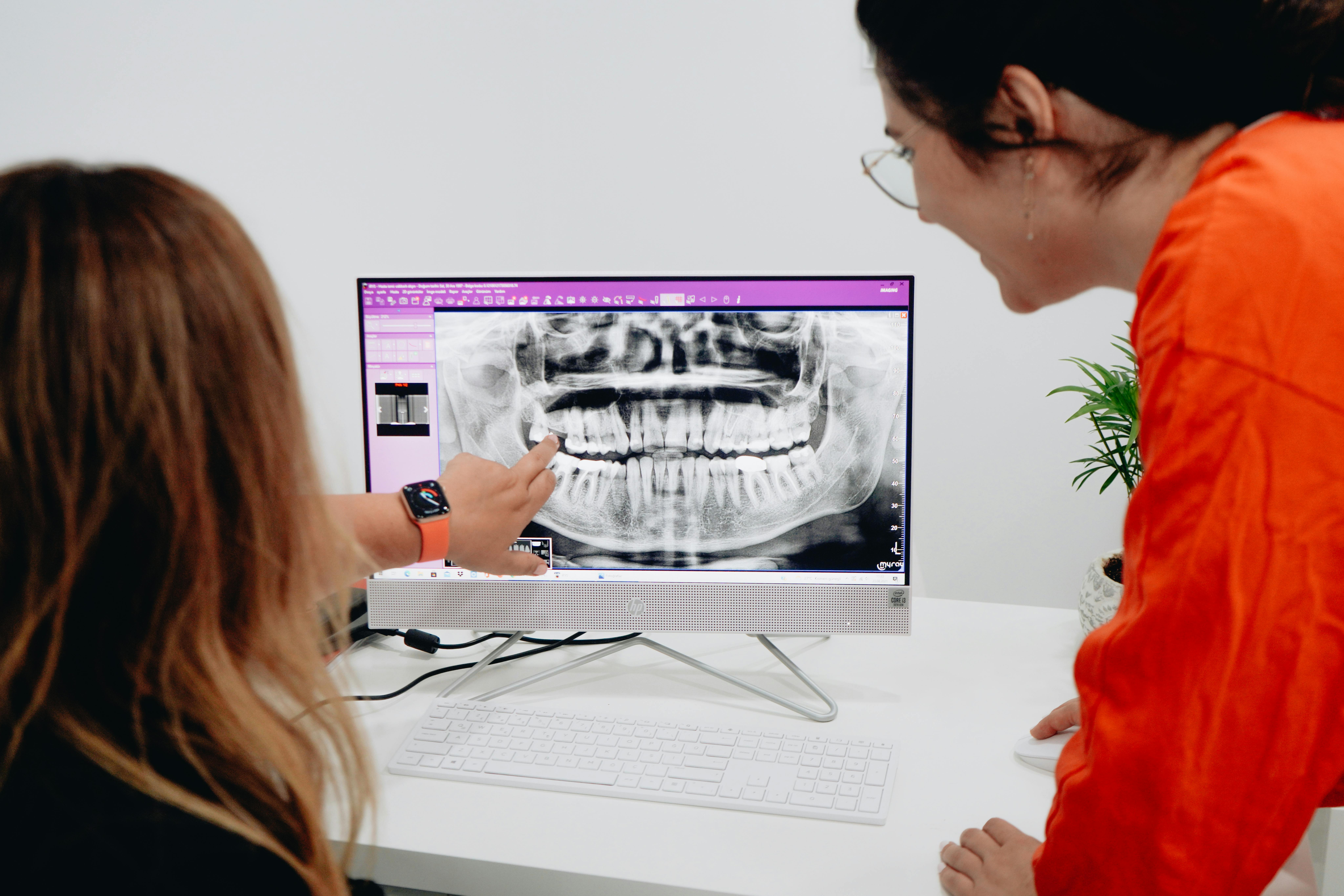
Our aim here in this case series is to investigate the presence of any notable postoperative complications associated with extracting wisdom teeth at the time of the designated surgical procedure. Eight patients, with an age range of 16-21 years, had their lower wisdom teeth extracted at the time of their bilateral sagittal split osteotomy procedure with/without LeFort1 and/or genioplasty. A bilateral examination for each patient was done postoperatively as each side can be examined and treated as a separate entity. These complications included pain, swelling, infection, and nerve damage. Minimal pain or swelling was noted for most patients on their short-term follow-up appointments.
Slight paraesthesia/hypoesthesia was noted on the medium and long-term follow-ups with a resolution of the majority of the remaining complications.
As a conclusion, the concomitant extraction of wisdom teeth at the time of the BSSO poses no extra major postoperative complications; as evidenced by our eight patients. It is rather a technique that comes with a reduced need for a second surgical procedure and its associated complications.
## V. LIMITATIONS
- Our case series has some limitations in terms of standardizing the intervals between our patients' follow-up appointments. Since not all patients showed up at exact follow-up appointments, their visits were categorized and standardized into short-term, medium-term and long-term follow-up appointments.
- Results were taken directly from follow-up and postoperative notes.
<table><tr><td>Patient #</td><td>Age</td><td>Gender</td><td>Side</td><td>Pain</td><td>Swelling</td><td>Nerve dysfunction</td><td>Infection</td><td>"Bad" split</td></tr><tr><td rowspan="2">Patient(1)</td><td rowspan="2">16</td><td rowspan="2">Female</td><td>Right</td><td>Absent</td><td>Absent</td><td>V3 paraesthesia</td><td>Absent</td><td>-</td></tr><tr><td>Left</td><td>Absent</td><td>Absent</td><td>V3 hypoesthesia</td><td>Absent</td><td>-</td></tr><tr><td rowspan="2">Patient(2)</td><td rowspan="2">21</td><td rowspan="2">Female</td><td>Right</td><td>Minimal</td><td>Minimal</td><td>V2 hypoesthesia</td><td>Absent</td><td>-</td></tr><tr><td>Left</td><td>Minimal</td><td>Minimal</td><td>V2 hypoesthesia</td><td>Absent</td><td>Absent</td></tr><tr><td rowspan="2">Patient(3)</td><td rowspan="2">19</td><td rowspan="2">Male</td><td>Right</td><td>Minimal to absent</td><td>Minimal to absent</td><td>V2/V3 paraesthesia (eventually resolved)</td><td>Absent</td><td>-</td></tr><tr><td>Left</td><td>Minimal to absent</td><td>Minimal to absent</td><td>Absent</td><td>Absent</td><td>-</td></tr><tr><td rowspan="2">Patient(4)</td><td rowspan="2">18</td><td rowspan="2">Female</td><td>Right</td><td>Absent</td><td>Absent</td><td>Some hypoesthesia</td><td>Absent</td><td>-</td></tr><tr><td>Left</td><td>Absent</td><td>Absent</td><td>Some hypoesthesia</td><td>Absent</td><td>-</td></tr><tr><td rowspan="2">Patient(5)</td><td rowspan="2">18</td><td rowspan="2">Female</td><td>Right</td><td>Absent</td><td>Minimal</td><td>Absent</td><td>Absent</td><td>-</td></tr><tr><td>Left</td><td>Absent</td><td>Minimal</td><td>V3 hypoesthesia</td><td>Absent</td><td>-</td></tr><tr><td rowspan="2">Patient(6)</td><td rowspan="2">17</td><td rowspan="2">Female</td><td>Right</td><td>Minimal</td><td>Absent</td><td>V3 hypoesthesia</td><td>Absent</td><td>-</td></tr><tr><td>Left</td><td>Minimal</td><td>Absent</td><td>V3 hypoesthesia</td><td>Mild</td><td>-</td></tr><tr><td rowspan="2">Patient(7)</td><td rowspan="2">18</td><td rowspan="2">Female</td><td>Right</td><td>Absent</td><td>Minimal</td><td>V3 anesthesia/hypoesthesia</td><td>Absent</td><td>-</td></tr><tr><td>Left</td><td>Absent</td><td>Minimal</td><td>V3 anesthesia/ hypoesthesia</td><td>Absent</td><td>-</td></tr><tr><td rowspan="2">Patient(8)</td><td rowspan="2">18</td><td rowspan="2">Male</td><td>Right</td><td>Minimal</td><td>Minimal</td><td>Mental nerve hypoesthesia</td><td>Absent</td><td>-</td></tr><tr><td>Left</td><td>Minimal</td><td>Minimal</td><td>Mental nerve hypoesthesia</td><td>Absent</td><td>-</td></tr></table>
Generating HTML Viewer...
References
13 Cites in Article
Adaia Valls-Ontañón,Özlem Kesmez,Thomas Starch-Jensen,Sergi Triginer-Roig,David Neagu-Vladut,Federico Hernández-Alfaro (2023). Bilateral sagittal split osteotomy with or without concomitant removal of third molars: a retrospective cohort study of related complications and bone healing.
S Balaji (2014). Impacted third molars in sagittal split osteotomies in mandibular prognathism and micrognathia.
Jop Verweij,Gertjan Mensink,Marta Fiocco,J Van Merkesteyn (2014). Presence of mandibular third molars during bilateral sagittal split osteotomy increases the possibility of bad split but not the risk of other post-operative complications.
Pushkar Mehra,Vanessa Castro,Rogerio Freitas,Larry Wolford (2001). Complications of the mandibular sagittal split ramus osteotomy associated with the presence or absence of third molars.
N (2023). Bjoms.com.
Jean-Charles Doucet,Archibald Morrison,Benjamin Davis,Chad Robertson,Reginald Goodday,David Precious (2011). Concomitant Removal of Mandibular Third Molars During Sagittal Split Osteotomy Minimizes Neurosensory Dysfunction.
D Precious (2004). Removal of third molars with sagittal split osteotomies: the case for.
Madhulaxmi Marimuthu,Pua Wahab,Nobin Mathew,R Abhinav (2021). Intraoperative removal of third molars does not affect the postoperative infections after BSSO - Randomized controlled trial.
L Morton,I Downie (2017). Surgical and social implications of extraction of mandibular third molars as a separate procedure before bilateral sagittal split osteotomy.
A Caillot,A Veyssière,A Chatellier,D Diep,A Ambroise,H Bénateau (2016). Enquête nationale : avulsion des dents de sagesse incluses en chirurgie orthognathique mandibulaire.
Majid Eshghpour,Ali Labafchi,Sahand Samieirad,Majid Hosseini Abrishami,Elham Nodehi,Abdollah Rashid Javan (2021). Does the Presence of Impacted Mandibular Third Molars Increase the Risk of Bad Split Incidence During Bilateral Sagittal Split Osteotomy?.
Thomas Bagourd,Andrea Varazzani,Sophie Dugast,Pierre Guyonvarc'h,Pierre Corre,Hélios Bertin (2023). Radiological evaluation of inferior alveolar nerve displacement after removal of impacted mandibular third molars prior to sagittal split osteotomy.
No ethics committee approval was required for this article type.
Data Availability
Not applicable for this article.
How to Cite This Article
Nadeen Haj Ahmad. 2026. \u201cConcomitant Extraction of Wisdom Teeth with Bilateral Sagittal Split Osteotomy(BSSO): A Case Series\u201d. Global Journal of Medical Research - J: Dentistry & Otolaryngology GJMR-J Volume 24 (GJMR Volume 24 Issue J1): .
Explore published articles in an immersive Augmented Reality environment. Our platform converts research papers into interactive 3D books, allowing readers to view and interact with content using AR and VR compatible devices.
Your published article is automatically converted into a realistic 3D book. Flip through pages and read research papers in a more engaging and interactive format.
Our website is actively being updated, and changes may occur frequently. Please clear your browser cache if needed. For feedback or error reporting, please email [email protected]
Thank you for connecting with us. We will respond to you shortly.