I. INTRODUCTION
Most materials experience volumetric variations when are subjected to temperature variations and the consequent thermal stresses developed due to temperature gradient in the surface vicinity results in micro-crack and others imperfection development at the surface of anisotropic materials. Thus owing to anisotropic material's applications in aeronautics, astronautics, plasma physics, nuclear reactors and high-energy particle and in various others engineering sciences, theory of thermoelasticity has aroused intense attention in our challenge to understand the nature of the interaction between temperature and strain fields.
Thermo elasticity theory, Chadwick (1960, 1979) and Nowacki (1962, 1975), of thermal disturbances has aroused considerable interest in the last century, but systematic research started only after thermal waves – called second sound – were first measured in materials like solid helium, bismuth and sodium fluoride. Thus, the thermoelasticity theories, which admit a finite speed for thermal signals, have been receiving a lot of attention for the past thirty years. In contrast to the conventional coupled thermoelasticity theory based on a parabolic heat equation, Biot (1956), which predicts an infinite speed for the propagation of heat, these theories involve a hyperbolic heat equation and are referred to as generalized thermoelasticity theories.
The Lord and Shulman (1967) theory introduces a single time constant to dictate the relaxation of thermal propagation as well as the rate of change of strain rate and the rate of change of heat generation, and obtained a wave-type heat equation by postulating a new law of heat conduction to replace the classical Fourier law for isotropic bodies. Green and Lindsay (1972) developed a temperature rate dependent thermoelasticity that includes two thermal relaxation times and does not violate the classical Fourier law of heat conduction, when body under consideration has center of symmetry.
Dhaliwal and Sherief (1980) derived the governing field equations of generalized thermoelasticity for anisotropic media and also developed a variational principle for these equations. Dhaliwal and Rokne (1989) investigated the one dimensional thermal shock problem with two relaxation times. Simionescu (1992) studied the effect of concentrated loads in quasi-static coupled thermoelasticity.
Green and Naghdi (1993) proposed a new theory of thermoelasticity without energy dissipation and presented the derivation of a complete set of governing equations of the linearized version of the theory for homogenous and isotropic materials in terms of displacement and temperature fields and proved the uniqueness of the solutions of the corresponding initial mixed boundary value problem. An important feature of this theory, which is not present in other theories, is that this theory does not accommodate dissipation of thermal energy.
Tzou(1995) and Chandrasekharaiah(1998) developed dual-phase-lags thermoelastic model, In these models two different phase-lags, i.e., one for the heat flux vector and other for the temperature gradient have been introduced in the Fourier's law. Cimmelli(1998) studied thermodynamics of anisotropy solids near absolute zero.
Das and Lahiri (2001) employed the eigen value approach to determine the thermal stress in an orthotropic elastic slab due to prescribed surface temperatures.
Kumar and Rani(2004)investigated the disturbance due to mechanical and thermal sources in generalized orthorhombic thermoelastic material.
Kumar and Rani(2007) considered a two-diamensional problem of thermoelasticity and discussed the effects of mechanical and thermal sources in generalized orthorhombic thermoelastic material. Ieşan and Quintanilla(2009) studied inner structure and microtemperatures of thermoelastic bodies. Dolotov and Kill (2012) considered a dynamic problem for an elastic half-space with asymmetric normal loading on its boundary and obtained expressions for the components of the stress tensor in the form of series, possessing asymptotic properties, which converge for short values of the time. Liu, Lin and Li(2013) discussed convergence result for the thermoelasticity of type III.
Sherief and El-Latief (2014) applied the fractional order theory of thermoelasticity to a 2D problem for a half-space, solved it with Laplace and exponential Fourier transform techniques and study the effect of the fractional derivative parameter on the behavior of the solution. Marotti de Sciarra and Salerno (2014) discussed thermodynamic functions in thermoelasticity without energy dissipation. Yermolenko and Ivanov(2014) developed the principles of correspondence between static boundary value problems of thermoviscoelasticity and thermoelasticity Abbas, Kumar and Rani (2015) studied ramp-type heating in a thermally conducting cubic crystal. Zhyhailo and Bajkowski (2016) discussed axisymmetrical problem of thermoelasticity for halfspace with gradient coating. El-Karamany and Ezzat (2016) proposed three models of generalized thermoelasticity: a single -phase - lag Green-Naghdi theory of type III, a dual-phase-lag Green-Naghdi theory of type II and of type III for linear anisotropic inhomogeneous material. Fernández and Masid(2017) studied mixture of thermoelastic solids with two temperatures
The present work aims to determine the distributions of the displacement component, stresses and temperature distribution in a three-phase-lag model of homogeneous, thermally conducting, orthotropic materialdue to thermal loading in presence and absence of the viscosity for two values of time. Expressions for the physical quantities are obtained using eigen value approach and are presented graphically. The results of the problem may be applied to a wide class of geophysical problems involving temperature change. The physical applications are encountered in the context of problems such as ground explosions and oil industries. This problem is also useful in the field of geomechanics, where the interest is in various phenomenon occurring in earthquakes and measurement of displacements, stresses and temperature field due to the presence of certain sources.
II. BASIC EQUATIONS
The constitutive relations for orthotropic thermoelastic medium following Dhaliwal and Sherief (1980) and Green and Lindsay (1972) are given by
Equation of motion for anorthotropic thermoelastic medium in the absence of body force is given by
The heat conduction equation following Green and Nadhdi (1993) and Choudhuri (2007) is
where list of symbols has been given at the end of the paper. The comma notation is used for spatial derivatives and dot notation represents time differentiation.
satisfies the (Green) symmetry conditions:
III. FORMULATION AND SOLUTION OF THE PROBLEM
We consider a homogenous, orthotropic thermoelastic half-space in the undeformed state at uniform temperature . The rectangular Cartesian co-ordinate system having origin on the plane surface z=0 with z-axis pointing vertically into medium is introduced. The boundary of the half-space is affected by thermal loading, which depends on time t and spatial coordinate z ( ).
In equation (2), we have used the contracted Voigt notation for stiffness to according to the scheme , , , , , .
In order to account for the material damping behavior the material coefficients are assumed to be function of the time operator , i.e.
where
Assuming that the viscoelastic nature of the material is described by the Voigt model of linear viscoelasticity (1963), we write
where is the relaxation time assumed to be identical for each .
Making use of the from equation (2) in equation (1) then the field equations and constitutive relations for such a medium in the absence of body forces and heat sources in non-dimensional form after suppressing the primes can be rewritten as
where comma notation is used for spatial derivatives, we have defined the quantities
and and are, respectively, the velocity of compressional waves in x-direction and characteristic frequency of the medium.
The initial and regularity conditions are given by
Applying the Laplace and Fourier transforms
the resulting expressions, we obtain
where
The equations (14)-(16) can be written as
where
To solve the equation (17), we take
so that
which leads to an eigenvalue problem. The characteristic equation corresponding to the matrix A is given by
which on expansion leads to
where
The roots of equation (20) are .
The eigenvalues of the matrix A are roots of equation (20). The eigenvector X corresponding to the eigenvalues can be determined by solving the homogeneous equation
The set of eigenvectors , ( ) may be obtained as
where
and
The solution of equation (21) is given by
where are arbitrary constants.
Thus equation (22) represents the solution of the general problem in the plane strain case of generalized homogeneous thermoelasticity by employing the eigenvalue approach and therefore can be applied to a broad class of problems in the Laplace and Fourier transforms. Displacements and temperature distribution that satisfy the regularity conditions (12) are given by
IV. APPLICATION
a) Dynamic thermoelasticcase
i. Thermoelastic Interactions due to Thermal Source
The boundary conditions at the plane surface are
where
Applying the Laplace and Fourier transforms defined by (12), we get
Making use of Eqs. (1), (9)-(13) in the boundary conditions given by Eq. (26) and with the help of Eqs. (23)-(25), we obtain the expressions for displacement components, stresses and temperature distribution as
On replacing by and respectively, we obtain the expressions for temperature gradient boundary and temperature input boundary.
we set a triangular pulse
in equation (26). Using equations (9)-(10) and applying the Laplace and Fourier transform defined by equation (13), we get
which leads to an eigenvalue problem. The characteristic equation corresponding to the Case 1: Instantaneousloading:
The plane boundary z=0 is assumed to be traction free and is subjected to an instantaneous input in temperature, i.e.
with
where is a constant representing the magnitude of constant temperature and is the Dirac delta function.
Case 2: Continuous loading:
The plane boundary is subjected to a continuous input in temperature, i.e. , with
is a constant representing the magnitude of constant temperature and is the Heaviside unit step function.
V. SPECIAL CASES
Transformed solutions of equation (27) reduce to various models of thermoelasticity as:
(5) Uncoupled thermoelasticity(UCT) model - . (6) Green-Nighdi(G-N)model(Type-1)- . (7) Green-Nighdi(G-N)model(Type-II)- (8) Green-Nighdi(G-N)model(Type-III)-
VI. PARTICULAR CASES
a) Transversely isotropic materials
This type of medium has only one axis of thermal and elastic symmetry. We take the z axis along the axis of symmetry. Then the non-vanishing elastic and thermal parameters are
b) Cubic crystal
For cubic crystals, the nonvanishing elastic and thermal parameters are
c) Isotropic media
For isotropic material every direction is a direction of elastic as well as thermal symmetry and the nonvanishing elastic and thermal parameters are
VII. INVERSION OF THE TRANSFORMS
To obtain the solution of the problem in the physical domain, we must invert the transforms in equation (26) for three phase lag theory of thermoelasticity. These expressions are functions of z, the parameters of Laplace and Fourier transforms p and , respectively, and hence are of the form . To get the function in the physical domain, first we invert the Fourier transform using
where and are, respectively, even and odd parts of the function .
Thus, expression (30) gives us the Laplace transform (x, z, p) of the function . Following Honig and Hirdes(1984), the Laplace transform function (x, z, p) can be inverted to .
The last step is to calculate the integral in equation (30). The method for evaluating this integral is described by Press et al. (1986), which involves the use of Romberg's integration with adaptive step size. This, also uses the results from successive refinements of the extended trapezoidal rule followed by extrapolation of the results to the limit when the step size tends to zero.
VIII. NUMERICAL RESULT AND DISCUSSION
Following Dhaliwal and Singh (1980), we take the case of magnesium crystal-like material for numerical calculations. The physical constants used are:
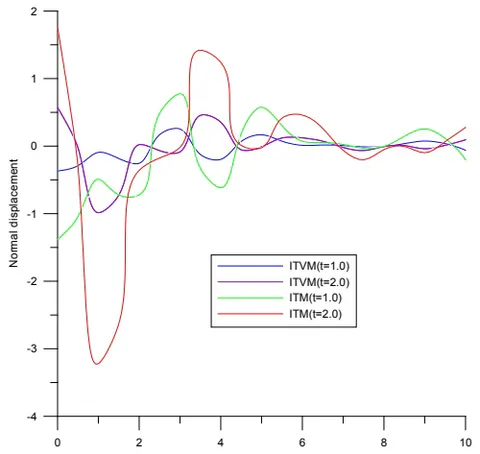
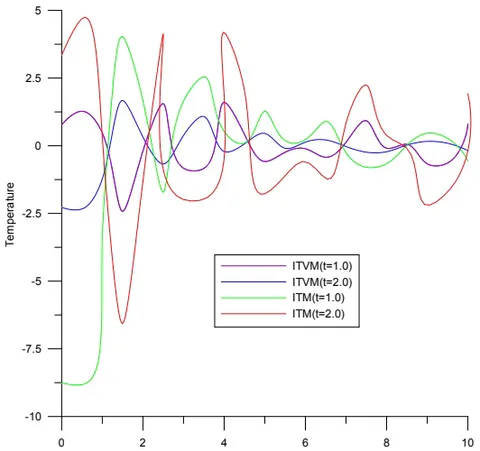
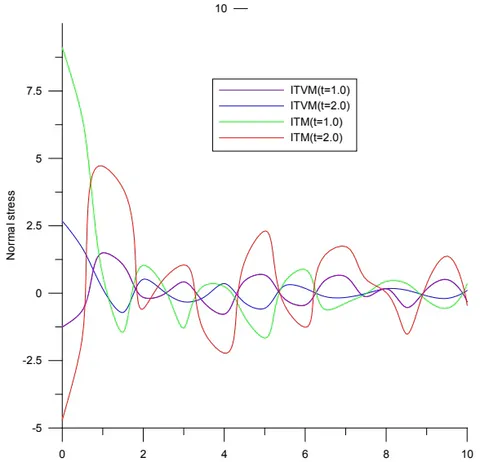
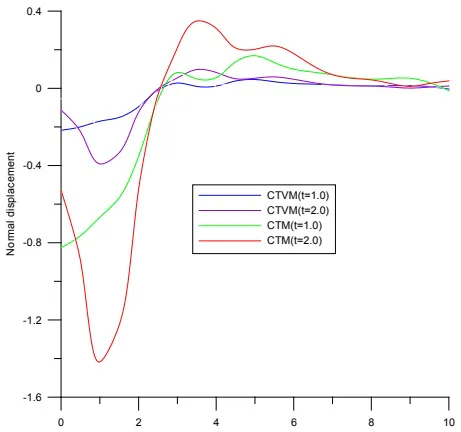
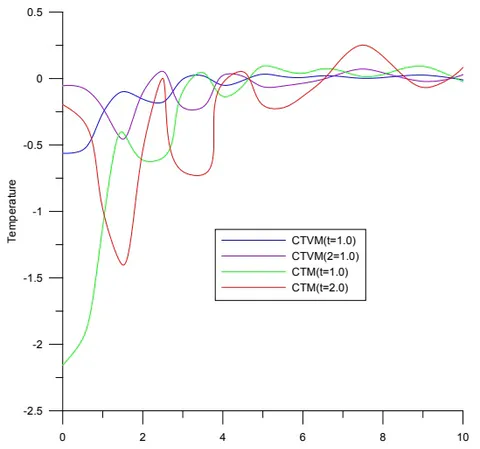
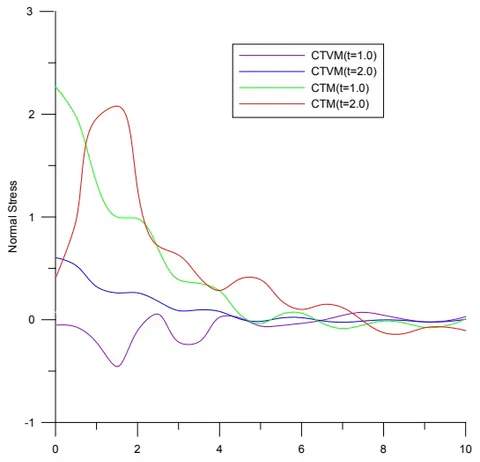
The comparison of normal boundary displacement and boundary temperature field , and normal stress for instantaneous thermoviscoelastic material (ITVM) and instantaneous thermoelastic material (ITM) are depicted in Figures 1-3 and continuous thermoviscoelastic material (CTVM) and continuous thermoelastic material (CTM) are depicted in Figures 4-6. for three-phase-lag theory of thermoelasticity. The computations were carried out for two values of time and , non-dimensional relaxation times , , , at in the range .
a) Thermoelastic Interactions due to Thermal Source (Temperature gradient boundary)
Dynamic thermoelastic case:
- Figure 1. depicts the variation of normal displacement 'w' with distance x for ITM and ITVM for different values of time in context of three phase-lag-model. At t=1.0 the viscosity effect on 'w' is prominent in the ranges , , and less in rest of ranges where as at t=2.0 the viscosity effect on 'w' is more in the ranges , and less in rest of ranges.
- Figure 2. determinethe variation of temperature distribution with distance . At the the ITVM and ITM show opposite oscillatory behavior in the whole range .
- Figure 3. displays the variation of normal stress with distance x. Near the point of application of source, the magnitude of normal stress for ITM is more ITVM and then become oscillatory in the whole range about zero for the time t=1.0 and t=2.0, respectively.
- Figure 4. shows the variation of normal displacement 'w' with distance x for CTM and CTVM. The viscosity effect is more prominent than thermal effect in the range for time and , respectively, and less in rest of the range.
- Figure 5. depicts the variation of temperature distribution with distance . The values of temperature shows same oscillatory pattern in the whole range for CTVM and CTM for time and , respectively.
- Figure 6. display the variation of normal stress with distance . The thermal effect is more prominent than viscosity effect in the range and reverse in rest of the range for both values of time and , respectively.
IX. CONCLUSION
The problem of investigating displacement component, temperature and stress components in anhomogeneous anisotropic thermoelastic half-space is studied in the purview of viscothermoelasticity. Eigen value technique is employed to express the results mathematically. Theoretically obtained field variables are also shown through a specific model to present the results in graphical form.
The results of the present work can be summarized as
The Laplace and Fourier technique is used to derive expressions for displacement components, stresses and temperature distribution for dynamic thermo-elastic case.
The values of all physical quantities are observed to follow oscillatory pattern about zero in the whole range with increase in distance x.
The viscosity effect has a significant role in the considered physical quantities.
The time effect has significant influence on the distribution of the considered physical quantities.