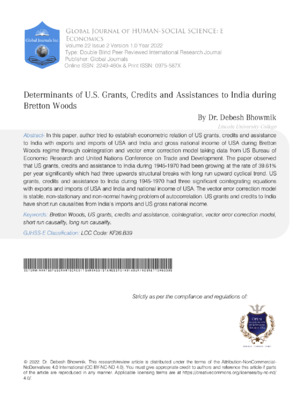
Determinants of us Grants, Credits and Assistances to India During Bretton Woods

α
Dr. Debesh Bhowmik
Dr. Debesh Bhowmik

Send Message

To: Author

Determinants of us Grants, Credits and Assistances to India During Bretton Woods

Article Fingerprint

ReserarchID

F00QF

Determinants of us Grants, Credits and Assistances to India During Bretton Woods Banner

AI TAKEAWAY

Connecting with the Eternal Ground
  • English
  • Afrikaans
  • Albanian
  • Amharic
  • Arabic
  • Armenian
  • Azerbaijani
  • Basque
  • Belarusian
  • Bengali
  • Bosnian
  • Bulgarian
  • Catalan
  • Cebuano
  • Chichewa
  • Chinese (Simplified)
  • Chinese (Traditional)
  • Corsican
  • Croatian
  • Czech
  • Danish
  • Dutch
  • Esperanto
  • Estonian
  • Filipino
  • Finnish
  • French
  • Frisian
  • Galician
  • Georgian
  • German
  • Greek
  • Gujarati
  • Haitian Creole
  • Hausa
  • Hawaiian
  • Hebrew
  • Hindi
  • Hmong
  • Hungarian
  • Icelandic
  • Igbo
  • Indonesian
  • Irish
  • Italian
  • Japanese
  • Javanese
  • Kannada
  • Kazakh
  • Khmer
  • Korean
  • Kurdish (Kurmanji)
  • Kyrgyz
  • Lao
  • Latin
  • Latvian
  • Lithuanian
  • Luxembourgish
  • Macedonian
  • Malagasy
  • Malay
  • Malayalam
  • Maltese
  • Maori
  • Marathi
  • Mongolian
  • Myanmar (Burmese)
  • Nepali
  • Norwegian
  • Pashto
  • Persian
  • Polish
  • Portuguese
  • Punjabi
  • Romanian
  • Russian
  • Samoan
  • Scots Gaelic
  • Serbian
  • Sesotho
  • Shona
  • Sindhi
  • Sinhala
  • Slovak
  • Slovenian
  • Somali
  • Spanish
  • Sundanese
  • Swahili
  • Swedish
  • Tajik
  • Tamil
  • Telugu
  • Thai
  • Turkish
  • Ukrainian
  • Urdu
  • Uzbek
  • Vietnamese
  • Welsh
  • Xhosa
  • Yiddish
  • Yoruba
  • Zulu

Abstract

In this paper, author tried to establish econometric relation of US grants, credits and assistance to India with exports and imports of USA and India and gross national income of USA during Bretton Woods regime through cointegration and vector error correction model taking data from US Bureau of Economic Research and United Nations Conference on Trade and Development. The paper observed that US grants, credits and assistance to India during 1945-1970 had been growing at the rate of 39.61% per year significantly which had three upwards structural breaks with long run upward cyclical trend. US grants, credits and assistance to India during 1945-1970 had three significant cointegrating equations with exports and imports of USA and India and national income of USA. The vector error correction model is stable, non-stationary and non-normal having problem of autocorrelation. US grants and credits to India have short run causalities from India’s imports and US gross national income.

References

24 Cites in Article
  1. Aditya Balasubramanian (1939). India, World War II, and the Bretton Woods System.
  2. Aditya Balasubramanian (2018). India, the Global Economy and the Bretton Woods Conference.
  3. Anand Chandavarkar (2001). Chandavarkar, Sir Narayen Ganesh, (1855–14 May 1923), President of the Bombay Legislature since 1921.
  4. Jeremy Raisman,Finance Member,G (1939). Public Finance Surveys : India.
  5. C Deshmukh (1974). The Course of My Life.
  6. Barry Eichengreen (2018). Barry, Rt Rev. (Frank) Russell, (28 Jan. 1890–24 Oct. 1976).
  7. James Hamilton (2018). Why You Should Never Use the Hodrick-Prescott Filter.
  8. H Hansen,J Doornik (1994). An omnibus test for univariate and multivariate normality.
  9. Eric Helleiner (2015). India and the Neglected Development Dimensions of Bretton Woods.
  10. Robert Hodrick,Edward Prescott (1997). Postwar U.S. Business Cycles: An Empirical Investigation.
  11. Søren Johansen (1988). Statistical analysis of cointegration vectors.
  12. Soren Johansen (1991). Estimation and Hypothesis Testing of Cointegration Vectors in Gaussian Vector Autoregressive Models.
  13. J Joshi (1944). JOINT STATEMENT BY EXPERTS ON THE ESTABLISHMENT OF AN INTERNATIONAL MONETARY FUND (April 1944).
  14. Angus Maddison (2007). Review Article on <i>The World Economy: A Millennial Perspective</i> by Angus Maddison.
  15. Allan Meltzer (1991). U.S. Policy in the Bretton Woods Era.
  16. George Monboit (2008). Unknown Title.
  17. Y Reddy (2000). Unknown Title.
  18. Joseph Saderno (2012). International Monetary System. (Power Point Slides).
  19. Takahira Sato (2010). India's macroeconomic performance in the long run.
  20. Kurt Schuler (2013). Bretton Woods viewed from India.
  21. S Simha (1970). History of Reserve Bank of India.
  22. (2017). India Financial Sector Assessment.
  23. Abraham Wald (1943). Tests of statistical hypotheses concerning several parameters when the number of observations is large.
  24. (2017). Post-war reconstruction and development in the Golden Age of Capitalism.

Funding

No external funding was declared for this work.

Conflict of Interest

The authors declare no conflict of interest.

Ethical Approval

No ethics committee approval was required for this article type.

Data Availability

Not applicable for this article.

How to Cite This Article

Dr. Debesh Bhowmik. 2026. \u201cDeterminants of us Grants, Credits and Assistances to India During Bretton Woods\u201d. Global Journal of Human-Social Science - E: Economics GJHSS-E Volume 22 (GJHSS Volume 22 Issue E2): .

Download Citation

Alt text: Research article on U.S. grants' influence on India’s forestry industry, focusing on credits and financial assistance.
Issue Cover
GJHSS Volume 22 Issue E2
Pg. 55- 70
Journal Specifications

Crossref Journal DOI 10.17406/GJHSS

Print ISSN 0975-587X

e-ISSN 2249-460X

Keywords
Classification
GJHSS-E Classification: LCC Code: KF26.B39
Version of record

v1.2

Issue date

March 30, 2022

Language
en
Experiance in AR

Explore published articles in an immersive Augmented Reality environment. Our platform converts research papers into interactive 3D books, allowing readers to view and interact with content using AR and VR compatible devices.

Read in 3D

Your published article is automatically converted into a realistic 3D book. Flip through pages and read research papers in a more engaging and interactive format.

Article Matrices
Total Views: 1695
Total Downloads: 50
2026 Trends
Related Research

Published Article

In this paper, author tried to establish econometric relation of US grants, credits and assistance to India with exports and imports of USA and India and gross national income of USA during Bretton Woods regime through cointegration and vector error correction model taking data from US Bureau of Economic Research and United Nations Conference on Trade and Development. The paper observed that US grants, credits and assistance to India during 1945-1970 had been growing at the rate of 39.61% per year significantly which had three upwards structural breaks with long run upward cyclical trend. US grants, credits and assistance to India during 1945-1970 had three significant cointegrating equations with exports and imports of USA and India and national income of USA. The vector error correction model is stable, non-stationary and non-normal having problem of autocorrelation. US grants and credits to India have short run causalities from India’s imports and US gross national income.

Our website is actively being updated, and changes may occur frequently. Please clear your browser cache if needed. For feedback or error reporting, please email [email protected]

Request Access

Please fill out the form below to request access to this research paper. Your request will be reviewed by the editorial or author team.
X

Quote and Order Details

Contact Person

Invoice Address

Notes or Comments

This is the heading

Lorem ipsum dolor sit amet, consectetur adipiscing elit. Ut elit tellus, luctus nec ullamcorper mattis, pulvinar dapibus leo.

High-quality academic research articles on global topics and journals.

Determinants of us Grants, Credits and Assistances to India During Bretton Woods

Dr. Debesh Bhowmik
Dr. Debesh Bhowmik

Research Journals