This study examines how business intelligence (BI) tools are adopted in a higher education setting. It made use of the theories of Diffusion of Innovation (DOI), Technology Readiness Index, and Technology Acceptance Model (TAM). The psychometric features of the intended end-users were defined using TAM. The technology readiness of the users was assessed using TRI. The DOI was used to describe the innovation itself. The important factors for the adoption of the technology in this particular environment were identified through the examination of both quantitative and qualitative data. To gain a better understanding of the socio-technical system as a whole, a systems dynamics tool is presented to model the interaction of these elements along with the recommended interventions.
## I. INTRODUCTION
A management dashboard, similar to a car or airplane dashboard, offers information regarding the working conditions of what or where the user is viewing. It is a system in which multiple components are constructed so that data can be processed and displayed. The back end of such a dashboard is a technical system that enables it to function as intended. The dashboard and the user are components of an additional system known as the human-computer interaction system. According to Brian Whitworth [11], social-technical systems emerge when cognitive and social interaction is mediated by information technology rather than the natural world.
### a) This Study's Socio-Technical System
The technical system automates business intelligence data retrieval, analysis, transformation, and reporting. In addition, it includes data cleansing and, extracting and loading technologies. Such a technical solution was developed in a higher education institution (HEI), where large amounts of data are presumed to exist to support sound decision- making.
Its administrators are the end-users in this study. They monitor metrics that are crucial to the achievement of institutional goals and objectives. Prior to the availability of these business intelligence (BI) tools, they were required to obtain foundational data from sources that maintain such data in an unstandardized format and varying structure. It took so much time to collect data that, if decisions had to be made, there would be little time for analysis. Thus, leading to decisions that may not be particularly sound.
Interaction refers to the communication between the end-user and the computer, as well as the manner in which the user and computer collaborate. This interaction occurs via the interface of the BI tools, in which the computer visualizes the data and the user draws insight from the information and formulates a plan of action based on whether they are working and contributing to the university's ultimate objective.
This institution's deployment of a BI tool was primarily motivated by the need to facilitate such activities in an efficient manner. However, regardless of how information technology intends to aid organizations, technology adoption issues may arise and impede any potential benefits [9]. In order to optimize its intended benefits, an examination of the degree of end-user adoption of this business intelligence product is being conducted.
### b) Focus of the Study
In the context of the generalizability concept of theories, the Technology Acceptance Model (TAM), Technology Readiness Index (TRI), and Diffusion of Innovation (DOI) are utilized to characterize the intended users of the technology in a higher education institution and generate recommendations on how to best approach the intended users and popularize the information technology (IT).
This study aims to establish the following:
- The state of adoption of the technology by its intended users
- The innovation itself, as may be described by the major elements that influence adoption of an innovation, according to the theory of DOI
- The technological readiness index (TRI) of the intended users at this higher education institution as well as the prospective adopter categories into which these users fall based on previous research employing TRI
- The Technology Acceptance Model-based psychometric profile of this HEI's intended users, as measured by their behavioral intent to adopt technology.
- To model an effective means of increasing the adoption of BI tools in HEIs
## II. METHODOLOGY
A review of the Diffusion of Innovation (DOI) Theory, the Technology Readiness Index (TRI), and the Technology Acceptance Model (TAM) was conducted [1]. The concept gained from such a review, though intended to enhance the adoption and use of intelligent waste management systems in smart cities, is utilized in this investigation. The conclusion of the study was a recommendation to integrate the three adoption models, as each model complements the deficiencies of the others.
E.M. Rogers created the DOI Theory in 1962, making it one of the oldest social science ideas. It originates in communication to describe how an idea or product gets momentum and spreads within a certain demographic or social system over time. This theory considers the innovation itself to be the primary element affecting adoption, which neither the TRI Model nor the TAM Model account for. It investigates the perceived characteristics of the innovation in terms of relative advantage, compatibility, complexity, trialability, and observability.
The Technology Readiness Index (TRI) examines four dimensions of technological beliefs that influence a user's techno-readiness: innovativeness, optimism, discomfort, and security. The first two are contributory, whereas the latter two are inhibiting. The greater the level of technology readiness, the greater the level of satisfaction and behavioral intent. This theory enables the measurement of user readiness, something the Technology Acceptance Model does not cover. According to Colby and Albert [4], the construct can be regarded as a gestalt of mental enablers and inhibitors that collectively influence a person's propensity to adopt new technology.
The Technology Acceptance Model provides a psychometric description of the behavioral intent of technology users. It takes into account four constructs: perceived usefulness, perceived ease of use, attitude towards using and behavioral intention to use. This permits the categorization of the users' perception, which is not addressed in the Dol.
Figure 1 illustrates how the investigation of the adoption of the BI tools in an HEI is carried out. The characteristics of the intended users are gathered via a survey questionnaire, while the features of the technology are gathered from the available documentations, such as presentation documents, workshop notes, and project post mortem analysis.
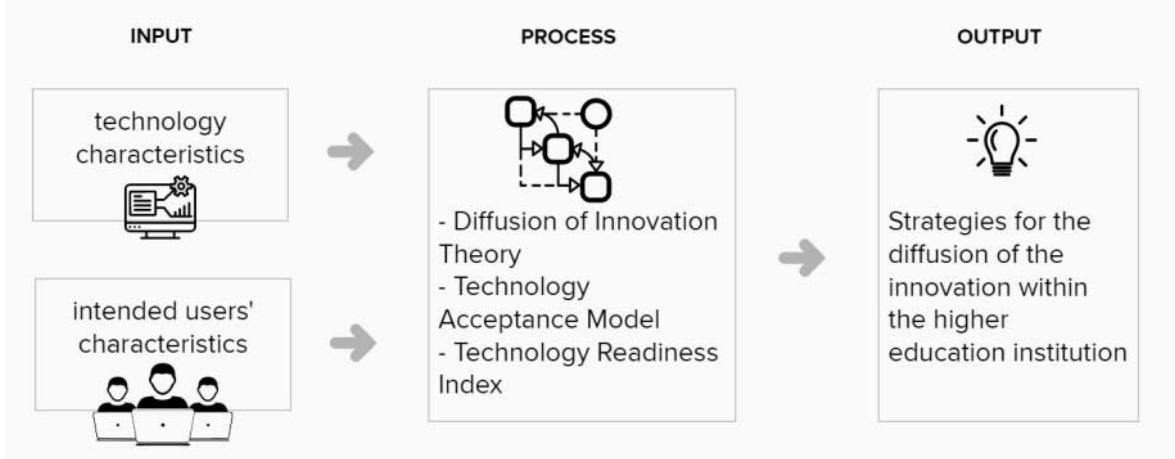 Figure 1: Methodology employed in this study
The theories are then used to process these inputs to produce a model that will serve as the basis for strategies in increasing the adoption of the BI tools.
### a) Quantitative Method to Determine Intended Users' Characteristics
The initial questionnaire was distributed to 10 respondents for data standardization reliability analysis. Following the standardization and reliability analysis, the Cronbach's alpha coefficient was calculated to demonstrate the interrelationships between each factor and to assess its validity and internal reliability. The
Cronbach analysis indicates a satisfactory level, hence all constructs were retained.
To ensure confidentiality of the data, the compilation of responses was stored and the questionnaire itself was distributed via the university's Google Workplace account, with access restricted to university employees and the researchers.
Two questions were added in the survey to eliminate insincere answers. Forty-eight percent (48%) of the replies submitted were eliminated because they were deemed "insincere." The remaining 52 percent is being analyzed.
Using a 5-point Likert scale, user acceptance and technological readiness were assessed. Respondents were required to assess their level of agreement on a 5-point Likert scale for each item (1 = strongly disagree, 5 = strongly agree) and answer six demographic questions.
### b) Qualitative Method to Describe Perceived Characteristics of the Innovation
From the introduction and subsequent stages in the deployment of the BI tool, which is the innovation referred to in this study, suitable documentation and field notes were maintained along the journey and used as data sources in this study.
The relative advantage of the technology is derived from related memos and communications thread that explicitly articulate the said advantage of the BI tools. While there are project documents available, the perspective of the management as one of the end-users of the tool was purposefully chosen as the source document since it would characterize how the management perceived the relative advantage of the new methods over the old ones.
Learning sessions with small groups of individuals who do not necessarily hold managerial positions was offered for voluntary participation. Compatibility, or the degree to which an innovation is regarded to be consistent with existing values, past experiences, and the needs of potential adopters, is extracted from the notes derived from these learning sessions. The purpose of the workshops then was to persuade potential adopters that their processes could be streamlined with the use of such information technology.
In the project's status reports, the progress of the deployment and interaction of the components of the technical system and how the end-users understood what's going on are being recorded. From such documents, the perceived complexity of the innovation was deduced.
A workshop was arranged to document the utilization of the BI tool in its early phases. This is where trialability, the extent to which the innovation was experimented, as perceived by the participants, can be sourced.
Understanding the perceived observability of the invention can be obtained from a variety of sources, such as excerpts from the president's report to the board of trustees; where the innovation is utilized on an institutional level; and documents from accreditation preparations and continuity planning during the pandemic.
An analysis of these qualitative data, though primary intended to extract perceived characteristics of innovation, can also provide additional context for the survey results.
## III. DISCUSSION OF THE RESULTS
# a) The Intended Users' Characteristics in Terms of Technology Readiness
Individual personality and demographics may influence technology acceptance, as suggested by technology acceptance researches.
Table 1 displays the composition of the study's sample population. Slightly more than half of the responses are academic employees, and 24.59 percent are also academic employees or teaching staff but are handling administrative functions. The remainder are administrative personnel or non-teaching staff, with $18.03\%$ who are purely administrative employees and $6.56\%$ with teaching load. $57.38\%$ of these employees have been at the university for more than 15 years.
Table 1: Profile of the respondents in terms of employee categories and number of years in the institution
<table><tr><td></td><td>1-5 years</td><td>10-15 years</td><td>5-10 years</td><td>>10 years</td><td>Total%</td></tr><tr><td>Academic employee</td><td>11.48%</td><td>3.28%</td><td>4.92%</td><td>31.15%</td><td>50.82%</td></tr><tr><td>Academic employee with *</td><td>3.28%</td><td>1.64%</td><td>6.56%</td><td>13.11%</td><td>24.59%</td></tr><tr><td>Administrative employee</td><td>4.92%</td><td>1.64%</td><td>0.00%</td><td>11.48%</td><td>18.03%</td></tr><tr><td>Administrative employee w/ **</td><td>1.64%</td><td>3.28%</td><td>0.00%</td><td>1.64%</td><td>6.56%</td></tr><tr><td>Total Percentage</td><td>23.32%</td><td>9.84%</td><td>11.48%</td><td>57.38%</td><td>100.00%</td></tr></table>
Table 2 shows the mean scores for each factor used to calculate the TRI. The mean value of optimism is greater than that of innovativeness, whereas the mean value of insecurity is greater than that of discomfort. It surpasses the contributing factor of innovativeness. Thus, it is evident that the predominant personality trait of these end-users is optimism coupled with insecurity.
Table 2: Mean Values of the TRI Factors
<table><tr><td></td><td>Mean</td></tr><tr><td>Contributors</td><td></td></tr><tr><td>innovativeness</td><td>3.2098</td></tr><tr><td>optimism</td><td>4.0983</td></tr><tr><td>Inhibitors</td><td></td></tr><tr><td>discomfort</td><td>3.1366</td></tr><tr><td>insecurity</td><td>3.4819</td></tr></table>
Certain studies analyze TRI in conjunction with the following user classifications: explorers, pioneers, skeptics, paranoid, and laggards, as shown in Table 3. Based on an individual's technology readiness score and the TRI, Badri et. al [3] used cluster analysis to further classify technology users further into these five technology-readiness segments.
Table 3. Characteristics of the five segments with TRI [3]
<table><tr><td></td><td>Optimism</td><td>Innovativeness</td><td>Insecurity</td><td>Discomfort</td></tr><tr><td>Explorers</td><td>high</td><td>high</td><td>low</td><td>low</td></tr><tr><td>Pioneers</td><td>high</td><td>high</td><td>high</td><td>low</td></tr><tr><td>Skeptics</td><td>low</td><td>low</td><td>low</td><td>low</td></tr><tr><td>Paranoids</td><td>high</td><td>high</td><td>high</td><td>low</td></tr><tr><td>Laggards</td><td>low</td><td>low</td><td>high</td><td>high</td></tr></table>
Based on the high optimism and insecurity scores of end-users in this study, they may be either pioneers, as early adopters, or paranoids, as the late majority in social categorization. Inferring a composition of pioneers and paranoid individuals whose insecurity, when handled, may eventually join the adopters.
It is possible to calculate a mean total technological readiness (TR) score by subtracting inhibitors from contributors. A positive TRI is suggestive of a technology-ready orientation, whereas a negative TRI for an orientation that was not technology-ready [7].
Sixty-four (64%) percent of the population are tech-ready while the 36% are non tech ready, meaning that their inhibiting factors outweigh their contributing factors. Figure 2 illustrates the breakdown based on employment categorization.
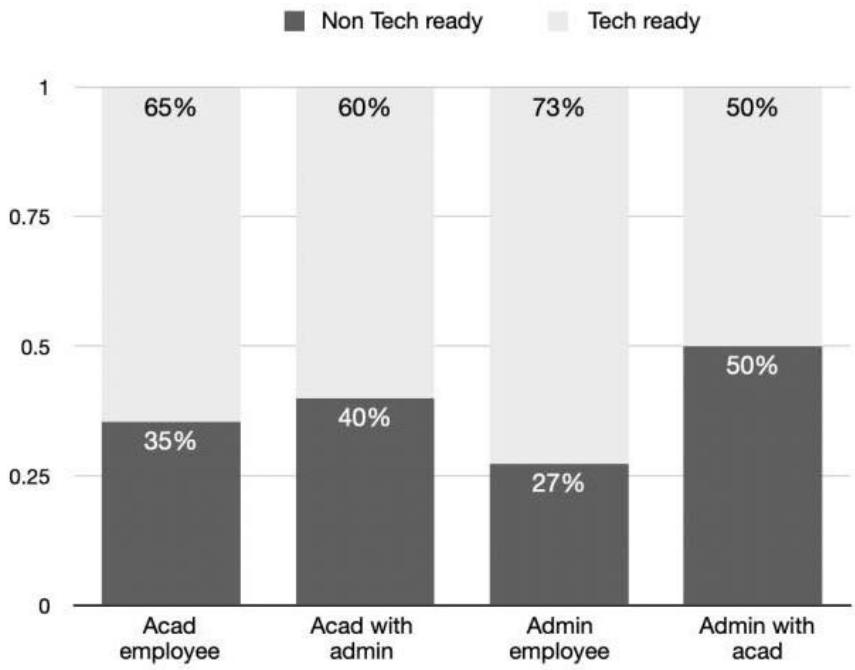 Figure 2: Breakdown based on employment Categorization
Purely administrative employees appear to have a greater proportion of technology-ready than nontechnology ready employees. This may be due to their consideration of BI tools while creating performance scorecards for their quality management system. On the other hand, the proportion for academic employees is lower, possibly because they are more focused on their teaching obligations and the current phase of the project is more focused on management metrics.
TRI, which is calculated by reversing the code for inhibiting factors, yields the value of 3.1503. According to the study by Parasuraman [8], this indicates that the higher education institution has MEDIUM technology readiness.
# b) The Intended Users' Characteristics in Reference to TAM
The dynamics of the interaction between people and automation are essential to the performance and survival of developing technologies. The Technology Acceptance Model (TAM) and the Theory of Planned Behaviour (TPB) will continue to be key tools for researchers wishing to examine the elements influencing consumers' adoption intentions of various technologies [6], where TAM can be accepted as an adaptation of the TPB model [2].
The correlation values of the constructs of technology acceptance model of this study concur with other studies suggesting that perceived ease of use correlates with attitude and, consequently, the intention to use the model.
When optimism, which in the technology-readiness calculation had the highest mean value, is taken into consideration, it shows a high correlation to perceived usefulness and perceived ease of use (Figure 3). Innovativeness, the other contributing factor, has relatively lower correlation values than optimism but nevertheless contributed positively. On the other hand, insecurity and discomfort have negative and practically zero correlation values, which consistently suggests that they are also inhibiting factors in the context of this particular HEI.
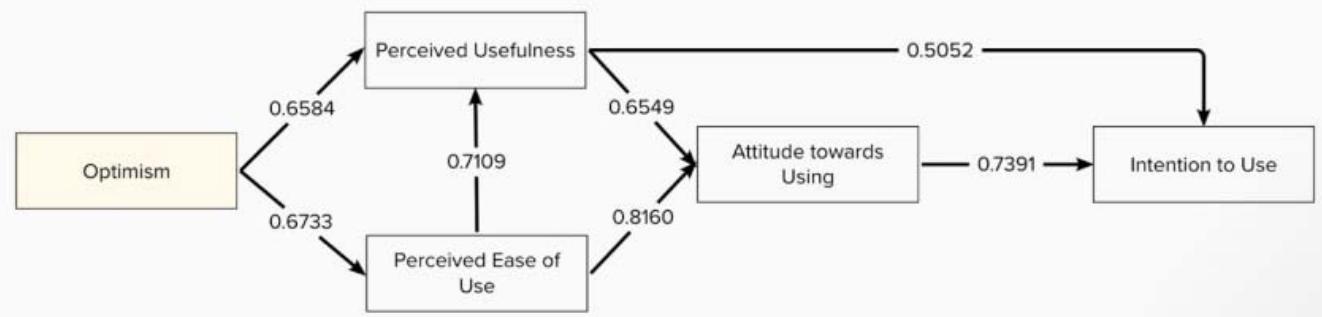 Figure 3: Correlation of Factors
Recalling the instances when the adoption of this BI tool was pushed, it had always been about influencing the perceived usefulness. Survey results from this study would in fact confirm the effectiveness of such communication as evidenced by a high mean value of perceived usefulness in Table 4 below. Additionally, computation shows that perceived usefulness has mean values that are higher than perceived ease of use. Given that perceived ease of use correlates more strongly with attitude towards using than perceived usefulness, it may be advantageous to make steps to provide end users a more accurate perception of the ease of use.
Table 4: Mean Values of the TAM Constructs
<table><tr><td></td><td>Mean</td></tr><tr><td>Perceived usefulness</td><td>4.2172</td></tr><tr><td>Perceived ease of use</td><td>3.8000</td></tr><tr><td>Attitude to use</td><td>3.9645</td></tr><tr><td>Intention to use</td><td>4.2582</td></tr></table>
### c) The innovation in the context of the frames of the Dol theory
## i. Relative Advantage
Top management can be reported as saying that the new reporting method has a relative benefit over the old one as,
It is very much in line with what I would like the QR of each department to look like - a graphic summary of where they are. They can always supplement the chart with a narrative report if they like; the important thing is that their status is objectively presented so that the achievement status is unmistakable, but also where the gaps are. Planning should then concentrate precisely where the gaps are. I think our instruments are beginning to take on more communication, assessment and planning values. (P1)
Additionally, communications emanating from the realized relative advantage as in the memo with the statement, "Please be notified that at its regular meeting yesterday, the Cabinet decided to adopt a common reporting template for all academic departments. These instruments are also intended to support forwarding planning." help in the adoption of the innovation.
## ii. Compatibility
One example of the many instances in which one can affirm that the end users can resonate to the innovation being deployed as compatible with their values and experiences is the local phrase, "sakto ingon ana jud ang nahitabo, maong dapat naa tay ingon ana nga system," which means, "exactly, that is exactly what is happening, that is why we need a system like this." This is regarded to have influenced a favorable attitude towards the use of such technology.
## iii. Complexity
Many of the supposedly action plans on the narrative sections of the BI tool are clarifications on the connections between data sets, which increases the perception of the technology's complexity. They consider it excessively complex when they are clarified that data sets must be addressed at the source and processed in a specific manner. Consequently, this influenced the non-utilization of the technology.
## iv. Trialability
The innovation gave middle management the opportunity to test the system out gradually, beginning with familiar interfaces to actual BI interface in the end. The number of people taking part in the trial stages has grown over time. According to a project document on the BI interface, 14 middle managers are already mindful of the management metrics at the tactical and operational level, while 4 have started to reflect on them, 4 have started to consider them, and 2 were completely unaware of them. This is suggestive of a positive attitude toward the innovation, which may have been prompted by the fact that the innovation allowed them to test the system.
## v. Observability
End-users are not seeing the benefits of the innovation, as evidenced by comments like, "How come we are no longer asked for the reports like before?", "This X office is still asking for these documents. They are not at all utilizing what we have submitted to the system," and "I thought you will just extract it from the As a result, people are developing a negative attitude toward innovation because they start to believe that the system is not actually being used.
In summary, relative advantage, compatibility, and trialability produced good reactions to the innovation, whereas observability and complexity produced unfavorable ones. Demands for the inclusion of the use of these BI tools in recently drafted institutional policies and requests for informational materials or orientation sessions from a number of stakeholders are indicative of the need to address these two frames.
## IV. CONCLUSIONS AND RECOMMENDATIONS
The analysis of the gathered data from this higher education institution in the context of the three theories allowed for an understanding of the factors contributing to the gaps in the adoption of the technology. The study found that insecurity, which is impeding technology readiness; perceived ease of use, which is delaying technology acceptance, and the complexity and observability of the technology, which are influencing the formation of unfavorable attitude towards the innovation, are the areas that need to be addressed.
Interventions will be necessary to get this sociotechnical system close to fully utilizing the BI tool as the best course of action, as expected and as desired in this study. This study is not, however, merely settling on recommendations addressing the causes of the specific event that this study is looking at, which is adoption rate, in isolation. Rather, it is taking into account that such a system is complex in the sense that it involves interacting cross-functional processes and entails strategic level considerations rather than merely operational actions. Therefore, this study uses a system thinking model called a causal loop diagram to show how cause and effect operate from the perspective of the system (Figure 4).
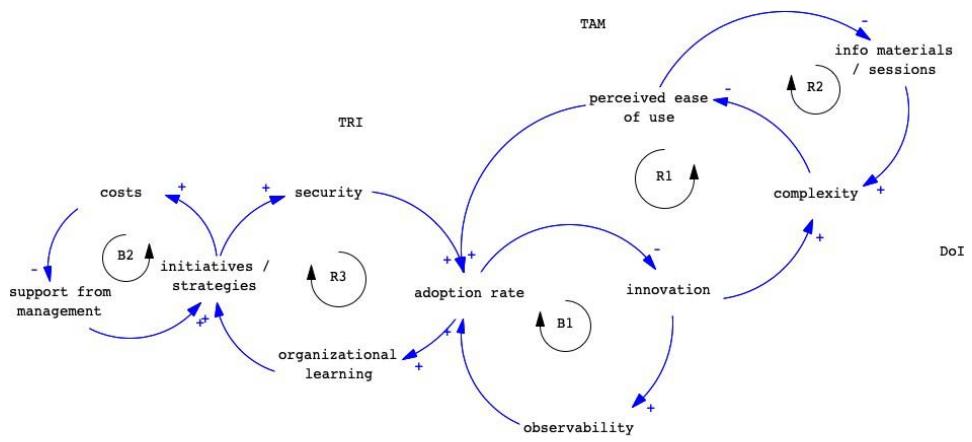 Figure 4: Causal Loop Diagram
Kim [5] claims that in the context of systems thinking, there are two fundamental loops: reinforcing and balancing, which are comparable to the building blocks of complex social systems and when combined, produce a complex system that managers are expected to manage. The top management of this higher education institution must therefore think about managing the interaction of the loops produced by the factors and the potential interventions.
### a) Reinforcing loops
These loops will continue in the direction of change of the variables within the loop. Accordingly, as the cause increases, the effect rises above what it would have been otherwise, and as the cause reduces, the effect falls below what it would have been otherwise [10].
- R1. The complexity of an innovation has an impact on how quickly people adopt it because, as complexity rises, people perceive technology as being harder to use.
- R2. The management of users' perception of ease of use may involve the increase of the provision of orientation sessions and informational resources. But it's also important to note that as information materials become more abundant, complexity may also rise, as in information overload. Understanding such dynamics is necessary to determine the best strategy for delivering these information or orientation sessions.
- R3. The implementation of these business intelligence tools aims to improve the institution's capacity for reflection, which will help decision-makers make wise choices when considering measures to address problems with technological readiness like insecurity and, as a result, boost adoption rates.
### b) Balancing loops
In contrast, balancing loops prevent further changes in one direction. If the cause increases, the effect reduces below what it would have been otherwise, and if it decreases, the effect increases above what it would have been otherwise [10].
- B1. The more the necessity for the innovation's observability, which may also include certain reinventions of earlier versions, the better the adoption rate will be until the use of business intelligence tools becomes institutionalized.
- B2. As the cost of implementing actions or strategies to overcome barriers to technology readiness rises (i.e. insecurity), management support could decline, necessitating careful consideration of cost-effective options.
Generating HTML Viewer...
References
11 Cites in Article
Stephen Ajwang,James Abila,Irish Tejero-Dakay (2021). Adoption Conceptual Model for Intelligent Waste Management in Smart Cities: Theoretical Review.
Icek Ajzen (1991). The theory of planned behavior.
Masood Badri,Asma Al Rashedi,Guang Yang,Jihad Mohaidat,Arif Al Hammadi (2014). Technology Readiness of School Teachers: An Empirical Study of Measurement and Segmentation.
C Colby,T Albert (2003). A national strategy for the export of US geothermal technology.
D Kim (2017). Building Blocks.
Sahil Koul,Ali Eydgahi (2017). A systematic review of technology adoption frameworks and their applications.
W Lee,W Chiu,M Chiang,C Chiu (2009). Technology readiness in the quality-value-loyalty chain.
A Parasuraman (2000). Technology Readiness Index (Tri).
Cagla Seneler,Nuri Basoglu,Tugrul Daim (2008). A taxonomy for technology adoption: A human computer interaction perspective.
J Sterman (2020). Business Dynamics: Systems Thinking and modeling for a Complex World.
Explore published articles in an immersive Augmented Reality environment. Our platform converts research papers into interactive 3D books, allowing readers to view and interact with content using AR and VR compatible devices.
Your published article is automatically converted into a realistic 3D book. Flip through pages and read research papers in a more engaging and interactive format.
This study examines how business intelligence (BI) tools are adopted in a higher education setting. It made use of the theories of Diffusion of Innovation (DOI), Technology Readiness Index, and Technology Acceptance Model (TAM). The psychometric features of the intended end-users were defined using TAM. The technology readiness of the users was assessed using TRI. The DOI was used to describe the innovation itself. The important factors for the adoption of the technology in this particular environment were identified through the examination of both quantitative and qualitative data. To gain a better understanding of the socio-technical system as a whole, a systems dynamics tool is presented to model the interaction of these elements along with the recommended interventions.
Our website is actively being updated, and changes may occur frequently. Please clear your browser cache if needed. For feedback or error reporting, please email [email protected]
Thank you for connecting with us. We will respond to you shortly.