I. INTRODUCTION
Climate change is on the agenda of several international debates, because the increase in temperature on the globe ends up intensifying extreme weather events such as floods, droughts, storms, rising of sea levels, among others. According to Vargas (2021), as of the 1930s, Brazil's environmental policy begins to be designed, mainly due to pressure of international and multilateral organizations, such as the United Nations (UN), the World Bank, and environmental movements.
According to Moreno and Ravache (2021) the UN, through the Intergovernmental Panel on Climate Change (IPCC), has been disseminating efforts to mitigate climate changes and its effects. The
Archipelago of Fernando de Noronha, located in the state of Pernambuco, presents peculiar characteristics being a place of geographical isolation, therefore ecologically more fragile and vulnerable to climate change.
With paradisiacal landscapes, Fernando de Noronha, the only inhabited island of the archipelago of the same name, becomes a relevant place from the scenic point of view in relation to tourism. It presents significant importance for the conservation of coastal and marine biodiversity, whose necessity for conservation led to the creation of two Federal Conservation Units in this territory - Marine National Park of Fernando de Noronha (PARANAMAR) and Environmental Protection Area (APA) of Fernando de Noronha - Rocas - São Pedro e São Paulo. By presenting these characteristics, it was chosen by the government of Pernambuco to start actions to decrease carbon emissions.
The Noronha Zero Carbon Program, according to Cordeiro and Körössy (2018), was announced in 2013 presenting as perspectives of low carbon on the island, being a pioneer territory offsetting greenhouse gas (GHG). Besides the insertion of electric cars, the program also foresees the replacement of the island's main energy matrix, the diesel. The Tubarão Power Plant, owned by Neoenergia, is the thermoelectric plant that produces and distributes energy within the island, that is the most used energy matrix. Noronha, as the island is called, also has two solar power plants, Noronha I and Noronha II, which supply only of the energy demand needed to supply the island.
Thus, in 2020, Law 16.810/2020 was sanctioned, prohibiting the entry, circulation, and permanence of combustion vehicles within the State District of Fernando de Noronha. Combustion-driven vehicles will be prohibited entering the island from August 10, 2022, and from August 10, 2030, this type of vehicle will be prohibited from remaining on the island. The law makes an exception when it comes to boats, tractors, aircraft, cranes, and vehicles for road paving or airport operations.
This paper analyzed how governance is being conducted in the implementation of the law that provides the insertion of the use of electric mobility within this environment, environmental public policies related to electric mobility within the Fernando de Noronha Archipelago, seeking to understand what environmental and economic impacts this entails. Since the cost of an electric car is high, and importing it to the island places an additional burden on the owners. In light of this, it will be analyzed whether environmental governance, in terms of the attributes of good governance of Bursztyn and Bursztyn (2012), can be met, or at least have the tendency to occur in this place with very peculiar environmental, geographical, territorial, and economic characteristics.
II. MATERIALS AND METHODS
a) Study area
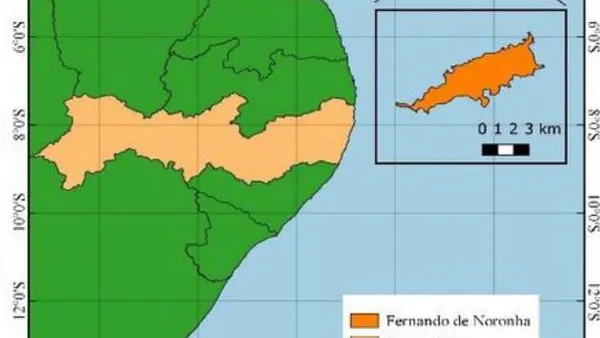
The research took place on the island of Fernando de Noronha, which according to Cordeiro and Körössy (2018), is a state district with protected areas through two conservation units: the Marine National Park (PARANAMAR), which is of full protection and the Environmental Protection Area (APA) of Fernando de Noronha - Rocas - São Pedro e São Paulo, which presents sustainable use (Figure 1).
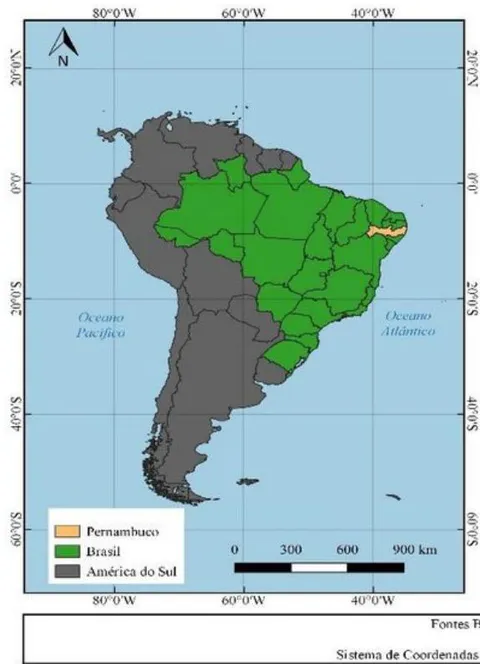
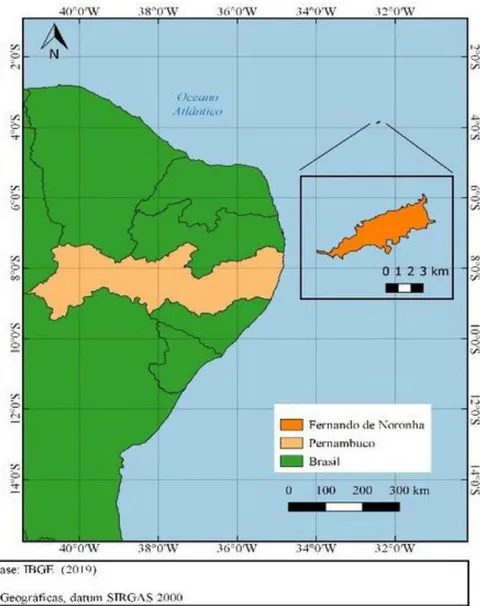
Source: https://www.researchgate.net/figure/Figura-1-Mapa-de-Localizacao-de-Fernando-de-Noronha-PE-Brasil FIG1_346854559
b) Data collection and analysis
In order to analyze the insertion model of a new mobility modal in Fernando de Noronha, this research used the qualitative approach, which according to Gonçalves, Gonçalves and Marques (2021) acts when a problem or question needs to be explored, it is necessary to understand the contexts and scenarios in which the study participants live, listen to their voices and share their stories. For Gonçalves, Gonçalves and Marques (2021), qualitative data collection is part of three main strategies for conducting studies: document analysis, interviews and observation.
The bibliographic and documentary research was one of the research steps in collecting information about electric mobility, solar energy, environmental impact, and social impact. Articles relevant to the theme were surveyed. Were also used the normative documents intended for Fernando de Noronha regarding electric mobility from Federal, State and Municipal (District Council).
The structured interview was another data collection instrument, aimed at understanding the attributes of good governance. The interviews took place in person on the island of Fernando de Noronha, and were conducted by the main author of this article. The interviews were conducted particularly with each selected actor and lasted approximately 40 minutes. All interviewees are residents of the island and were connected to some activity relevant to electric mobility. The interview script followed is available in Table 01.
| 7. Accountability | Provide clarification, provide information, reformulate systems and practices, and ensure the establishment and enforcement of sanctions | Are there resources intended to facilitate the purchase and transport of electric vehicles for residents of the island? How does the association/organization receive or seek information about the insertion of electric mobility in Noronha? Are there participatory ways of social control over these resources? |
| 8. Transparency | Clear information and decisions with communication channels between actors and operators | How are the decisions taken here passed to other institutions (if they do not actively participate in the decision-making process)? And to civil society? What are the existing communication channels on electric mobility? How often does this occur? How does this institution have access to the information and decisions that were taken for electric mobility in Noronha? When does it happen? |
| 9. Security | People are free from any kind of threat | Can you report any occasion where there was any kind of discomfort with the actors involved in the change of modal on the island? Do residents feel comfortable with this change within the island? |

Were defined 10 social actors with relevant connection to the object of study of various segments for the application of the interviews: public authorities (administration, NGOs, district council, school), association of buggy drivers, association of taxi drivers, inns owners, artisans' association, dive operators and tourist receptive. All interviews were audio recorded with the consent of the interviewee, respecting their anonymity in the face of the speeches.
(2016) of content analysis was used, which takes place through three processes: (1) pre-analysis (systematizing the initial ideas, organization); (2) exploration of the material (coding, decomposition or enumeration operations); (3) treatment of results, inference and interpretation. To maintain the anonymity of respondents, they will be represented throughout the results with the codes contained in Table 02.
| Respondent code | Respondent's gender | Representation sector |
| EPP01 | Female | Public Authorities |
| EPP02 | Female | Public Authorities |
| EPP03 | Male | Public Authorities |
| EPP04 | Female | Public Authorities |
| ESC01 | Female | Civil society |
| ESC02 | Female | Civil society |
| EEP01 | Female | Private company |
| EEP02 | Male | Private company |
| EEP03 | Male | Private company |
| EEP04 | Male | Private company |
III. RESULTS AND DISCUSSION
When it comes to environmental governance, according to Bursztyn and Bursztyn (2012, p.166) it can be considered as "the set of practices involving institutions and interfaces of actors and interests, aimed at conserving the quality of the natural and built environment, in line with the principles of sustainability". For Silva et al. (2022, p.15) environmental governance relates to "interventions aimed at modifying incentives related to the environment, knowledge, institutions, decision-making and behavior".
When thinking about electric mobility, environmental governance, characterized by Jacobi and Sinisgalli (2012), aims to encompass each and every one about the decisions involving the environment in order to obtain broad and unrestricted adherence to a given project that comes to contribute with the maintenance of the planet's integrity. For Fonseca and Bursztyn (2009, s/p), "governance is a key term in the implementation of environmental and development policies".
This multiscale nature brings the challenges that need to be overcome through coordinated actions between society and the State, in the pursuit of sustainable development (ADMS et al., 2020). Thinking about the definitions cited by the authors above, each of the principles of good governance related to the insertion of electric mobility in Fernando de Noronha will be discussed.
The principle of decentralization acts in the insertion of new actors in the decision-making process, so that decisions can be taken by more people. Thus, the State would no longer be the sole decision-maker. When questioned about this principle (the guiding questions can be seen in Table 01), the answers were not unanimous among the interviewees. Some feel that their sectors are included in the discussions, being part of the process, while others are unable to assert their opinion, as can be seen from the interviewees' statements:
"Yes, usually as a consultant. Ask what we think, we try to express ourselves. Our opinion is not always accepted (EEP02)".
"It is directly linked to the administrator, it goes through some things through the Environment sector (EPP02)".
"As far as I know, from these meetings that they are having, but previously what happened was within that initial policy of insertion of some vehicles, the companies entered as participants in relation to the adhesion and inclusion of these vehicles in the routine (EEP01)".
"No (EEP04)".
"Yes, both from the law and from the decree. The decree is ours, from district, and then we made it, the law is almost a mirror image of it. In the discussions in the district government itself, we said to the government staff, the government deputies, you have to leave a provision there that if it arrives in 2022 and the thing is not in conditions, we try to extend it. And that was it, this mechanism remained because the people of the island have to do their duty, but the government also has to do its own (EPP03)".
"But our association, for example, is not being asked for an isolated opinion, but rather collectively, together with the population (EEP03)".
"In no way, nor was it consulted, nor was it informed about any activity (ESC01)".
According to Gouveia (2019, p.22), governance "has as its main point the decentralization of power, the State no longer governs alone and relies on other actors (private companies, NGOs, Universities, organized civil society) that will collaborate in the decision-making process. It is important in this process that users of electric mobility can understand the positive impacts of its implementation and also be decision makers. Fernando de Noronha, being an island, a closed and complex system, becomes a very interesting case for the applicability of a new mobility modal.
For Bursztyn and Bursztyn (2012, p.169) some aspects can be credited to the local institutional capacity that facilitate the principle of decentralization: "qualified government personnel; clear, legitimate and effective rules; social control mechanisms (accountability); and instances of sovereign participation of society in government decisions".
Regarding the principle of subsidiarity, it was noted that the principle is not visible within the management of electric mobility on the island. The only agency that claimed to have some responsibility from the administration was the Department of Environment. This principle acts in the transfer of responsibilities that were in the hands of the State to society or companies. This department has the task of enforcing the electric mobility decree, through actions that make it possible through The Noronha Zero Carbon Program, which aims to zero carbon emissions on the island by the year 2030.
The principle of flexibility, for Bursztyn and Bursztyn (2012) takes away the rigid and bureaucratic structures, replacing it for more flexible instruments of action adapted to the context in which it is inserted. The place for the biggest debates on the island is in the District Council, which according to Pernambuco (1995, art. 42) may constitute, through resolution, permanent or temporary commissions for the analysis and appreciation of specific matters of interest to the State District of Fernando de Noronha and the island population, as provided in the Internal Regulations".
In the interviews, it was noted that a large portion of the population, even with this instrument, did not feel heard by the Public Authorities, especially in the sense that the deadlines and subsidies for the purchase of electric vehicles were not negotiated, taking into consideration mainly the time when the entire fleet should become electric.
As Calame (2004) affirms, states usually tend to be above society, even though they are expressions of it. The idea of an egalitarian dialogue is still a reality far removed from the community, the institutional mechanisms often seem incomprehensible to the community and their aspirations lose their validity for governments.
The bottom-up decision-making principle works so that the decision-making process can occur from the bottom up, coming from the community, with its desires and points of view. According to Ildi, Silva and Brasil (2022), in Brazil, public hearings and consultations are the main mechanisms for the operationalization of popular participation, but these are still top-down models, as information comes from experts to the public. It is necessary that the dissemination and public contributions are carried out within the process.
It can be seen through the word cloud (Figure 2), how this principle was detected in the research locus when it comes to electric mobility.
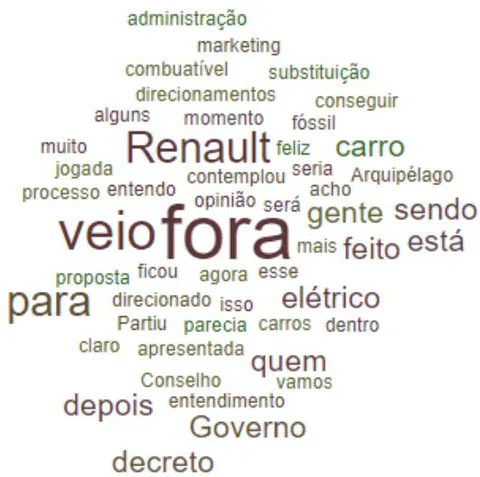
Source: Elaborated by the authors based on: https://wordlitout.com/word-cloud/create. Most relevant words from the interviews: outside (fora); come (veio); Renault; electric (eletrico); government (Governo); decree (decreto)
Fig. 2: Word cloud from the speech of respondents representing the bottom-up principle, 2022.
There is a higher incidence of the word "outside" (in Portuguese: "Fora"). The residents of the island refer to the mainland as "outside" because the decisions are not being made on the island; therefore, it can be understood that decisions tend to come from the mainland to the island and do not meet the wishes of the community.
Residents were not consulted about the insertion of this modal on the island; therefore, it is necessary to pay attention, as stated by Edgar, Marshal and Basset (2006), the decisions taken by institutions need to seek to serve all interested parties, besides producing results that meet the needs of the collectivity.
The principle of participation/empowerment of civil society is quite interesting, because according to Gouveia (2019), public policies related to the environment, being created from governance structures, will allow to serve local communities, as they can be part of part of the decision-making process, through their representatives. This can occur through the adoption of good governance practices, where policies can be created stronger and effective to face the problems.
"Generally speaking, the population is heard when it is encouraged to be heard. It is in the District Council Chamber, which is like our City Council, they are the voice of the people. So, when we really need the population to be heard, we go to them and ask for a hearing, then we have the plenary, and we give the information we are looking for, so to speak (EEP03)".
"It doesn't happen, it doesn't. Not even the District Council does this function of intermediating, although there were some meetings there that they called, I didn't participate, I couldn't say, but I think the council called to ask something (ESC01)".
According to Indi, Silva and Brasil (2022), popular participation requires operationalization, which is formed through participation methods, procedural instruments, mechanisms or tools to promote public engagement. This is not just about planning for urban mobility, but about planning in general. According to Alves (2021, p.5) "Social participation in issues that may significantly impact their lives is a corollary of the Democratic Rule of Law".
In the principle of belonging, actors need to assume decisions as their own, but for that they must be heard and put into practice what is expected of the popular voice. When asked if the segments feel heard by the government, the following responses can be analyzed:
"No. There was a meeting recently and this board now went to get some information to find out how it was going to be. Things here went downhill this year, there were some meetings, but the issue of electric cars was treated as if it was nothing, this is not going to happen now, and suddenly it happened, it arrived and now everyone is a little upset (EEP02)".
"Yes. From the moment the subject is raised, they listen to what is being brought (EEP01)".
"No. What was done was a meeting with the entire population and not with the segments and a verdict was reached. But not even in this verdict that we reached, everyone is in a consensus, not even that was heard properly. When the decree came out, nothing contemplated the wishes of the population (EEP04)".
"She is heard, in quotes like that... he doesn't stop communicating, because if he doesn't announce something, it hangs on them too later, you know? (ESC02)".
"I'm sure that the wishes reached them, so far as it's still on the deadline, let's say, nothing has been done. So, until then, the fight is: extend this, extend this norm, extend this law because it really isn't possible now and we also want a counterpart in the improvement deadlines, not only on our side, but a counterpart deadline for those who are trying to change the island too (EEP03)".
The sense of belonging is fundamental for the effectiveness of the activities, since "the triggering point of citizen autonomy must be permeated by the promotion of values and critical educational processes oriented towards sustainability and the appreciation of local environmental characteristics and potential" (SANTOS and FREITAS, 2017, p.1633). Thus, when asked if what was requested and discussed with the civil community went from the discourse to practice, the following answers were obtained:
"Let's put it in this way: part of it yes, some part no. Because I also imagine that what we bring is a desire, a look, but it's not always what's there in their reality as a government, right? So, when they are provoked, they listen in some way and part is answered and part is not (EEP01)".
"No. None. In this universe that we live here in Noronha, there are many well-meaning people. But this issue has been politicized, and then interests are moving slowly, attitudes are very timid. I think it should be more aggressive about it. Starting from the Government, from an Autarchy, which would be the Secretariat of Technology and the Environment and using Noronha as a pilot, a model for us to test how far it will work, to be able to replicate this model in the entire state. Noronha should be a barn for this (EEP04)".
The deadline for the changes is a point much questioned by island residents. In Europe, the insertion plan for electric mobility implemented by the European Institute Smart Cities – SETIS, was 10 years, taking into consideration that European countries are developed, in addition to incentives for purchase such as subsidies, tax deductions, among others (SOARES, 2012). According to Reia (2018) in a survey carried out on the island of Corvo (Azores, Portugal) it is essential to have government incentives for the acquisition of electric vehicles, at least while it is still a more expensive technology than the conventional ones.
In the principle of accountability, it is emphasized that "can be used traditional mechanisms, such as audit courts, ombudsmen, controllers and employee codes of conduct, but also participatory forms of social control (BURSZTYN and BURSZTYN, 2012, p. 172).
It was not observed in the interviews by the respondents, any form of social control over the resources destined to the insertion of electric mobility on the island. Therefore, they were asked if there was any kind of incentive for the acquisition of vehicles.
Respondents report that the incentives were in relation to the authorization letter for the entry of the car (see the following reports). On the island, only a few residents have the right to own a car, due to local weaknesses. These people, in addition to buying the car on the mainland and paying for the freight on the ships, need to "have" (buy) the license.
"I know that the administration authorized, if I'm not mistaken, 100 authorizations for the acquisition of electric vehicles, but then I don't know who were these people (EPP01)".
"Until now, the only incentive we've had was through authorization. The car only enters the island through an authorization, it opened 150 [authorizations], and then obviously the one with the longest time living on the island was contemplated. They did not set a criterion, anyone who had a permanent card could sign up (EPP04)".
"I don't think there is, that's why I even proposed it there today, because there has to be some subsidy and counterparts through companies, right?! Which vehicle manufacturing companies are going to sell the cars here? Is it one? Are several? Who defined it? Who chose which company? How is this process? We don't know either (ESC01)".
An electric car has a higher purchase price than a conventional one (internal combustion) and residents ask about an incentive, financing, help from the State to acquire a good that can often reach the value of an apartment on the mainland.
[...] doing its best to get a car, but let's say, the car she's looking for is at least 180.000 BRL, 180.000 BRL is very expensive, it's a tiny SUV that even looks like a popular car, it really is a very big individual effort, it is a financial sacrifice (EEP03)".
"You have to have an incentive from the government. I'm not just talking about social freight, there has to be some kind of financing, special credit for that person to be able to invest that amount. The social freight is you don't pay to bring the car by ships, but close to what could be done, it's very little. We see that other places are much more advanced than us in this discussion, the local government, for example in London, we see those taxis that are famous. The government has financed, it has given a portion of approximately of the value of the vehicle for the driver to switch from fossil combustion to electric (EEP04)".
This fact raises another debate: island's infrastructure. The island has the smallest Federal Highway in Brazil, the BR-363 with 7.9 km in length and the other accesses to the beaches and other areas of the island are made by dirt roads. These roads are in poor condition on dry days. On rainy days, it is even dangerous for certain types of vehicles to reach the beaches, such as Praia do Cachorro located in Vila dos Remédios, the busiest area of the island. Residents claim that the electric car is more fragile, as its battery is located underneath the car, making it an easy target for potholes on the roads.
There are great environmental benefits that the implementation of electric mobility will bring to the environment. According to Dourado (2016), electric vehicles differ from vehicles powered by gasoline or diesel, as they use an electric motor instead of an internal combustion engine that runs on fossil fuels, which emit GHGs into the atmosphere, contributing to global warming.
Besides being non-renewable natural resources, fossil fuels also release into the environment high rates of carbon dioxide , a gas that contributes to the increase of the greenhouse effect. For Novais (2016) the transportation area is responsible for of emissions on the planet, showing a tendency to reach in 2050 emitting of this total if nothing is done about it. To meet the target, drastic actions will be necessary, especially in the transportation area.
The population understands and supports this need, however, what has been generating greater discomfort is the timeframe for this to occur and the island's infrastructure, which needs to be quickly improved.
In the principle of transparency, information needs to be clear and there must be efficient communication channels. This is a principle that works within the island, taking into account mainly the "WhatsApp" channel. But in addition to this, the radio on the island is also a mean that is widely used by everyone when it needs to be publicized, as can be seen:
"The government releases. Put it on their social media, in the Federal Register and so on... (EEP03)".
"There is the Golinho Comunication System, which has the programs, they do the reports we end up knowing, then the moment comes when it is formalized and we know that it was formalized, but... when they put it on the communication system they say: such a thing happened, such a thing will happen, but they don't ask: what do you think about such a thing? (ESC01)".
"They have TV Golinho and the radio, which are channels that they use and that we watch, but in general also through WhatsApp, through the existing communication groups that they also participate with the community (EEP01)".
"They use social media, Instagram messages, messages that are shared on WhatsApp and we find out (EEP04)".
It can also be observed that normally these channels are used when the "fact" has already happened and not to call people to moments of debate. The island also has an official website (https://www.noronha.pe.gov.br/), where news is formalized by the Administration.
Luna et al. (2019, p.2) points out that "the change to electric cars is not simple and requires profound changes in society, such as the creation of new supply chains, charging infrastructure, technological improvements in batteries, changes in people's behavior, among others".
Another factor that also demands debate in mobility is the use of charging stations that are directly connected to the grid, without an interconnected photovoltaic system. Well, there is no point in using electric vehicles if the source of energy generation is diesel, a non-renewable fossil fuel that releases gases that intensify the greenhouse effect. According to Dourado (2016), energy is the basis of the economic development of any country and therefore has a vital importance in world economies.
The use of energy considered clean, reduces the environmental impact compared to other forms of generation. Speaking of electric mobility, solar energy is the most popular for vehicle supply systems. There is no point in using electric cars if they are supplied through an energy matrix that is not clean.
According to Nascimento (2020), the generation of photovoltaic solar energy occurs through the conversion of solar radiation, so the solar panel is formed from a photovoltaic cell with semiconductor materials. It is inside the cell that the conversion of solar radiation into electrical energy takes place. This type of production has been growing and is a promising clean and renewable technology for generating electricity.
It is necessary to strengthen the generation of energy from renewable sources, just like Noronha, the Galápagos Island only has of its generation coming from clean sources of energy generation (PIZARRO, 2021). A study carried out by the WWF (2021) in Fernando Noronha, pointed out that electric vehicles will emit more than internal combustion models with ethanol on the island, if the energy matrix is not changed to a clean matrix.
In a country marked by great social differences, it is essential to guarantee the principle of security. It could be public, social or food security. As it is an island, cases of violence, robberies are not common, but even so, social inequality is evident. When asked if there has been any discomfort in relation to electric mobility, the following reports can be seen:
"Not yet. There was a delay due to the pandemic, many people were unable to put into practice what was planned, but no one has been harmed so far (EEP04)".
"No, it didn't. There was, like, general dissatisfaction like all things that come like this... they complained... ah this was imposed, no one asked us, it comes from the top down, so there is always this same complaint. And in the case of electric cars too, mainly a very big reaction is that there are dates to carry out the acquisition of a good that is very expensive and that people don't have money and to make things worse, there was the pandemic, so it is difficult, right?! so much so that now they will try to make these deadlines longer (ESC01)".
"Yes, they comment that on certain roads that we have here, many of them are muddy, and they say that in the mud, when it rains, it doesn't perform well. And since the battery of these cars is underneath it, and the most popular ones are low, they fear that it will be hit. In the meetings things were difficult too. They protested inside the Council (EPP03)".
According to the Intergovernmental Panel on Climate Change (IPCC, 2022) global warming in the short term will continue to cause damage to plants and animals, may move their geographic ranges. Without urgent and deep emissions reductions, some ecosystems will face in the coming decades temperatures beyond their historical levels, as for example in the polar regions. These temperature rises leads to mass death of trees, corals, reef bleaching and large declines in species. Thus, as corroborated by Artaxo (2020), ecosystems are greatly affected by climate change in all spheres (global, regional and local).
Thus, it is important to consider that the use of electric mobility will bring several environmental benefits to the region, mainly because Fernando de Noronha is an island with a highly regarded environmental attraction that needs preservation. However, this modal change needs to be accompanied by planning so that the energy generating on the island is also modified and can achieve effective sustainability on the island.
IV. CONCLUSIONS
The research indicates that there is evidence of the use of the following principles of good governance: decentralization, transparency and security.
The principles subsidiarity, flexibility, bottom-up decisions, participation, belonging, and accountability tended to distance themselves from electric mobility according to the survey participants.
It is reflected that the residents are aware of the benefits of the island's transformation to electric mobility, but point out some difficulties such as: the cost of obtaining the car, the short time to acquire the vehicle, the precarious infrastructure of the island, and the use of a thermoelectric plant powered by diesel as the energy generator in that area.
In order for the island to become truly sustainable, it is necessary to increase photovoltaic generation, both for supplying cars and for homes and commercial establishments, and for this to occur, planning should have taken place before the purchase of electric vehicles by the population in detriment of internal combustion vehicles.
Thinking about sustainability is also thinking about the population that experiences this reality: it is necessary to identify and try to remedy existing local difficulties presented by residents in search of balance with environmental, social and economic aspects.
This research would not have been possible without the support of NEOENERGIA, through the
Research and Development Program of the National Electric Energy Agency - ANEEL.