I. INTRODUCTION
The story which led to the development of the first synthetic genome JCVI-syn1.0 has its origins as far back as 1995, when Venter and his team published the sequence of Mycoplasma genitalium (Fraser, 1995) and (Sleator, 2010). In 2010, a 1079-kb genome based on the genome of Mycoplasma mycoides (JCV-syn1.0) was chemically synthesized and supported cell growth when transplanted into cytoplasm. (Gibson, 2010). In 2016, Hutchinson et al design, build, and test cycle to reduce this Mycoplasma mycoides genome to 531 kb (473 genes). JCV-syn3.0 retains genes involved in key processes such as transcription and translation, but also contains 149 genes of unknown function. Since 2012 the Synthetic Yeast Genome Project (Sc2.0 http://synthetic yeast.org/sc2-0/) results from a worldwide partnership, « Sc2.0 International Consortium team», members spanning 4 continents to provide remote mentorship and solve challenges associated with synthetic individual chromosome design features and assembly (Jee Loon Foo 2018). Read the analysis in §Discussion. In January 2019, Breuer et al. published a synthetic cell resulting from the synthetic genome JCVI-syn3A, a robust minimal cell with a 543 kbp genome and 493 genes, providing a versatile platform to study the basics of life. Simultaneously, in 2019, Venetz et al. reduced the native Caulobacter crescentus NA1000 genome sequence real genome (4042929 bp) to the 785,701-bp reduced synthetic genome Caulobacter ethensis-2.0 (C. eth-2.0). Finally, also in 2019 (Fredens, 2019), researchers published a synthetic genome of E COLI changing systematically genetic code equivalent codons. They replaced every occurrence of the serine codon TCG with AGC, every TCA (also serine) with AGT, and every TAG (stop) with TAA. Read the analysis in § Discussion.
In a completely different field, 30 years ago, we had just published the first 2 French books on Artificial Intelligence (AI) neural networks (Perez, 1988; Perez, 1989; Perez, 1990a). It is the exploration of our network FRACTAL CHAOS (Perez 1990c), (Pellionisz et al, 2012), (Perez Montagnier, 2021), which will reveal a hypersensitivity of this network to successive ratios of
Fibonacci numbers, for example 34/21 (Perez, 1990b). While the big project of sequencing of the human genome "HUGO" just begins, we have the intuition to look for ratios of Fibonacci numbers between the contiguous proportions of TCAG nucleotides of genes and small genomes available at that time (like HIV, mtDNA, viruses, bacteria, or small genes). We published a first article in 1991 (Perez, 1991; Marcer, 1992) demonstrating the evidence of such biomathematic structures (Perez, 1991). This discovery was completely published 22 years ago in the book "DNA decrypted" (Perez, 1997). This method, which the Nobel prize winner Luc Montagnier called "DNA supracode" (Fleaux, 1995), was used to search exaustively in DNA searched exhaustively in DNA sequences for remarkable proportions of Fibonacci numbers (https://en.wikipedia.org/wiki/Fibonacci_number) between nucleotides called "resonances": for example if a contiguous sequence of 377 bases TCAG is subdivided into 233 (C + A) and 144 (T + G), there is a resonance of CA/TG of length 377 (where 144, 233 and 377 are three Fibonacci numbers). In (Perez, 2017a), it is precisely such resonances CA/TG that characterize this optimality of the mtDNA genome of humans. It is still such resonances that are affected during mutations associated with cancers. In particular, we have analyzed this type of resonance in the 3 respective mtDNA genomes of humans, mice, and the famous naked mole rat as well as in more than a dozen other mammalian species.
In a comprehensive analysis of all (ALL) listed mutations of the human mitochondrial mtDNA genome associated with cancers: effectively, multiple mutations associated with the mitochondrial genome of tumor cells have been reported. An open question is whether these mutations are only the CONSEQUENCE of the cancer process or if, on the contrary, they would be a possible ORIGINAL CAUSE of the cancer genesis process. In a paper in preparation (Perez, 2019) we'll propose a generic and universal law (of a numerical nature) allowing us to detect and classify these mutations at the early stage of the genesis of the tumors. Finally, in (Perez 2019) we will present a generic law of prediction and classification of tumors by the simple analysis of the DNA SUPRACODE of the mitochondrial genomes associated with these tumors. In this upcoming article, we analyse all known somatic mutations listed all cancers combined. We then discover a global strategy of mutation of all these basic somatic mutations materialized by a numerical score which systematically increases in ALL the cases of elementary somatic mutations related to 91 referenced cases involved in 9 different cancers (prostate, pancreatic, colon, thyroid, bladder, breast, head neck, meduloblastoma, ovarian) with a success rate of . This predictive method should make it possible to categorize and classify the potential pathogenicity of tumors from the early stage.
Particularly, we find an interesting symmetric property of resonances with very short periods: for example, the resonances 3 (1 TC 2AG) and 3 (2TC 1AG) correspond to the symmetrical beginnings of the Fibonacci and Lucas sequences. Similarly, the resonances 5 (2 TC, 3AG) and (3TC 2AG) correspond to the symmetrical beginnings of the Fibonacci and sequences. By looking for these resonances in all the known tumor mutations of human mtDNA genomes applied to the genomes inherited by evolution of the RSRS mother sequence (EVE), it appears the functional role of such local resonances whose repercussions on the global scale of the genome becomes a indicator of early diagnosis of tumors.
It is this type of symmetry that we will generalize in this article by extending it to longer Fibonacci, and Lucas sequences.
Example 34 TCAG 13 TC, 21 AG in one hand (regular) and 34 TCAG 21 TC, 13 AG in other hand (reverse).
II. EXPERIMENTAL SECTION
Part I: Genomes analysed
We will analyze 8 bacterial genomes, 3 real reference genomes, one transgenic genome, and four synthetic genomes.
Name: NA1000 real
Reference: Caulobacter crescentus NA1000, complete genome
Publication: Venetz, 2019
Length: 4042929 bp
Access: native Caulobacter NA1000 genome sequence [National Center for Biotechnology Information (NCBI) accession no. NC 011916.1] https://www.ncbi.nlm.nih.gov/nuccore/NC_011916.1
Name:Ethensis CETH 2.0
Reference: Synthetic Caulobacter sp. 'ethensis' strain CETH2.0 chromosome, complete genome
Publication; Venetz, 2019
Access:
https://www.ncbi.nlm.nih.gov/nuccore/CP035535
The 6 Mycoplasma Mycoides genomes:
Name: MycRef
Reference: Mycoplasma mycoides subsp. mycoides strain izsam_mm5713, complete genome
Publication: Orsini, 2015
Length: 1192498 bp
Access:
https://www.ncbi.nlm.nih.gov/nuccore/CP010267.1?report genbank
Name: JCVI-syn1.0
Reference: Synthetic Mycoplasma mycoides JCVI-syn1.0 clone sMmYCp235-1, complete sequence
Publication: Gibson, 2010
Length: 1078809 bp
Access:
https://www.ncbi.nlm.nih.gov/nuccore/296455217
Name: Capritrans
Reference: Mycoplasma mycoides subsp. capri str. GM12 transgenic clone tetM-lacZ, complete genome
Publication: Direct Submission
JOURNAL Submitted (14-MAY-2009) The J. Craig
Venter Institute, 9702 Medical
Center Drive, Rockville, MD 20850, USA
Length: 1089202 bp
Access:
https://www.ncbi.nlm.nih.gov/huffcore/CP001621.1
Name: Capri real
Reference: Mycoplasma mycoides subsp. mycoides SC str. PG1
Length: 1211703 bp
Access:
https://www.ncbi.nlm.nih.gov/nuccore/NC_005364.2
Name: JCVI-Syn3.0
Reference: Synthetic bacterium JCVI-Syn3.0, complete genome
Publication: Hutchinson, 2016
Length: 531490 bp
Access:
https://www.ncbi.nlm.nih.gov/huffcore/CP014940.1
Name: JCVI-Syn3A
Reference: Synthetic bacterium JCVI-Syn3A chromosome, complete genome
Publication: Breuer, 2019
Length: 543379 bp
Access:
https://www.ncbi.nlm.nih.gov/nuccore/CP016816.2
Part II: Computing DNA Supra Code Resonances:
Let us consider the 2 digital sequences:
Fibonacci: 1 1 2 3 5 8 13 21 34 55 89
Lucas: 2 1 3 4 7 11 18 29 47 76
For any contiguous sequence of nucleotides, one will search for "resonance" or exact proportions of the TG/CA types then mainly TC/AG.
For example, if 34 TCAG bases are subdivided exactly into 13 TC bases and 21 AG bases, we will
consider having discovered a TC/AG resonance of length 34. We will do the same for the search for Lucas resonances. The whole genome is explored by taking each of the positions as successive exploration points. On the other hand, the genome being circular, the analysis from the last pivots at the end of the sequence is looped back to the positions of the start nucleotides.
We will thus search for 2 symmetrical types of resonances:
Main resonances (or forward): Exp. 34 TCAG 13 TC, 21 AG.
Inverse Resonances (or backward): Exp. 34 TCAG 21 TC, 13 AG.
For each length of Fibonacci (or Lucas) 3 5 8 13 21 34 55 89, we memorize the respective accumulations of the forward resonances on the one hand, and backward on the other hand.
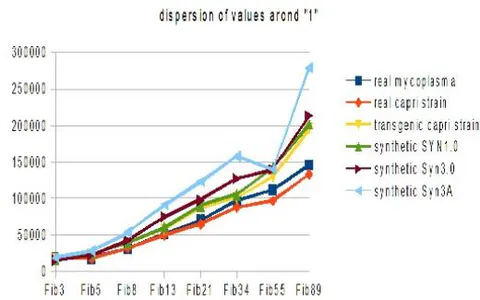
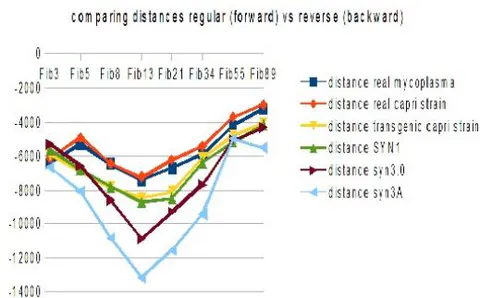
It appears then that these 2 values are very close in the case of REAL genomes, whereas they are very different in the case of SYNTHETIC genomes.
We will therefore consider very significant: The forward/backward ratios. Forward-backward spreads. Since the lengths of real and synthetic genomes are generally very different, we will weight the forward-backward differences by the respective lengths of the real or synthetic genomes.
III. RESULTS
We analyse here, in one hand, Caulobacter crescentus NA1000 genome and synthetic genome Caulobacter ethensis-2.0 (C. eth-2.0), and, in other hand, Mycoplasma Mycoides JCVI-syn1.0, JCVI-syn3.0 and JCVI-syn3A.
The actual NA1000 genome being about 5 times longer than the synthetic genome C. eth-2.0, one might think that the comparison of these 2 genomes is skewed. However, in all the above results, we had already incorporated this difference by weighting the results by the length of the respective genomes.
TC/AG analysis:
Note: All tables in this article are identical: each box contains 4 numerical values: 1/The number "L" of Fibonacci or Lucas constituting the length of the subsequence analyzed. 2/The cumulated volume of the corresponding resonances (n x L) in regular exploration (forward). 3/The cumulative volume of the corresponding resonances (L x n) in reverse (backward) exploration. 4/The ratio of the 2 values below regular/ reverse.
| TC/AG Real genome NA1000 | TC/AG Synthetic genome CAULOBACTER 2.0 | ||||
| Fibonacci | Lucas | Fibonacci | Lucas | ||
| 3 1580254 1582201 0.9987694357 | 3 1582201 1580254 1.00123208 | 3 290047 293417 0.9885146396 | 3 293417 290047 1.011618807 | ||
| 5 1346353 1346512 0.9998819171 | 4 993497 994619 0.9988719299 | 5 239292 242875 0.9852475553 | 4 194318 198624 0.9783208474 | ||
| 8 924521 926003 0.9983995732 | 7 1186993 1186953 1.0000337 | 8 168546 172325 0.9780705063 | 7 209444 211890 0.9884562745 | ||
| 13 650861 652564 0.9973902943 | 11 661049 662784 0.9973822542 | 13 120565 124586 0.9677251055 | 11 123932 128203 0.966685647 | ||
| 21 377329 378580 0.9966955465 | 18 489878 492487 0.9947023982 | 21 74278 77737 0.9555038141 | 18 92499 96693 0.9566256089 | ||
| 34 188645 190539 0.9900597778 | 29 232050 233697 0.9929524127 | 34 40816 44246 0.9224788681 | 29 48895 52692 0.9279397252 | ||
| 55 71250 72070 0.9886221729 | 47 104152 104668 0.9950701265 | 55 18131 20974 0.8644512253 | 47 24743 27988 0.8840574532 | ||
| 89 19694 19535 1.008139237 | 76 30804 31161 0.9885433715 | 89 6300 8172 0.7709251101 | 76 9026 11226 0.8040263674 | ||
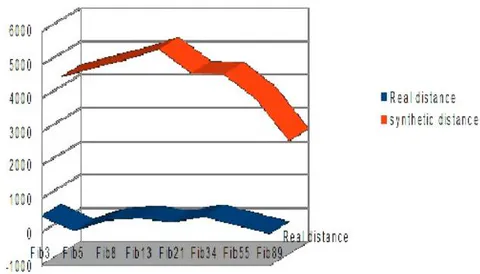
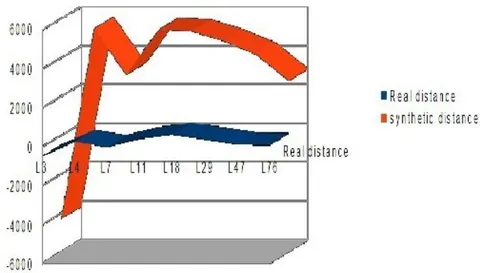
regular - reverse distance = 290047-293417 = ~3370 (see more details in supplementary materials page 2).
In the figure on the left, the average ratio of weighted distances by genome length between real genome and synthetic genome is 14.39 for TC/AG Fibonacci resonances (see supplementary materials).
For information, the same ratio related to Lucas TC/AG is
Computing details
real genome abs. Distances: 482 40 367 422 310 469 203 39 cumulating real genome abs. Distances: 2332
cumulating synthetic genome abs. Distances: 33548
Ratio synthetic genome abs. Distances/real genome abs. Distances = 14.38593482
TG/AC analysis
| TG/CA Real genome NA1000 | TG/CA Synthetic genome CAULOBACTER 2.0 | ||||
| Fibonacci | Lucas | Fibonacci | Lucas | ||
| 3 1607779 1614874 0.9956064684 | 3 1614874 1607779 1.00441292 | 3 296256 299993 0.9875430427 | 3 299993 296256 1.012614091 | ||
| 5 1349192 1358378 0.993237523 | 4 1011587 1022025 0.9897869426 | 5 244860 248873 0.9838753099 | 4 195156 199978 0.9758873476 | ||
| 8 915781 925976 0.9889899954 | 7 1174192 1180896 0.9943229548 | 8 169216 174299 0.9708374689 | 7 213326 216126 0.9870445944 | ||
| 13 642769 652548 0.9850141292 | 11 654997 665831 0.9837286038 | 13 120130 125243 959176 | 11 123819 128731 0.9618429127 | ||
| 21 384426 392873 0.9784994133 | 18 489376 497649 0.9833758332 | 21 73909 78870 0.9370990237 | 18 92670 96745 0.9578789602 | ||
| 34 209433 218299 0.9593859798 | 29 251102 259033 0.9693822795 | 34 42458 46179 0.9194222482 | 29 50145 53889 0.9305238546 | ||
| 55 91756 97158 0.9443998436 | 47 127067 133142 0.9543720239 | 55 20641 22427 0.9203638471 | 47 27305 29582 0.9230275167 | ||
| 89 31478 34303 0.917645687 | 76 45537 49636 0.9174188089 | 89 8188 9531 0.859091386 | 76 11334 12669 0.8946246744 | ||
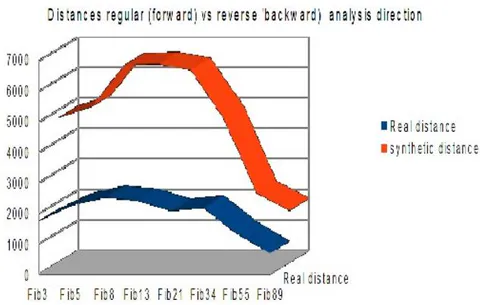
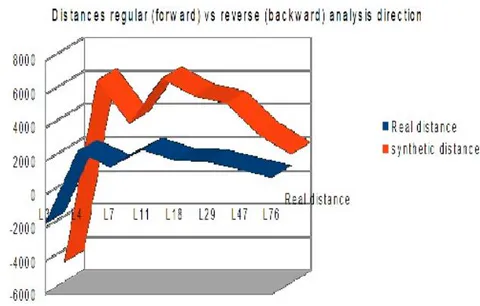
Part II: Mycoplasma Mycoides JCVI-syn1.0 (2010), JCVI-syn3.0 (2016) and JCVI-syn3A (2019) In 2010, a 1079-kb genome based on the genome of Mycoplasma mycoides (JCV-syn1.0) was chemically synthesized and supported cell growth when transplanted into cytoplasm. (Gibson, 2010). In 2016, Hutchinson et al. design, build, and test cycle to reduce this Mycoplasma mycoides genome to 531 kb (473 genes). JCV-syn3.0 retains genes involved in key
processes such as transcription and translation, but also contains 149 genes of unknown function. In the following section, we compare 6 (six) genomes: two reference real strain mycoplasma genomes including CAPRI strain, one transgenic building strain and the 3 strong JCV Labs; synthetic genomes.
| Mycoplasm REF real genomes | Synthetic Mycoplasm genomes | ||||||
| Natural reference genomes | Transgenic genome | Synthetic genomes | |||||
| Reference real strain | Reference real strain CAPRI | Transgenic CAPRI strain | JCVI-Syn1.0 | JCVI-Syn3.0 | JCVI-Syn3A | ||
| 3 425653 418009 1.01828 6688 | 3 431863 424453 1.017457 763 | 3 389604 383147 1.0168525 4 | 3 386328 380244 1.016000 252 | 3 191148 188330 1.014963 097 | 3 195794 192178 1.0188158 89 | ||
| 5 349081 342772 1.01840 5821 | 5 353999 348030 1.017150 82 | 5 322151 314644 1.0238587 1 | 5 319643 312321 1.023443 829 | 5 158678 155189 1.022482 264 | 5 162644 158262 1.0276882 64 | ||
| 8 249100 241395 1.03191 864 | 8 252787 244971 1.031905 817 | 8 228917 220387 1.0387046 42 | 8 227112 218687 1.038525 381 | 8 112973 108400 1.042186 347 | 8 116120 110250 1.0532426 3 | ||
| 13 182285 173428 1.05107 0185 | 13 184673 175894 1.049910 742 | 13 167319 158110 1.0582442 6 | 13 166119 156734 1.059878 52 | 13 83100 77329 1.074629 182 | 13 85559 78424 1.0909798 02 | ||
| 21 122345 114349 1.06992 6278 | 21 123850 116312 1.064808 446 | 21 111834 103016 1.0855983 54 | 21 110910 101748 1.090045 996 | 21 55296 50364 1.097927 091 | 21 57103 50837 1.1232566 83 | ||
| 34 80074 73025 1.09652 8586 | 34 81099 74515 1.088358 049 | 34 72890 66214 1.1008245 99 | 34 72247 65356 1.105437 909 | 34 36064 31989 1.127387 539 | 34 37460 32353 1.1578524 4 | ||
| 55 49907 44879 1.11203 4582 | 55 50665 46176 1.097215 003 | 55 45287 40085 1.1297742 3 | 55 44848 39272 1.141984 111 | 55 22000 19301 1.139837 314 | 55 22992 19368 1.1871127 63 | ||
| 89 30152 26319 1.14563 6232 | 89 30708 27108 1.132802 125 | 89 27153 22722 1.1950092 42 | 89 26742 22243 1.202265 881 | 89 13030 10741 1.213108 649 | 89 13749 10743 1.2798101 09 | ||
IV. DISCUSSION
a) Comparing real E COLI Genome and synthetic changing TAG by TAA stop codons
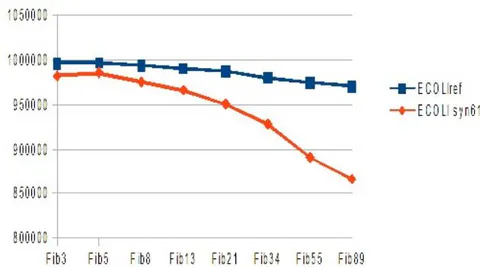
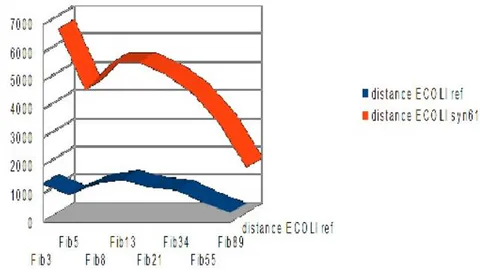
In (Fredens et al., 2019), researchers published a synthetic genome of E COLI changing systematically genetic code equivalent codons. They replaced every occurrence of the serine codon TCG with AGC, every TCA (also serine amino acid) with AGT, and every TAG (stop codon) with TAA, for a total of 18,214 replacements. Here we run a sample comparison of TG
Fibonacci resonances changing stop codons TAG in TAA, then 7725 changes considering only TAG of the first codons reading frame; In (Fredens et al., 2019), the sequences and genome design details used in this study are available in the Supplementary Data. Supplementary Data 1 provides the GenBank file of the E. coli MDS42 genome (NCBI accession number AP012306.1); Fredens's team systematically replaced every occurrence of the serine codon TCG with AGC, every TCA (also serine) with AGT, and every TAG (stop codon) with TAA, for a total of 18,214 replacements; Not having access to the modified sequence of the synthetic genome yet, we simply changed all TAG codons to TAA codons, that is, 7,725 altered codons. We have limited this change to only the first reading frame codons.
| ECOLI reference wild type genome | ECOLI syn61 like where 7725 TAG ==> TAA | ||||||
| 3 | 1471002 | 1476399 | 0.9963444841 | 3 | 1458201 | 1484100 | 0.9825490196 |
| 5 | 1211718 | 1215554 | 0.9968442373 | 5 | 1204279 | 1221598 | 0.9858226683 |
| 8 | 852126 | 857586 | 0.9936332916 | 8 | 844110 | 865264 | 0.9755519703 |
| 13 | 612152 | 618151 | 0.9902952515 | 13 | 604631 | 625851 | 0.9660941662 |
| 21 | 385231 | 390203 | 0.9872579145 | 21 | 378106 | 397617 | 0.9509301665 |
| 34 | 222919 | 227478 | 0.9799585015 | 34 | 216935 | 233775 | 0.9279649235 |
| 55 | 107343 | 110152 | 0.9744988743 | 55 | 102252 | 114831 | 0.8904564099 |
| 89 | 43863 | 45199 | 0.9704418239 | 89 | 41531 | 47929 | 0.8665108807 |
b) Yeast Synthetic Genome, the case of the longer chromosome XII
Since 2012 the Synthetic Yeast Genome Project (Sc2.0 http://syntheticallyeast.org/sc2-0/) results from a worldwide partnership, « Sc2.0 International Consortium team», members spanning 4 continents to provide remote mentorship and solve challenges associated with synthetic individual chromosomes design features and assembly (Jee Loon Foo, 2018).
Sources synthetic yeast project
http://syntheticyeast.org/
7 chromosomes now synthesised http://syntheticyeast.org/sc2-0-data/
Consorsium has successfully synthesized seven chromosomes. Check the following links to learn about details related to each finished chromosomes:
synll synlll synV synVI synXR synX synXII In (Weiming Zhang et al., 2017) process building the whole synthetic chromosome XII.
Having not yet obtained the synthetic genome from the authors, we have limited here our study to the concatenation of all wild type PCRTags on the one hand and synthetic ones on the other hand. For example:
Forward wild type PCRTag: TGCTTGAACTGCAAATACAGGCCCACTC
Forward synthetic PCRTag: AGCTTGGACAGCGAAAACTGGACCTGAT
They published particularly all the wild type and synthetic PCR Tags.
The full PCR Tags are available online:
http://syntheticyeast.org/wp-
Details: PCRTags
PCRTags are alterations incorporated into most open reading frames (ORFs) (on average one per ORF, as some ORFs are too small and others contain multiple PCRTags). These are made by recoding a bp segments of the coding region of an ORF to a different DNA sequence encoding the same amino acid sequence. PCR primer pairs can then be designed that will selectively amplify only the synthetic or wild type sequences. In this way, transformants that have incorporated a synthetic segment can be quickly scanned to ascertain that a complete substitution of the segment has occurred. PCRTags can also be used to monitor for the deletion of non-essential segments post-SCRaMbLE induction. » (from http://syntheticallyeast.org/designs/alterations/pcrtags/).
We analysed 681 PCRTags of each 28 bp from wild YEAST XII and artificial SYN XII chromosomes. Then only resonances bp are to be considered in the following analysis.
We run 3 analysis:
Fibonacci sequence
Lucas sequence= 1 3 4 7 11 18 29 47 76
FibLuc sequence= 571219315081131
| YEAST XII real genome (681 wild type PCRTags) | Synthetic genome SYNXII (681 synthetic PCRTags) | ||||||||||
| Fibonacci | Lucas | FibLuc | Fibonacci | Lucas | FibLuc | ||||||
| 3 | 6906 | 3 | 7073 | 5 | 5726 | 3 | 7133 | 3 | |||
| 7073 | 6906 | 5649 | 7436 | ||||||||
| 0.976389 | 1.024181 | 1.0136307 | 0.959252 | ||||||||
| 0853 | 871 | 31 | 2862 | 62 | 2 | ||||||
| 5 | 5649 | 4 | 4760 | 7 | 3094 | 5 | 5982 | 4 | |||
| 5726 | 4886 | 3237 | 6195 | ||||||||
| 0.986552 | 0.974212 | 0.9558232 | 0.965617 | ||||||||
| 5672 | 0344 | 932 | 4334 | 6734 | 081 | ||||||
| 8 | 4012 | 7 | 4894 | 12 | 3518 | 8 | 4142 | 7 | |||
| 4124 | 5032 | 3552 | 4396 | ||||||||
| 0.972841 | 0.972575 | 0.9904279 | 0.942220 | ||||||||
| 9011 | 5167 | 279 | 2002 | 6598 | 023 | ||||||
| 13 | 2942 | 11 | 2993 | 19 | 1769 | 13 | 2877 | 11 | |||
| 3009 | 3058 | 1924 | 3272 | ||||||||
| 0.977733 | 0.978744 | 0.9194386 | 0.879278 | ||||||||
| 4663 | 2773 | 694 | 7286 | 0943 | 316 | ||||||
| 21 | 1785 | 18 | 2232 | 31 | 1236 | 21 | 1749 | 18 | 2193 | 31 | 1057 |
| 1864 | 2317 | 1272 | 2055 | 2511 | 1362 | ||||||
| 0.957618 | 0.963314 | 0.9716981 | 0.851094 | 0.873357 | 0.7760646 | ||||||
| 0258 | 631 | 132 | 8905 | 2282 | 109 | ||||||
| 34 | 1038 | 29 | 1261 | 50 | 607 | 34 | 853 | 29 | 1101 | 50 | 419 |
| 1121 | 1264 | 623 | 1121 | 1298 | 566 | ||||||
| 0.925958 | 0.997626 | 0.9743178 | 0.760927 | 0.848228 | 0.7402826 | ||||||
| 9652 | 5823 | 17 | 7431 | 0431 | 855 | ||||||
| 55 | 538 | 47 | 719 | 81 | 221 | 55 | 358 | 47 | 491 | 81 | 172 |
| 507 | 697 | 212 | 438 | 710 | 177 | ||||||
| 1.061143 | 1.031563 | 1.0424528 | 0.817351 | 0.691549 | 0.9717514 | ||||||
| 984 | 845 | 3 | 5982 | 2958 | 124 | ||||||
| 89 | 195 | 76 | 265 | 131 | 37 | 89 | 105 | 76 | 188 | 131 | 17 |
| 179 | 237 | 38 | 122 | 212 | 19 | ||||||
| 1.089385 | 1.118143 | 0.9736842 | 0.860655 | 0.886792 | 0.8947368 | ||||||
| 475 | 46 | 105 | 7377 | 4528 | 421 | ||||||
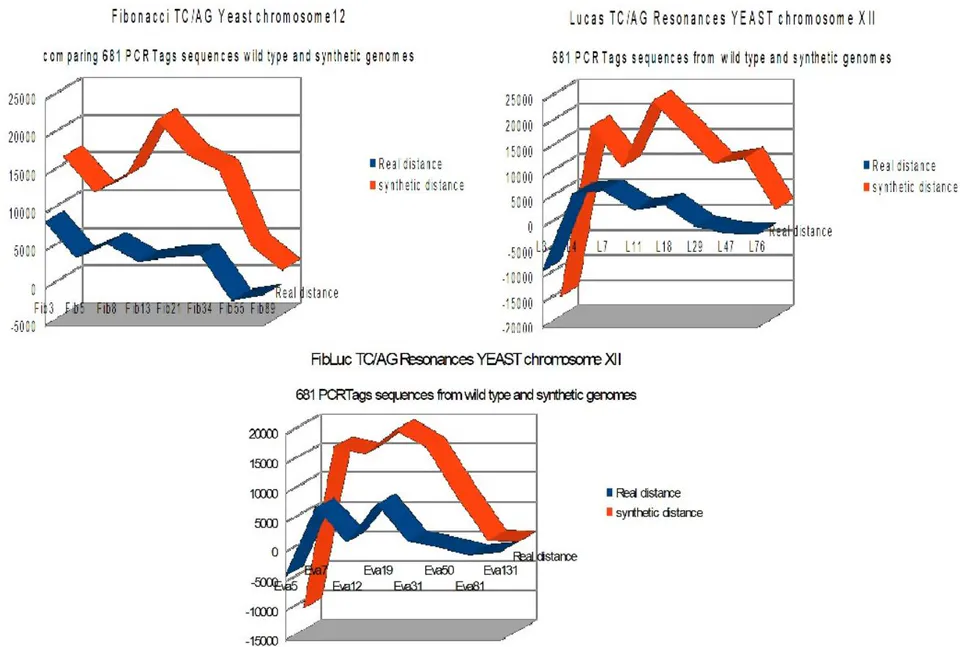
V. CONCLUSIONS
In all the cases analyzed here, we find that the real genomes or chromosomes have a property of coherence, consistency and unity that our method highlights. This property disappears in almost all (ALL) studied cases of synthetic genomes or chromosomes.
Transposons: a possible explanation of global harmonics structure In (Weiming Zhang, 2017), authors write «RATIONALE: The synthetic yeast genome, designated Sc2.0, was designed according to a set of arbitrary rules, including the elimination of transposable elements and incorporation of specific DNA elements to facilitate further genome manipulation.»
In our article (Perez, 2010), https://www.ncbi.nlm.nih.gov/m/pubmed/20658335 we wrote:
"Why and how could this ancient code be preserved and maintained in spite of the changes and mutations during millions of years of evolution of the human genome?"
In the 1940's and 1950's, Nobel prize winner Barbara McClintock discovered a peculiar phenomenon in maize: certain regions of a chromosome moved, or transposed, to other positions. This was the discovery of TRANSPOSONS (Fedoroff, 1984): often called "jumping genes" because of their ability to "jump" to completely different regions within the chromosome and later "jump" back to their original positions. Meanwhile, "jumping genes" is a misleading term because transpositions are related to noncoding areas as well as coding areas. A particular class of transposons moves from one place to another. (Class II transposons consist of DNA sections that move directly from place to place).
Sometimes there is a palindrome-like swap of the transposon during this move. Example, the original sequence:
- 5' TAAGGCTATGC 3'
- 3' ATTCCGATACG 5'
... Moves to another genome region and becomes reversed as follows:
- 5'GCATAGCCTTA 3'
- 3' CGTATCGGAAT 5'
We found the same process here. It joins a codon with its "mirror-codon". Perhaps DNA double strand topological reshaping processes could explain genesis of the reported facts (hairpin-like unfolding, Moebius-like ribbon, Class II transposons?)...
These two observations about the role of transposons already partly explain the digital disharmony that we prove in this article. These famous transposons disrupt the functioning of synthetic genomes, so we delete them (!). On the contrary, we believe that these same transposons constitute a major piece of genome stability.
The creation by men of SYNTHETIC genomes leads to a paradox on which I invite you now to think about:
On the one hand, NATURAL DNA is a luxury of REDUNDANCY and SYMMETRY...
On the other hand, SYNTHETIC DNA manipulation and synthesis technologies rely on and exploit the same luxury of REDUNDANCY and symmetries... Thus; Sometimes the technology will try to EXPLOIT SYMMETRY and REDUNDANCY: this is the case of CRISPR technology based on DNA PALINDROMES, so on SYMMETRY and REDUNDANCY. Sometimes the technology will try to DESTROY symmetry and REDUNDANCY: Such is the case of mutations and alterations of transposons (Breuer, 2019) in order to fight against these transposons which will alter the SYNTHETIC genome. This is also the case when one tries to reduce the REDUNDANCE of the universal genetic code by reducing it from 64 to 61 codons (Fredens, 2019). By our different research on the biomathematics of DNA, we have on the contrary demonstrated that this REDUNDANCY and this symmetry contribute to the UNITY and INTEGRITY of genes, chromosomes and genomes:
When a Meta-code unifies DNA, RNA and amino acids (Perez, 2009; Perez, 2011; Perez, 2015; Perez, 2018d);
When this master code unifies the genomic and proteomic meta structures of a gene (Perez, 2000; Perez, 2017e; Perez, 2017f; Perez, 2017g; Perez 2017h); When the multiple repetition of the same gene as DUF1220 is associated with mammalian brain properties via a kind of «FibLuc sequence» digital standing waves of its DNA (Sikela, 2006; Weiss, 2006; Parayon, 2011; Perez, 2017b);
When we prove the existence of a UNITY of Fibonacci sequences on the scale of an whole human chromosome such as chromosome4 (Perez, 2017c);
When we demonstrate how numerical proportions characterize the DNA of whole genomes of viruses, bacteria or Euchariotes (Perez 2013);
When we highlight the UNITY of the 3 billion base pairs of the entire human genome (Perez, 2010; Perez, 2017d);
When this whole human genome UNITY is destroyed by Cancer mutations (Perez, 2018a; Perez, 2018b; Perez, 2018c);
When there is an evidence that these numerical structures (Petoukhov, 2019) of the genomes, particularly SYMMETRY and REDUNDANCY, are of TOPOLOGICAL nature (Rapoport 2016). This topological unified hyper structure of whole genomes is based particularly on Fibonacci Numbers, Golden ratio (Friedman, 2018), and Klein bottle (Rapoport 5$ Perez, 2018).
To conclude we will finally notice that the REAL genomes of bacteria analyzed obey two simultaneous numerical constraints of Phi and Phi (where Phi = 1.618 is the golden ratio and Phi ). For example, for a contiguous sequence of 21 TCAGs, we have simultaneously:
Regular (forward) 21 TCAG/8 TC = Phi * 2 And
Reverse (backward) 21 TCAG/13 TC = Phi.
This double strong constraint on REAL genomes almost disappears in the case of SYNTHETIC genomes.
We can not manipulate the genomes "no matter how". Thus, transposons certainly play a key role in the stability and epigenetics of genomes.
Manipulation technologies (CRISPR) and especially of artificial creation of genomes will have to respect these laws of nature.
In (Strecker et al., 2019) by using DNA sequences referred to as transposons, or "jumping genes" (genes that can change their position within the genome), a team from MIT led by NYSCF - Robertson Stem Cell Investigator Dr. Feng Zhang has created a new version of CRISPR (called CRISPR-associated transposase, or "CAST") that can insert functional DNA sequences into the genome without making cuts, which can often lead to unintended damage.
What about for the FUTURE? There are theoretical new background for Biology and Genetics, these tracks are MATHEMATICS (Perez § Montagnier L., 2021).
ACKNOWLEDGEMENTS
We especially thanks Dr. Robert Friedman M.D. practiced nutritional and preventive medicine in Santa Fe, New Mexico, woldwide expert on Golden ratio Life applications (https://tinyurl.com/y9dxaauv) and Diego Rapoport (mathematician), Retired Full Professor, UNQ & Universidad de Buenos Aires, Instituto Balseiro Bariloche; CONICET (Argentina); Universidade de Sao Paulo & PUC-Rio (Brasil); Univ. Autonoma Metropolitana de Mexico; Univ. of Tel Aviv; Univ of Bío Bío (Chile). Patagonia, Argentina. We also thank Marco F. Paya Torres (M.D Alicante), professor E.G. Rajan, Founder President PENTAGRAM Research Centre (P) Limited Hyderabad INDIA, the French biologist Pr. François Gros for its strong comments on HGO and cancer mutations (Pasteur institute, codiscoverer of RNA messenger with James Watson and Walter Gilbert), Professor Andras Pellionisz (HolGenTech), Professor Sergey V. Petoukhov (Dr. Phys.-Math. Sci, Grand Ph.D., Full Professor, Laureate of the State prize of the USSR), Volkmar Weiss (Dr. rer. nat. habil. Dr. phil. Habil. Leipzig, Germany), and RIP Pr. Luc Montagnier, medicine Nobel prizewinner for their interest in my research of biomathematical laws of genomes.