I. INTRODUCTION
Due to urbanization and expanding economic activities, about 13% of the world's population do not have access to safe drinking water. With current trend of water demand, water shortage will become even more intense and approximately, half of the world's population will suffer from major water scarcity by the year 2030 said by UNESCO. Industrial sector, contributes about 20% of the national income. Textile industry contributes nearly 14% of the total industrial production in India. There are about 10,000 garment manufactures and 2100 bleaching and dyeing industries in India. Textile waste water includes a large variety of dyes and chemical additions that pose an environmental challenge for textile industry not only as liquid waste but also due to its chemical composition. The shifting of irrigation water to fulfil the need of industrial use as well as water quality and lowering of water table around. The surface as well as ground water quality induces environmental degradation over long period of time because of discharge of highly contaminated effluent accelerated by over exploitation of existing water resources. The world bank estimates that 17 to 20 percent of industrial water pollution comes from textile dyeing and finishing treatment given to fabric majority are concentrated at Tirupur and Karur in Tamil Nadu, Ludiyana in Punjab and Surat in Gujarat. In recent decades, major research project are undergone to develop the utilisation of industrial waste into useful one.
II. METHODOLOGY
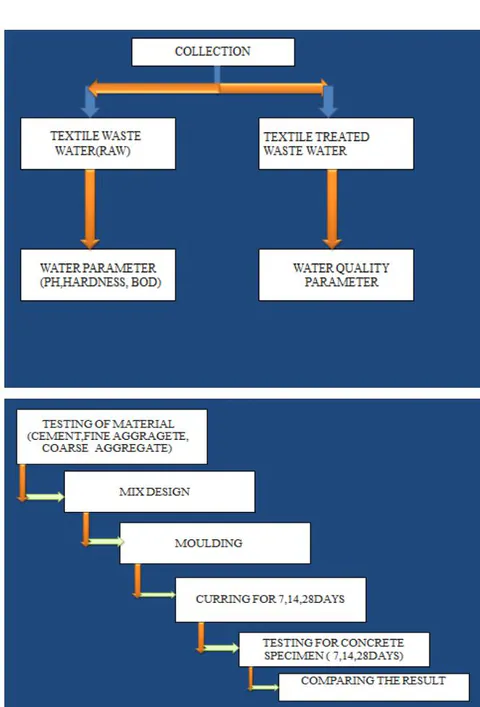
IV. TESTING OF MATERIAL
a) Tests For Cement
√ Ordinary or low heat Portland cement conforming to IS:269-1976
√ RAMCO 53 grade ordinary Portland cement (OPC) is used for the study programme.
i. Setting time test (Vicat apparatus)
- Initial Setting Time
√ Lower the needle gently and bring it in contact with the surface of the test block and quick release.
Initial Setting time = 20 min
- Final Setting Time
√ Replace the needle of vicat apparatus by a circular attachment.
Final Setting time = 10 hrs
ii. Specific Gravity of Cement
√ Take a clean dry pycnometer with its cap and weight it. (M )Take about 200g of dry cement in the pycnometer and find the weight of pycnometer with cement. (M )
Specific Gravity of Cement = 3.15
b) Tests For Aggregate
i. Specific gravity of sand
√ Fill the pycnometer with distilled water up to the hole in the conical cap and shake it to remove the air. Then take the weight of pycnometer with sand and distilled water. (M3 g).
Specific gravity of sand = 2.68
ii. Sieve Analysis
√ Arrange the sieve set in orders of 4.75mm,2.36mm,1.18mm,1mm, 600μ,300μ,150μ size and a pan at the bottom.
√ Position the sieves set in the sieve shaker and sieve the sample for a period of 10 minutes
iii. Tests for Coarse Aggregate
a. Sieve Analysis
√ Arrange the sieve set in orders of 25mm, 22.4mm, 20mm, 16mm, 12.5mm, 10mm, 6.3mm, 4.75mm, 2.36mm size and a pan at the bottom.
√ Position the sieves set in the sieve handshakes in top and bottom or rotate in the sieves in approximately 5 minutes.
b. Impact Strength Test
√ The test sample consists of aggregate, the whole of which passes 12.5mm sieve and retained on 10mm sieve.
√ The test sample is subjected to a total of 15 below with a time interval of not less than one second.
The aggregate impact value = 13.23%
c. Crushing Strength Test
√ The test sample consists of aggregate, the whole of which passes 12.5mm sieve and retained on 10mm sieve.
√ The test sample is added in thirds, and each third is tamped by equally distributed strokes of the tamping rod. The depth of the aggregate in the cylinder is about 10 cm.
√ The loaded at a uniform rate in such a way that a total load of 400KN is reached in 10 minutes.
√ The load is released and the whole of the material is removed from the cylinder.
√ The removed material from the cylinder is sieved on 2.36mm sieve for the fraction passing the sieve is weighed.
The aggregate crushing value = 17.7%
d. Flakiness Index Test:
√ Each fraction is gauged in turn for thickness gauge. The separate aggregate fractions are passed through the corresponding slots in the thickness gauge as indicated in the table.
√ The weight of aggregate passing through each of the slot is determined.
Flakiness index= 31.02%
V. MIX DESIGN
Given
Specificgravity of cement= 3.15
Specificgravity of coarse aggregate= 2.90
Specificgravity of fine aggregate= 2.68(ZONE 3)
Degree of workability= 0.90 CF
W/C ratio = 0.38
TARGET MEAN STRENGTH OF CONCRETE (fck)
Fck = 39.9N/mm2
| Grade | Cement (kg/m3) | Fine aggregate (kg/m3) | Coarse aggregate (kg/m3) | Water (lit/m3) |
| M30 | 504.15 | 497.13 | 1285.03 | 191.58 |
VI. TEST FOR FRESH CONCRETE
a) Slump Cone Test
√ A concrete Mix of filled in the three layers compacted with tamping rod.
√ Top surface is leveled and mould is raised vertically.
√ The slump which is the difference in height between the top mould and the highest point on the subsided concrete measured.
The sulmp observed = 25 cm
b) Compaction Factor Test
√ The inner surface of the hopper and cylinder are greased. The weight of empty cylinder with its base (W1 gm) is taken.
√ The given concrete mix proportion is prepared. The concrete mix is gently placed and levelled in the upper hopper using the hand scoop.
√ The cylinder is refilled with the sample of concrete in approximately six equal layer. Each layer is being heavily rammed or vibrated so as to obtain full compaction.
√ The top surface of the cylinder is levelled and the outside of the cylinder is wiped and weighted with concrete ( gm)
The compaction factor = 0.8
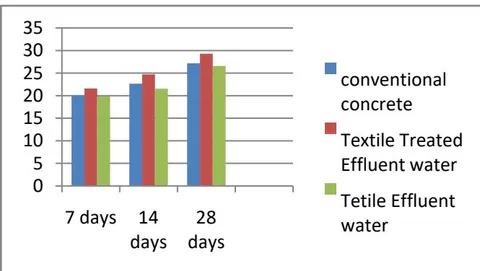
| Sl.no | Age of test | Conventional Concrete | TEXTILE TREATED EFFLUENT WATER | TEXTILE EFFLUENT WATER |
| 1 | 7 | 20 | 21.6 | 19.8 |
| 2 | 14 | 22.67 | 24.72 | 21.54 |
| 3 | 28 | 27.18 | 29.30 | 26.57 |
VII. STRENGTH TEST
Compressive strength
Split tensile strength
Flexural strength
a) Compressive Test For Concrete In Cube b) Splitting Tensile Strength For Concrete In Cylinder
c) Flexural Strength Concrete in Prism
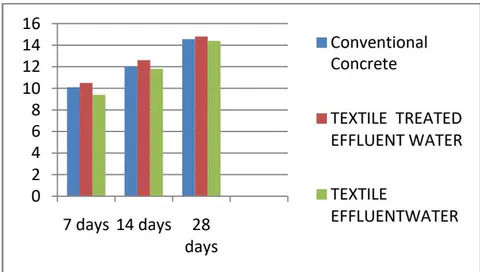
| Sl. no | Age of test | Conventional Concrete | TEXTILE TREATED EFFLUENT WATER | TEXTILE EFFLUENT WATER |
| 1 | 7 | 10.1 | 10.5 | 9.4 |
| 2 | 14 | 12 | 12.6 | 11.8 |
| 3 | 28 | 14.56 | 14.8 | 14.4 |
VIII. CONCLUSION
√ This study shows the possible utilization of textile water in making concrete cubes with good and equivalent strength of concrete cubes made with potable water.
√ Compressive strength of concrete cubes made with TETW and TEW was good and equivalent to potable water.
√ The behavior of acid attack on concrete cubes made with TEW was less compare to the potable water.
√ Further durability studies are needed and planned to know the durability properties in detail
√ The study can be further extended as study of chemical nature of the sludge by undergoing several periodic analyses on sludge produced in different chemical processing industries, leachability and toxicity analysis on the sludge and sludge bricks, and other applications which can utilize sludge.
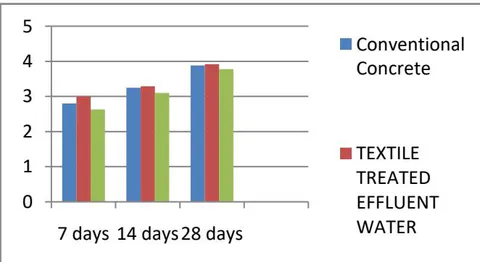
| Sl. no | Age of test | Conventional Concrete | TEXTILE TREATED EFFLUENT WATER | TEXTILE EFFLUENT WATER |
| 1 | 7 | 2.83 | 3.0 | 2.63 |
| 2 | 14 | 3.25 | 3.29 | 3.1 |
| 3 | 28 | 3.88 | 3.92 | 3.78 |