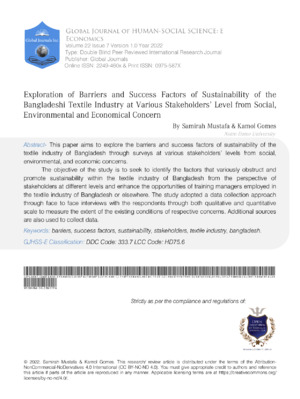
Exploration of Barriers and Success Factors of Sustainability of the Bangladeshi Textile Industry at Various Stakeholders’ Level from Social, Environmental and Economical Concern

α
Samirah Mustafa
Samirah Mustafa
σ
Kamol Gomes
Kamol Gomes
α Notre Dame University Bangladesh

Send Message

To: Author

Exploration of Barriers and Success Factors of Sustainability of the Bangladeshi Textile Industry at Various Stakeholders’ Level from Social, Environmental and Economical Concern

Article Fingerprint

ReserarchID

KUTLS

Exploration of Barriers and Success Factors of Sustainability of the Bangladeshi Textile Industry at Various Stakeholders’ Level from Social, Environmental and Economical Concern Banner

AI TAKEAWAY

Connecting with the Eternal Ground
  • English
  • Afrikaans
  • Albanian
  • Amharic
  • Arabic
  • Armenian
  • Azerbaijani
  • Basque
  • Belarusian
  • Bengali
  • Bosnian
  • Bulgarian
  • Catalan
  • Cebuano
  • Chichewa
  • Chinese (Simplified)
  • Chinese (Traditional)
  • Corsican
  • Croatian
  • Czech
  • Danish
  • Dutch
  • Esperanto
  • Estonian
  • Filipino
  • Finnish
  • French
  • Frisian
  • Galician
  • Georgian
  • German
  • Greek
  • Gujarati
  • Haitian Creole
  • Hausa
  • Hawaiian
  • Hebrew
  • Hindi
  • Hmong
  • Hungarian
  • Icelandic
  • Igbo
  • Indonesian
  • Irish
  • Italian
  • Japanese
  • Javanese
  • Kannada
  • Kazakh
  • Khmer
  • Korean
  • Kurdish (Kurmanji)
  • Kyrgyz
  • Lao
  • Latin
  • Latvian
  • Lithuanian
  • Luxembourgish
  • Macedonian
  • Malagasy
  • Malay
  • Malayalam
  • Maltese
  • Maori
  • Marathi
  • Mongolian
  • Myanmar (Burmese)
  • Nepali
  • Norwegian
  • Pashto
  • Persian
  • Polish
  • Portuguese
  • Punjabi
  • Romanian
  • Russian
  • Samoan
  • Scots Gaelic
  • Serbian
  • Sesotho
  • Shona
  • Sindhi
  • Sinhala
  • Slovak
  • Slovenian
  • Somali
  • Spanish
  • Sundanese
  • Swahili
  • Swedish
  • Tajik
  • Tamil
  • Telugu
  • Thai
  • Turkish
  • Ukrainian
  • Urdu
  • Uzbek
  • Vietnamese
  • Welsh
  • Xhosa
  • Yiddish
  • Yoruba
  • Zulu

References

71 Cites in Article
  1. Carol Adams (2008). A commentary on: corporate social responsibility reporting and reputation risk management.
  2. Nazneen Ahmed (2009). Sustaining Ready-made Garment Exports from Bangladesh.
  3. M Baer,M Frese (2003). Innovation Is Not Enough: Climates for Initiative and Psychological Safety, Process Innovations, and Firm Performance.
  4. Wendy Barnes,Joy Kozar (2008). The exploitation of pregnant workers in apparel production.
  5. Stephanie Barrientos,Andrienetta Kritzinger (2004). Squaring the circle: global production and the informalization of work in South African fruit exports.
  6. S Barrientos,G Gereffi,A Rossi (2011). Economic and Social Upgrading In Global Production Networks: A New Paradigm for a Changing World.
  7. S Barrientos (2013). Corporate Purchasing Practices in Global Production Networks -A Socially Contested Terrain.
  8. Ataur Belal,Robin Roberts (2010). Stakeholders’ Perceptions of Corporate Social Reporting in Bangladesh.
  9. Ataur Belal,Stuart Cooper,Niaz Khan (2015). Corporate environmental responsibility and accountability: What chance in vulnerable Bangladesh?.
  10. D Bhattacharya,M Rahman (1999). Female Employment under Export-Propelled Industrialization: Prospects for Internalizing Global Opportunities in Bangladesh's Apparel Sector.
  11. Simone Borghesi,Alessandro Vercelli (2003). Sustainable globalisation.
  12. H Brezet,C Hemel (1997). Ecodesign, a Promising Approach to Sustainable Production and Consumption.
  13. L Burke,J Logsdon (1996). How Corporate Social Responsibility Pays Off.
  14. Ajay Das,Mark Pagell,Michael Behm,Anthony Veltri (2008). Toward a theory of the linkages between safety and quality.
  15. Marisa De Brito,Valentina Carbone,Corinne Blanquart (2008). Towards a sustainable fashion retail supply chain in Europe: Organisation and performance.
  16. René De Koster,Daan Stam,Bert Balk (2011). Accidents happen: The influence of safety‐specific transformational leadership, safety consciousness, and hazard reducing systems on warehouse accidents.
  17. Marsha Dickson (1999). US consumers' knowledge of and concern with apparel sweatshops.
  18. A Dusuki (2008). What does Islam say about corporate social responsibility?.
  19. R Freeman (1984). Strategic Management: A Stakeholder Perspective.
  20. A Fuad-Luke (2002). The Eco-Design Handbook, a Complete Sourcebook for the Home and Office.
  21. Jeremy Galbreath (2006). Corporate social responsibility strategy: strategic options, global considerations.
  22. Geneva Brown,G (2011). Corporate social responsibility: what is it good for? Factory fires in Bangladesh: again and again and again.
  23. Paul Godfrey (2005). The Relationship Between Corporate Philanthropy And Shareholder Wealth: A Risk Management Perspective.
  24. B Goldewijk,B De Gaay Fortman (1999). Where Needs Meet Rights: Economic, Social, and Cultural Rights in a New Perspective.
  25. K Gordhan,Saini (2011). Implications of Non-Tariff Measures On International Business Operations: A Case of India's Textiles and Clothing Firms.
  26. Saheli Goswami,Jung Ha-Brookshire (2015). From compliance to a growth strategy.
  27. D Hanzl-Wei (2004). Enlargement and the Textiles, Clothing and Footwear Industry.
  28. P Hirst,G Thompson (1996). Globalization in Question.
  29. D Hofmann,A Stetzer (1998). THE ROLE OF SAFETY CLIMATE AND COMMUNICATION IN ACCIDENT INTERPRETATION: IMPLICATIONS FOR LEARNING FROM NEGATIVE EVENTS..
  30. M Islam,C Deegan (2008). Motivations for an Organization within a Developing Country to Report Social Responsibility Information: Evidence From Bangladesh.
  31. Tal Katz-Navon,Eitan Naveh,Zvi Stern (1988). Safety Climate in Health Care Organizations: A Multidimensional Approach.
  32. M Khan,C Wichterich (2015). Safety and Labour Conditions: The Accord And The National Tripartite Plan of Action for the Garment Industry Of Bangladesh.
  33. F Khatun (2017). Step 2: Macro Environmental Analysis.
  34. M Khor (2000). Globalization And The South: Some Critical Issues.
  35. N Khosla (2009). The Ready-Made Garments Industry in Bangladesh: A Means To Reducing Gender-Based Social Exclusion Of Women?.
  36. Denise Kleinrichert (2008). Ethics, Power and Communities: Corporate Social Responsibility Revisited.
  37. P Lund-Thomsen (2008). The Global Sourcing and Codes of Conduct Debate: Five Myths and Five Recommendations.
  38. P Lund-Thomsen,A Lindgreen (2014). Corporate Social Responsibility In Global Value Chains: Where Are We Now And Where Are We Going?.
  39. J Mashaw (2005). Structuring A 'Dense Complexity': Accountability And The Project Of Administrative Law.
  40. Janine De Medeiros,Jose Ribeiro,Marcelo Cortimiglia (2014). Success factors for environmentally sustainable product innovation: a systematic literature review.
  41. Mesbah Chowdhury (2007). International Cooperation and Infrastructure Development in Bangladesh: An Analysis of Financial and Technical Support System.
  42. D Myers,S Stolton (1999). Organic Cotton -From Field to Final Product, Intermediate Technology, London, Practical Action.
  43. Nakib Nasrullah,Mia Rahim (2014). CSR in Private Enterprises in Developing Countries.
  44. Eitan Naveh,Tal Katz-Navon,Zvi Stern (2005). Treatment Errors in Healthcare: A Safety Climate Approach.
  45. E Parker (2011). Responsible Food Purchasing.
  46. T Parry,P Molmen,A Newman (2002). How CFOs View Investment in Health and Productivity: On the Brink of Change, Integrated Benefits Institute.
  47. Gary Peters,Andrea Romi (2013). Discretionary compliance with mandatory environmental disclosures: Evidence from SEC filings.
  48. M Rahim (2012). Legal regulation of corporate social responsibility: evidence from Bangladesh.
  49. Mia Rahim,Pornchai Wisuttisak (2013). Corporate Social Responsibility–Oriented Compliances and SMEs Access to Global Market: Evidence from Bangladesh.
  50. Shahidur Rahman (2004). The Bangladesh Garment Industry and the Global Supply Chain.
  51. M Rashid (2009). Made in Bangladesh.
  52. K Rissa (2001). Ekotehokkuus-Enemmän Vähemmästä.
  53. A Rossi (2011). Economic and Social Upgrading In Global Production Networks: The Case of the Garment Industry in Morocco.
  54. Jennifer Rubenstein (2007). Accountability in an Unequal World.
  55. K Ruwanpura,N Wrigley (2011). The costs of compliance? Views of Sri Lankan apparel manufacturers in times of global economic crisis.


  56. D Salvador (2007). Can consumers rely on fair trade claims?.
  57. S Saxena (2014). Made in Bangladesh, Cambodia, and Sri Lanka: The Labor Behind the Global Garments and Textiles Industries.
  58. Allen Scott (2006). The Changing Global Geography of Low-Technology, Labor-Intensive Industry: Clothing, Footwear, and Furniture.
  59. Noemi Sinkovics,Rudolf Sinkovics,Mo Yamin (2014). The role of social value creation in business model formulation at the bottom of the pyramid – Implications for MNEs?.
  60. N Sinkovics,R Sinkovics,S Hoque,L Czaban (2015). A Reconceptualisation of Social Value Creation as Social Constraint Alleviation.
  61. N Sinkovics,S Hoque,R Sinkovics (2016). Rana Plaza Collapse Aftermath: Are CSR Compliance And Auditing Pressures Effective?.
  62. Kristin Smith‐crowe,Michael Burke,Ronald Landis (2003). Organizational climate as a moderator of safety knowledge–safety performance relationships.
  63. Nancy Stanforth,William Hauck (2010). The effects of ethical framing on consumer price perceptions.
  64. P Talvenmaa (1998). ECJ 19 November 2019, joined cases C-609/17 and C-610/17 (TSN), Paid leave.
  65. (2017). Rising Garment Export to China -The Next Big Export Destination for Bangladesh.
  66. (2019). Bangladesh's apparel export trend of 2018.
  67. N Tokatli,N Wrigley,O Kizilgün (2008). Shifting Global Supply Networks And Fast Fashion: Made In Turkey For Marks & Spencer.
  68. (2007). Non-equity modes of international production and development.
  69. R Welford,W Young (2002). World Shopping Guide:.
  70. J Yardley (2012). Horrific Fire Revealed a Gap in Safety for Global Brands.
  71. D Zohar (1980). Safety Climate in Industrial Organizations: Theoretical and Applied Implications.

Funding

No external funding was declared for this work.

Conflict of Interest

The authors declare no conflict of interest.

Ethical Approval

No ethics committee approval was required for this article type.

Data Availability

Not applicable for this article.

How to Cite This Article

Samirah Mustafa. 2026. \u201cExploration of Barriers and Success Factors of Sustainability of the Bangladeshi Textile Industry at Various Stakeholders’ Level from Social, Environmental and Economical Concern\u201d. Global Journal of Human-Social Science - E: Economics GJHSS-E Volume 22 (GJHSS Volume 22 Issue E7): .

Download Citation

Exploring sustainability barriers and success factors in Bangladesh's textile sector from social, environmental, and economic perspectives.
Issue Cover
GJHSS Volume 22 Issue E7
Pg. 77- 99
Journal Specifications

Crossref Journal DOI 10.17406/GJHSS

Print ISSN 0975-587X

e-ISSN 2249-460X

Keywords
Classification
GJHSS-E Classification: DDC Code: 333.7 LCC Code: HD75.6
Version of record

v1.2

Issue date

February 9, 2023

Language
en
Experiance in AR

Explore published articles in an immersive Augmented Reality environment. Our platform converts research papers into interactive 3D books, allowing readers to view and interact with content using AR and VR compatible devices.

Read in 3D

Your published article is automatically converted into a realistic 3D book. Flip through pages and read research papers in a more engaging and interactive format.

Article Matrices
Total Views: 1554
Total Downloads: 54
2026 Trends
Related Research

Published Article

Abstract not found

Our website is actively being updated, and changes may occur frequently. Please clear your browser cache if needed. For feedback or error reporting, please email [email protected]

Request Access

Please fill out the form below to request access to this research paper. Your request will be reviewed by the editorial or author team.
X

Quote and Order Details

Contact Person

Invoice Address

Notes or Comments

This is the heading

Lorem ipsum dolor sit amet, consectetur adipiscing elit. Ut elit tellus, luctus nec ullamcorper mattis, pulvinar dapibus leo.

High-quality academic research articles on global topics and journals.

Exploration of Barriers and Success Factors of Sustainability of the Bangladeshi Textile Industry at Various Stakeholders’ Level from Social, Environmental and Economical Concern

Samirah Mustafa
Samirah Mustafa Notre Dame University Bangladesh
Kamol Gomes
Kamol Gomes

Research Journals