
I. INTRODUCTION
The development of entrepreneurial activity is accompanied by the complication of economic ties, a significant number of which, on the one hand, indicates the possibility of income growth, and, on the other hand, the inevitability of the emergence and development of threats to economic security. At the same time, the difficulty of identifying such threats, and even more so their correct assessment, is due to the fact that they, as a rule, are not obvious, which, in turn, leads to the need for maximum attention to their signals and the corresponding indicators of economic security.
It is obvious that any threats to economic security inflict financial losses on business entities or lead to the loss of assets, along with reputational losses (decreased image in the eyes of the public). Whatever the consequences of the "actions" of threats to economic security, they are always preceded by certain signals, the interpretation of which should be the basis for the formation of appropriate indicators. However, the solution to the problem of diagnosing the economic security of entrepreneurial activity cannot be reduced only to the formation of the structure of such indicators and consideration of the possibility of their relationship.
Here, it is important to understand that the approach to the formation of key indicators of the economic security of entrepreneurial activity acts as a link between distinguishable consulting services in the area under study, based on the forms of their provision. It is on the basis of the analysis of certain indicators that it is possible to draw a conclusion about the level of economic security of the customer of services, the impact of certain threats on the efficiency of his activities and, based on the results obtained, develop a list of measures aimed at solving existing problems.
II. RESEARCH RESULTS
The main consulting services in the field of economic security in the context of consulting forms and the logic of developing an approach to the formation of key indicators
The fundamental point for further research is the interpretation of our earlier thesis that the target orientation of the researched consulting services is associated with the identification, assessment, counteraction to threats to the economic security of business activities based on the development of information, organizational, methodological, institutional support. It is difficult to argue with the fact that the basis for the formation of at least these types of provision of consulting services should be based on the direction of their provision through the prism of consulting forms. This also requires an understanding of the information needs for the implementation of basic consulting services in the field of economic security, which are presented in table 1 in the context of consulting forms.
| Form of consulting | Basic consulting services | Information needs |
| Management consulting | Development of concepts of economic security, incl. within the framework of the enterprise development strategy; analysis of existing and potential threats to economic security, as well as the development of recommendations to counter them; development of an integrated economic security management system | Information about the directions of activity, the development strategy of the enterprise (including missions, tasks, etc.), the distribution of job responsibilities, the organizational structure of the enterprise, analytical information about the main performance indicators. |
| Project consulting | Development of internal documents related to economic security; development and implementation of measures regulating the process of ensuring economic security; development of recommendations for solving specific problems of ensuring economic security with the help of individual projects and programs; | Information on the dynamics and rates of change in indicators for individual areas of activity, supported by a description of already implemented, as well as planned management decisions, indicating quantitative and qualitative results (economic, social effect). |
| Educational consulting | organizing and conducting training events of various formats (lectures, trainings, seminars, round tables, etc.); publication of educational materials (analytical reports, guidelines, etc.); development of cooperation in the field of education with other organizations and institutions. | Information about the level of knowledge of the target audience of the theoretical and methodological foundations for ensuring the economic security of entrepreneurial activity, as well as modern and effective methodology of the educational process. |
It is obvious that in order to obtain or form the information necessary for the implementation of consulting services (table 1), the scientific and methodological approach to the formation of key indicators of the economic security of entrepreneurial activity is important. Its development, in our opinion, should include:
- Determination of the most similar basic theories in meaning (along with theories of industrial markets), consideration of the causes and consequences of the emergence of threats to economic security within which will create the necessary basis for their clear identification;
- Substantiation and necessary concretization (classification) of threats to economic security, which will be preceded by an essential characteristic of their features in modern conditions;
- Structural and content content of key indicators of economic security of entrepreneurial activity, which will confirm the importance of the developed approach for consulting services.
Theories that reveal the essence of threats to the economic security of entrepreneurial activity In our opinion, in order to determine threats to the economic security of entrepreneurial activity (including by areas of occurrence), as well as their signals, it is first of all necessary to consider their causes and consequences. At the same time, the logic of the study, which combines theory and methodology at each of its
stages, requires consideration, first of all, of the theoretical foundations of the root causes and consequences of threats to the economic security of entrepreneurial activity.
Most closely the essence of threats to the economic security of business activities reflect the provisions of the theories of catastrophes, conflicts and risks. Without aiming at a detailed consideration of the provisions of these theories, we will indicate their main features that are of interest for further research.
The catastrophe theory is used to study and predict the instability of any systems, since its provisions make it possible to assess the current state of the system (entrepreneurial entity) and determine the equilibrium parameters (threat signals and indicators of economic security). According to studies (Klenin, 2016; Oliva, 1991; Tugui, 2009; Zeeman, 1976), a jump-like transition of a system from one stationary state to another with a monotonous change in one or several parameters is called a catastrophe, and a qualitative change in an object, with a slight transformation of parameters, is called a bifurcation.
In the context of our study, it is legitimate to believe that a disaster is the inability of a business entity (system) to counteract threats to economic security using the available signals and indicators. That is, if the business structure is not able to diagnose economic security, then we should talk about its instability.
In other words, the very threat to economic security will be a catastrophe, which will first lead to financial or other losses (bifurcation), and in the future - to the termination of the business entity. So, in order to prevent this (we are talking about a catastrophe and bifurcation), it is necessary to clearly identify the chains of "cause-effect", "cause-signal-indicator" and on their basis it will be possible to identify and assess the threats to the economic security of entrepreneurial activity with a high degree of reliability. activities.
When considering these chains, it is impossible to avoid conflicts of interest that arise both in the process of diagnosing economic security and in the course of ensuring it. Interpreting the main provisions of the theory of conflicts in the plane of entrepreneurial activity (Alekseev, 2002; Danelyan, 2010; Commons, 2012) and the problems of our study, we can conclude that if an enterprise is able to diagnose economic security, overcoming a conflict of interests (for example, a possible fraudster and financially responsible person), then it will be able to provide it.
In the process of diagnosing economic security, the resolution or development of conflict situations inevitably occurs, that is, the coordination or disagreement of interests. At the same time, attention should be focused on the fact that we are talking about not just two opposite, but antagonistic interests of persons "violating" economic security (if any), and persons diagnosing or ensuring it. The interest of the former lies in taking possession of other people's property or acquiring the right to property through the implementation of fraudulent schemes (actions), and the latter in counteracting this with the help of appropriate methods.
In other words, the essence of diagnosing the economic security of entrepreneurial activity is reduced to the chain "cause-threat-consequence". It follows that a direct consequence of the conflict are threats to economic security for the assessment and identification of which, in each individual case (as well as for conflicts), it is necessary to use different methods that take into account their features and specifics as much as possible.
It is difficult to disagree with the fact that threats to economic security are accompanied by the risks of their detection or non-detection. The prism of economic science in the theory of risks (we note separately the works (Arrow, 1994; Vitlinsky, 2000; Yastremsky, 1992; Cherkasov, 1998) reduced it to uncertainty due to the lack of "... comprehensive information about the conditions for making decisions" (Yastremsky, 1992, 14).
In order to counteract anything, including threats to economic security, appropriate information is needed, the absence of which introduces the so-called uncertainty factor into the further activities of the business structure. In this context, we are talking not about information, but about its sources, to which we will include signals of threats to economic security and its indicators. So, the prospect of ensuring the economic security of entrepreneurial activity should be opened by understanding the chain "cause-uncertainty-signal-indicator", which underlies its effective diagnostics.
Given the above, it should be concluded that the process of diagnosing economic security depends on the causes of its threats, the level of detail of their signals and indicators, and understanding of their consequences. In other words, such a diagnosis boils down to a thesis: from the causes of threats to consequences through signals and indicators. At the same time, the provisions of each of the theories discussed above contribute to the causes and consequences of threats to the economic security of business activities, which is schematically shown in figure 1.
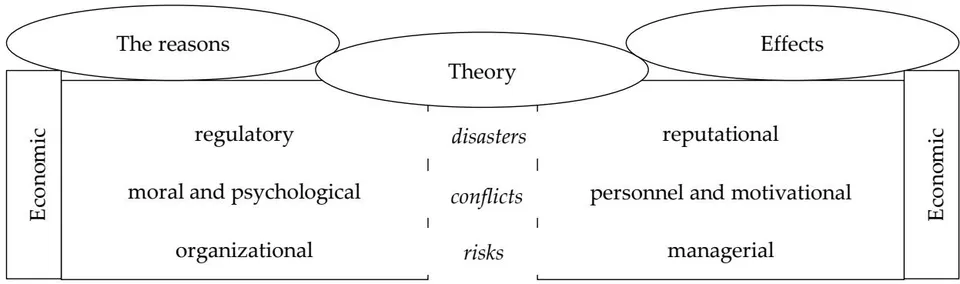
The cause-and-effect relationship of threats to economic security in the context of theories of catastrophes, conflicts and risks is based solely on economic reasons (the desire to obtain economic benefits or other benefits) and consequences (deterioration of the economic, material and technical condition of the enterprise).
The economic reasons for the emergence of threats to the economic security of entrepreneurial activity also determine other derivatives of them:
- regulatory and legal (imperfection of domestic legislation in ensuring the economic security of entrepreneurial activity; lack of regulatory documents in business structures regarding economic security, etc.);
- moral and psychological (the desire for quick profit; lack of respect for the head of the structural unit or the business structure as a whole; the psychological propensity of individual employees to fraud, etc.);
- organizational (conclusion of risky transactions associated with a one-time receipt of a large income; reduced confidentiality of information about the personal data of employees; inadequate level of identification and assessment of threats to economic security, etc.).
- In turn, along with the obvious economic consequences of threats to the economic security of entrepreneurial activity, the following should be highlighted:
- reputational (decreasing the image of a business entity, management personnel, individual employees for stakeholders, etc.);
- personnel and motivational (decreased motivation of employees; the need to improve the skills of personnel; a decrease in professionalism due to a forced change of personnel, etc.);
- managerial (improvement of the organizational structure; unfavorable creative environment; urgent need to promptly search for new methods of ensuring economic security; adjustment and adaptation of job responsibilities of individual employees, etc.).
The identified causes and consequences of threats to the economic security of business activity, according to the theories of catastrophes, conflicts, risks, allow us to assert that the process of diagnosing it is a complex and multifaceted problem that often goes beyond the scope of economic science (and jurisprudence). This is also due to the fact that the range of threats to economic security in modern conditions is extremely wide. The key classification feature of threats to economic security, as previously established, is the scope of their occurrence.
Classification of threats to the economic security of business activities In the economic sense, any threat is one of the elements of the sequential chain "security-threat-danger-loss". Consequently, it is legitimate to consider danger and loss as a form of manifestation of a threat, which, ultimately, affects the result of an activity. The correctness of this understanding is confirmed by the explanatory dictionary of the modern Russian language, in which the
threat is understood as "the possibility of something unpleasant" (Ushakov, 2013, 711).
Such a simplified understanding largely determines the direction of the thoughts of scientists who understand threats to economic security as:
- the most specific and immediate form of danger or a set of conditions and factors that create a danger to the interests of various subjects (Oleinikov, 1997);
- the real possibility of the influence of an action of an intentional or unintentional nature that violates the stability of the enterprise, causing material and moral harm, which leads to deviations from the strategy (Reverchuk, 2004);
- a potential or actual action, process or phenomenon that can disrupt the stability of the enterprise and its development or lead to the termination of activities (Arefieva & Kuzenko, 2005);
- a set of conditions and factors that create a threat to the vital interests of the enterprise, complicate or make it impossible to realize economic interests (Gorak, 2015);
- endogenous and exogenous shocks of economic or political origin that can cause destabilization of the national or international economic system (Afontsev, 2001).
The most characteristic definitions of threats to economic security presented above indicate that they are the cause of danger. Accordingly, a threat in its essence is a potential opportunity to obtain a negative economic result arising from destabilizing factors of the internal and external environment. However, we note that a threat may not always be a direct cause of a negative economic result, but indirectly leads to it. Thus, a decrease in the image of a business entity in the eyes of the public is essentially a threat to its economic security, as it can lead to a decrease in the volume of activities and staff turnover, which will ultimately affect economic results.
In other words, from a practical point of view, it should be understood that the threats and their negative consequences for both business entities and state bodies of society are extremely diverse, which is explained by a number of reasons (for example, a constant lack of resources, the inability to reliably predict socio-economic and political changes in factors of the internal and external environment, etc.).
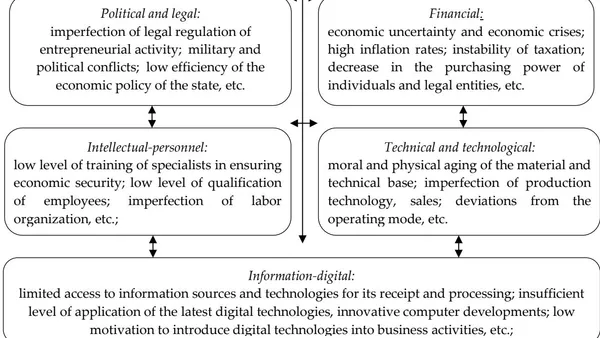
At the same time, threats to the economic security of entrepreneurial activity exist both at the level of individual enterprises (micro level) and at the level of the national economy (macro level). Taking into account the scope of threats to the economic security of entrepreneurial activity, in our opinion, their totality can be aggregated into 5 groups, which are presented in figure 2: political and legal, financial, intellectual and personnel, technical and technological, information and digital.
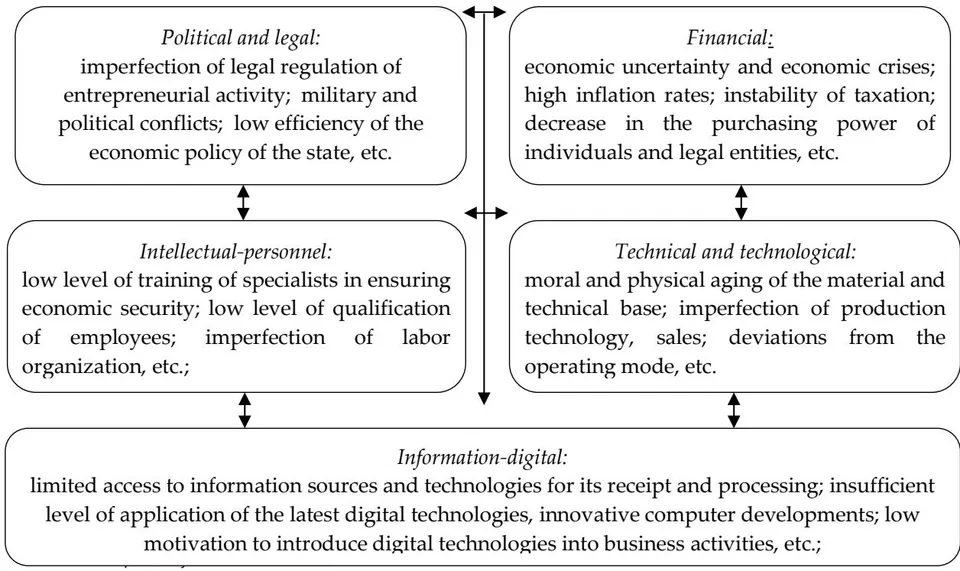
Political and legal threats to the economic security of entrepreneurial activity are associated exclusively with the legislative plane of its regulation, which, on the one hand, can be a reaction to international conflicts (including military ones), and on the other hand, reflects the vector of development of state economic policy, creating a framework and restrictions.
Financial threats to economic security are the main ones, since their influence directly affects the volume of financial resources, which largely determines the development of entrepreneurial activity in general.
Intellectual and personnel threats to the economic security of entrepreneurial activity are associated with the activities of employees of the enterprise. At the same time, personnel threats directly relate to the organization of labor and the interaction of workers with each other, and intellectual threats are associated with the efficiency and quality of their performance of their duties, depending on the level of qualification.
The consequence of the imperfection of the technological process, violation of the cyclical production, non-compliance of products, goods, works and services with certain standards are technical and technological threats to the economic security of entrepreneurial activity.
In modern conditions, information and digital threats to economic security are becoming important, which manifest themselves not only in limited access to information (both official and unofficial), but also in violation of its confidentiality and content with the help of modern technologies. It should be specially emphasized that the use of digital technologies in entrepreneurial activity provides an opportunity to increase the arrays of analyzed information for the enterprise of management decisions, and, consequently, to constantly increase the scale of entrepreneurial activity.
The structure and content of the scientific and methodological approach to the formation of key indicators of the economic security of entrepreneurial activity in the system of consulting services
So, the approach presented below is based on the implementation of a series of sequential actions of the management of a business entity (consulting firm/individual consultant), which will allow the formation and adaptation of economic security indicators to the specifics of their activities, as well as ensure their targeted identification and, as a result, generate reliable information for making managerial decisions to neutralize threats.
Given the above, the scientific and methodological approach to the formation of key indicators of the economic security of entrepreneurial activity is implemented through clearly defined stages, alternating in a logical sequence with a certain amount of work on each of them.
The first stage is monitoring threats to economic security. At this stage, it is necessary to analyze the business processes of the enterprise structure and identify bottlenecks (operations, documents, etc.) that most contribute to the emergence of threats to economic security. Based on the results of monitoring, a list of threats to economic security in the context of areas of occurrence should be formed.
The second stage is modeling possible threats to economic security, determining their causes and consequences. The practical implementation of this stage should be reflected in the description of specific threats to economic security, indicating the areas of occurrence, subjects, causes and their consequences.
The third stage is the direct formation of key indicators of economic security. The implementation of the stage is associated with the formation of a system of indicators (with threshold values, if possible) of economic security in those areas of threats that can be quantified. For other indicators, an abstract-logical approach should be implemented in combination with experience.
The fourth stage is the introduction of key indicators of the economic security of entrepreneurial activity in the process (concept) of its diagnostics. The stage involves fixing the list of indicators of economic security, as well as the entire scope of work with them in regulatory documents (standards, guidelines, etc.).
The fifth stage is the assessment of changes and the study of indicators of the economic security of entrepreneurial activity over time. The specificity of this stage lies in the fact that tracking the dynamics of indicators should occur by comparing current results with the results of previous periods with possible extrapolation into the future.
The sixth stage is monitoring and reporting. The purpose of the stage is to draw up the necessary reporting on indicators of the economic security of entrepreneurial activity. This stage involves the formation of tables, analytical notes on changes in the signals of the emergence of threats to indicators of the economic security of entrepreneurial activity. It should be noted that documenting such signals and indicators, fixing deviations from them is the most universal way of generating information. At the same time, it should be understood that there can be no universal form of reporting, since it must meet the necessary requests of management, take into account the specifics of the business entity (for example (Bessarabov, 2021)).
An example of an interim report form is presented in table 2. It should be emphasized that in foreign practice in such reports there is a use of color zones (red, yellow, green, etc.), which are convenient for drawing the attention of management to the most significant indicators of the economic security of entrepreneurial activity.
| Signal | Change over period | Indicator | Indicator structure | Changing 1 structural element of the indicator | Changing... of the structural element of the indicator | Causes/consequences of changing the indicator | |||
| +;- | % | +;- | % | +;- | % | ||||
| 1 | 2 | 3 | 4 | 5 | 6 | 7 | 8 | 9 | 10 |
| ... | ... | ... | ... | ... | ... | ... | ... | ... | ... |
| Stage | Target orientation of the stage | Practical orientation of the stage |
| I stage Monitoring of Threats to Economic Security | Identification of business processes (operations) that are most at risk of threats to the economic security of the customer of consulting services | Formation of a list of existing and potential threats to the economic security of the customer of consulting services |
| II stage Modeling possible threats to economic security | Analysis of the causes and consequences of threats to the economic security of the customer of consulting services | Description of specific threats to economic security, indicating the causes of their occurrence and consequences for the customer of consulting services |
| III stage Formation of key indicators of economic security | Substantiation and adjustment of the structure, content of threat signals and indicators of economic security of the customer of consulting services | Formation of the structure of signals and a system of indicators (with threshold values, if possible) of economic security, taking into account the specifics of the customer of consulting services |
| IV stage Introduction of key indicators of economic security | Adaptation of key indicators of economic security to the specifics of the business activity of the customer of consulting services | Fixing the list of indicators of economic security, as well as the entire necessary scope of work with them in the regulatory documents of the customer of consulting services |
| Stage V Assessing change and examining indicators over time | Tracking the dynamics of indicator deviations and analyzing the possibility of extrapolating their values into the future | Implementation of a logical procedure for comparing indicators, studying trends in their change |
| VI stage Monitoring and reporting | Drawing up the necessary reporting on threat signals and indicators of economic security of the customer of consulting services | Formation and analysis of tables (analytical reports) on deviations of key indicators of economic security of the customer of consulting services |
III. CONCLUSION
Thus, a scientific and methodological approach has been developed to the formation of key indicators of the economic security of entrepreneurial activity in the system of consulting services, the rationale for the logic of which is considered by comparing the causes and consequences of its threats by areas of occurrence, which are also reflected in the corresponding matrix. The implementation of the approach is aimed at identifying and assessing threats to the economic security of business activities, which form the basis of its diagnostics: from monitoring threats to compiling the necessary reporting forms based on the results of the implementation of key indicators of economic security. In turn, the target and practical orientation of the stages of the scientific and methodological approach to the formation of key indicators of the economic security of entrepreneurial activity predetermine the need to develop the concept of its diagnostics.