Fluid Gauge Theory

Article ID

SFR6H77Q

Accurate explanation of fluid gauge principles and applications in scientific research and engineering.

Fluid Gauge Theory

Tsutomu Kambe
Tsutomu Kambe
DOI

Abstract

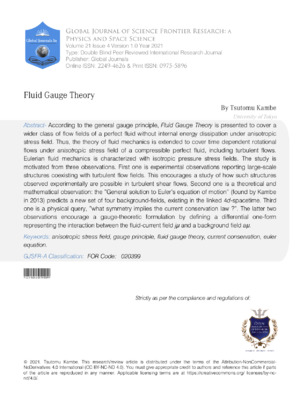
According to the general gauge principle, Fluid Gauge Theory is presented to cover a wider class of flow fields of a perfect fluid without internal energy dissipation under anisotropic stress field. Thus, the theory of fluid mechanics is extended to cover time dependent rotational flows under anisotropic stress field of a compressible perfect fluid, including turbulent flows. Eulerian fluid mechanics is characterized with isotropic pressure stress fields. The study is motivated from three observations. First one is experimental observations reporting largescale structures coexisting with turbulent flow fields. This encourages a study of how such structures observed experimentally are possible in turbulent shear flows, Second one is a theoretical and mathematical observation: the ”General solution to Euler’s equation of motion” (found by Kambe in 2013) predicts a new set of four background-fields, existing in the linked 4d-spacetime. Third one is a physical query, ”what symmetry implies the current conservation law ?”. The latter two observations encourage a gauge-theoretic formulation by defining a differential one-form representing the interaction between the fluid-current field and a background field . A known relativistic action of a perfect fluid is introduced together with the interaction action just mentioned, and furthermore, a third gauge invariant action is defined to govern the field linearly in its free-state. The general gauge principle is applied to the combined system of the three actions to describe general time-dependent rotational flow fields of an ideal compressible fluid. The combined system can be shown to be invariant under both global and local gauge transformations of variations of . The global gauge transformation is a diagnostic test whether the system is receptive to a new field . Since the test is cleared, a new internal stress field is introduced into the flow field of a perfect fluid, together with the current conservation = 0, where the stress is an anisotropic stress field which is an extension added to the Eulerian isotropic pressure-stress field jμ aμ aμ aμ aμ(xν ( Mik(xν ( ∂μjμ Mik p δik.


Fluid Gauge Theory

According to the general gauge principle, Fluid Gauge Theory is presented to cover a wider class of flow fields of a perfect fluid without internal energy dissipation under anisotropic stress field. Thus, the theory of fluid mechanics is extended to cover time dependent rotational flows under anisotropic stress field of a compressible perfect fluid, including turbulent flows. Eulerian fluid mechanics is characterized with isotropic pressure stress fields. The study is motivated from three observations. First one is experimental observations reporting largescale structures coexisting with turbulent flow fields. This encourages a study of how such structures observed experimentally are possible in turbulent shear flows, Second one is a theoretical and mathematical observation: the ”General solution to Euler’s equation of motion” (found by Kambe in 2013) predicts a new set of four background-fields, existing in the linked 4d-spacetime. Third one is a physical query, ”what symmetry implies the current conservation law ?”. The latter two observations encourage a gauge-theoretic formulation by defining a differential one-form representing the interaction between the fluid-current field and a background field . A known relativistic action of a perfect fluid is introduced together with the interaction action just mentioned, and furthermore, a third gauge invariant action is defined to govern the field linearly in its free-state. The general gauge principle is applied to the combined system of the three actions to describe general time-dependent rotational flow fields of an ideal compressible fluid. The combined system can be shown to be invariant under both global and local gauge transformations of variations of . The global gauge transformation is a diagnostic test whether the system is receptive to a new field . Since the test is cleared, a new internal stress field is introduced into the flow field of a perfect fluid, together with the current conservation = 0, where the stress is an anisotropic stress field which is an extension added to the Eulerian isotropic pressure-stress field jμ aμ aμ aμ aμ(xν ( Mik(xν ( ∂μjμ Mik p δik.

Tsutomu Kambe
Tsutomu Kambe

No Figures found in article.

Tsutomu Kambe. 2021. “. Global Journal of Science Frontier Research – A: Physics & Space Science GJSFR-A Volume 21 (GJSFR Volume 21 Issue A4): .

Download Citation

Journal Specifications

Crossref Journal DOI 10.17406/GJSFR

Print ISSN 0975-5896

e-ISSN 2249-4626

Issue Cover
GJSFR Volume 21 Issue A4
Pg. 113- 147
Classification
GJSFR-A Classification: FOR Code: 020399
Keywords
Article Matrices
Total Views: 1952
Total Downloads: 854
2026 Trends
Research Identity (RIN)
Related Research
Our website is actively being updated, and changes may occur frequently. Please clear your browser cache if needed. For feedback or error reporting, please email [email protected]

Request Access

Please fill out the form below to request access to this research paper. Your request will be reviewed by the editorial or author team.
X

Quote and Order Details

Contact Person

Invoice Address

Notes or Comments

This is the heading

Lorem ipsum dolor sit amet, consectetur adipiscing elit. Ut elit tellus, luctus nec ullamcorper mattis, pulvinar dapibus leo.

High-quality academic research articles on global topics and journals.

Fluid Gauge Theory

Tsutomu Kambe
Tsutomu Kambe

Research Journals