

Fossil Fuel, Greenhouse Gas and Global Warming

Article ID

FSN04

Alt text: Earth with fossil fuel and greenhouse gas emissions illustration.

Fossil Fuel, Greenhouse Gas and Global Warming

Chunji Liu
Chunji Liu
DOI

Abstract

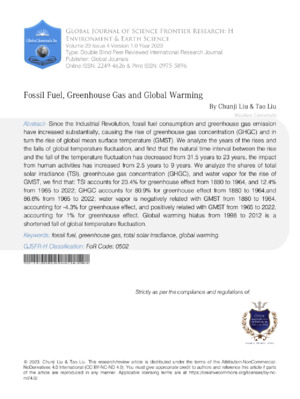
Since the Industrial Revolution, fossil fuel consumption and greenhouse gas emission have increased substantially, causing the rise of greenhouse gas concentration (GHGC) and in turn the rise of global mean surface temperature (GMST). We analyze the years of the rises and the falls of global temperature fluctuation, and find that the natural time interval between the rise and the fall of the temperature fluctuation has decreased from 31.5 years to 23 years, the impact from human activities has increased from 2.5 years to 9 years. We analyze the shares of total solar irradiance (TSI), greenhouse gas concentration (GHGC), and water vapor for the rise of GMST, we find that: TSI accounts for 23.4% for greenhouse effect from 1880 to 1964, and 12.4% from 1965 to 2022; GHGC accounts for 80.9% for greenhouse effect from 1880 to 1964,and 86.6% from 1965 to 2022; water vapor is negatively related with GMST from 1880 to 1964, accounting for -4.3% for greenhouse effect, and positively related with GMST from 1965 to 2022, accounting for 1% for greenhouse effect. Global warming hiatus from 1998 to 2012 is a shortened fall of global temperature fluctuation.

Fossil Fuel, Greenhouse Gas and Global Warming

Since the Industrial Revolution, fossil fuel consumption and greenhouse gas emission have increased substantially, causing the rise of greenhouse gas concentration (GHGC) and in turn the rise of global mean surface temperature (GMST). We analyze the years of the rises and the falls of global temperature fluctuation, and find that the natural time interval between the rise and the fall of the temperature fluctuation has decreased from 31.5 years to 23 years, the impact from human activities has increased from 2.5 years to 9 years. We analyze the shares of total solar irradiance (TSI), greenhouse gas concentration (GHGC), and water vapor for the rise of GMST, we find that: TSI accounts for 23.4% for greenhouse effect from 1880 to 1964, and 12.4% from 1965 to 2022; GHGC accounts for 80.9% for greenhouse effect from 1880 to 1964,and 86.6% from 1965 to 2022; water vapor is negatively related with GMST from 1880 to 1964, accounting for -4.3% for greenhouse effect, and positively related with GMST from 1965 to 2022, accounting for 1% for greenhouse effect. Global warming hiatus from 1998 to 2012 is a shortened fall of global temperature fluctuation.

Chunji Liu
Chunji Liu

No Figures found in article.

Chunji Liu. 2026. “. Global Journal of Science Frontier Research – H: Environment & Environmental geology GJSFR-H Volume 23 (GJSFR Volume 23 Issue H4): .

Download Citation

Journal Specifications

Crossref Journal DOI 10.17406/GJSFR

Print ISSN 0975-5896

e-ISSN 2249-4626

Issue Cover
GJSFR Volume 23 Issue H4
Pg. 21- 29
Classification
GJSFR-H Classification: FoR Code: 0502
Keywords
Article Matrices
Total Views: 1101
Total Downloads: 16
2026 Trends
Research Identity (RIN)
Related Research
Our website is actively being updated, and changes may occur frequently. Please clear your browser cache if needed. For feedback or error reporting, please email [email protected]

Request Access

Please fill out the form below to request access to this research paper. Your request will be reviewed by the editorial or author team.
X

Quote and Order Details

Contact Person

Invoice Address

Notes or Comments

This is the heading

Lorem ipsum dolor sit amet, consectetur adipiscing elit. Ut elit tellus, luctus nec ullamcorper mattis, pulvinar dapibus leo.


High-quality academic research articles on global topics and journals.

Fossil Fuel, Greenhouse Gas and Global Warming

Chunji Liu
Chunji Liu

Research Journals





























































