
I. INTRODUCTION
What is the physical certification mark that distinguishes particles and antiparticles? " When considering an electrically charged particle, say an electron, the difference between this particle and its antiparticle is evident: one has charge -e, the other +e. What happens when the particle is neutral? There is no general answer,......" then the graphic expression of two states of a Majorana massive field is given by G. Fantini, A. Gallo Rosso, V. Zema and F. Vissani [1], that indicates Majorana particle [2] is a neutral charge massive fermion consist of two opposite charges, charge -e and charge +e.
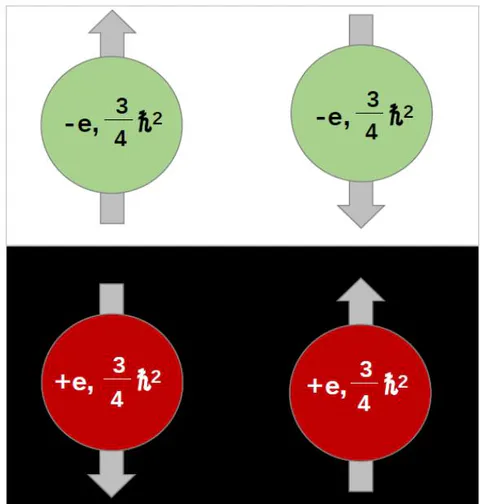
We see Majorana particle possesses a symmetrical picture shown in Table 1 and Figure 1. Here, the lefthand demonstrates the four states of a Dirac massive field, or a Dirac particle and a Dirac antiparticle. The righthand shows the two states of a Majorana massive field. Majorana particle is a neutral fermion made of negative charge -e and positive charge +e., that called the duality of charges. All these particles mentioned are with the same CO and with spin eigenvalues and respectively.
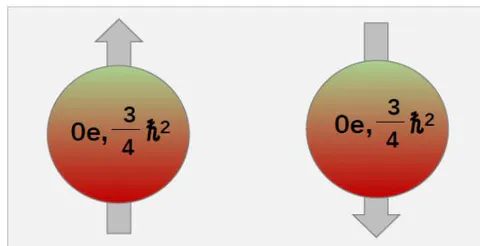
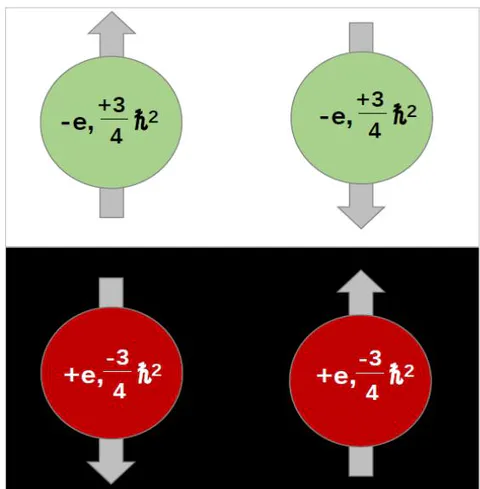
Being inspired, similar to Majorana did, this paper poses an assumption: Except the duality of charges of particle charge and antiparticle charge, maybe, there is another so-called duality of Casimir Opertors of positive Casimir Operator and negative Casimir Operator shown in Table 2 and Figure 2.
In contrast with the lefthands of the two Figures, now, the four states of a Dlrac massive field are replaced by a Majorana massive field, or replaced by a Majorana particle and a Majorana antiparticle, and at the same time, Majorana particle and a Majorana antiparticle are carry opposite CO each other.
The righthands of the two Figures indicate: a more neutral fermion that comprises not only positive charge +e and negative charge -e, but also positive Casimir Operator and negative Casimir Operator , than the Majorana Neutrino did. There are two dualities now the more neutral fermion is so-called Dark Neutrino, DN or that labelled with two physical quantities 0 e and .
| Charge | || | Casimir Operator | |
| Dirac particle | -e | || | |
| — Majorana Neutrino | — 0 e — | — — | — — |
| Dirac antiparticle | + e | || |
| Casimir Operator | || | Charge | |
| Majorana Neutrino | || | 0 e | |
| — Dark Neutrino — | — | — — — | — 0 e — |
| Majorana Antineutrino | || | 0 e |
The following: schematics of Table 1 and table 2
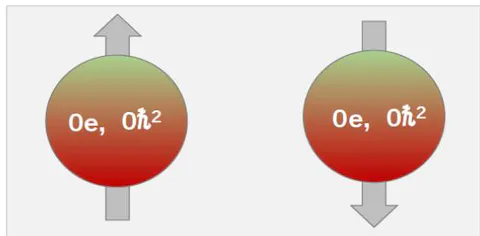
Dark Neutrino,
II. THE CONDITIONAL STATEMENTS FOR CASIMIR OPERATORS IN TABLE. 2 AND FIGURE. 2
The Casimir operator, a quantum operator, is the square sum of three operator components of angular momentum . Due to the Hermiticity of angular momentum, the square sum always are , that is, the CO is a positive operator.
In particle physics Pauli matrices are positive operators, so the Casimir operators of spin 1/2 particles, . , are positive too. Pauli matrices are the constituents of Dirac equation, further, the solutions of Dirac equation naturally implies a priori concept (0) below
Formula (0) shows: In Table.1 and Figure.1, the Spin Casimir operators and of both electron and positron are all positive operators. further, (0) is suitable for and of neutrinos v and antineutrinos as well in current theory.
This paper bases on the assumption Table.2 and Figure.2, so we see formula (0) is merely the CO of spin 1/2 particles, and however, formula (1) is the CO of spin 1/2 antiparticles
And the formula (2) is the CO of the peculiar Dark Neutrino
(1) and (2) really are two amusing questions, to find them, let us appeal to the math frame STS.
III. SPIN TOPOLOGICAL SPACE, STS (COMPLEX REGION)
Go back to Spin Topological Space, STS [3], this time we concern about another important concept: Casimir Operator of spin 1/2 particles.and spin 1/2 antiparticles.
Remind: the two dimension Hermitan spin matrix operators that appear in formula (0) are instead by the infinite dimension matrices , and 1st and 2nd Hermitan components and become non-Hermitan matrices and .
Firstly, in order for the assumption (1) to be self-consistent, Spin Topological Coordinate should be extended from real region to complex region (3) (4) below
■ Define the transformation
Imaginary numbers b and d now are introduced to raising operator and lowering operator respectively.
Using to construct the spin angular momentum in complex region
It can be shown, still satisfies the commutative algebra rule (9), which is in accord with the Lie algebraic theory of infinite dimension matrix rotation group.
Further, get the representation of invariant, Casimir Operator formula below
■ The explicit expressions of Casimir Operators, which are in accordance with Table.2 and Figure.2, are given For neutrino
For antineutrino
After substituting them into (10) obtain two pairs of conjugative CO between v and
We see the real part, and , of the above formulas are just the previous assumption (0) and (1), the Casimir operators for spin 1/2 particles and for spin 1/2 antiparticles respectively, which are what we except to be originally.
IV. CASIMIR OPERATOR OF DN, DARK NEUTRINO
For the implement of the progress of , is written into the superposition of spin angular momentums and in complex region below
In much same way as discussed in section III by using (11) and (12), obtain an important formula below
Thus we have CO of DN
where
and
We see the real part of (20) is just the previous assumption (2), which is the CO of Dark Neutrino , and is in accord with the CO which appears in Table, 2, Figure 2. and formular (2).
V. THE SPIN THIRD COMPONENTS OF DN, DARK NEUTRINO
For convenience, in the following we take the imaginarys (ref.(8)) of the third components of neutrino and antineutrino to be zero
Further obtain
Thus we have CO of DN
Where
Applying above results to lead to two groups of solutions for (27): solution of integers (30) and solution of half-integers (31), and illustrated in Table. 3
| (19) | Antineutrino | ||||||
| Neutrino | |||||||
(19) and (30) construct a zero-spin boson (32). with one invariant Co of group representation
Where for (33) below
Next following, using (20),(28) and (31) to research Dark Neutrino in the case of , Left-handed Neutrino and , Right-handed Antineutrino. The more details are shown in Table 4 and section 5.
A particle is called chiral if it is distinguishable from its mirror image [4], Mark chiral arrow is used to play the role in particle physics. The direction of the chiral arrows for particle and antiparticle are the same. Mark motion arrow is used to represent the direction of a particle momentum that is aligned along with the z-axis.
Base on the two marks, and , we constructe Table.4 and Table.5 below
| Direction of motion motion arrow | Left-handed Neutrino chiral arrow | flavour | flavour | Right-handed Antineutrino chiral arrow | Direction of motion motion arrow | |||| | DN |
| ↑ | ↓ | ↑ | ↑ | ↑ | |||
| ↑ | ↓ | ↑ | ↑ | ↑ | |||
| ↑ | ↓ | ↑ | ↑ | ↑ | |||
| ↓ ◆ | ↑ | ◆ | ◆ | ↑ | ◆↑ | 0 | |
| ↓ | ↑ | ↓ | ↓ | ↓ | |||
| ↓ | ↑ | ↓ | ↓ | ↓ | |||
| ↓ | ↑ | ↓ | ↓ | ↓ |
Table 5: Formation of DN with
| Direction of motion | Left-handed Neutrino | Right-handed Antineutrino | Direction of motion | |||| | DN | ||
| motion | arrow | chiral arrow | flavour | flavour | chiral arrow | motion | arrow |
| ↓ | ↑↑ | ↓↓ | ↓ | ↓ | |||
| ↓ | ↑↑ | ↓↓ | ↓ | ↓ | |||
| ↓ | ↑↑ | ↓↓ | ↓ | ↓ | |||
| ↑ | ◆ | ↓↓ | ◆ | ◆ | ↓↓ | ◆↓ | 0 |
| ↑ | ↓↓ | ↑↑ | ↑ | ↑ | |||
| ↑ | ↓↓ | ↑↑ | ↑ | ↑ | |||
| ↑ | ↓↓ | ↑↑ | ↑ | ↑ |
In the above two tables, the rotation orientation of these spin particles may be clockwise or counterclockwise, which is discribed by their third components of spin angular momentum [5],[6]. The clockwise, corresponding to the positive value of and the counterclockwise to the negative values of . Further, People usually provide: if parallel to direction of its momentum , we speak of a particle with right-handed helicity, RH, and if antiparallel to direction of its momentum , with left-handed helicity, LH. Remind parallel chiral arrows .
In nature there are only right-handed antineutrinos and only left-handed neutrinos, so, we have and in Table.4 and in Table.5.
Continuing with the concept of Table 4 and Table 5, then Table.3 turns into Table.6
VII. DARK SPIN PARTICLES, DSP
DSP are spin particles that have yet to be observed in nature up to now, but are existing in math Spin Topological Space, STS. To give a succinct explanation account of DSP, we back to real region, spin topological coordinate can help us describe spin particles and write down their group representations. In the following Tables, and are Casimir Operator and the third components of spin particles.
In Table 7 the values with underline are the spin eigenvalues of Bosons and Fermions, only those values are what we could explore and see in current theory and experiment now. Any other values without underline are the "spin-excited states" of Bosons and Fermions in STS.
| Boson | 0 | +1 | (+2, +1) | (+1, 0) | (0, -1) | (-1, -2) | (-2, -3) | (-3, -4) | |
| A1 | 0(0+1) | +2 | +1 | -1 | -2 | -3 | |||
| Boson | 2 | +3 | (+3, 0) | (+2, -1) | (+1, -2) | (0, -3) | (-1, -4) | (-2, -5) | |
| A2 | 1(1+1) | +2 | -2 | -3 | |||||
| Boson | 6 | +5 | (+4, -1) | (+3, -2) | (+2, -3) | (+1, -4) | (0, -5) | (-1, -6) | |
| A3 | 2(2+1) | -3 | |||||||
| Boson | 12 | +7 | (+5, -2) | (+4, -3) | (+3, -4) | (+2, -5) | (+1, -6) | (0, -7) | |
| A4 | 3(3+1) | ||||||||
| Fermion | +2 | (+3, +1) | (+2, 0) | (+1, -1) | (0, -2) | (-1, -3) | (-2, -4) | ||
| B1 | |||||||||
| Fermion | +4 | (+4, 0) | (+3, -1) | (+2, -2) | (+1, -3) | (0, -4) | (-1, -5) | ||
| B2 | |||||||||
| Fermion | +6 | A7 | (+5, -1) | (+4, -2) | (+3, -3) | (+2, -4) | (0, -6) | ||
| B3 |
■ Regular Dark Spin Particles
Spin particles in Table 8 are called regular dark spin particles, due to their is connected to one of the values of their . Here the spin topological coordinate of spin-1/3, spin-2/3 and spin-1/6, spin-5/6 are listed, the more details about others spin can be referred to author's works. The particles in Table 7 possess the same property.
| C1 | |||||||||
| C2 | |||||||||
| D1 | |||||||||
| D2 |
■ Peculiar Dark Spin Particles
Spin particles in the next six tables are referred to peculiar dark spin particles, which are cataloged by different CO. The first three tables are with even number CO, and the last three tables with odd number.
Peculiar dark spin particles are neither Bosons, Fermions nor regular dark spin particles,
Compare (20), (28) and (31) with the Series in Table 9, we see the former (complex region) is the extension of the latter (real region), the latter is the special case of the former. Both of them are all with CO and . So DN is one kind of peculiar dark spin particles.
| Series | ||||||
| (j,k) | ||||||
| Series | ||||||
| (j,k) | ||||||
| Series | ||||||
| (j,k) | ||||||
| Series | ||||||
| (j,k) | ||||||
| Series | ||||||
| (j,k) | ||||||
| Series | ||||||
| (j,k) | ||||||
| Series | ||||||
| (j,k) | ||||||
| Series | ||||||
| (j,k) | ||||||
| Series | ||||||
| (j,k) | ||||||
| Series | ||||||
| (j,k) | ||||||
| Series | ||||||
| (j,k) | ||||||
| Series | ||||||
| (j,k) | ||||||
| Series | ||||||
| (j,k) | ||||||
| Series | ||||||
| (j,k) | ||||||
| Series | ||||||
| (j,k) | ||||||
| Series0 | ||||||
| +2 | +1 | 0 | -1 | -2 | -3 | |
| Series | ||||||
| Series | ||||||
| Series | ||||||
| Series | ||||||
| Series0 | ||||||
| +2 | +1 | 0 | -1 | -2 | -3 | |
| Series | ||||||
| Series | ||||||
| Series | ||||||
| Series | ||||||
Remind: For all the above tables mentioned, when transformation
lead to
VIII. CONCLUSIONS
This paper suggests a possibility of the existence of DN, Dark Neutrino which is the superposition of Majorana Neutrino and Majorana Antineutrino . is a charge neutral particle that could possess CO and half-integer eigenvalues of the third component of its own, further we are in a dilemma as to judge the physical certification of spin particle , to be a Boson or to be a Fermion?
The only most plausible explanation is that is a kind of dark spin particles.
The tables of section VII are the fundamental representations of spin particles in STS, which are heuristic and useful, the examples are given below:
The spin topological coordinates of Fermion B1 of Table 7 are just the flavour quantum numbers of quarks in STS (isospin ) which is the last column of Table 2 in [3]. The of regular dark spin particles of Table 8 lead to the colour spectral line array of u quark, [3], then the definition of CSDF, Colour Spectrum Diagram of Flavour is ascertained.
The goal of this paper is mainly to explore the math properties of CO, Casimir Operator of angular momentum of spin particles in STS, and to show the roles of CO in distinguishing the identities between particles and antiparticles of particle physics. The spin-coupling of the third components of two spin particles, multi-body spin particles are rather complex, the difficulty can be seen from the discussions in section V and VI, here we see to ensure the harmony between the consistency of math discipline and reality of physical spin, is not an easy job. There are some critical concepts left are requested to be introduced, the relevant topics will be presented later.