
Loading menu…

Generic Rank-2 Perturbation of Hamiltonian Systems with Periodic Coefficients

§ Université Félix Houphouët-Boigny

Send Message

To: Author

Generic Rank-2 Perturbation of Hamiltonian Systems with Periodic Coefficients

Article Fingerprint

ReserarchID

RMV1B

Generic Rank-2 Perturbation of Hamiltonian Systems with Periodic Coefficients Banner

Key Research Insights

Synthesized scholarly intelligence & interactive research assistant
  • English
  • Afrikaans
  • Albanian
  • Amharic
  • Arabic
  • Armenian
  • Azerbaijani
  • Basque
  • Belarusian
  • Bengali
  • Bosnian
  • Bulgarian
  • Catalan
  • Cebuano
  • Chichewa
  • Chinese (Simplified)
  • Chinese (Traditional)
  • Corsican
  • Croatian
  • Czech
  • Danish
  • Dutch
  • Esperanto
  • Estonian
  • Filipino
  • Finnish
  • French
  • Frisian
  • Galician
  • Georgian
  • German
  • Greek
  • Gujarati
  • Haitian Creole
  • Hausa
  • Hawaiian
  • Hebrew
  • Hindi
  • Hmong
  • Hungarian
  • Icelandic
  • Igbo
  • Indonesian
  • Irish
  • Italian
  • Japanese
  • Javanese
  • Kannada
  • Kazakh
  • Khmer
  • Korean
  • Kurdish (Kurmanji)
  • Kyrgyz
  • Lao
  • Latin
  • Latvian
  • Lithuanian
  • Luxembourgish
  • Macedonian
  • Malagasy
  • Malay
  • Malayalam
  • Maltese
  • Maori
  • Marathi
  • Mongolian
  • Myanmar (Burmese)
  • Nepali
  • Norwegian
  • Pashto
  • Persian
  • Polish
  • Portuguese
  • Punjabi
  • Romanian
  • Russian
  • Samoan
  • Scots Gaelic
  • Serbian
  • Sesotho
  • Shona
  • Sindhi
  • Sinhala
  • Slovak
  • Slovenian
  • Somali
  • Spanish
  • Sundanese
  • Swahili
  • Swedish
  • Tajik
  • Tamil
  • Telugu
  • Thai
  • Turkish
  • Ukrainian
  • Urdu
  • Uzbek
  • Vietnamese
  • Welsh
  • Xhosa
  • Yiddish
  • Yoruba
  • Zulu
Reading Preferences
Font Size
Line Spacing
Background

I. INTRODUCTION

Let J∈R2n×2n ( n is a fixed non-zero positive integer) be skew-symmetric and nonsingular (i.e. JT=−J ) and τ be a positive real. Consider the following Hamiltonian system with τ -periodic coefficients

(1.1){JdX(t)dt=H(t)X(t)X(0)=I

where t↦H(t)∈R2n×2n is a piecewise continuous matrix function on [0,τ] such that

H(t+τ)=H(t)=(H(t))T,∀t∈R.

Throughout this paper, the identity and zero matrices of order k are denoted by Ik and 0k or just I and 0 whenever the order is clear from the context.

The solution of the system (1.1) is called the fundamental solution of the Hamiltonian system with τ -periodic coefficients JdX(t)dt=H(t)X(t), ∀t∈R. It verifies ∀t∈R, X(t)TJX(t)=J and satisfies the following relationship

X(t+pτ)=X(t)Xp(τ)≠Xp(τ)X(t),∀(t,p)∈R×N.

We say that the solution of (1.1) has a symplectic structure. Recall that a matrix W∈R2n×2n has a J -symplectic structure or W is J -symplectic (or J-orthogonal) if it verifies WTJW=J.

The symplectic matrices come very often from Hamiltonian differential systems with periodic coefficients (see [14, Chapter 3]). Besides many problems in physics and engineering lead to systems of linear differential equations with periodic coefficients consequently to Hamiltonian systems with periodic coefficients. This gives an important place to the study of these systems; particularly to the study of the stability of Hamiltonian systems which is closely related to the analysis of their perturbations. Regarding stability (strong stability) of system (1.1), we have the following definition

Definition 1.1 1. System (1.1) is stable if its solution X(t) remains bounded for all t∈R.

  1. System (1.1) is strongly stable if any Hamiltonian system with τ -periodic coefficients sufficiently close to (1.1) is stable.

Specifically, system (1.1) is strongly stable if there exists ε>0 such that any Hamiltonian system with τ-periodic coefficients of the form JX~(t)dt=H~(t)X~(t) and satisfying ‖H−H~‖≡∫0τ‖H(t)−H~(t)‖dt<ε, is stable. Therefore, we focus our study in this paper to study of a type of perturbation of Hamiltonian system with periodic coefficients called rank-one perturbation studied by Mehl, et al. in [11, 12] but within the framework of a structured matrix such as a symplectic matrix. In some of our work, we have defined from the work of Mehl, et al. the rank-one perturbation of a Hamiltonian system with τ-periodic coefficients [1, 2, 5].

In this paper, we consider the case of generic structure-preserving rank-2 perturbation of system (1.1). Let us recall the meta-conjecture resulting from a numerical experiment with random perturbations [4].

Meta -Conjecture 1 Let W∈Rp×p be a structured matrix with respect to some indefinite inner product and E∈Rp×p be a matrix of rank k so that W+E is of the same structure class as W. Then generically the Jordan structure and sign characteristic of W+E are the same that one would obtain by performing a sequence of k generic structure-preserving rank-one perturbations on W.

Let us give some reminders on generic sets [3, 11]

Definition 1.2 1. A set Ω⊆R2n is said to be algebraic if there exists a finite set of polynomials p1(x1,…,s2n),…,pk(x1,…,x2n) with real coefficients such that (α1,α2,…,α2n)T∈Ω if and only if pj(α1,…,α2n)=0, ∀j=1,…,k.

  1. An algebraic set Ω⊂R2n is said non-trivial if Ω≠R2n.

  2. A non-trivial set Ω∈R2n is said to be generic if Ω is not empty and R2n∖Ω is contained in a finite union of non-trivial algebraic sets.

Recall a result of [12] to the case of unstructured generic rank-one perturbation theory

Theorem 1.1 Let W∈Cℓ×ℓ be a matrix having the pairwise distinct eigenvalues λ1,…,λp with geometric multiplicities r1,…,rp and having the Jordan canonical form

⨁k=1r1Jℓ1,k(λ1)⊕⋯⊕⨁k=1rpJℓp,k(λp),

where lj,1≥⋯≥lj,rj, j=1,…,p. Consider the rank one matrix E=uvT, with u,v∈Cℓ. The generically (with respect to the entries of u and v) the Jordan blocks of W+E with eigenvalue λj are just the rj−1 smallest Jordan blocks of W with eigenvalue λj, and all other eigenvalues of W+E are simple; if rj=1, then generically λj is not an eigenvalue W+E.

More precisely, there is a generic set Ω⊆Cℓ×Cℓ such that for every (u,v)∈Ω, the Jordan structure of W+uvT is described in (a) and (b) bellow:

(a) the Jordan structure of W+uvT for the eigenvalues λ1,…,λp is given by

⨁k=2r1Jℓ1,k(λ1)⊕⋯⊕⨁k=2rpJℓp,k(λp);

(b) the eigenvalues of W+uvT that are different from any of λ1,…,λp, are all simple.

II. GENERALITY ON A RANK-ONE PERTURBATION THEORY

a) Generic rank-one perturbation of a symplectic matrix

Ref

Consider a symplectic matrix W∈R2n×2n and an anti-symmetric matrix J∈R2n×2n. Recall that the spectrum of any symplectic matrix of order 2n is divided into three groups of eigenvalues: n0 eigenvalues inside the unit circle, n∞=n0 eigenvalues outside the unit circle and symmetrically placed with respect to the first group, and n1=2(n−n0) eigenvalues on the unit circle [8, 9, 10]. These types of matrices which belong to a group of so-called structured matrices, have simple and useful spectral properties that we recall in the following theorem ([8])

Theorem 2.1 Let W∈R2n×2n be a symplectique matrice. Then any eigenvalue of W verifies:.for all eigenvalue λ of W,

  1. if λ∈C∗, with |λ|≠1, then λ¯, 1/λ and 1/λ¯ are eigenvalues of W;

  2. if λ∈C with |λ|=1 then λ¯ is an eigenvalue of W;

  3. if λ∈R∗, 1/λ is an eigenvalue of W.

Regarding a rank-one perturbation treated by Mel, et al. in [11], we have the following lemma:

Lemma 2.1 If W and W~∈R2n×2n are J -symplectiques such that

rg(W~−W)=1,

then there exists a vector u∈R2n verifying

W~=(I+cuuTJ)W,

where c=±1. Moreover for all u∈R2n, the matrix W~ is J -symplectic.

Proof

The hypothesis

rg(W~−W)=1,

implies that there exists two non-zero vectors u^ and v∈R2n such that

W~=W+u^vT.

Thus, W~ J -symplectic implies W~TJW~=J and we have

(W+u^vT)TJ(W+u^vT)=J
WTJW⏟=J+vu^TJW+WTJu^vT+vu^TJu^⏟=0vT=J

this implies

(2.2)vu^TJW+WTJu^vT=0,

which gives, by multiplying on the right by v,

vu^TJWv+WTJu^vTv=0.

We deduce

WTJu^=−vu^TJWvvTv,( since v≠0)=−vu^TwvTv, where w=JWv.

By setting

n=u^TwvTv,

Ref

We get WTJu^=−nv which shows that v and WTJu^ are collinear. Thus, there is a non-zero real constant α such as v=−αWTJu^. Therefore

W~=(I+αu^u^TJ)W,whereα=±1.

Since the matrix αu^u^TJ is J-Hamiltonian ( (Jαu^u^TJ)T=Jαu^u^T ), according to point 3) of Lemma 2.3 of [4], there is a vector u∈R2n and a constant c=±1 such that αu^u^TJ=cuuTJ. Therefore

W^=(I+cuuTJ)W, where c=±1.

Moreover, for any u∈R2n, we easily show that W~JW~=J.

We have the following general definitions

Definition 2.1 Let W∈R2n×2n be a symplectic matrix. We call rank-one perturbation of W, any symplectic matrix W~ of the form

W~=(I+cuuT)W,

where c=±1 and u∈R2n

In Theorem (1.1), if we consider a J -symplectic matrix W∈R2n×2n and take v=WTJTu, we get the following theorem

Theorem 2.2 Let W∈R2n×2n be a matrix having the pairwise distinct eigenvalues λ1,…,λ2p with geometric multiplicities r1,…,r2p and having the Jordan canonical form

(2.4)⨁k=1r1Jℓ1,k(λ1)⊕⋯⊕⨁k=1r2pJℓ2p,k(λ2p),

where lj,1≥⋯≥lj,rj, j=1,…,2p. Consider the rank one matrix E=uuTJW, with u∈R2n. Then generically (with respect to the entries of u) the Jordan blocks of W+E with eigenvalue λj are just the rj−1 smallest Jordan blocks of W with eigenvalue λj, and all other eigenvalues of W+E are simple; if rj=1, then generically λj is not an eigenvalue W+E.

More precisely, there is a generic set Ω⊆C2n such that for every u∈Ω, the Jordan structure of (I+uuTJ) W is described in (a) and (b) bellow:

(a) the Jordan structure of (I+uuTJ)W for the eigenvalues λ1,…,λ2p is given by

⨁k=2r1Jℓ1,k(λ1)⊕⋯⊕⨁k=1r2pJℓ2p,k(λ2p)

(b) the eigenvalues of (I+uuTJ)W that are different from any of λ1,…,λ2p, are all simple.

Note that, λ being an eigenvalue of W, 1/λ, λ¯ et 1/λ¯ are also eigenvalues of W. So the number of eigenvalues W is even. Thus, W will have the Jordan canonical form (2.4).

According to (a) of Theorem (1.1), the structure of W by the eigenvalues λ1,λ2,…,λ2p is given by

⨁k=2r1Jℓ1,k(λ1)⊕⋯⊕⨁k=1r2pJℓ2p,k(λ2p);

Notes and from point (b) of the same Theorem, the eigenvalues of (I+uuTJ)W which are different from λ1,…,λ2p are all simple.

b) Generic rank-one perturbation of the Hamiltonian system with periodic coefficients Let u be a vector of a generic set Ω⊂R2n. Consider the Hamiltonian systems with τ -periodic coefficients

(2.5)JdX~(t)dt=[H(t)+E(t)]X~(t),

where t↦H(t) and t↦E(t) are piecewise continuous matrix functions on [0,τ] such that for all t∈R and τ>0,

H(t+τ)=H(t)=HT(t)∈R2n×2n and E(t+τ)=E(t)=ET(t)∈R2n×2n.

Definition 2.2 We call a rank-one perturbation of the fundamental solution (X(t))t∈R of (1.1) any matrix function of the form

(2.6)X~(t)=(I+cuuTJ)X(t),∀t∈R

where c=±1.

The rank-one perturbations of fundamental solution of (1.1) are J -symplectic [2, 5]. Therefore, we collect some properties of Hamiltonian systems with periodic coefficients of the type (2.5) in Proposition 2.1

Proposition 2.1 1. Let t∈R and (X(t))t∈R be the fundamental solution of (1.1). If a solution (X~(t))t∈R of (2.5) is of the form

X~(t)=(I+c(t)u(t)uT(t)J)X(t),

where t↦u(t)∈R2n is a vector function and t↦c(t) is a function with value in {−1,+1}. Then there exists a constant vector u such that u(t)=u, c(t)=c=±1 is a real constant and E(t) is of the form

(2.8)E(t)=(cJuuTH(t))T+cJuuTH(t)+c2(uuT)TH(t)(uuTJ).
  1. Let u be a non-zero vector of R2n. Consider the perturbed Hamiltonian equation of (1.1)
(2.9)JdX~(t)dt=[H(t)+E(t)]X~(t)

where t↦H(t) is piecewise continuous and

E(t)=(cJuuTH(t))T+cJuuTH(t)+c2(uuT)TH(t)(uuTJ).

Then X~(t)=(I+cuuT)X(t) is a solution of (2.9)

3. System (2.9) can be put in the form
(2.10){JX~(t)dt=(I−cuuT)TH(t)(I−cuuT)X~(t),∀t∈RX~(0)=I+cuuTJ.

Proof

  1. Suppose u(t) is not constant. Then u(t)u(t)T is not also constant. We have

Ref

JdX~(t)dt=J(I+c(t)u(t)uT(t)J)X(t)dt+J[d(c(t)u(t)uT(t))dt]JX(t)=J(I+c(t)u(t)uT(t)J)J−1H(t)X(t)+J[d(c(t)u(t)uT(t))dt]JX(t)=[(I−c(t)u(t)uT(t)J)TH(t)(I−c(t)u(t)uT(t)J)+Jd(c(t)u(t)uT(t))dtJ(I−c(t)u(t)uT(t)J)]X~(t)withX~(t)=(I+c(t)u(t)uT(t)J)X(t)=[H(t)+(c(t)Ju(t)u(t)H(t))T+c(t)Ju(t)uT(t)H(t)+c(t)2(u(t)uT(t)J)TH(t)(u(t)uT(t)J)⏟E(t)]X~(t)+[Jd(c(t)u(t)uT(t))dtJ(I−c(t)u(t)uT(t)J)⏟F(t)]X~(t)=[H(t)+E(t)+F(t)]X~(t),

We note that E(t)+F(t) is not symmetric because E(t) is symmetric and F(t) is not symmetric. Which gives us a contradiction. To have H(t)+E(t)+F(t) symmetric, we must have F(t)=0, ∀t∈R. Then c(t)u(t)uT(t) is constant. In particular, c(t)u(t)uT(t)=c(0)u(0)u(0)T∀t∈R. We deduce that there is a constant vector u=u(0) and a real constant c=c(0)∈{−1,+1} such that E(t) is of the form (2.8).

2. By deriving X~(t), we get
JdX~(t)dt=J(I+cuuTJ)J−1JdX(t)dt

We then obtain equation (2.9) with

E(t)=c(JuuTH(t))T+cJuuTH(t)+c2(uuTJ)TH(t)(uuTJ).

This shows that X~(t)=(I+cuuTJ)X(t) is a solution of (2.9).

  1. Indeed, it suffices to develop (I−uuTJ)TH(t)(I−uutJ) to obtain

Ref

(I−cuuTJ)TH(t)(I−cuutJ)=H(t)+
(cJTuuTH(t))T+cJTuuTH(t)+c2(uuTJ)TH(t)(uuTJ)⏟E(t)

III. GENERIC DOUBLE RANK-ONE PERTURBATION OF HAMILTONIAN SYSTEM WITH PERIODIC COEFFICIENTS

In this section, we consider two vectors u1 and u2 taken in a generic set Ω of R2n such that u1TJu2=0. Note that this holds if u1=u2. On the other hand, we can consider generic vectors belonging to isotropic (or Lagrangian) subspaces. A subspace X⊆R2n is called isotropic if X⟂JX. The maximum isotropic subspaces containing X are of dimension n [4]. Hence we have this definition

Definition 3.1 A subspace L of R2n is called a Lagrangian subspace if it is of the dimension n and

xTJy=0,∀x,y∈L.

We first consider the rank-one perturbation

X1(t)=(I+c1u1u1TJ)X(t),∀t∈Randc=±1

of the solution (X(t))t∈R of system (1.1) using the vector u. Then we perturb the solution a second time using the second vector u2. We get

(3.1)X2(t)=(I+c2u2u2TJ)(I+c1u1u1TJ)X(t),∀t∈Randc1,c2∈{−1,+1}

We have the following Proposition

Proposition 3.1 The double rank-one perturbation of the solution of (1.1) is the solution of the following system

(3.2){JX^(t)dt=(I−c2u2u2TJ)T(I−c1u1u1TJ)TH(t)(I−c1u1u1TJ)(I−c2u2u2TJ)X^(t)X^(0)=(I+c2u2u2TJ)(I+c1u1u1TJ)

The double rank-one perturbation of the solution of (1.1) is given by (3.1). Then ∀t∈R and c1,c2∈ {−1,+1}, we have

dX2(t)dt=(I+c2u2u2TJ)(I+c1u1u1TJ)X(t)dt,=(I+c2u2u2TJ)(I+c1u1u1TJ)J−1H(t)X(t),=[(I+c2u2u2TJ)(J−1+c1u1u1T)H(t)(I+c1u1u1TJ)−1(I+c2u2u2TJ)−1]×
(I+c2u2u2TJ)(I+c1u1u1TJ)X(t)⏟X2(t),=[(I+c2u2u2TJ)J−1(I−c1u1u1TJ)TH(t)(I+c1u1u1TJ)−1(I+c2u2u2TJ)−1]X2(t)=J−1[(I−c2u2u2TJ)T(I−c1u1u1TJ)TH(t)(I−c1u1u1TJ)(I−c2u2u2TJ)]X2(t),

because for all vector u and c∈{−1,+1}, we have (I+cuuTJ)−1=(I−cuuTJ). Moreover X2(0)=(I+c2u2u2TJ)(I+c1u1u1TJ)X(0).

Notes

Remark 3.1 The double rank-one perturbation X2(t) (or X^(t) ) of X(t) can be put in the form

(3.3)X2(t)=X(t)+c2u2u2TJX(t)+c1u1u1JX(t),∀t∈Rc1,c2∈{−1,+1};

or by putting the vectors u1 and u2 as column of a matrix U=[u1u2]∈R2n×2

(3.4)X2(t)=(I+UΣ2UTJ)X(t)=X(t)+UΣ2UTJX(t)

where Σ1=(c100c2)∈R2×2 is a diagonal matrix with c1,c2∈{−1,+1}.

We have the following Definition

Definition 3.2 We call a generic rank-2 perturbation of system (1.1), any system given by (3.2).

From (3.2), the following corollary gives another writing of system (3.2)

Corollary 3.1 System (3.2) can be put in the form below

(3.5){JX^(t)dt=(I−UΣ2UTJ)TH(t)(I−UΣ2UTJ)X^(t)

or in a following simple form

(3.6){JX^(t)dt=(H(t)+E(t))X^(t)

where

E(t)=JUΣ2UTH(t)+(JUΣ2UTH(t))T+(UΣ2UTJ)TH(t)(UΣ2UTJ)

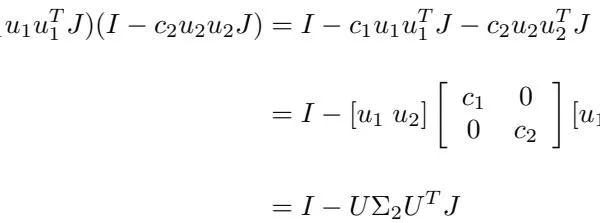
To have (3.5), It suffices to notice that

(I−c1u1u1TJ)(I−c2u2u2J)=I−c1u1u1TJ−c2u2u2TJ=I−[u1u2][c100c2][u1u2]TJ=I−UΣ2UTJ

Similarly, we have (I+c1u1u1TJ)(I+c2u2u2J)=I+UΣ2UTJ.

Next, by developing (I−UΣ2UTJ)TH(t)(I−UΣ2UTJ) in (3.5), we get

(I−UΣ2UTJ)TH(t)(I−UΣ2UTJ)=H(t)+E(t)

Notes where E(t)=JUΣ2UTH(t)+(JUΣ2UTH(t))T+(UΣ2UTJ)TH(t)(UΣ2UTJ). Hence we have (3.6).

ACKNOWLEDGMENT

Many thanks to the referees for the helpful remarks and suggestions.

References

12 Cites in Article
  1. 1. T Arouna,M Dosso,J.-C. Koua Brou (2020). Application of a Rank-One Perturbation to Pendulum Systems. Journal of Mathematics Research, 12(5)
  2. 2. Traoré Arouna,Mouhamadou Dosso,Jean-Claude Koua Brou (2018). ON A PERTURBATION THEORY OF HAMILTONIAN SYSTEMS WITH PERIODIC COEFFICIENTS. International Journal of Numerical Methods and Applications, 17(2), 47-89.
  3. 3. Leonhard Batzke (2014). Generic rank-one perturbations of structured regular matrix pencils. Linear Algebra and its Applications, 458, 638-670.
  4. 4. Leonhard Batzke,Christian Mehl,André Ran,Leiba Rodman (2016). Generic rank-k Perturbations of Structured Matrices. Operator Theory: Advances and Applications, 27-48.
  5. 5. M Dosso,T Arouna,J Koua,Brou (2018). On rank one perturbation of Hamiltonian system with periodic coefficients. Wseas Translations on Mathematics, 17, 377-384.
  6. 6. M Dosso,M Sadkane (2013). On the strong stability of symplectic matrices. Numerical Linear Algebra with Applications, 20, 234-249.
  7. 7. Mouhamadou Dosso,Namory Coulibaly (2014). AN ANALYSIS OF THE BEHAVIOR OF MULTIPLIERS OF HAMILTONIAN SYSTEM WITH PERIODIC COEFFICIENTS. Far East Journal of Mathematical Sciences (FJMS), 99(3), 301-322.
  8. 8. M Dosso (2006). Sur quelques algorithms d'analyse de stabilit_e forte de matrices symplectiques. Sur quelques algorithms d'analyse de stabilit_e forte de matrices symplectiques
  9. 9. S Godunov,M Sadkane (2001). Numerical determination of a canonical form of a symplectic matrix. Siberian Mathematical Journal, 42, 629-647.
  10. 10. S Godunov,M Sadkane (2006). Spectral Analysis of Symplectic Matrices with Application to the Theory of Parametric Resonance. SIAM Journal on Matrix Analysis and Applications, 28(4), 1083-1096.
  11. 11. Christian Mehl,Volker Mehrmann,André Ran,Leiba Rodman (2014). Eigenvalue perturbation theory of symplectic, orthogonal, and unitary matrices under generic structured rank one perturbations. BIT Numerical Mathematics, 54(1), 219-255.
  12. 12. Christian Mehl,Volker Mehrmann,André Ran,Leiba Rodman (2011). Eigenvalue perturbation theory of classes of structured matrices under generic structured rank one perturbations. Linear Algebra and its Applications, 435(3), 687-716.

Funding

No external funding was declared for this work.

Conflict of Interest

The authors declare no conflict of interest.

Ethical Approval

No ethics committee approval was required for this article type.

Data Availability

Not applicable for this article.

How to Cite This Article

Mouhamadou Dosso. 2021. "Generic Rank-2 Perturbation of Hamiltonian Systems with Periodic Coefficients". Global Journal of Science Frontier Research - F: Mathematics & Decision GJSFR-F Volume 21 (GJSFR Volume 21 Issue F1).

More Citation Formats

Download Citation

Journal Specifications

Crossref Journal DOI 10.17406/GJSFR

Print ISSN 0975-5896

e-ISSN 2249-4626

Keywords
Classification
GJSFR-F Classification MSC 2010: 15A21
47A55
93B10
93C73
Version of record
v1.2

Issue date
February 12, 2021

Language
English
Order Article Reprint
Experience in AR

Explore published articles in an immersive Augmented Reality environment. Our platform converts research papers into interactive 3D books, allowing readers to view and interact with content using AR and VR compatible devices.

Read in 3D

Your published article is automatically converted into a realistic 3D book. Flip through pages and read research papers in a more engaging and interactive format.

Article Matrices
Total Views: 581
Total Downloads: 45
All Trends

Request Access

Please fill out the form below to request access to this research paper. Your request will be reviewed by the editorial or author team.
X

This is the heading

Lorem ipsum dolor sit amet, consectetur adipiscing elit. Ut elit tellus, luctus nec ullamcorper mattis, pulvinar dapibus leo.

High-quality academic research articles on global topics and journals.

Generic Rank-2 Perturbation of Hamiltonian Systems with Periodic Coefficients

Mouhamadou Dosso
Mouhamadou Dosso Université Félix Houphouët-Boigny