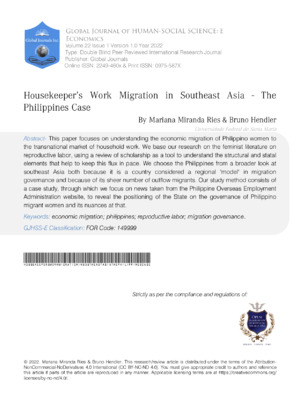
Housekeeper’s Work Migration in Southeast Asia – the Philippines Case

α
Mariana Ries
Mariana Ries

Send Message

To: Author

Housekeeper’s Work Migration in Southeast Asia – the Philippines Case

Article Fingerprint

ReserarchID

S4D3Q

Housekeeper’s Work Migration in Southeast Asia – the Philippines Case Banner

AI TAKEAWAY

Connecting with the Eternal Ground
  • English
  • Afrikaans
  • Albanian
  • Amharic
  • Arabic
  • Armenian
  • Azerbaijani
  • Basque
  • Belarusian
  • Bengali
  • Bosnian
  • Bulgarian
  • Catalan
  • Cebuano
  • Chichewa
  • Chinese (Simplified)
  • Chinese (Traditional)
  • Corsican
  • Croatian
  • Czech
  • Danish
  • Dutch
  • Esperanto
  • Estonian
  • Filipino
  • Finnish
  • French
  • Frisian
  • Galician
  • Georgian
  • German
  • Greek
  • Gujarati
  • Haitian Creole
  • Hausa
  • Hawaiian
  • Hebrew
  • Hindi
  • Hmong
  • Hungarian
  • Icelandic
  • Igbo
  • Indonesian
  • Irish
  • Italian
  • Japanese
  • Javanese
  • Kannada
  • Kazakh
  • Khmer
  • Korean
  • Kurdish (Kurmanji)
  • Kyrgyz
  • Lao
  • Latin
  • Latvian
  • Lithuanian
  • Luxembourgish
  • Macedonian
  • Malagasy
  • Malay
  • Malayalam
  • Maltese
  • Maori
  • Marathi
  • Mongolian
  • Myanmar (Burmese)
  • Nepali
  • Norwegian
  • Pashto
  • Persian
  • Polish
  • Portuguese
  • Punjabi
  • Romanian
  • Russian
  • Samoan
  • Scots Gaelic
  • Serbian
  • Sesotho
  • Shona
  • Sindhi
  • Sinhala
  • Slovak
  • Slovenian
  • Somali
  • Spanish
  • Sundanese
  • Swahili
  • Swedish
  • Tajik
  • Tamil
  • Telugu
  • Thai
  • Turkish
  • Ukrainian
  • Urdu
  • Uzbek
  • Vietnamese
  • Welsh
  • Xhosa
  • Yiddish
  • Yoruba
  • Zulu

Abstract

This paper focuses on understanding the economic migration of Philippino women to the transnational market of household work. We base our research on the feminist literature on reproductive labor, using a review of scholarship as a tool to understand the structural and statal elements that help to keep this flux in pace. We choose the Philippines from a broader look at southeast Asia both because it is a country considered a regional “model” in migration governance and because of its sheer number of outflow migrants. Our study method consists of a case study, through which we focus on news taken from the Philippine Overseas Employment Administration website, to reveal the positioning of the State on the governance of Philippino migrant women and its nuances at that.

References

20 Cites in Article
  1. Jean Encinas-Franco (2020). Gendered Constructions of Overseas Filipino Workers and the Politics of National Shame.
  2. Matt Withers (2021). The migration ban policy cycle: a comparative analysis of restrictions on the emigration of women domestic workers.
  3. Nana Oishi (2005). Women in Motion.
  4. (2020). Facts and perspectives: Women's Labour Migration from the Philippines.
  5. Brenda Yeoh (2016). Migration and Gender Politics in Southeast Asia.
  6. Catherine Cheng,Hae Choo (2015). Women's Migration for Domestic Work and Cross‐Border Marriage in East and Southeast Asia: Reproducing Domesticity, Contesting Citizenship.
  7. Amarjit Kaur (2007). On the Move: International Migration in Southeast Asia since the 1980s.
  8. Iom (2019). Glossary.
  9. Johan Lindquist (2010). Labour Recruitment, Circuits of Capital and Gendered Mobility: Reconceptualizing the Indonesian Migration Industry.
  10. Pierrette Hongdaneu-Sotelo Gender and Migration Scholarship: An Overview from a 21st Century Perspective.
  11. N (2011). Enero / Junio 2011.
  12. Mechthild Hart (2005). Capitalist Patriarchy.
  13. Nicola Piper,Keiko Yamanaka (2005). About the United Nations Research Institute for Social Development (UNRISD) and the United Nations University (UNU).
  14. N Teixeira,Corpo (2021). Cotidiano e Reprodução: Considerações sobre o Neoliberalismo a partir de Silvia Federici.
  15. Pei-Chia Lan (2008). Migrant Women’s Bodies as Boundary Markers: Reproductive Crisis and Sexual Control in the Ethnic Frontiers of Taiwan.
  16. Juanita Elias (2017). Governing Domestic Worker Migration in Southeast Asia: Public-Private Partnerships, Regulatory Grey Zones and the Household.
  17. Nicola Piper,Anders Uhlin (2002). Transnational Advocacy Networks, Female Labor Migration and Trafficking in East and Southeast Asia: A Gendered Analysis of Opportunities and Obstacles.
  18. Apichai Shipper (2010). Introduction: Politics of Citizenship and Transnational Gendered Migration in East and Southeast Asia.
  19. Maruja Asis (2003). When Men and Women Migrate: Comparing Gendered Migration in Asia.
  20. Maricris Cudal,Liberty Calimbo,Diosdado Jr,Jaidel Salise,Jessa Gomez,Meraflor Pagaling,Jasper Locson,Joel Cahayagan,Jernol Seno,Jahuel Daculio (2021). Diversity of Pteridophytes in Mount Timolan Protected Landscape, Zamboanga del Sur, Philippines.

Funding

No external funding was declared for this work.

Conflict of Interest

The authors declare no conflict of interest.

Ethical Approval

No ethics committee approval was required for this article type.

Data Availability

Not applicable for this article.

How to Cite This Article

Mariana Ries. 2026. \u201cHousekeeper’s Work Migration in Southeast Asia – the Philippines Case\u201d. Global Journal of Human-Social Science - E: Economics GJHSS-E Volume 22 (GJHSS Volume 22 Issue E1): .

Download Citation

Study on Filipino housekeepers' migration trends and economic impact in Southeast Asia.
Issue Cover
GJHSS Volume 22 Issue E1
Pg. 11- 18
Journal Specifications

Crossref Journal DOI 10.17406/GJHSS

Print ISSN 0975-587X

e-ISSN 2249-460X

Keywords
Classification
GJHSS-E Classification: FOR Code: 149999
Version of record

v1.2

Issue date

February 7, 2022

Language
pt
Experiance in AR

Explore published articles in an immersive Augmented Reality environment. Our platform converts research papers into interactive 3D books, allowing readers to view and interact with content using AR and VR compatible devices.

Read in 3D

Your published article is automatically converted into a realistic 3D book. Flip through pages and read research papers in a more engaging and interactive format.

Article Matrices
Total Views: 2017
Total Downloads: 49
2026 Trends
Related Research

Published Article

This paper focuses on understanding the economic migration of Philippino women to the transnational market of household work. We base our research on the feminist literature on reproductive labor, using a review of scholarship as a tool to understand the structural and statal elements that help to keep this flux in pace. We choose the Philippines from a broader look at southeast Asia both because it is a country considered a regional “model” in migration governance and because of its sheer number of outflow migrants. Our study method consists of a case study, through which we focus on news taken from the Philippine Overseas Employment Administration website, to reveal the positioning of the State on the governance of Philippino migrant women and its nuances at that.


Our website is actively being updated, and changes may occur frequently. Please clear your browser cache if needed. For feedback or error reporting, please email [email protected]

Request Access

Please fill out the form below to request access to this research paper. Your request will be reviewed by the editorial or author team.
X

Quote and Order Details

Contact Person

Invoice Address

Notes or Comments

This is the heading

Lorem ipsum dolor sit amet, consectetur adipiscing elit. Ut elit tellus, luctus nec ullamcorper mattis, pulvinar dapibus leo.

High-quality academic research articles on global topics and journals.

Housekeeper’s Work Migration in Southeast Asia – the Philippines Case

Mariana Ries
Mariana Ries

Research Journals