
I. INTRODUCTION
The optimum use of information systems is certainly one of the fastest changing and dynamic processes in today's business organizations. It is proven today that information technologies are among the most important tools for achieving business success. In earlier days, all the information flows were managed manually. Since last several years' business information is being kept, analyzed and processed in computerized and different electronic formats to communicate properly and manage the activities effectively. Due to the expansion of Management Information Systems (MIS) in business firms, HR functions increasingly started to deploy HRIS in their day-to-day work.
Firms in the Twenty First century have realized to implement different systems to cope up with the existing challenges and managing the complexities. HRIS is one of them that depict as vital tool of managing Information resources to execute the contemporary administrative and strategic activities of HR Management department more efficiently and effectively.
HRIS supports the HR department to make a more dynamic role in organizational planning. Automation will make predicting more timely, cost effective, and efficient. Integration and storage in a single database all of the HR Information. An effective HRIS will assist the easy storage and recovery of HR records that are very vital for operations. HRIS can show an important role in a firm's HR functions.
Human Capital considers labor as an item that can be bought and sold. This theory concentrates much on exploiting labor. Education and training makes employees obtain skills, expertise and knowledge needed to perform, which is more valuable so a lot of consideration has to be given it in terms of investment in people. To differentiate firms specific and general HC, general is gained is through education while specific is done through areas of knowledge as, Accountants, engineers.
The Organization Performance depends on its employees, who are a basic part of it, and on the team that works toward accomplishing the organization's objectives.
Organization Performance is the eventual Dependent Variable of researcher's interests for concerned with just about any area of management. Market competition for inputs, customers, and Capital which make O. Pvital to the existence and success of the new business.
a) Research Aim and Objectives
The aim of this research is to understand the impact of HRIS perception on O.P, mediated by H.C, and investigate the moderating role of HR Analytics in Egyptian Private Telecom Sector.
The objectives of this research are:
Review Human Resources literature in a variety of sectors with regards to investigate and understand the HRIS impact on H.C and Organizational Performance.
Derive the main dimensions that directly and indirectly affect Organizational Performance.
Identify the key variables that impact Organizational Performance, and develop a proposed theoretical framework of O.P in the Egyptian Private Telecom industry.
Make an investigation (Survey) to understand how HR senior/middle managers and key employees in HR departments and other departments that use HRIS, view HRIS, H.C, HR Analytics, and the main factors that affect O.P.
Understand the effect of HR Analytics on the relationship between HRIS and Organizational Performance.
Statistically analyze the data collected, relate the research findings to previous studies, find similarities, differences, and the main points that could emerge during the investigation.
Make recommendations for the HR Decision Makers in Egyptian private telecom sector.
b) Research Problem
- Previous researches investigated the effect of HRIS on H.C hand other studies examined the Effect of H.C on O.P. Yet, there was no clear linkage between HRIS and O.P through the H.C, and negligible researches on the impact of HR Analytics on the relation between HRIS and O.P. Accordingly, the study at hand investigates the impact of HRIS perception on Organizational Performance and the mediating role of H.C together with the moderating impact of HR Analytics in Egyptian Private Sector Telecom Firms.
c) Research Questions
- RQ1: What are the main key variables affecting Organizational Performance?
- RQ2: What are mediating and moderating roles of H.C and HR Performance Analytics on O.P?
d) Research Design In order to investigate the research problem an applied research methodology is adopted in order to help solve a specific, practical issue affecting an individual or group. The research is mainly descriptive; as it reports the characteristics and behavior of the sample. In order to achieve the purpose of the study; the research followed the research onion by Saunders et al. (2016); where a positivistic philosophy, deductive reasoning and a quantitative approach; as the study investigates what others have done, read existing
theories, and tested hypotheses that were derived from those theories.
A quantitative research approach was also used, as it allows generalization of conclusions and flexibility in the treatment of data. A suitable method for addressing the research question was structured questionnaires. Structured questionnaires are considered for surveying a relatively large number of managers and key employees in telecom organizations in Egypt, and producing data which can be statistically analyzed by Creswell and Guetterman, (2019) using AMOS to apply SEM (Structural Equation Model) in order to obtain results and demonstrate them.
The Probability sampling method has been applied, through Stratified sampling technique where researcher divided the population into multiple groups as applied in this research. The researcher targeted the H.R "Senior, Middle Managers and Employees" Plus "Other Department's Senior, Middle Managers and Employees of Telecommunications Private Sector Organizations in Egypt.
The Researcher targeted the H.R "Senior, Middle Managers and Employees" Plus "Other Department's Senior, Middle Managers and Employees of Telecommunications Private Sector Organizations in Egypt. Data collected from 740 questionnaires, 472 were considered valid and were imported into AMOS to be statistically analyzed using structure equation modeling in order to test the research hypotheses.
e) Research Significance
HRIS provides management with strategic information not only in employment and retention strategies, but also in merging HRIS data into large-scale of organization's strategy.
Through proper HRM, firms are able to perform calculations that have effects on the business as a whole. Such calculations include health-care costs per employee, pay benefits as a percentage of operating expense, cost per hire, return on training, turnover rates and costs, time required to fill certain jobs, return on H.C invested, and human value added.
HRIS are seen to facilitate the providing of quality information to management for make informed decisions. In particular, it supports the provision of executive reports and summaries for top management and is crucial for learning organizations that see their human resource as providing a major competitive advantage.
When the employees in organization acquire new knowledge, the H.C value, the intellectual capital, and the market value of the business are enriched. Because of the importance of H.C in organizations, it is very important that the organization dimension the level of knowledge, skills, and attitudes of its employees. Based on the H.C diagnosis, the organization will be able to make investment decisions for the employees' development.
Good utilization of HRIS can lead to the growth and efficiency of the organizations in the long run. The technology based HR functions provides real time metrics to the managers, which help them to track and spot trends effects and thus leads to an effective management of the workforce. Effective HR transactions, increased speed, lesser paperwork and cost effectiveness are definitely some of the advantages which not only ensures transparency, but also facilitates better controls by the top management. But the implementation of HRIS requires a fundamental change in the way HR professionals view their roles. The successful implementation is only possible when the HR professionals learn to be proficient with the traditional HR skills and knowledge, and develop the ability to apply their knowledge via the technology.
This study is beneficial for HR Departments in Egyptian Private Sector Telecom Firms in adopting and understanding the perception of utilizing HRIS applications at organizations as well as for academics to study the impact of HRIS perception further in this area; as it describes an integration of HRIS applications and O.P through H.C. Results shed the light on the mediating and moderating variables for decision makers and allow them to fully utilize HRIS applications and unlock their potential in improving O.P.
II. LITERATURE REVIEW
I.T has significantly affected the HRM through one of the important and effective tool; i.e. HRIS. The two key areas of application of computer in the managerial decision making process include, the increasing use of electronic computers in managerial decision making and the coordination among the various strategic functions in the organization. HRIS helps HR managers in performing their job roles more effectively.
Seleim et al. (2007) investigated on how HC relates with O.P. They seek to test empirically a variety of hypotheses related to HC and organizational performance within software companies in Egypt. The findings suggested that organizational performance in terms of export intensity in software firms is most influenced by superstar developers who have some distinct capabilities such as initiation, ambition, inimitability, and a high level of intelligence, creative ideas.
Bondarouk et al. (2009) and Farndale et al. (2009) have detected that organizations are becoming increasingly adept at using HRIS and that a correspondingly strategic role for HR.
Although there are numerous options for managers such as enterprise resources management, outsourcing, as well as a variety of tools designed specifically for transformation and upgrading Information systems; many failures still occur. They also indicated that there are many causes for failure including project desertion, enthusiasm, and outsourcing. Failures are also due to inexperienced management, the users who lack the skills needed to operate a newer system and stakeholders that withdraw support for a project before it is completed, (Sira and Wayne 2011).
Jamal and Saif (2011) tried in their study to explain the relationship amid HC management and organizational performance. Their Hypotheses were established to test the impact of HCM on the performance of organizations. Study results provided support to strategy of investment in HC and its management for competitive advantage at organizational and national level.
Rosemond and Ernesticia (2011) argued if a proper range of HR policies and processes are developed and implemented effectively, then HR will make a substantial impact on firm performance, and human resource management will be more effective if it fits the business strategy of the firm.
Sadiq et al. (2012) reported that HR professionals now have an increased capacity, not only to gather information, but also to store and retrieve it in a timely and effective manner. This has not only increased the efficiency of the organization, but also the effectiveness of management functions. HRIS helps to improve the performance of the HR function by providing managers with information needed to support resolutions on HRM, which increase the efficiency and effectiveness of HR to exploit most of the limited resources available for more output and adequate quality, particularly through controlling and reducing costs.
The role and importance of HRIS in Business Competitiveness studied in research; that according to them the combination of HR and IT known as HRIS are being implemented by many firms as strategic arms towards the uprising business competitiveness and meeting the needs of all investors in the company. They found that firms are progressively moving afar manual HR system today, by computerizing individual HR tasks, installing HRIS and using the internet and intranet, (Nisha and Mona 2012).
The biggest advantage of HRIS to an organization is its capability to create presentations and reports. The HRIS holds all Information surrounding the organizations HR initiatives including hiring practices details like a comprehensive listing of all job applicants, (Michael et al. 2012).
The modules on the HRIS should be aligned to the overall functioning in order to gain congruence.
In addition, the performance management module should be congruent with the overall performance management process in order to effectively manage performance. It is also important to nurture the organizational culture needed to support the new HRIS, (Nikhal 2013).
Previous studies investigated the Analysis of HRIS impact on Employees in order to determine the manner in which HRIS are being utilized. Weeks (2013) conducted research where data has been gathered concerning what type of HRIS is in use, the length of time that the HRIS has been in service, which person/department utilizes the HRIS, has the implementation of the HRIS increased efficiency within the organization, and if the HRIS is used in the strategic planning processes of the organization.
The absence of strategic or operational functionality has been a recurring problem with current HRIS. Inadequate integration with other systems within the organization, complication of the system, inflexibility, and lack of a user-friendly interface are also mentioned as ongoing problem the main burden being the financial situation of the firm.(Weeks 2013).
Awan and Sarfraz (2013), in their research paper made contributions in the field of H.C by targeting the telecom sector of Pakistan. The paper used quantitative data to conduct the research and test the various hypotheses. The results indicated the evidence that there is a significantly strong link between H.C investment and O.P. Furthermore, the study indicates that the variable of employee's satisfaction plays a significant role of a mediator between the two variables. The higher the H.C the better the firm performance therefore it is concluded as a result from the study that companies should strive to develop and train their employees to be able to perform better so it can attain its goals in an efficient way with a more rapid pace.
AncaDraghici et al. (2014) presented a proposed model for the organizational performance management (focus on the evaluation, analysis and monitor activity) in the context of the actual trends in the field. The proposed framework takes into consideration three organizational determinants: objectives, resources and results. The relation between them defines three important organizational characteristics: efficiency (described in our approach from the perspective of intellectual capital management), effectiveness and pertinence (diagnosis from the perspective of organizational and manager/leader behavior). The proposed model is considered a general one, because the methods and tools, considered for the organizational performance measurement were mostly defined based on introductory observations and reference studies.
Further research had been conducted on the relationship amid organizational HC and Organizational Performance. It's Questionnaire has been used to collect the data from a sample of 237 employees working at executive positions in different organizations. For exploration purpose, several regression techniques were used. Researchers concluded that organizational HC has positive impact on organizational performance, (Mahmood et al. 2014).
The potentiality of Information Technology is highlighted and well understood through the findings that those who were most fruitful in using Information Technology made additional system and organization development investments. He concluded by stating that actual value addition done by the use of HRIS can be possibly estimated through solid measures of benefits and costs in the organization and the long term advantage it allows the organization to handle the challenges in the competitive scenario, stated by Nath and Naidu (2015)in "HRM, IT and the competitive advantage" research.
Khashman, and Khashman (2016), attempted to build a more complete framework of the factors which impact the O.P in their Research Paper. Their paper showed the role of HRIS Applications that affected on achieving organizational performance by providing the members of the organization with real information which enable them to take correct decisions to enhance O.P. Their research contributes to the understanding of the HRIS applications and O.P in the literature. It describes an integration of HRIS applications and O.P.
Savalam and Dadhabai (2018), attempted in their research paper to empirically measure the effectiveness of Integrated HRIS in Mind tree Solutions. As proposed by Recent Research, the mostly accepted is Success Model, which is based on HRIS Effectiveness. User Satisfaction determines HRIS Effectiveness.
Additional Study tried to explore various aspects of HR Analytics and how it influences the functioning and performance of an organization. A methodical review of available literature has been done to investigate into various facets of HR Analytics. The investigation of previous studies has leaded in the direction of how repeatedly HR Analytics that used for improving the performance of an organization, (Lochab, et al., 2018).
Organizations to expand their effectiveness and efficiency must go ahead to two facilitators: HRM and IT (Talebi & al; 2014). The Technology evolution has encouraged organizations to adopt HRIS.
A critical aspect of financial development investigated the HC and their collaborating term on economic growth from the perspective of emerging economies. In emerging countries, HC also has a positive impact on economic growth. Financial development and HC interactively affect economic growth for emerging economies positively and significantly, (Sarwar et al. 2020).
McCartney, Murphy, and McCarthy (2020), added in their research to the developing and fast-growing field of HR Analytics literature by presenting evidence supporting a set of six distinct competencies required by HR Analysts including: data analysis, technical knowledge, consulting, data fluency, storytelling, and communication.
Fernandez and Gallardo-Gallardo (2020), contributed to the literature on HR digitalization, specifically on HR Analytics, disentangling the concept of Analytics applied to HR and explaining the factors that hinder companies from moving to Analytics. Yet, it appears that there is an emerging consensus on what HR Analytics encompasses.
III. RESEARCH METHODOLOGY
This research is a descriptive one, which used to report the characteristics and behavior of a sample of the population. In descriptive studies, data collection facilitated without changing the environment (Saunders' et al. 2016). This research is used Mono method. Quantitative research approach used in this study to gather and analyze all efficient questionnaires outcomes.
The four scales used in this research are ordinal Likert Scales. The questionnaire was divided in five sections; first, one is demographics, then second section for the questions of Independent Variable HRIS, the third section related to mediator variable questions, afterwards the fourth section listed the Moderator Variable (HR Analytics) questions, and finally the last section for Dependent Variable O.P questions.
All variables items have been measured using Five-Point Likert Scale, which ranged from "strongly disagree" to "strongly agree.
In order to achieve the purpose of the study, a deductive theoretical approach used in this study.
A quantitative research approach also used, as it allows generalization of conclusions and flexibility in the treatment of data. A suitable method for addressing the research question was structured questionnaires. The Probability Sampling method applied through Stratified Sampling technique that divided the population into various groups as applied in this study.
For the purpose to investigate the research problem; an applied research methodology was held. It would be possible to help in solving a specific, practical issue affecting an individual or group.
a) Research Design
i. Population and Sampling Methods
Population of a research is defined by Saunders' et al. (2016) as the collection' of all items whether of objects or of events or of people, that are to be considered in a given' problem situation. For the purpose' of this research, the research population refers' to Egyptian's Telecom Private Sector Organizations.
a. Sampling Technique
Telecommunications affects how people connect and do business on a global scale. For businesses, in particular, reliable and timely communication is the lifeblood of your company's brand reputation, productivity, and overall success. Telecommunications firms possess the technology necessary for communication through the internet, phone, airwaves, cables, wires, or wirelessly. They have built the infrastructure necessary for passing voice, words, video, and audio through these means to anywhere in the world. Accordingly, the Telecom industry was selected for the investigation at hand.
The private sector in particular has been recognized as more efficient, especially in developing countries; as it delivers vital goods and services, contributes to tax revenues and the national income. Private providers often have more recruitment autonomy, lower pay levels, and market-like conditions. These may contribute towards better efficiency, and thus the private sector was chosen to select the case organizations; namely Vodafone, Orange, and Etisalat.
The perception of key users: Senior, Middle Managers, and employees in HR and other departments in the Three Telecom Organizations in Egyptian Private Sector are selected as potential respondents in this research. Senior Managers are essentials in formulation of achievable goals and good strategy. Moreover, they tend to think in how to create effective organizational processes and how to deal with overriding concerns. Middle Managers are also responsible for implementing Senior Management plans by ensuring junior staff fulfill their roles. On the other hand, employees are the valuable asset of an organization and the key to success; as they are the actual users of HRIS system in any department of organization.
Accordingly, the research sample included respondents from all categories (strata) Senior/Middle managers and employees in HR departments and other departments as well at the Three Telecommunications Private Sector Firms in Egypt; namely Vodafone Egypt, EtisalatMisr, and Orange.
b. Data Collection
The research questionnaire was administered to seven hundred forty (740) respondents, 525 questionnaires representing were returned, and 53 questionnaires representing were incomplete or ineligible or refusals and 215 were not reached. There were 519 acceptable responses, a response rate , which is highly adequate for the nature of this study.
Researcher applied cross-sectional study as a snapshot of a certain group of people at a given point in time. This type of research is frequently used to determine the prevalent characteristics in a population at a certain point in time.
The Cross Sectional study has numerous benefits that make them beneficial to researchers, for example being Low-cost and Fast, so cross-sectional studies are usually allow researchers to collect a great deal of Information quite quickly. Data is often gotten inexpensively using self-report surveys. Researchers are then able to assemble large amounts of Information from a large pool of contributors.
The Cross Sectional study can contain multiple variables; therefore, researchers can collect data on a few different variables to see how differences in sex, age, educational status, and income.
c. Data Analysis
To test the research hypotheses and to examine the theoretical relationships; a Structural Equation Model (SEM) estimation was conducted in order to obtain my results and demonstrate them.
d. Measurements
All variables items will be measured using Five-Point Likert Scale, which ranged from "strongly disagree" to "strongly agree.
b) Research Variables
i. Independent Variable
HRIS are software or online solution for the data entry, data tracking, and data Information needs of the HR, payroll, management, and accounting functions within a business.
HRIS contains 4 Dimensions which are as following:
Quality of "HRIS System and Information" determines HR activities in an appropriate, systematic and scientific manner; it allows information to be readily accessible to employee, and provides accurate and sufficient Information.
HRIS "Perceived Ease of Use and Usefulness" means the smoothness of understanding how to drive HRIS Software and Applications. It can be achieved through allowing employees to accomplish job's tasks, to perform work's requirements more quickly, for example to increase productivity.
HRIS Satisfaction, which means that HRIS meets the HR requirements of accountability area, and employees' expectations.
HRIS Success supports to improves the assessment and training needs, increases employee benefits, develop HR Planning, plus to enhance Recruitment and Performance Management.
ii. Mediating Variable
The Mediating variable is H.C; which is intellectual Capital's essential component and is formed by the firm individuals' competence, including skills, knowledge, experience, capabilities, and expertise.
HC consists of 3 Dimensions as following:
a. Leadership and Motivation
They are related to aspects of leadership skills, employee performance, reflection on their actions, energy used in performing the tasks, and learning on the job.
b. Qualifications
That refers to issues related to training replacements, the capability of employees, support for the improvement of skills and qualifications of employees, talented, recognition, and appreciation of employees.
c. Satisfaction and Creativity
This means the generation of new ideas, employee satisfaction with the organization, and the organization's view about the maximum effort of the staff.
iii. Moderating Variable
HR Performance Analytics
The moderator variable is HR Performance Analytics which measures key performance indicators in order to track HR performance over time.
HR Analytics is an important driver for people Analytics, which is the development of agile organizations.
iv. Dependent Variable
Organization Performance
O.P is related to organizational fairness which allows employees to get committed to tasks assigned to him/her and this fairness of organization depends on employees trust in the organization that effects in employee growth as employees become indulges in "high commitment performance management" causing an increase in employees performance.
c) Research Model
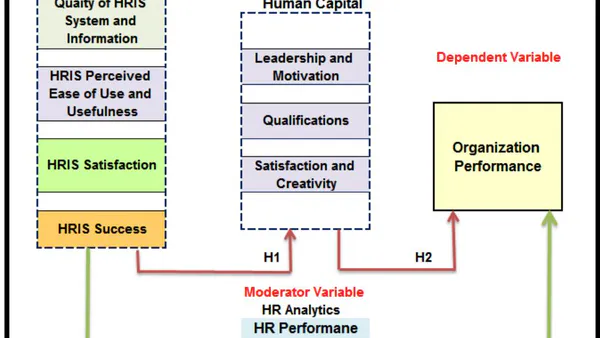
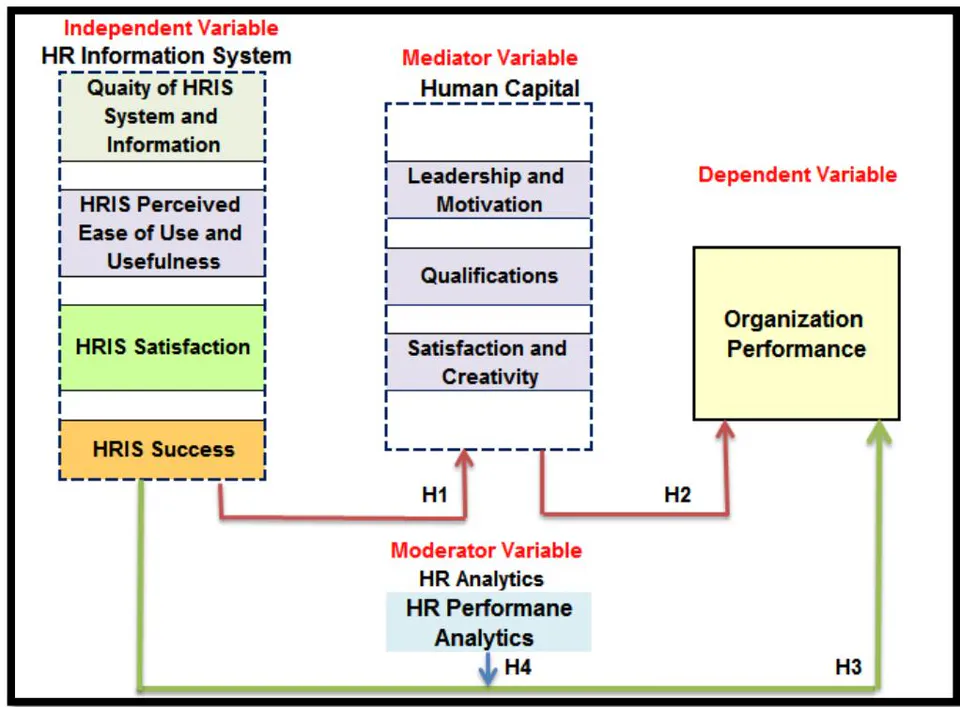
The researcher is presenting the Research Model which has been built into Four Hypotheses.
Researcher used HRIS as I.V which is consisted of four dimensions, in order to improve the D.V which is O.P, mediated by HC, in presence of H.R Performance Analytics as M.V which is my contribution in this research.
i. Research Hypotheses
H1 = There is a positive significant relationship amid HRIS and HC.
H2 = There is a positive significant relationship amid HC and O.P.
H3 = There is a positive significant relationship amid HRIS and O.P.
H4 = HR Analytics moderates the relationshipamid HRIS perception and O.P.
IV. FINDINGS AND RESULTS
a) Descriptive Statistics
The research questionnaire was administered to seven hundred forty (740) respondents, 525 questionnaires representing were returned, and 53 questionnaires representing were incomplete or ineligible or refusals and 215 were not reached. There were 472 acceptable responses, a response rate , which is highly adequate for the nature of this research.
The summary of analysis of the response rate in Table1.
| Questionnaire | Respondents | Percentage (%) |
| Number of Distributed Questionnaires | 740 | 100% |
| Unreachable Questionnaires | 215 | 29% |
| None Accepted Questionnaires | 53 | 7.2% |
| Accepted Questionnaires | 472 | 63.8% |
. So it clearly identified that in measurement model all construct have good reliability.
Measurement items have standardized loading estimates of 0.5 or higher (ranging from 0.662 to 0.884 at the alpha level of 0.05, indicating the convergent validity of the measurement model. Discriminant validity shows the degree to which a construct is actually different from other constructs (Hair et al., 2019).
All Variances Extracted (AVE) should be more than 0.50 (Hair et al., 2019). Table 2 shows that AVE of the specific constructs (HRIS System and Information = 0.572, HRIS PEOU and Usefulness = 0.690, HRIS Satisfaction = 0.591, HRIS Success = 0.590, O.P = 0.571,
Leadership and Motivation =0.620, Qualifications =0.614, Satisfaction and Creativity =0.605 and HR Performance Analytics =0.502) are more than 0.500. Generally, those measurement results are reasonable and recommend that, it is appropriate to proceed with the evaluation of the structural model.
| Variables | CR | AVE |
| HRIS System and Information | 0.870 | 0.572 |
| HRIS PEOU and Usefulness | 0.869 | 0.690 |
| HRIS Satisfaction | 0.812 | 0.591 |
| HRIS Success | 0.878 | 0.590 |
| O.P | 0.936 | 0.571 |
| Leadership and Motivation | 0.891 | 0.620 |
| Qualifications | 0.864 | 0.614 |
| Satisfaction and Creativity | 0.821 | 0.605 |
| HR Performance Analytics | 0.751 | 0.502 |
b) Model Fit
In SEM, there are different Fitness Indexes which reflect how fit is the model towards the data in hand. Nevertheless, there is no arrangement between researchers which fitness indexes to use Hair et al. (2019) recommend the use of at least one fitness index from each category of model fit. There are three model fit classes namely absolute fit, incremental fit, and parsimonious fit.
Table 3 provides the Goodness of Fit (GOF) Measures.
| Name of Category | Goodness of Fit Measures | Name of Index | Level of Acceptance |
| "Absolute-Fit" | Chi-Square | >0.05 | |
| Root-Mean-Square-Error-of Approximation | RMSEA | < 0.08 | |
| "Parsimonious-Fit" | Degrees-of-Freedom | DF | ≥0 |
| Chi-Square/ Degrees of Freedom | ≤3 | ||
| "Incremental-Fit" | Comparative Fit Index | CFI | ≥0.90 |
| Tucker Lewis Index | TLI | ≥0.90 |
According to Byrne (2016), Model estimating is commonly achieved in research using Weighted Least Squares (WLS), Generalised Least Square (GLS), Asymptomatic Distribution Free (ADF), and Maximum Likelihood Estimating (MLE). However, the estimations of the parameters and the overall fit index of the measurement model are based on the maximum likelihood (ML) method. The basic conditions assumed for the use of ML estimation (Byrne, 2016) are met or closely approximated in the study.
Table 4 provides a measurement model result – CFA.
| Goodness of Fit Measures | Name of index | Model Result | Remark |
| Chi-Square | x2 | 920.587 | Accepted |
| Degrees of Freedom | DF | 309 | Accepted |
| Chi-Square/ Degrees of Freedom | x2/DF | 2.979 | Accepted |
| Comparative Fit Index | CFI | 0.916 | Accepted |
| Tucker Lewis Index | TLI | 0.905 | Accepted |
| Root Mean' Square Error of Approximation | RMSEA | 0.062 | Accepted |
c) Measurement Model Summary
The 9 factors were subjected to CFA using the AMOS software. DF was 309 (it should be more than 0), has a value of 2.979, that is less than 2.0 (it should be less than or equal 2.0 or 3). The RMSEA was 0.062 (it should be less than 0.08). The TLI index was
0.905 which is very close to 1.0 (a value of 1.0 indicates perfect fit). The CFI was 0.916. All-over indices are near to 1.0 in CFA, indicating that the measurement models provide good support for the factor structure determined through the CFA in Table 4.
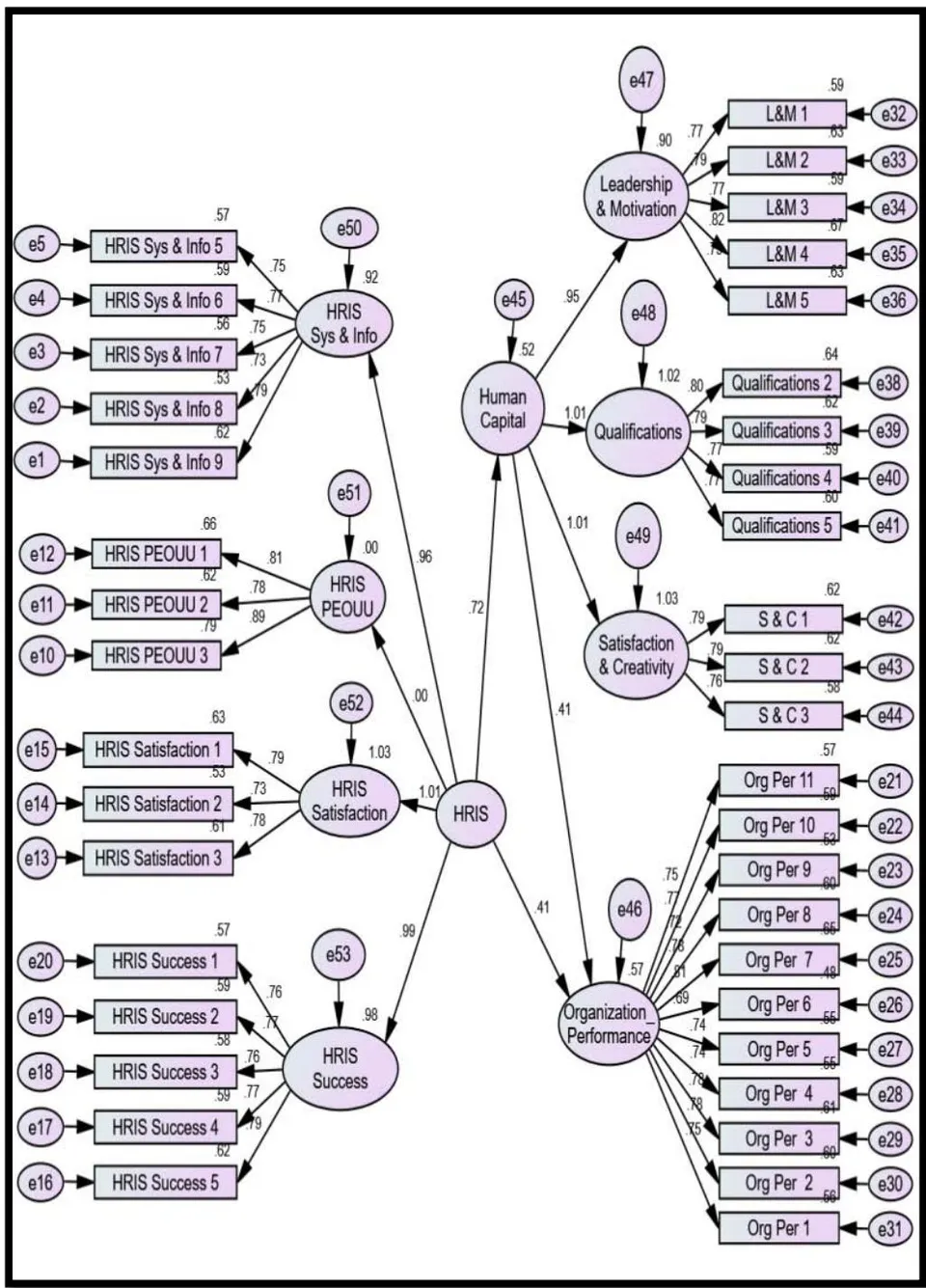
Fig. 2 shows a Structural Model (Final Result).
d) The Structural Model Validity - Final Result
Table 5 provides a Structural Model (Final Result)
| Goodness of Fit Measures | Name of Index | Model Result | Remark |
| Chi-Square | x2 | 1767.126 | Accepted |
| Degrees of Freedom | DF | 692 | Accepted |
| Chi-Square/Degrees of Freedom | x2/DF | 2.554 | Accepted |
| Comparative Fit Index | CFI | 0.919 | Accepted |
| Tucker Lewis Index | TLI | 0.913 | Accepted |
| Root-Mean-Square-Error-of-Approximation | RMSEA | 0.057 | Accepted |
e) Structural Model Summary
The results of structural' model using the AMOS software, shows that DF was 692 (it should be more than 0), has a value of 2.554, that is less than 2.0 (it should be less than or equal 2.0 or 3). The RMSEA was 0.057 (it should be less than 0.08). The TLI index was 0.913 which is very close to 1.0 (a value of 1.0 indicates perfect fit). The CFI was 0.919. All indices are close to a value of 1.0 in CFA, indicating that the measurement models provide good support for the factor structure determined through the CFA as reported in Table 5.
f) Direct Effects
Table 6 and Fig.2 present the results; the individual tests of significance of the relationship amid the variables. It reveals that, as expected HRIS have a positive influence on HC ( , CR (Critical Ratio) = 13.774, CR > 1.96, p = 0.000, p<0.05).
Therefore, (H1: There is a positive significant relationship amid HRIS and HC) is supported. These results support the findings and being matched with Savalam and Dadhabai (2018). However, these results don't match those observed in Weeks (2013) study.
Moreover, pertaining to H2: There is a positive significant relationship amid HC and O.P is supported as the result shows that , as it predicts that "There is a significant relationship amid HC and O.P".
These results of H2 are in line with those of previous studies of Jamaland Saif (2011), Mahmood et al. (2014), and Sarwar, et al. (2020). Furthermore, H2 is consistent with Seleim et al. (2007).
The result shows that H3: There is a positive significant relationship amid HRIS and O.P. is supported, as it predicts that "There is a positive significant relationship amid HRIS and O.P".
This result of H3 ties well with previous studies wherein found in Broderick R. and Boudreau (1992) research. Furthermore a similar conclusion was reached by Nisha and Mona (2012). In addition, this is consistent with what has been found in research of Michael et al. (2012). A similar pattern of results was obtained in Nikhal A. K. (2013). Those findings are directly in line with previous findings of Talebi & al; (2014). On other hand, those results of H3 don't match with those found in Sira, Wayne (2011) research.
| Hypothesized path | Estimate | Critical Ratio (C.R) | P-Value | |
| HC | ← HRIS | 0.772 | 13.774 | 0.00 |
| O.P | ← HC | 0.385 | 7.304 | 0.00 |
| O.P | ← HRIS | 0.398 | 7.035 | 0.00 |
Results shown in Table 7 show that the estimated structural model corroborated the three hypotheses, as HRIS statements constructively explained
52.8% of HC variance , Besides, HRIS statements through HC explained 57% of O.P variance .
| Variable | Squared Multiple Correlations(R2) |
| HC | 0.528 |
| O.P | 0.570 |
g) Indirect (Mediating) Effect
In order to test the mediating effects, this research employed the bootstrapping procedure and identified whether the direct relationship of HRIS and O.P through HCis statistically significant.
According to Baron and Kenny's (1986) mediation analysis, the researcher must first establish that there is statistical significance amid the dependent and independent variables. There must be a positive and significant relationship amid the relationship amid HRIS and O.P. Secondly, the researcher must show that there is a statistical significance amid the independent variable and the mediating variable. There must be a positive and significant correlation amid HCand O.P. Then, the researcher must illustrate a statistical significance amid the mediating variable and the dependent variable. There must be a positive and significant correlation amid HCand O.P. Lastly, researcher should look at the direct impact after controlling the mediating variable. If the presence of the mediator abolishes the straight relationship, it will be a full mediation; otherwise, mediation is partial or absent.
The direct effect results Table8 confirm that:
The direct effect amid HRIS and O.P is statistically significant.
The direct effect amid HRIS and HC is statistically significant.
The direct effect amid HC and O.P is statistically significant.
| Variable | HRPAS | HRIS | HC |
| HC | 0.000 | 0.727 | 0.000 |
| O.P | 0.609 | 0.382 | 0.387 |
Table 9 and Table 10 exposes a statistically significant indirect impact of HRIS on O.P through HC (P = 0.003, P<0.05). The results of the mediation effect indicate that there is partial mediation effect of the HC amid the relationship of HRIS and O.P.
| Variable | HRPAS | HRIS | HC |
| HC | 0.000 | 0.000 | 0.000 |
| O.P | 0.000 | 0.281 | 0.000 |
| Mediating Pass | Significant (Pvalue) |
| Effect HRIS on O.P through HC | 0.003 |
h) Moderating Effects
In order to test the moderating effect, this research using the double-mean-centering approach. (Crowson, 2020) and identified whether the moderating effect of Human Resources Performance Analytics on the relationship amid HRISand O.P are statistically significant.
Table 11 reveals a statistically significant moderating impact of HR Performance Analytics on the relationship amid HRIS and O.P.
The results of the moderating effect indicate that there is the low simple slope value is (0.852) and P value is (0.003) for the interaction, the med simple slope value is (0.356) and P value is (0.044) for the interaction and the high simple slope value is (-0.141) and P value is (0.386) for the interaction.
Signaling that the slope for the interaction amid HRISand O.P is positive and significant in the low simple slope value (0.852) and P value (0.003) and the slope for the interaction amid HRISand O.P is positive and significant in the med simple slope value (0.356) and P value (0.044).
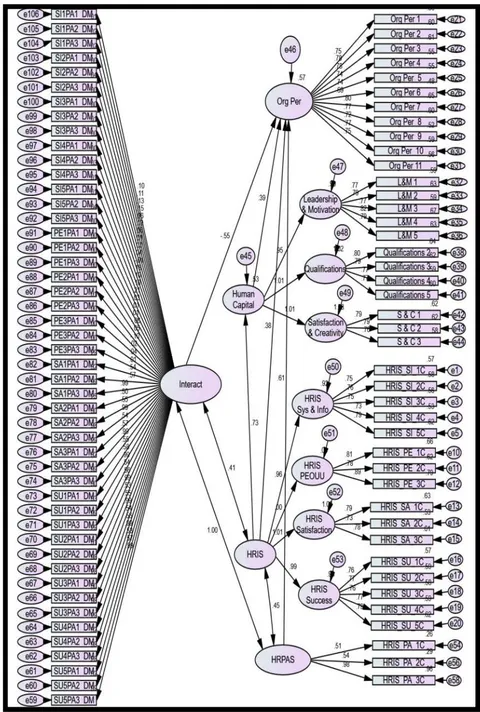
Therefore, (H4: HR Analytics moderates the relationship amid HRIS perception and O.P) is supported.
The results are very similar to Lochab, et al. (2018), McCartney, Murphy, and McCarthy, (2020), and Fernandez and Gallardo-Gallardo (2020).
A summary of the standardized path coefficients and direction of the hypothesized paths is shown in Table 11. The path coefficients significance analysed using one-tailed significance . It shows that all the hypothesized paths were supported by the result and significant at significance level.
| Hypotheses | Result |
| H1: There is a positive significant relationship amid HRIS and HC | Supported |
| H2: There is a positive significant relationship amid HC and O.P | Supported |
| H3: There is a positive significant relationship amid HRIS and O.P | Supported |
| H4: HR Analytics moderates the relationship amid HRIS perception and O.P | Supported |
As shown in Table 11; all proposed hypotheses were supported in this study, and as a result of this research; the offered hypotheses were proved.
V. RESEARCH CONTRIBUTION AND ORIGINALITY
The contribution of this study was through using H.C to mediate the relation between HRIS and O.P, in presence of HR Performance Analytics to influence the strength of Relation between them, and to apply this Frame work in specific private sector in Egypt which is Telecommunications.
Although previous research papers have shown that HRIS is an important factor influencing Organizational Performance and outcomes, this is one of the few studies that investigate the interrelationships between HRIS adoption, H.C, and HR Analytics effect on O.P. Furthermore, it is the first to test the model on the Telecommunications Sector in Egypt.
This study extends previous research to provide a more complete image of factors that influence O.P.
This study tests empirically the relationship between HRIS and O.P in the Egyptian Telecommunications Private Sector Organization and provides support for H.C and HR Analytics.
This study adds to the existing literature of HRIS antecedents and outcomes in a developing Performance of Egyptian Telecom Private Sectors Organizations.
Investigations into the relationship between HRIS and Organizational performance have become progressively common. However, empirical studies that measure the impact of HRIS perception which being liable on business strategies that fit in both content and role of H.C on organizational performance are still infrequent.
Moreover, this research brings clarity over the conceptualization of HR analytics by offering a comprehensive definition. Additionally, it facilitates business and HR Managers in making informed decisions on adopting and implementing HR Analytics as well.
VI. CONCLUSION
HRIS are considered as one of the most important elements that affect the activities of HR departments in organizations. This is supported by the main hypothesis of this study of having a relationship amid HRIS and O.P. Consequently, it was found that all dimensions that represent HRIS have a relationship with HC and O.P in same time. It was found that HRIS has relationship with O.P in presence of mediating role of H.C and moderating role of HR Performance Analytics.
The objective of the study was to find out the adoptions, advantages and challenges in the implementation of HRIS in the Egyptian Private Sector Telecom Organizations.
This study discovered the different dimensions of HRIS to find out how HRIS is used as compared with the previous studies which are conducted in different countries.
In addition to the descriptive analysis applied in order to understand better the characteristics of the sample, statistical tests of SEM were used to examine the relation amid the independent variable HRIS and dependent variable O.P through the mediator variable HCin presence of moderating variable (HR Analytics).
Furthermore, the main dimensions that directly and indirectly affect organizational performance have been derived. Accordingly, the research framework of the organizational performance in the Egyptian private telecom industry has been developed.
The research shows that there is a positive significant relationship with the HRIS and HC. Thus, the following hypothesis of the research is accepted: H1: There is a positive significant relationship among HRIS and HC.
There is also a positive significant relationship exists amid HC and O.P. Thus, the following hypothesis of the research is accepted: H2: There is a positive significant relationship amid HC and O.P.
In addition to, according to results; researcher found that the hypothesis H3: There is a positive significant relationship amid HRIS and O.P is accepted.
Finally, the findings accepted the hypothesis H4: HR Analytics moderates the relationship amid HRIS perception and O.P.
All proposed hypotheses were supported in this study, as a result of this research; the offered hypotheses were proved.
This study affords managers with practical support to the practice of planning and employing an effective HRIS in its four dimensions as a mechanism to improve organizational performance. Decision Makers and Managers should apply their HRIS adoption and applications more understandable, authentic, applicable, influential, usable and reliable to increase their HR practices effectiveness.
VII. RESEARCH LIMITATIONS
Research limitations recommend how the findings may be important for practice, theory, and subsequent research. They are basically the conclusions that the study draws from results and to explain how the findings may be important for practice, or theory.
The findings of the study help in developing and executing HRIS in similar types of organizations.
Using a questionnaire at a single point in time; the data were collected and thus, without allowing dynamic causal inferences. Future Researchers can
- increase and enlarge the size of their samples from different sectors in Egypt, for example; high educational, petroleum, and financial sectors.
- Data collection method can be changed to time series instead of cross sectional, in addition to gather data using several interviews plus the questionnaires outcomes.
- This study is applied on Egyptians Private Telecommunications Sector Firms concerning the Senior, Middle Managers, and Employees of H.R and other Departments in addition to the Employees of related organizations. The findings of the study potentially will help in developing and implementing of HRIS in similar types of organizations. Yet future work could add substance.
VIII. FUTURE WORK
- Although the sample size is considered a representative sample, yet a larger sample size could be more indicative.
- The study was conducted in the Telecom industry as one of the most important sectors in general, and in Egypt in particular. Conducting the same survey in other sectors, such as higher education, petroleum, and financial sectors could also be investigated.
- Data collection method can be changed to time series instead of cross sectional, which may reveal different results. Other data collection methods such as interviews, focus groups, and experimentation can help triangulate and validate the results obtained.
- Other research dimensions such as HR Talent Analytics and HR Leadership Analytics could also be studied to check their possible impact on the organizational performance. Antecedents and key factors affecting Strategic Work Force Planning may also bring in more substance to academia and the industry. Factors such as Workforce Analytics may be tested as a mediator.
- Finally, HR Analytics Privacy still needs further investigation; as it becoming more important than ever for HR to take a position on ethical data use, privacy and security, and employee communications related to data-related policies.