Institutional Analysis of the Determinants of Economic Non-Take-off and High Living Standards in Cameroon between 1990 and 2019

1
ENGONGA MEPOLIA Devy Dimitri
2
EKAMENA NTSAMA Sabine Nadine
3
TCHAKOUNTÉ NJODA Mathurin
4
DAWE Daniel
DAWE Daniel
1 University of Ngaoundere

Send Message

To: Author

GJHSS Volume 22 Issue E2

Article Fingerprint

ReserarchID

55B63

Institutional Analysis of the Determinants of Economic Non-Take-off and High Living Standards in Cameroon between 1990 and 2019 Banner
  • English
  • Afrikaans
  • Albanian
  • Amharic
  • Arabic
  • Armenian
  • Azerbaijani
  • Basque
  • Belarusian
  • Bengali
  • Bosnian
  • Bulgarian
  • Catalan
  • Cebuano
  • Chichewa
  • Chinese (Simplified)
  • Chinese (Traditional)
  • Corsican
  • Croatian
  • Czech
  • Danish
  • Dutch
  • Esperanto
  • Estonian
  • Filipino
  • Finnish
  • French
  • Frisian
  • Galician
  • Georgian
  • German
  • Greek
  • Gujarati
  • Haitian Creole
  • Hausa
  • Hawaiian
  • Hebrew
  • Hindi
  • Hmong
  • Hungarian
  • Icelandic
  • Igbo
  • Indonesian
  • Irish
  • Italian
  • Japanese
  • Javanese
  • Kannada
  • Kazakh
  • Khmer
  • Korean
  • Kurdish (Kurmanji)
  • Kyrgyz
  • Lao
  • Latin
  • Latvian
  • Lithuanian
  • Luxembourgish
  • Macedonian
  • Malagasy
  • Malay
  • Malayalam
  • Maltese
  • Maori
  • Marathi
  • Mongolian
  • Myanmar (Burmese)
  • Nepali
  • Norwegian
  • Pashto
  • Persian
  • Polish
  • Portuguese
  • Punjabi
  • Romanian
  • Russian
  • Samoan
  • Scots Gaelic
  • Serbian
  • Sesotho
  • Shona
  • Sindhi
  • Sinhala
  • Slovak
  • Slovenian
  • Somali
  • Spanish
  • Sundanese
  • Swahili
  • Swedish
  • Tajik
  • Tamil
  • Telugu
  • Thai
  • Turkish
  • Ukrainian
  • Urdu
  • Uzbek
  • Vietnamese
  • Welsh
  • Xhosa
  • Yiddish
  • Yoruba
  • Zulu

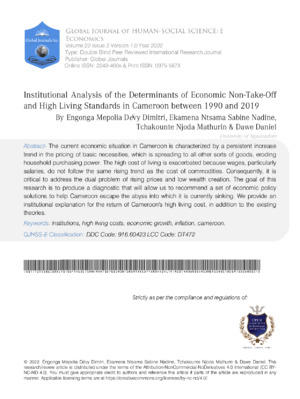
The current economic situation in Cameroon is characterized by a persistent increase trend in the pricing of basic necessities, which is spreading to all other sorts of goods, eroding household purchasing power. The high cost of living is exacerbated because wages, particularly salaries, do not follow the same rising trend as the cost of commodities. Consequently, it is critical to address the dual problem of rising prices and low wealth creation. The goal of this research is to produce a diagnostic that will allow us to recommend a set of economic policy solutions to help Cameroon escape the abyss into which it is currently sinking. We provide an institutional explanation for the return of Cameroon’s high living cost, in addition to the existing theories.

Funding

No external funding was declared for this work.

Conflict of Interest

The authors declare no conflict of interest.

Ethical Approval

No ethics committee approval was required for this article type.

Data Availability

Not applicable for this article.

ENGONGA MEPOLIA Devy Dimitri. 2026. \u201cInstitutional Analysis of the Determinants of Economic Non-Take-off and High Living Standards in Cameroon between 1990 and 2019\u201d. Global Journal of Human-Social Science - E: Economics GJHSS-E Volume 22 (GJHSS Volume 22 Issue E2): .

Download Citation

High standards in Cameroon 1990-2019, economic analysis, and policy impacts.
Issue Cover
GJHSS Volume 22 Issue E2
Pg. 29- 42
Journal Specifications

Crossref Journal DOI 10.17406/GJHSS

Print ISSN 0975-587X

e-ISSN 2249-460X

Keywords
Classification
GJHSS-E Classification: DDC Code: 339.420973 LCC Code: HD6983
Version of record

v1.2

Issue date

March 30, 2022

Language

English

Experiance in AR

The methods for personal identification and authentication are no exception.

Read in 3D

The methods for personal identification and authentication are no exception.

Article Matrices
Total Views: 1822
Total Downloads: 20
2026 Trends
Research Identity (RIN)
Related Research

Published Article

The current economic situation in Cameroon is characterized by a persistent increase trend in the pricing of basic necessities, which is spreading to all other sorts of goods, eroding household purchasing power. The high cost of living is exacerbated because wages, particularly salaries, do not follow the same rising trend as the cost of commodities. Consequently, it is critical to address the dual problem of rising prices and low wealth creation. The goal of this research is to produce a diagnostic that will allow us to recommend a set of economic policy solutions to help Cameroon escape the abyss into which it is currently sinking. We provide an institutional explanation for the return of Cameroon’s high living cost, in addition to the existing theories.

Our website is actively being updated, and changes may occur frequently. Please clear your browser cache if needed. For feedback or error reporting, please email [email protected]
×

This Page is Under Development

We are currently updating this article page for a better experience.

Request Access

Please fill out the form below to request access to this research paper. Your request will be reviewed by the editorial or author team.
X

Quote and Order Details

Contact Person

Invoice Address

Notes or Comments

This is the heading

Lorem ipsum dolor sit amet, consectetur adipiscing elit. Ut elit tellus, luctus nec ullamcorper mattis, pulvinar dapibus leo.

High-quality academic research articles on global topics and journals.

Institutional Analysis of the Determinants of Economic Non-Take-off and High Living Standards in Cameroon between 1990 and 2019

ENGONGA MEPOLIA Devy Dimitri
ENGONGA MEPOLIA Devy Dimitri University of Ngaoundere
EKAMENA NTSAMA Sabine Nadine
TCHAKOUNTÉ NJODA Mathurin
DAWE Daniel
DAWE Daniel

Research Journals