
Interpreting The Haor Eco-System Through Sustainable Design: Haor (Wetland) Eco-Interpretation Center, Moulvibazar , Sylhet, Bangladesh

Article ID

509FE

High-quality alt text describing ecological research on Bangladesh's Haor ecosystem and sustainable design.

Interpreting The Haor Eco-System Through Sustainable Design: Haor (Wetland) Eco-Interpretation Center, Moulvibazar , Sylhet, Bangladesh

Md. Arif Mahtab Kabir
Md. Arif Mahtab Kabir Ahsanullah University of Science & Technology, Dhaka, Bangladesh
Dr. Ayasha Siddiqua
Dr. Ayasha Siddiqua Ahsanullah University of Science & Technology, Dhaka, Bangladesh
DOI

Abstract

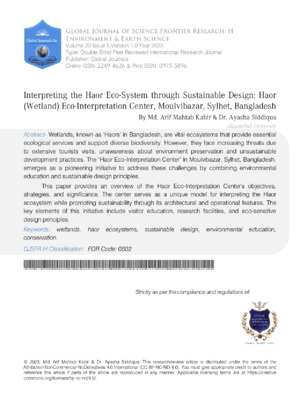
Wetlands, known as ‘Haors’ in Bangladesh, are vital ecosystems that provide essential ecological services and support diverse biodiversity. However, they face increasing threats due to extensive tourists visits, unawareness about environment preservation and unsustainable development practices. The “Haor Eco-Interpretation Center” in Moulvibazar, Sylhet, Bangladesh, emerges as a pioneering initiative to address these challenges by combining environmental education and sustainable design principles. This paper provides an overview of the Haor Eco-Interpretation Center’s objectives, strategies, and significance. The center serves as a unique model for interpreting the Haor ecosystem while promoting sustainability through its architectural and operational features. The key elements of this initiative include visitor education, research facilities, and eco-sensitive design principles.

Interpreting The Haor Eco-System Through Sustainable Design: Haor (Wetland) Eco-Interpretation Center, Moulvibazar , Sylhet, Bangladesh

Wetlands, known as ‘Haors’ in Bangladesh, are vital ecosystems that provide essential ecological services and support diverse biodiversity. However, they face increasing threats due to extensive tourists visits, unawareness about environment preservation and unsustainable development practices. The “Haor Eco-Interpretation Center” in Moulvibazar, Sylhet, Bangladesh, emerges as a pioneering initiative to address these challenges by combining environmental education and sustainable design principles. This paper provides an overview of the Haor Eco-Interpretation Center’s objectives, strategies, and significance. The center serves as a unique model for interpreting the Haor ecosystem while promoting sustainability through its architectural and operational features. The key elements of this initiative include visitor education, research facilities, and eco-sensitive design principles.

Md. Arif Mahtab Kabir
Md. Arif Mahtab Kabir Ahsanullah University of Science & Technology, Dhaka, Bangladesh
Dr. Ayasha Siddiqua
Dr. Ayasha Siddiqua Ahsanullah University of Science & Technology, Dhaka, Bangladesh

No Figures found in article.

Md. Arif Mahtab Kabir. 2026. “. Global Journal of Science Frontier Research – H: Environment & Environmental geology GJSFR-H Volume 23 (GJSFR Volume 23 Issue H5): .

Download Citation

Journal Specifications

Crossref Journal DOI 10.17406/GJSFR

Print ISSN 0975-5896

e-ISSN 2249-4626

Issue Cover
GJSFR Volume 23 Issue H5
Pg. 29- 47
Classification
GJSFR-H Classification: FOR Code: 0502
Keywords
Article Matrices
Total Views: 1026
Total Downloads: 15
2026 Trends
Research Identity (RIN)
Related Research
Our website is actively being updated, and changes may occur frequently. Please clear your browser cache if needed. For feedback or error reporting, please email [email protected]

Request Access

Please fill out the form below to request access to this research paper. Your request will be reviewed by the editorial or author team.
X

Quote and Order Details

Contact Person

Invoice Address

Notes or Comments

This is the heading

Lorem ipsum dolor sit amet, consectetur adipiscing elit. Ut elit tellus, luctus nec ullamcorper mattis, pulvinar dapibus leo.


High-quality academic research articles on global topics and journals.

Interpreting The Haor Eco-System Through Sustainable Design: Haor (Wetland) Eco-Interpretation Center, Moulvibazar , Sylhet, Bangladesh

Md. Arif Mahtab Kabir
Md. Arif Mahtab Kabir Ahsanullah University of Science & Technology, Dhaka, Bangladesh
Dr. Ayasha Siddiqua
Dr. Ayasha Siddiqua Ahsanullah University of Science & Technology, Dhaka, Bangladesh

Research Journals






























































