II. MATHEMATICAL INTRODUCTION TO QUARTICS
By "quartics" we mean algebraic equations of the fourth degree having the time as their independent variable. Thus, a quartic in the time has five coefficients and reads
This quartic, however, is too general for our purposes, for, in general, it has a graph like this one
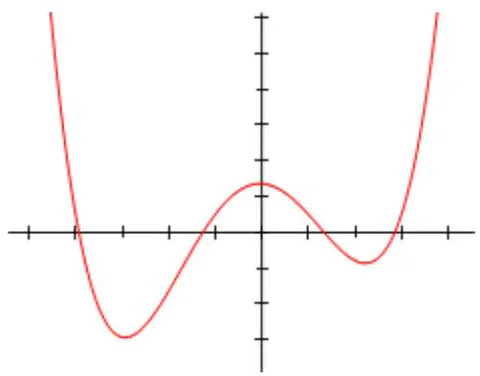
In order for the quartic to represent the lifetime of a living species, we rather need a quartic starting at instant (birth), reaching its maximum at time (peak time) and finally intercepting the time axis at death time . For instance, supposing the lifetime of a human being is 80 years, we need a quartic looking like this one:
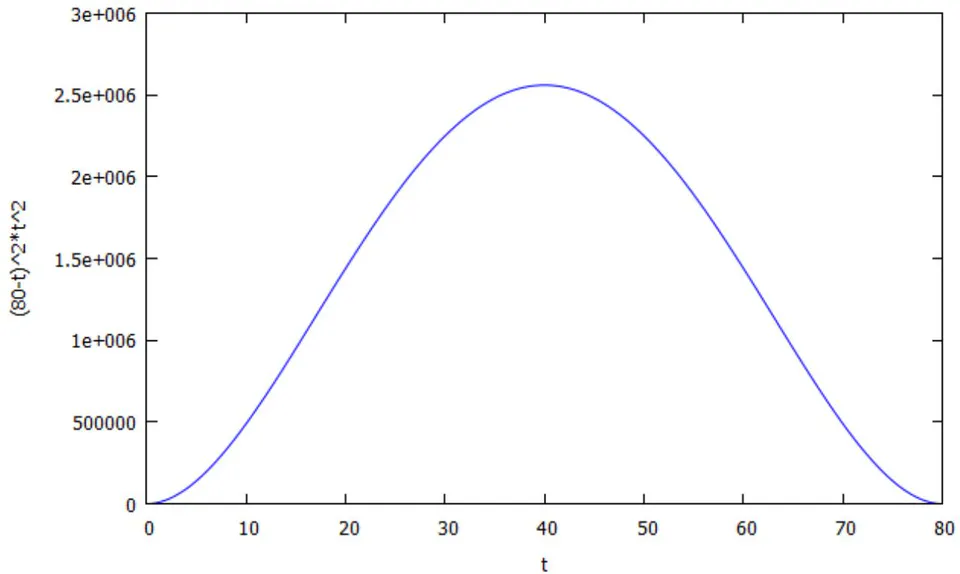
In his mathematical book "Evo-SETI" (standing for Evolution and SETI) (website https://link.springer.com/book/10.1007/978-3-030-51931-5), this author proved (see the pages 693-713) that the equation of every symmetric quartic between birth and death reads
Mathematically speaking, (2) is much easier to handle than the general quartic (1). In addition, the sign of the content inside each parenthesis of the symmetric quartic (2) is unimportant since both parentheses are raised to the square. This paper uses symmetric quartics to mathematically describe a variety of phenomena in Astrobiology and related disciplines, like Human History.
This author presented his first paper about Quartics during the SETI 2 Session of the International Astronautical Congress (IAC 2019) held in Washington D.C. in 2019 https://www.iafastro.org/events/iac/iac-2019/, paper # IAC-19-A4,2,x49155. In the Maxima Code of that paper the incorrect wording "quadric" is sometimes used instead of "quartic". Apologies.
III. OUR THREE LOGNORMAL-BASED POWER CURVES
In his 2020 mathematical book "Evo-SETI" (standing for "Evolution and SETI") (website: https://link.springer.com/book/10.1007/978-3-030-51931-5) this author represented the lifetime of every living being as either of the following three different Power Curves (namely we have time on the horizontal axis and Watt-measured Power on the vertical axis):
- b-lognormal (a lognormal curve between birth and the descending inflection called senility, followed by a straight line between senility sand death , intercept with the time axis). Its equation is (only for ):
However, we will not use this equation in this paper, which is why we won't number it.
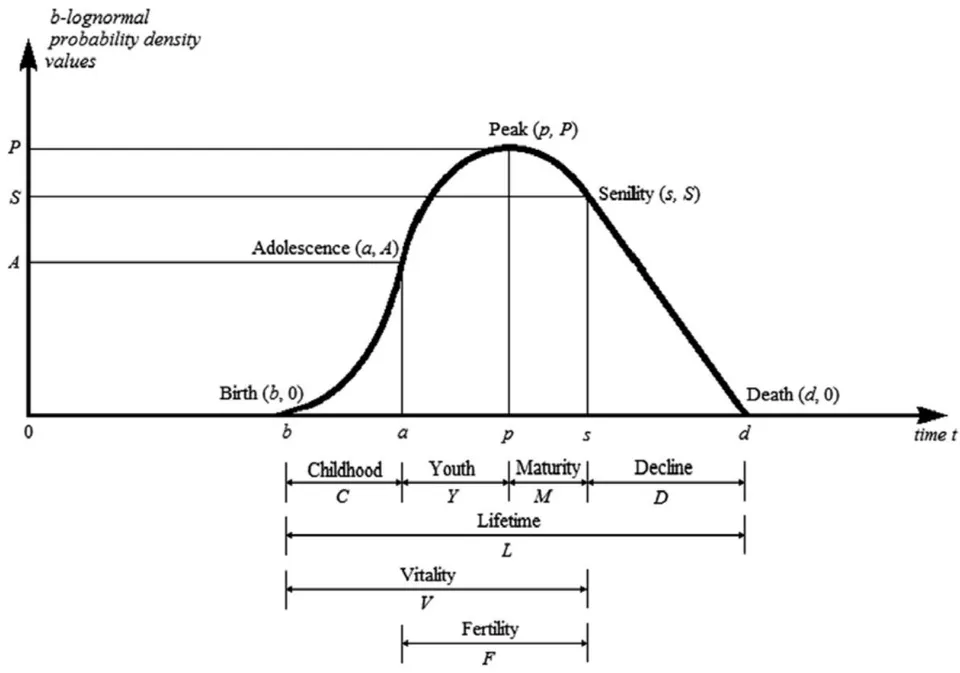
It became useful to us since we discovered (again since after 2010) its History Formulae:
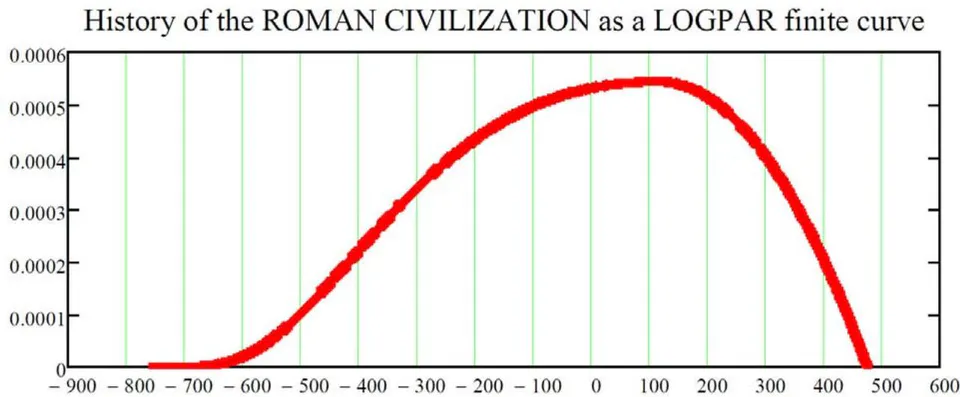
- Logpar (= LOG normal plus PAR abola). This is a lognormal curve between birth and the peak time , followed by a parabola starting at the peak time and having the same horizontal tangent at , then getting down as a parabola to intersect with the time axis at death time .
It became useful to us only after November , 2015, when we discovered the relevant History Formulae appearing hereafter (their proof is not obvious and it implies the minimum energy principle, meaning that every living being uses only the minimum energy it necessitates to survive during its own lifetime):
As a good Logpar example, just look at the following History of the Roman Civilization (753 B.C. through 476 A.D.) as a Logpar power curve (the peak is at A.D. 117 when emperor Trajan died and the Roman Empire reached its largest extent ever):
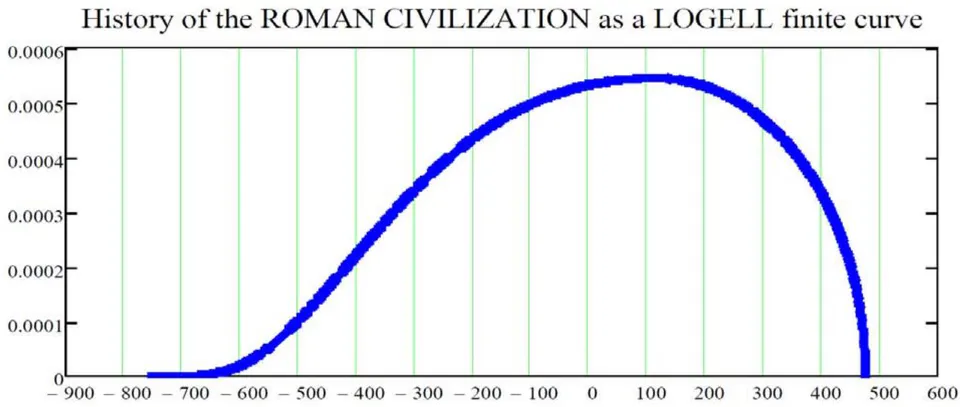
- Logell(= LOGnormal plus ELLipse). This power curve is a lognormal curve between birth and the peak time , followed by the quarter of an ellipse in between the peak time and the intercept time (death) between the ellipse and the time axis. In the example of the Roman Civilization used already to describe the Logpar, the Logell looks like this:
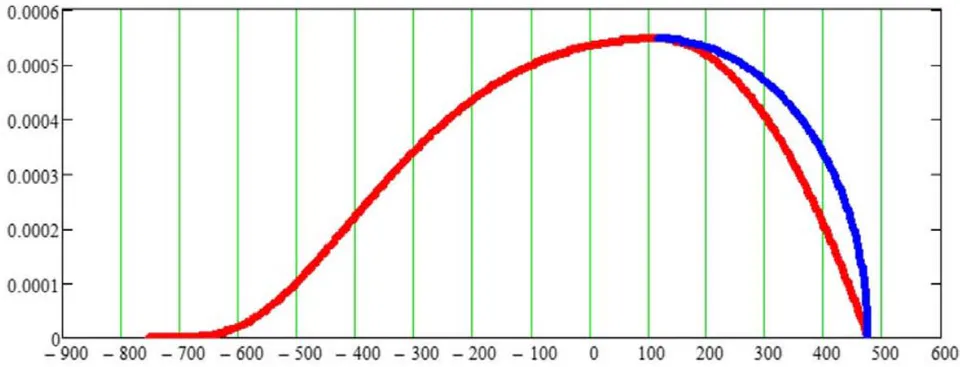
Rome's LOGPAR (red) and LOGELL (red before peak, blue after peak)
The Logell History Equations again follow from the Minimum Energy Principle and read:
IV. QUARTIC POWER CURVES DO NOT NEED ANY HISTORY EQUATION
Let us now go back to our Quartic power curves, the general equation of which is(2), that is
This equation contains two independent parameters, and , with .
In the practice, however, it is traditional to count the age (in years) of a person starting from his/her year of birth. If we so decide and call the number of years a person lives on, that is
then (3) takes the new and easier form
The advantage of (5) over (3) is that (5) contains one parameter only: the lifetime duration .
#1 Theorem: our quartic is perfectly symmetrical with respect to the peak vertical axis
Proof. Just compute the first derivative of (3) with respect to and set it equal to zero. Then you get three roots: , and (6), as expected and intuitively obvious.
#2 Theorem: The two inflection times of the quartic (3) occur at the two instants
Proof. Just compute the second derivative of (3) with respect to and set it equal to zero. Then solve the resulting quadratic equation with respect to the time , and (7) follows after a few reductions.
#3 Theorem: The "chord length between the two inflection times", which is the amount of time in between the left- and right-inflection times (7), simply is given by
In other words, the chord in between the two inflection times is about the of the whole lifetime of our living being. We shall we give it the special name of Vitality, and Vitality described in the next Section 5.
Please also look at the plot in Figure 2, which is the same as Figure 1 with the added horizontal line intercepting the symmetric quartic of an 80-years-old human being drawn through the two inflection points given by equations (7).
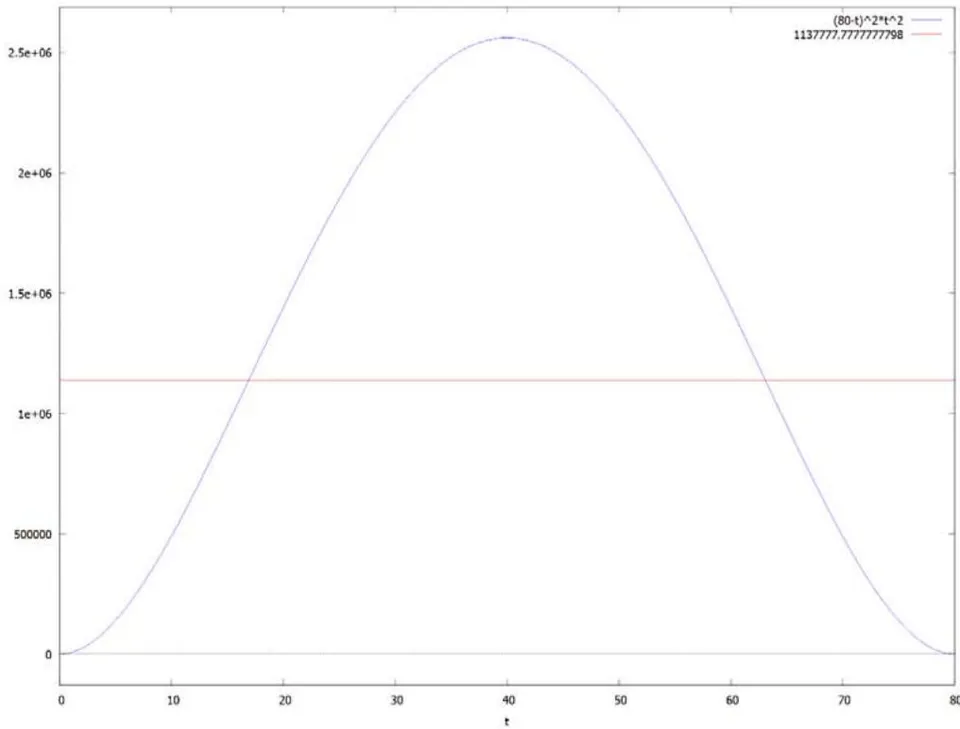
V. VITALITY IS WHAT WE CALL THE AMOUNT OF A LIFETIME IN BETWEEN
Indeed, VITALITY is the most vital part of one's lifetime. For a Human aged 80 years, this vitality starts about the age of 16.9 years:
This is the age of majority, also known as legal age, namely the threshold of legal adulthood as recognized or declared in law. It is the moment when a person ceases to be considered a minor and assumes legal control over their person, actions, and decisions, thus terminating the control and legal responsibilities of their parents or guardian over them. Please see the Wikipedia website https://en.wikipedia.org/wiki/Age_of_majority.
On the contrary, the vitality's end turns out to be around the age of
Please see the Wikipedia website https://en.wikipedia.org/wiki/Retirement_age. But, then, the definition of YOUTH now follows...
VI. YOUTH IS THE AMOUNT OF A LIFETIME IN BETWEEN BIRTH AND THE
Indeed, youth is the part of our quartic in between birth and the left-quartic-inflection, please see the Wikipedia site https://en.wikipedia.org/wiki/Youth This is also related to the voting age https://en.wikipedia.org/wiki/Voting_age And finally...
VII. SENILITY IS THE AMOUNT OF A LIFETIME IN BETWEEN THE LAST QUARTIC
Please see the related websites: https://en.wikipedia.org/wiki/Alois_Alzheimer and https://en.wikipedia.org/wiki/Gaetano_Perusini. Thanks.
VIII. TWO IMPORTANT EQUATIONS FOR CHORD AND HEIGHT OF ANY SYMMETRIC QUARTIC
On December , 2023, this author discovered the Chord equation and the Height equation that we describe in the present section. Clearly, both these equations might have been known to mathematicians very long ago already, perhaps known even in the 1540s to Lodovico Ferrari, credited to have discovered the solution to the quartic algebraic equation prior to 1545, when Gerolamo Cardano published all that in his Latin book "Ars Magna" (please enjoy the website: https://en.wikipedia.org/wiki/Quartic_equation).
In order to discover these two equations, we start by noting that, at height above the time axis, the two intercepts between our quartic and the horizontal -height straight line are given by the new equation with the time denoted by
Since one has , , and , we may take the square root of (11) and get
This is just a quadratic equation in , that we may solve for getting the two roots
Now, the chord length in between these two instants is the time segment parallel to the time axis and positioned at height above the time axis: we shall call it chord and its length is given by the difference between the right (time) root minus the left (time) root, that is
In other words, we have discovered the chord equation that will be important for practical applications:
In addition, the above chord equation may immediately be solved for yielding, after a few manipulations, the height equation
This height equation also will be of paramount importance for the applications of symmetric quartics to most diverse fields of learning, like Mathematical History, Astrophysics, Medicine, and more. Let us just check the results that (16) yields in some cases that we considered already:
- If the chord equals then we get the height above the time axis of the straight line passing through the two inflection points of the quartic, that is
One might wish to check that the same result is found upon replacing either of equations (7) into the quartic of equation (3). We leave that to the reader as an exercise.
- If the chord has zero length, then we are at the quartic PEAK, and then the peak height on the time axis is given by (16) with and reads
- If the chord equals the whole lifetime , then (16) shows that , as intuitively obvious.
IX. ENERGY OF THE POWER CURVES GIVEN BY OUR SYMMETRIC QUARTICS
Nowadays even schoolchildren know that , and freshmen know that "power is the time derivative of energy", so that, conversely, energy is the integral of a power curve with respect to the time. But in this section we face a more subtle Astrobiology question: "Suppose that all Humans have the same POTENTIAL ENERGY at birth, depending only on the Species they belong to. Then, are we going to NORMALIZE all our symmetric quartics by conventionally setting their potential energy to ONE?
The answer depends on which field of science we wish to apply our symmetric quartics to.
X. Quintics Yielding The Energy of OUR SYMMETRIC QUARTIC POWER CURVES
As mentioned, we assume that all Lifetimes considered in this paper are symmetric quartics. Thus, the energy requested for a living organism to live the whole of his/her lifetime is the integral of the symmetric quartic with respect to the time extended to that whole lifetime. That is, upon inserting (5) under the integral between 0 and
It is actually more convenient to define and compute just the energy requested by the living organism to live in between two assigned instants and with , like this:
Let us now compute the tree most important cases of the last formula:
- Youth Energy,
- Vitality Energy,
- Senility Energy.
The Youth Energy is obtained by replacing and into (20).
After a few reductions, one gets:
The Vitality Energy is obtained by replacing and into (20). Again a few reductions yield the desired Vitality Energy:
Finally, the Senility Energy is clearly equal to the Youth Energy because of the perfect symmetry of the quartic around the vertical axis and so one gets:
It is now easy to sum the three energies (21), (22) and (23) to get the total energy that a living organism needs in order to live his/her whole life in between birth and death. Some reduction yield:
XI. CONCLUSION
We prefer to stop our description of the Energy of Symmetric Power Curves at this point.
More paper(s) will follow as soon as we discover both more detailed mathematics and applications to real cases of interest in Biology, Astrobiology and Mathematical History.
- C. Maccone, Evo-SETI - Life Evolution Statistics on Earth and Exoplanets, a 878 pages mathematical book published by Springer Nature in 2020, but available only since March 2021, website https://link.springer.com/book/10.1007/978-3-030-51931-5.