We consider the Cauchy problem of time fractional reaction-diffusion equation where 0 < α 1 and denotes the Caputo time fractional derivative of order α. The initial condition is assumed to be nonnegative and bounded continuous function. For the nondecaying initial data at space infinity, we show that the positive solution blows up in finite time and give the estimate of the life span of positive solutions. It is also given blow-up time of the solutions when the initial data attain its maximum at space infinity.
## I. INTRODUCTION
We study the Cauchy problem for a time fractional reaction-diffusion equation
$$
\left\{ \begin{array}{l l} \partial_ {t} ^ {\alpha} u = \Delta u + u ^ {p}, & x \in \mathbf {R} ^ {n}, t > 0, \\u (x, 0) = u _ {0} (x) \geq 0, & x \in \mathbf {R} ^ {n} \end{array} \right. \tag {1.1}
$$
where n ≥ 1, 0 < α < 1, p > 1, u0 ∈ C(Rn) ∩ L∞(Rn), where $n \geq 1$, $0 < \alpha < 1$, $p > 1$, $u_0 \in C(\mathbf{R}^n) \cap L^\infty(\mathbf{R}^n)$, and $\partial_t^\alpha$ denotes the Caputo time fractional derivative of order $\alpha$ defined by
$$
\partial_t^\alpha u(t) = \frac{1}{\Gamma(1 - \alpha)} \int_0^t (t - s)^{-\alpha} \frac{\partial u}{\partial s}(x, s) ds, \quad 0 < \alpha < 1.
$$
Here, $\Gamma(\cdot)$ is the Gamma function. Moreover, the Caputo time fractional derivative (1.2) is related to the Riemann-Liouville derivative by
$$
\partial_ {t} ^ {\alpha} u (t) = \frac {1}{\Gamma (1 - \alpha)} \frac {d}{d t} \left(t ^ {- \alpha} * [ u - u _ {0} ]\right) (t) = \frac {1}{\Gamma (1 - \alpha)} \frac {d}{d t} \int_ {0} ^ {t} (t - s) ^ {- \alpha} \left(u (x, s) - u _ {0} (x)\right) d s. \tag {1.3}
$$
In this paper, we show that every solution of (1.1) blows up in finite time with the non-decaying initial data at space infinity, and also present the estimate on the life span of the solutions for (1.1). Then, we define the life span (or blow-up time) $T^{*}$ as
$T^{*} = \sup \{T > 0$; there exists a mild solution $u$ of (1.1) in $C([0,T],C(\mathbf{R}^n)\cap L^\infty (\mathbf{R}^n))\}$, where the definition of "mild solution" and the local "existence" of a mild solution are described in section 2. If $T^{*} = \infty$, the solution is global. On the other hand, if $T^{*} < \infty$, then the solution is not global in time in the sense that it blows up at $t = T^{*}$ such as
$$
\limsup_{t\to T^{*}}\| u(\cdot ,t)\|_{L^{\infty}(\mathbf{R}^{n})} = \infty .
$$
A brief review on the blow-up and global existence results obtained for Cauchy problem (1.1) is given below:
(A) Kirane et al. [12] obtained that the following results.
- If $1 < p \leq 1 + 2\alpha / \{\alpha n + 2(1 - \alpha)\}$, then (1.1) admits no global weak nonnegative solutions other than the trivial one.
- Let $u$ be a local solution to (1.1). Then, there exists a constant $C > 0$ such that
$$
\liminf_{|x|\to \infty}u_{0}(x)\leq CT^{\frac{\alpha}{1 - p}},
$$
where $0 < t \leq T < +\infty$
- Suppose that (1.1) has a nontrivial global nonnegative weak solution. Then, there is a constant $K > 0$ such that
$$
\liminf_{|x|\to \infty}|x|^{\frac{\alpha}{p - 1}}u_{0}(x)\leq K.
$$
(B) When $u_0 \in C_0(\mathbf{R}^n):= \{u \in C(\mathbf{R}^n) | \lim_{|x| \to \infty} u(x) = 0\}$, the following results were proved by Zhang and Sun [28] and Zhang et al. \[29\]:
- If $1 < p < 1 + 2/n$, then any nontrivial positive solution of (1.1) blows up in finite time.
- If $p \geq 1 + 2 / n$ and $\| u_0\|_{L^{qc}}$ is sufficiently small, where $q_{c} = n(p - 1) / 2$, then (1.1) has a global solution.
- If $\int_{\mathbf{R}^n}u_0(x)\chi (x)dx > 1$, where
$$
\chi (x) = \left(\int_ {\mathbf{R} ^ {n}} e ^ {- \sqrt{n ^ {2} + | x | ^ {2}}} d x\right) ^ {- 1} e ^ {- \sqrt{n ^ {2} + | x | ^ {2}}},
$$
then the solutions of (1.1) blow up in finite time.
(C) The following results were also obtained in Ahmad et.al. [1] when $u_0 \in C_0(\mathbf{R}^n)$:
- If $p \geq 1 + 2 / n$ and $\| u_0\|_{L^1} + \| u_0\|_{L^\infty} \leq \epsilon_0$ with some $\epsilon_0 > 0$, there exists $s > p$ such that (1.1) admits a global solution with $u \in L^{\infty}([0,\infty),L^{\infty}(\mathbf{R}^{n})) \cap L^{\infty}([0,\infty),L^{s}(\mathbf{R}^{n}))$. Furthermore, for all $\delta > 0$,
$$
\begin{array}{l} \max \left\{1 - \frac {p - 1}{\alpha p}, 2 - p \right\} < \delta < \min \left\{1, \frac {n (p - 1)}{2 p} \right\}, \\\left\| u (t) \right\| _ {L ^ {s}} \leq C (t + 1) ^ {- \frac {(1 - \delta) \alpha}{p - 1}}, \quad t \geq 0. \\\end{array}
$$
In addition, if $pn < 2s$, or
$$
n > 2 \text{and} p n \geq 2 s
$$
with
$$
\max \left\{\frac {1}{p ^ {2}}, \frac {p - 1}{p ^ {2}}, \frac {\alpha}{p}, \sqrt {\frac {\alpha}{p ^ {2}}} \right\} < \alpha < 1,
$$
then $u\in L^{\infty}([0,\infty),L^{\infty}(\mathbf{R}^{n}))$
$$
\left\| u (t) \right\| _ {L ^ {\infty}} \leq C (t + 1) ^ {- \sigma}, \quad t \geq 0,
$$
for some constant $\sigma > 0$.
- If $Z_0 \coloneqq \int_{\mathbf{R}^n} u_0(x) \chi(x) dx > 2^{1/(p-1)}$, then the solutions of (1.1) blow up in finite time, and the estimate of the blow-up time is
$$
T ^ {*} \leq \left[ \frac {\log \left(1 - 2 ^ {p} Z _ {0} ^ {1 - p}\right)}{2 (1 - p)} \Gamma (\alpha + 1) \right] ^ {1 / \alpha}.
$$
Several studies have been made on the life span of solutions. The results are given below:
(A) Gui and Wang [6] and Mukai et al. [17] considered
$$
\left\{ \begin{array}{l l} \partial_{t} v = \Delta v^{m} + v^{p_{1}}, & x \in \mathbf{R}^{n}, t > 0, \\v (x, 0) = v_{0} (x) \geq 0, & x \in \mathbf{R}^{n}, \end{array} \right. \tag{1.4}
$$
for $m = 1$ and $m > 1$, respectively, and proved the following life span results when an initial datum takes the form $v_{0}(x) = \lambda \phi(x)$, where $\lambda > 0$ and $\phi(x)$ is a bounded continuous in $\mathbf{R}^n$:
- If $\| \phi \|_{L^{\infty}(\mathbf{R}^{n})} = \phi (0) > 0$, then there exists $\lambda_1\geq 0$ such that $T^{*} < \infty$ for any $\lambda >\lambda_{1}$, and
$$
\lim _ {\lambda \rightarrow \infty} \lambda^ {p _ {1} - 1} T ^ {*} = \frac {1}{p _ {1} - 1} \phi (0) ^ {- (p _ {1} - 1)}.
$$
- If $\| \phi \|_{L^{\infty}(\mathbf{R}^{n})} = \lim_{|x|\to \infty}\phi (x) = \phi_{\infty} > 0$, then $T^{*} < \infty$ for any $\lambda >0$, and
$$
\lim _ {\lambda \rightarrow 0} \lambda^ {p _ {1} - 1} T ^ {*} = \frac {1}{p _ {1} - 1} \phi_ {\infty} ^ {- (p _ {1} - 1)}.
$$
(B) Giga and Umeda [4, 5], Seki [19] and Seki et al. [20] showed the solution of (1.4) blows up at minimal blow-up time (see Remark 1 below); that is,
$$
T ^ {*} = \frac {1}{p _ {1} - 1} \| v _ {0} \| _ {L ^ {\infty} (\mathbf {R} ^ {n})} ^ {1 - p _ {1}} \tag {1.5}
$$
if and only if there exists a sequence $\{x_{j}\} \subset \mathbf{R}^{n}$ such that
$$
\lim _ {j \rightarrow \infty} | x _ {j} | = \infty \text{and} \lim _ {j \rightarrow \infty} v _ {0} (x + x _ {j}) = \| v _ {0} \| _ {L ^ {\infty} (\mathbf{R} ^ {n})} \text{a . e . i n} \mathbf{R} ^ {n}.
$$
Remark 1. Applying the comparison principal to (1.4), it follows that
$$
T ^ {*} \geq \frac {1}{p _ {1} - 1} \| v _ {0} \| _ {L ^ {\infty} (\mathbf {R} ^ {n})} ^ {1 - p _ {1}}. \tag {1.6}
$$
So, when (1.5) holds, we call the time $T^{*}$ the "minimal blow-up time" and the solution $v$ to (1.4) a "blow-up solution with the minimal blow-up time".
(C) Maingé [15] considered (1.4) for $\max(0,1 - 2/n) < m < 1$, and proved if the initial data satisfies
$$
v _ {0} (x) \geq c _ {0} \max \left\{0, 1 - | x - x _ {0} | ^ {2} \phi_ {0} \right\} ^ {s},
$$
where $x_0 \in \mathbf{R}^n$, $s > 2$, and $c_0^{p_1 - m} > C_b\phi_0$ for some constant $C_b > 0$ and $\phi_0 > 0$, then the solution of (1.4) blows up in finite time, and
$$
\frac {1}{p _ {1} - 1} \| v _ {0} \| _ {L ^ {\infty} \left(\mathbf {R} ^ {n}\right)} ^ {1 - p _ {1}} \leq T ^ {*} \leq \max \left\{\frac {d _ {1}}{c _ {0} ^ {p _ {1} - 1}}, \frac {d _ {2} c _ {0} ^ {1 - m}}{c _ {0} ^ {p _ {1} - m} - C _ {b} \phi_ {0}} \right\},
$$
where $d_1 > 0$ and $d_2 > 0$.
(D) Yamauchi [18, 25, 26, 27] considered (1.4) for $m = 1$, the author [8, 9] for $\max(0,1 - 2/n) < m < 1$ or $1 < m < p_1$, and showed the following life span results:
(a) Let $n\geq 2$. For some $\xi \in S^{n - 1}$ and $\delta >0$, we set the conic neighborhood $D_{\xi}(\delta)$
$$
D _ {\xi} (\delta) = \left\{\eta \in \mathbf {R} ^ {n} \backslash \{0 \}; \left| \xi - \frac {\eta}{| \eta |} \right| < \delta \right\}, \tag {1.7}
$$
and set $S_{\xi}(\delta) = D_{\xi}(\delta)\cap S^{n - 1}$. Define
$$
N_{\infty}:=\sup_{\xi\in S^{n-1},\,\delta>0}\left\{\operatorname{ess.inf}_{\theta\in S_{\xi}(\delta)}\left(\liminf_{r\to+\infty}v_{0}(r\theta)\right)\right\} ,
$$
where $r = |x|$, $\theta = x / r$.
- If $N_{\infty} > 0$, then the solution of (1.4) blows up in finite time, and
$$
\frac {1}{p _ {1} - 1} \left\| v _ {0} \right\| _ {L ^ {\infty} (\mathbf {R} ^ {n})} ^ {1 - p _ {1}} \leq T ^ {*} \leq \frac {1}{p _ {1} - 1} N _ {\infty} ^ {1 - p _ {1}}.
$$
- If $N_{\infty} = \| v_0\|_{L^{\infty}(\mathbf{R}^{n})}$, then the solution of (1.4) blows up at minimal blow-up time; that is,
$$
T ^ {*} = \frac {1}{p _ {1} - 1} \| v _ {0} \| _ {L ^ {\infty} (\mathbf {R} ^ {n})} ^ {1 - p _ {1}} = \frac {1}{p _ {1} - 1} N _ {\infty} ^ {1 - p _ {1}}.
$$
(b) Let $n = 1$. Define
$$
n _ {\infty} := \max \left(\lim _ {x \to \infty} \inf _ {v _ {0} (x), \lim _ {x \to - \infty} \inf _ {v _ {0} (x)} v _ {0} (x)}\right).
$$
- If $n_{\infty} > 0$, then the solution of (1.4) blows up in finite time, and
$$
\frac {1}{p _ {1} - 1} \left\| v _ {0} \right\| _ {L ^ {\infty} (\mathbf {R})} ^ {1 - p _ {1}} \leq T ^ {*} \leq \frac {1}{p _ {1} - 1} n _ {\infty} ^ {1 - p _ {1}}.
$$
- If $n_{\infty} = \| v_0\|_{L^{\infty}(\mathbf{R})}$, then the solution of (1.4) blows up at minimal blow-up time; that is,
$$
T ^ {*} = \frac {1}{p _ {1} - 1} \| v _ {0} \| _ {L ^ {\infty} (\mathbf {R})} ^ {1 - p _ {1}} = \frac {1}{p _ {1} - 1} n _ {\infty} ^ {1 - p _ {1}}.
$$
(E) The author [10] also considered
$$
\left\{ \begin{array}{l l} \partial_{t} v = v^{p_{2}} \left(\Delta v + v^{q}\right), & x \in \mathbf{R}^{n}, t > 0, \\v (x, 0) = v_{0} (x) > 0, & x \in \mathbf{R}^{n}, \end{array} \right. \tag{1.8}
$$
for $p_2 \geq 1$ or $q \geq 1$, and showed the following life span results:
(a) Let $n\geq 2$
- If $N_{\infty} > 0$, then the solution of (1.8) blows up in finite time, and
$$
\frac {1}{p _ {2} + q - 1} \| v _ {0} \| _ {L ^ {\infty} \left(\mathbf {R} ^ {n}\right)} ^ {1 - p _ {2} - q} \leq T ^ {*} \leq \frac {1}{p _ {2} + q - 1} N _ {\infty} ^ {1 - p _ {2} - q}.
$$
- If $N_{\infty} = \| v_0\|_{L^{\infty}(\mathbf{R}^{n})}$, then the solution of (1.8) blows up at minimal blow-up time; that is,
$$
T ^ {*} = \frac {1}{p _ {2} + q - 1} \| v _ {0} \| _ {L ^ {\infty} (\mathbf {R} ^ {n})} ^ {1 - p _ {2} - q} = \frac {1}{p _ {2} + q - 1} N _ {\infty} ^ {1 - p _ {2} - q}.
$$
(b) Let $n = 1$
- If $n_{\infty} > 0$, then the solution of (1.8) blows up in finite time, and
$$
\frac {1}{p _ {2} + q - 1} \| v _ {0} \| _ {L ^ {\infty} (\mathbf {R})} ^ {1 - p _ {2} - q} \leq T ^ {*} \leq \frac {1}{p _ {2} + q - 1} n _ {\infty} ^ {1 - p _ {2} - q}.
$$
- If $n_{\infty} = \| v_0\|_{L^{\infty}(\mathbf{R})}$, then the solution of (1.8) blows up at minimal blow-up time; that is,
$$
T ^ {*} = \frac {1}{p _ {2} + q - 1} \| v _ {0} \| _ {L ^ {\infty} (\mathbf {R})} ^ {1 - p _ {2} - q} = \frac {1}{p _ {2} + q - 1} n _ {\infty} ^ {1 - p _ {2} - q}.
$$
Several recent studies show that the minimal blow-up time is strongly associated with blow-up at space infinity. Related researchers are Giga and Umeda [4, 5], Mochizuki and Suzuki [16], Ozawa and Yamauchi [18], Seki [19], Seki et al. [20], Shimojo [22], Yamaguchi and Yamauchi [27], Yamauchi [25, 26] and the author [8, 9].
Here, we state the main results.
Theorem 1. Consider the Cauchy problem (1.1) for $0 < \alpha < 1$ and $p > 1$.
(a) Let $n \geq 2$. Suppose that there exist $\xi \in S^{n-1}$ and $\delta > 0$ such that
$$
M _ {\infty} := \sup _ {\xi \in S ^ {n - 1}, \delta > 0} \left\{\operatorname {e s s. i n f} _ {\theta \in S _ {\xi} (\delta)} \left(\lim _ {r \rightarrow + \infty} u _ {0} (r \theta)\right)\right\} > 0, \tag {1.9}
$$
where $r = |x|$, $\theta = x / r$, $S_{\xi}(\delta) = D_{\xi}(\delta) \cap S^{n-1}$ and $D_{\xi}(\delta)$ is the conic neighborhood defined by (1.7). Then the solution of (1.1) blows up in finite time, and we have
$$
\left[ \frac {(p - 1) ^ {p - 1} \Gamma (\alpha + 1)}{p ^ {p}} \| u _ {0} \| _ {L ^ {\infty} (\mathbf {R} ^ {n})} ^ {1 - p} \right] ^ {1 / \alpha} \leq T ^ {*} \leq \left[ \frac {\Gamma (\alpha + 1)}{p - 1} M _ {\infty} ^ {1 - p} \right] ^ {1 / \alpha}. \tag {1.10}
$$
Inparticular,assumingthat
$$
M _ {\infty} = \left\| u _ {0} \right\| _ {L ^ {\infty} \left(\mathbf {R} ^ {n}\right)}, \tag {1.11}
$$
the solution of (1.1) blows up at
$$
T ^ {*} = \left[ \frac {\Gamma (\alpha + 1)}{p - 1} \| u _ {0} \| _ {L ^ {\infty} \left(\mathbf {R} ^ {n}\right)} ^ {1 - p} \right] ^ {1 / \alpha} = \left[ \frac {\Gamma (\alpha + 1)}{p - 1} M _ {\infty} ^ {1 - p} \right] ^ {1 / \alpha}. \tag {1.12}
$$
(b) Let $n = 1$. Suppose that
$$
m _ {\infty} := \max \left(\lim _ {x \rightarrow \infty} \inf _ {u _ {0} (x), \lim _ {x \rightarrow - \infty} \inf _ {u _ {0} (x)} u _ {0} (x)}\right) > 0. \tag {1.13}
$$
Then the solution of (1.1) blows up in finite time, and we have
$$
\left[ \frac {(p - 1) ^ {p - 1} \Gamma (\alpha + 1)}{p ^ {p}} \| u _ {0} \| _ {L ^ {\infty} (\mathbf {R} ^ {n})} ^ {1 - p} \right] ^ {1 / \alpha} \leq T ^ {*} \leq \left[ \frac {\Gamma (\alpha + 1)}{p - 1} m _ {\infty} ^ {1 - p} \right] ^ {1 / \alpha}. \tag {1.14}
$$
In particular, assuming that
$$
m _ {\infty} = \| u _ {0} \| _ {L ^ {\infty} (\mathbf {R})}, \tag {1.15}
$$
the solution of (1.1) blows up at
$$
T ^ {*} = \left[ \frac {\Gamma (\alpha + 1)}{p - 1} \| u _ {0} \| _ {L ^ {\infty} (\mathbf {R})} ^ {1 - p} \right] ^ {1 / \alpha} = \left[ \frac {\Gamma (\alpha + 1)}{p - 1} m _ {\infty} ^ {1 - p} \right] ^ {1 / \alpha}. \tag {1.16}
$$
Theorem 1 allows us the information of the life span for the initial data of intermediate size and the non-decaying initial data at space infinity; (1.9) and (1.13).
Remark 2. We show some examples of the initial data $u_0$ which satisfy $M_{\infty} > 0$ in the space dimensions $n \geq 2$. For simplicity, we employ polar coordinates.
(i) $u_0(r,\alpha) = 1 - \exp (-r^2)$
$$
\text{Since} \lim _ {r \rightarrow + \infty} \inf _ {u _ {0} (r, \alpha) = 1}, \text{wehave} M _ {\infty} = 1.
$$
(ii) $u_0(r,\alpha) = \{1 - \exp (-r^2)\} (2 - \cos r).$
$$
\text{Since} \lim _ {r \rightarrow + \infty} \inf _ {0} u _ {0} (r, \alpha) = 1, \text{wehave} M _ {\infty} = 1.
$$
(iii) $u_0(r,\alpha) = \{1 - \exp (-r^2)\} (1 + \cos \alpha).$
$$
S i n c e \lim _ {r \rightarrow + \infty} \inf _ {0} u _ {0} (r, \alpha) = 1 + \cos \alpha , w e h a v e M _ {\infty} = 2.
$$
(iv) $u_0(r,\alpha) = \{1 - \exp (-r^2)\} (1 + \cos \alpha)(2 - \cos r).$
$$
S i n c e \lim _ {r \rightarrow + \infty} \inf _ {0} u _ {0} (r, \alpha) = 1 + \cos \alpha , w e h a v e M _ {\infty} = 2.
$$
For the examples (i) and (iii), the initial data $u_0$ satisfies (1.11). However, for the examples (ii) and (iv), since $\| u_0 \|_{L^\infty(\mathbf{R}^n)} = 3$ and $\| u_0 \|_{L^\infty(\mathbf{R}^n)} = 6$, respectively, it follows that $M_\infty \neq \| u_0 \|_{L^\infty(\mathbf{R}^n)}$.
The outline of the rest of this paper is organized as follows. In section 2, we give the existence theorem of a local solution to (1.1). In section 3, we prove the main results by improving the method in the author [8, 9], Ozawa and Yamauchi [18] and Yamauchi [25, 26].
## II. EXISTENCE OF A LOCAL MILD SOLUTION
In this section, we show the local existence and uniqueness theorem of a mild solution to problem (1.1). Here, we state the definition of a mild solution of (1.1).
Definition. Let $T^{*} > 0$. We say $u \in C([0, T^{*}], C(\mathbf{R}^{n}))$ is a mild solution of (1.1) if $u$ satisfies the integral equation
$$
u(t) = E_{\alpha,1}(-t^{\alpha}A)u_{0} + \int_{0}^{t} s^{\alpha-1}E_{\alpha,\alpha}(-s^{\alpha}A)f(u(t-s))\,ds,
$$
where $f(u(s)) = u^{p}(s)$, and $A$ is realization of $-\Delta$ and $E_{\alpha, \beta}(z)$ is the Mittag-Leffler function (see [11]):
$$
E _ {\alpha , \beta} (z) = \sum_ {k = 0} ^ {\infty} \frac {z ^ {k}}{\Gamma (\alpha k + \beta)}, \quad \alpha , \beta > 0. \tag {2.2}
$$
Theorem 2. Suppose that $u_0 \in C(\mathbf{R}^n) \cap L^\infty(\mathbf{R}^n)$. Then there exists a unique local mild solution $u \in C([0, T^*], C(\mathbf{R}^n))$ for the problem (1.1).
Proof. See [21, Theorem 1] noting that the nonlinear term $f(u(s)) = u^{p}(s)$ is a locally Lipschizian function. (See also [24, Theorem 2.2].)
Remark 3. If $u$ solves (1.1), then $u$ satisfies (2.1) by the method of the proof for [21, Lemma 1].
Remark 4. If $u_0(x) \geq 0$, then (1.1) admits a solution which satisfies $u(x,t) \geq 0$ by the maximum principle \[2\](see also [3, Theorem 3.1] and [21, Theorem 3]).
## III. PROOF OF THEOREM 1
In this section, we shall estimate the life span $T^{*}$ both from below and from above. Here, we improve the method in Yamauchi [25, 26] and the author [8, 9, 10].
First, we shall show a lower estimate of $T^{*}$ in the space dimensions $n \geq 1$. This is obtained by comparing the solution $u$ of (1.1) with the solution $U$ of the ordinary differential equation
$$
\left\{ \begin{array}{l} \partial_{t}^{\alpha} U (t) = U^{p} (t), \quad t > 0, \\U (0) = \| u_{0} \|_{L^{\infty} \left(\mathbf{R}^{n}\right)}. \end{array} \right. \tag{3.1}
$$
The solution $U$ of (3.1) satisfies the integral equation
$$
\begin{array}{l} U (t) = E _ {\alpha , 1} (0) U (0) + \int_ {0} ^ {t} s ^ {\alpha - 1} E _ {\alpha , \alpha} (0) U ^ {p} (t - s) d s \\= U (0) + \frac {1}{\Gamma (\alpha)} \int_ {0} ^ {t} (t - s) ^ {\alpha - 1} U ^ {p} (s) d s, \tag {3.2} \\\end{array}
$$
where $E_{\alpha, \beta}(z)$ is the Mittag-Leffler function by defined in (2.2). Now, we take the same strategy as in [7, Theorem 3.2] and [13, Theorem 3.1]. Here, changing of variables
$$
U (t) = U (0) [ V (t) + 1 ] \quad \text{and} \quad k (t) = \gamma t ^ {\alpha - 1} \text{with} \gamma = \frac{[ U (0) ] ^ {p - 1}}{\Gamma (\alpha)}, \tag{3.3}
$$
the integral equation (3.2) can be expressed as
$$
V (t) = \int_ {0} ^ {t} k (t - s) [ V (s) + 1 ] ^ {p} d s. \tag {3.4}
$$
Then, the solution $U$ blows up in finite time $T^{*}(U)$ such that
$$
\left[ \frac{(p - 1) ^ {p - 1} \Gamma (\alpha + 1)}{p ^ {p}} \| u _ {0} \| _ {L ^ {\infty} (\mathbf{R} ^ {n})} ^ {1 - p} \right] ^ {1 / \alpha} \leq T ^ {*} (U) \leq \left[ \frac{\Gamma (\alpha + 1)}{p - 1} \| u _ {0} \| _ {L ^ {\infty} (\mathbf{R} ^ {n})} ^ {1 - p} \right] ^ {1 / \alpha}. \tag{3.5}
$$
By a comparison argument, we obtain
$$
T ^ {*} \geq T ^ {*} (U). \tag {3.6}
$$
Next, we shall prove a upper estimate of $T^{*}$ by two cases of $n \geq 2$ and $n = 1$.
### a) Case (a): $n \geq 2$
For $\xi \in S^{n - 1}$ and $\delta >0$ as in the theorem, we determine the sequences $\{a_j\} \subset \mathbf{R}^n$ and $\{R_j\} \subset (0,\infty)$. Let $\{a_j\} \subset \mathbf{R}^n$ be a sequence satisfying that $|a_{j}|\to \infty$ as $j\to \infty$, and that $a_{j} / |a_{j}| = \xi$ for any $j\in \mathbf{N}$. Put $R_{j} = (\delta \sqrt{4 - \delta^{2}} /2)|a_{j}|$ for $\delta \in (0,\sqrt{2})$. For $R_{j} > 0$, let $\rho_{R_j}$ be the first eigenfunction of $-\Delta$ on
$$
B _ {R _ {j}} (0) = \{x \in \mathbf{R} ^ {n}; | x | < R _ {j} \}
$$
with zero Dirichlet boundary condition under the normalization
$$
\int_ {B _ {R _ {j}} (0)} \rho_ {R _ {j}} (x) d x = 1.
$$
Moreover, let $\mu_{R_j}$ be the corresponding first eigenvalue. For the solutions of (1.1), we define
$$
w _ {j} (t) := \int_ {B _ {R _ {j}} (0)} u \left(x + a _ {j}, t\right) \rho_ {R _ {j}} (x) d x. \tag {3.7}
$$
Then we have the following propositions.
Proposition 1. We have
$$
\lim _ {j \rightarrow + \infty} \inf _ {0} w _ {j} (0) \geq \operatorname * {e s s . i n f} _ {\theta \in S _ {\xi} (\delta)} \left(\lim _ {r \rightarrow \infty} \inf _ {u _ {0}} u _ {0} (r \theta)\right), \tag {3.8}
$$
and
$$
\lim _ {j \rightarrow + \infty} \frac {\log \left(1 - \mu_ {R _ {j}} w _ {j} ^ {1 - p} (0)\right)}{- \mu_ {R _ {j}} w _ {j} ^ {1 - p} (0)} = 1. \tag {3.9}
$$
Proof. See [25, Proposition 1].
Proposition 2. Let $0 < \alpha < 1$ and $p > 1$. Suppose that
$$
w _ {j} (0) > \mu_ {R _ {j}} ^ {\frac {1}{p - 1}}. \tag {3.10}
$$
Then $u$ blows up in finite time, and we have
$$
T ^ {*} \leq \left[ \frac {\log \left(1 - \mu_ {R _ {j}} w _ {j} ^ {1 - p} (0)\right)}{(1 - p) \mu_ {R _ {j}}} \Gamma (\alpha + 1) \right] ^ {1 / \alpha}. \tag {3.11}
$$
Proof. We use the method in [1, Theorem 3.7] and [3, Thorem 2.2].
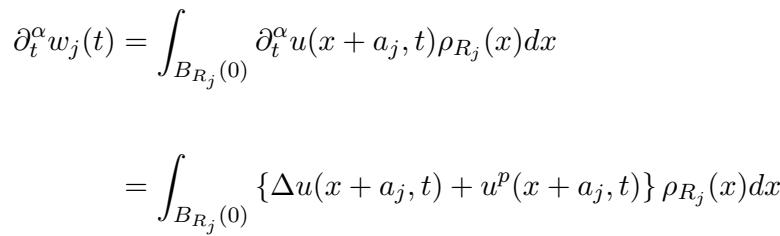
By (1.1) and (3.7), we have
$$
\begin{array}{l} \partial_ {t} ^ {\alpha} w _ {j} (t) = \int_ {B _ {R _ {j}} (0)} \partial_ {t} ^ {\alpha} u (x + a _ {j}, t) \rho_ {R _ {j}} (x) d x \\= \int_ {B _ {R _ {j}} (0)} \left\{\Delta u (x + a _ {j}, t) + u ^ {p} (x + a _ {j}, t) \right\} \rho_ {R _ {j}} (x) d x \\\end{array}
$$
$$
\geq - \mu_ {R _ {j}} \int_ {B _ {R _ {j}} (0)} u (x + a _ {j}, t) \rho_ {R _ {j}} (x) d x + \int_ {B _ {R _ {j}} (0)} u ^ {p} (x + a _ {j}, t) \rho_ {R _ {j}} (x) d x. \tag {3.12}
$$
Since $p > 1$ and
$$
\int_ {B _ {R _ {j}} (0)} \rho_ {R _ {j}} (x) d x = 1,
$$
by Jensen's inequality, we have
$$
\int_ {B _ {R _ {j}} (0)} u ^ {p} (x + a _ {j}, t) \rho_ {R _ {j}} (x) d x \geq \left(\int_ {B _ {R _ {j}} (0)} u (x + a _ {j}, t) \rho_ {R _ {j}} (x) d x\right) ^ {p}. \tag {3.13}
$$
Thus, by (3.12)-(3.13), we obtain
$$
\partial_ {t} ^ {\alpha} w _ {j} (t) \geq - \mu_ {R _ {j}} w _ {j} (t) + w _ {j} ^ {p} (t). \tag {3.14}
$$
By (1.3), the inequality (3.14) implies
$$
\frac {d}{d t} \left(k * \left[ w _ {j} - w _ {j} (0) \right]\right) (t) \geq - \mu_ {R _ {j}} w _ {j} (t) + w _ {j} ^ {p} (t) \quad \text {w i t h} k (t) = \frac {t ^ {- \alpha}}{\Gamma (1 - \alpha)}. \tag {3.15}
$$
We put $F(\zeta) = -\mu_{R_j}\zeta + \zeta^p$. Then the function $F$ is convex in $\zeta \geq 0$, and we get
$$
\frac {d}{d t} \left(k * \left[ w _ {j} - w _ {j} (0) \right]\right) (t) \geq F \left(w _ {j} (t)\right). \tag {3.16}
$$
in (3.15). $F$ is positive and increasing for all $\zeta >\mu_{R_j}^{\frac{1}{p - 1}}$. If $w_{j}(0)$ satisfies (3.10), then (3.16) implies that $w_{j}(t) > \mu_{R_{j}}^{\frac{1}{p - 1}}$ for all $t\in (0,T^{*})$ (see [1, P.24-25]). Knowing that $w_{j}(t)\geq w_{j}(0) > \mu_{R_{j}}^{\frac{1}{p - 1}}$ for all $t\in (0,T^{*})$, it follows from (3.16) that
$$
\partial_ {t} ^ {\alpha} w _ {j} (t) = \frac {d}{d t} \left(k * \left[ w _ {j} - w _ {j} (0) \right]\right) (t) \geq F \left(w _ {j} (t)\right) > 0, \quad \text {f o r a l l} t \in \left(0, T ^ {*}\right). \tag {3.17}
$$
Therefore the function $w_{j}(t)$ satisfying (3.17) is an upper solution of the problem
$$
\partial_ {t} ^ {\alpha} \zeta = F (\zeta) = - \mu_ {R _ {j}} \zeta + \zeta^ {p}, \quad \zeta (0) = w _ {j} (0), \tag {3.18}
$$
we have $w_{j}(t) \geq \zeta(t)$ by comparison principle (see [14, Theorem 2.3]).
On the other hand, since $F(0) \geq 0$, $F(\zeta) > 0$ and $F'(\zeta) > 0$ for all $\zeta \geq w_j(0) > \mu_{R_j}^{\frac{1}{p - 1}}$. Then, it follows from \[1, Lemma 3.8\](see also [23, Lemma 3.10]) that $v(t) = g\left(\frac{t^\alpha}{\Gamma(\alpha + 1)}\right)$ is a lower solution for (3.18), where $v(t)$ satisfies
$$
\partial_ {t} ^ {\alpha} v \leq F (v) = - \mu_ {R _ {j}} v + v ^ {p}, \quad v (0) \leq w _ {j} (0),
$$
and $g(t)$ solves the ordinary differential equation
$$
\frac {d g}{d t} = F (g) = - \mu_ {R _ {j}} g + g ^ {p}, \quad g (0) = w _ {j} (0). \tag {3.19}
$$
By comparison principle (see [14, Theorem 2.3]), we obtain $\zeta(t) \geq v(t)$. Solving the initial value problem (3.19), we have the solution
$$
g (t) = \left[ w _ {j} ^ {1 - p} (0) - \frac {1 - \exp \{(1 - p) \mu_ {R _ {j}} t \}}{\mu_ {R _ {j}}} \right] ^ {\frac {1}{1 - p}} \exp \left(- \mu_ {R _ {j}} t\right),
$$
and obtain that $g(t) \to \infty$ as $t \to \frac{\log\left(1 - \mu_{R_j}w^{1 - p}(0)\right)}{(1 - p)\mu_{R_j}}$. By comparison principle (see [14, Theorem 2.3]), we conclude that
$$
w _ {j} (t) \geq \zeta (t) \geq v (t) = g \left(\frac {t ^ {\alpha}}{\Gamma (\alpha + 1)}\right) = \left[ w _ {j} ^ {1 - p} (0) - \frac {1 - \exp \left\{\frac {(1 - p) \mu_ {R _ {j}} t ^ {\alpha}}{\Gamma (\alpha + 1)} \right\}}{\mu_ {R _ {j}}} \right] ^ {\frac {1}{1 - p}} \exp \left(- \frac {\mu_ {R _ {j}} t ^ {\alpha}}{\Gamma (\alpha + 1)}\right). \tag {3.20}
$$
By (3.20), if $w_{j}(0)$ satisfies (3.10), then we obtain that $v(t) \to \infty$ as
$$
t \rightarrow \left[ \frac {\log \left(1 - \mu_ {R _ {j}} w _ {j} ^ {1 - p} (0)\right)}{(1 - p) \mu_ {R _ {j}}} \Gamma (\alpha + 1) \right] ^ {1 / \alpha}, \tag {3.21}
$$
and that $w_{j}(t)$ blows up in finite time. Therefore, the solution $u$ blows up in finite time, and it follows that the estimate (3.11) holds, the proof of Proposition 2 is complete.
Now let us prove the Case (a).
By Propositions 1 and 2, we obtain that
$$
\begin{array}{l} T ^ {*} \leq \lim _ {j \to \infty} \sup _ {\alpha > 0} \left[ \frac {\log \left(1 - \mu_ {R _ {j}} w _ {j} ^ {1 - p} (0)\right)}{(1 - p) \mu_ {R _ {j}}} \Gamma (\alpha + 1) \right] ^ {1 / \alpha} \\= \lim _ {j \to \infty} \sup _ {\alpha} \left[ \frac {\log \left(1 - \mu_ {R _ {j}} w _ {j} ^ {1 - p} (0)\right)}{- \mu_ {R _ {j}} w _ {j} ^ {1 - p} (0)} \cdot \frac {w _ {j} ^ {1 - p} (0)}{p - 1} \Gamma (\alpha + 1) \right] ^ {1 / \alpha} \\= \left(\frac {\Gamma (\alpha + 1)}{p - 1}\right) ^ {1 / \alpha} \lim _ {j \to \infty} \left[ \frac {\log \left(1 - \mu_ {R _ {j}} w _ {j} ^ {1 - p} (0)\right)}{- \mu_ {R _ {j}} w _ {j} ^ {1 - p} (0)} \right] ^ {1 / \alpha} \cdot \left(\lim _ {j \to \infty} \inf _ {w _ {j} (0)} \frac {1 - p}{\alpha}\right) \\\leq \left(\frac {\Gamma (\alpha + 1)}{p - 1}\right) ^ {1 / \alpha} \left\{\underset {\theta \in S _ {\xi} (\delta)} {\operatorname {e s s . i n f}} \left(\lim _ {r \rightarrow \infty} \inf _ {u _ {0} (r \theta)}\right)\right\} ^ {\frac {1 - p}{\alpha}}. \tag {3.22} \\\end{array}
$$
From arbitrariness of $\xi \in S^{n - 1}$ and $\delta >0$, by (3.22), we obtain
$$
\begin{array}{l} T ^ {*} \leq \left(\frac {\Gamma (\alpha + 1)}{p - 1}\right) ^ {1 / \alpha} \left[ \sup _ {\xi \in S ^ {n - 1}, \delta > 0} \left\{\operatorname * {e s s . i n f} _ {\theta \in S _ {\xi} (\delta)} \left(\lim _ {r \to \infty} \inf _ {u _ {0}} (r \theta)\right) \right\} \right] ^ {\frac {1 - p}{\alpha}} \\= \left[ \frac {\Gamma (\alpha + 1)}{p - 1} M _ {\infty} ^ {1 - p} \right] ^ {1 / \alpha}. \tag {3.23} \\\end{array}
$$
By (3.6) and (3.23), we have
$$
\left[ \frac {(p - 1) ^ {p - 1} \Gamma (\alpha + 1)}{p ^ {p}} \| u _ {0} \| _ {L ^ {\infty} (\mathbf {R} ^ {n})} ^ {1 - p} \right] ^ {1 / \alpha} \leq T ^ {*} \leq \left[ \frac {\Gamma (\alpha + 1)}{p - 1} M _ {\infty} ^ {1 - p} \right] ^ {1 / \alpha}. \tag {3.24}
$$
Therefore, we obtain (1.10). Moreover, by (1.10) and (1.11), we have (1.12). This completes the proof.
### b) Case (b): $n = 1$
Let $a_{j} = j$ or $-j$. Put $R_{j} = j / 2$. For $R_{j} > 0$, let $\rho_{R_j}$ be the first eigenfunction of $-\frac{\partial^2}{\partial x^2}$ on $(-R_{j},R_{j})$ with zero Dirichlet boundary condition under the normalization
$$
\int_ {- R _ {j}} ^ {R _ {j}} \rho_ {R _ {j}} (x) d x = 1.
$$
Moreover, let $\mu_{R_j}$ be the corresponding first eigenvalue. For the solutions of (1.1), we define
$$
w _ {j} (t) := \int_ {- R _ {j}} ^ {R _ {j}} u (x + a _ {j}, t) \rho_ {R _ {j}} (x) d x. \tag {3.25}
$$
Then we have the following propositions.
Proposition 3. We have
$$
\lim _ {j \rightarrow + \infty} \inf w _ {j} (0) \geq \max \left(\lim _ {x \rightarrow + \infty} \inf u _ {0} (x), \lim _ {x \rightarrow - \infty} \inf u _ {0} (x)\right) \tag {3.26}
$$
and
$$
\lim _ {j \rightarrow + \infty} \frac {\log (1 - \mu_ {R _ {j}} w _ {j} ^ {1 - p} (0))}{- \mu_ {R _ {j}} w _ {j} ^ {1 - p} (0)} = 1. \tag {3.27}
$$
Proof. See [25, Proposition 2].
Proposition 4. Let $0 < \alpha < 1$ and $p > 1$. Suppose that
$$
w _ {j} (0) > \mu_ {R _ {j}} ^ {\frac {1}{p - 1}}. \tag {3.28}
$$
Then $u$ blows up in finite time, and we have
$$
T ^ {*} \leq \left[ \frac {\log \left(1 - \mu_ {R _ {j}} w _ {j} ^ {1 - p} (0)\right)}{(1 - p) \mu_ {R _ {j}}} \Gamma (\alpha + 1) \right] ^ {1 / \alpha}. \tag {3.29}
$$
Proof. It is shown in the same way as in Proposition 2.
Finally, let us prove the Case (b). The rest of the proof is the same as in that of the Case (a).
By Propositions 3 and 4, we see that
$$
\begin{array}{l} T ^ {*} \leq \operatorname * {l i m s u p} _ {j \to \infty} \left[ \frac {\log \left(1 - \mu_ {R _ {j}} w _ {j} ^ {1 - p} (0)\right)}{(1 - p) \mu_ {R _ {j}}} \Gamma (\alpha + 1) \right] ^ {1 / \alpha} \\= \lim _ {j \rightarrow \infty} \sup _ {\alpha} \left[ \frac {\log \left(1 - \mu_ {R _ {j}} w _ {j} ^ {1 - p} (0)\right)}{- \mu_ {R _ {j}} w _ {j} ^ {1 - p} (0)} \cdot \frac {w _ {j} ^ {1 - p} (0)}{p - 1} \Gamma (\alpha + 1) \right] ^ {1 / \alpha} \\= \left(\frac {\Gamma (\alpha + 1)}{p - 1}\right) ^ {1 / \alpha} \lim _ {j \to \infty} \left[ \frac {\log \left(1 - \mu_ {R _ {j}} w _ {j} ^ {1 - p} (0)\right)}{- \mu_ {R _ {j}} w _ {j} ^ {1 - p} (0)} \right] ^ {1 / \alpha} \cdot \left(\lim _ {j \to \infty} \inf _ {w _ {j} (0)} \frac {1 - p}{\alpha}\right) \\\leq \left(\frac {\Gamma (\alpha + 1)}{p - 1}\right) ^ {1 / \alpha} \left\{\max \left(\lim _ {x \rightarrow + \infty} u _ {0} (x), \lim _ {x \rightarrow - \infty} u _ {0} (x)\right)\right\} ^ {\frac {1 - p}{\alpha}}. \tag {3.30} \\\end{array}
$$
From (3.6) and (3.30), we have
$$
\left[ \frac {(p - 1) ^ {p - 1} \Gamma (\alpha + 1)}{p ^ {p}} \| u _ {0} \| _ {L ^ {\infty} (\mathbf {R} ^ {n})} ^ {1 - p} \right] ^ {1 / \alpha} \leq T ^ {*} \leq \left[ \frac {\Gamma (\alpha + 1)}{p - 1} m _ {\infty} ^ {1 - p} \right] ^ {1 / \alpha}. \tag {3.31}
$$
Therefore, we obtain (1.14). Moreover, by (1.14) and (1.15), we have (1.16). This completes the proof.
Generating HTML Viewer...
References
28 Cites in Article
B Ahmad,A Alsaedi,M Berbiche,M Kirane (2020). Existence of global solutions and blow-up of solutions for coupled systems of fractional diffusion equations.
A Alsaedi,B Ahmad,M Kirane (2015). Maximum principle for certain generalized time and space fractional diffusion equations.
Jianxiong Cao,Guojie Song,Jie Wang,Qihong Shi,Sujing Sun (2019). Blow-up and global solutions for a class of time fractional nonlinear reaction–diffusion equation with weakly spatial source.
Y Giga,N Umeda,; Giga,N Umeda (2005). Blow-up directions at space infinity for solutions of semilinear heat equations.
C Gui,X Wang (1995). Life Span of Solutions of the Cauchy Problem for a Semilinear Heat Equation.
D Hnaien,F Kellil,R Lassoued (2014). Blowing-up solutions and global solutions to a fractional differential equation.
Takefumi Igarashi (2013). Life span of solutions for a quasilinear parabolic equation with initial data having positive limit inferior at infinity.
Takefumi Igarashi (2015). LIFE SPAN OF SOLUTIONS FOR A FAST DIFFUSION EQUATION WITH SOURCE.
Takefumi Igarashi (2019). LIFE SPAN OF SOLUTIONS FOR A DEGENERATE PARABOLIC EQUATION WITH NON-DECAYING INITIAL DATA.
M Kirane,Y Laskri,N-E Tatar (2005). Critical exponents of Fujita type for certain evolution equations and systems with spatio-temporal fractional derivatives.
C Kirk,W Olmstead,C Roberts (2013). A system of nonlinear Volterra equations with blow-up solutions.
V Lakshmikantham,A Vatsala (2007). Differential inequalities with initial time difference and applications.
P Maing´e (2008). Blow-up and propagation of disturbances for fast diffusion equations.
Kiyoshi Mochizuki,Ryuichi Suzuki (1992). Blow-up sets and asymptotic behavior of interfaces for quasilinear degenerate parabolic equations in RN.
Kentaro Mukai,Kiyoshi Mochizuki,Qing Huang (2000). Large time behavior and life span for a quasilinear parabolic equation with slowly decaying initial values.
T Ozawa,Y Yamauchi (2011). Life span of positive solutions for a semilinear heat equation with general non-decaying initial data.
Yukihiro Seki (2008). On directional blow-up for quasilinear parabolic equations with fast diffusion.
Linfei Shi,Wenguang Cheng,Jinjin Mao,Tianzhou Xu (2021). Blow-Up and Global Existence of Solutions for the Time Fractional Reaction–Diffusion Equation.
M Shimoj (2008). The global profile of blow-up at space infinity in semilinear heat equations.
S Subedi (2019). Analysis of Blow-Up and Quenching for Caputo Time Fractional Reaction-Diffusion Equation.
R Lu,B Orebek (2020). Global existence and blow-up of solutions of the timefractional space-involution reaction-diffusion equation.
Y Yamauchi (2011). Life span of solutions for a semilinear heat equation with initial data having positive limit inferior at infinity.
Yusuke Yamauchi (2012). Life Span of Positive Solutions for the Cauchy Problem for the Parabolic Equations.
Masaki Yamaguchi,Yusuke Yamauchi (2010). Life span of positive solutions for a semilinear heat equation with non-decaying initial data.
Q Zhang,H Sun (2015). The blow-up and global existence of solutions of Cauchy problems for a time fractional diffusion equation.
Q Zhang,H Sun,Y Li (2019). Global existence and blow-up of solutions of the Cauchy problem for a time fractional diffusion system.
No ethics committee approval was required for this article type.
Data Availability
Not applicable for this article.
How to Cite This Article
Takefumi Igarashi. 2026. \u201cLife Span of Solutions for a Time Fractional Reaction-Diffusion Equation with Non-Decaying Initial Data\u201d. Global Journal of Science Frontier Research - F: Mathematics & Decision GJSFR-F Volume 22 (GJSFR Volume 22 Issue F2).
Explore published articles in an immersive Augmented Reality environment. Our platform converts research papers into interactive 3D books, allowing readers to view and interact with content using AR and VR compatible devices.
Your published article is automatically converted into a realistic 3D book. Flip through pages and read research papers in a more engaging and interactive format.
Our website is actively being updated, and changes may occur frequently. Please clear your browser cache if needed. For feedback or error reporting, please email [email protected]
Thank you for connecting with us. We will respond to you shortly.