Light Deflection in Massive Dyonic Black Holes

§ Institute of Gravitation and Cosmology, Peoples Friendship University of Russia Institute of Gravitation and Cosmology, Peoples Frie...

Send Message

To: Author

Light Deflection in Massive Dyonic Black Holes

Article Fingerprint

ReserarchID

6SEY8

Light Deflection in Massive Dyonic Black Holes Banner

AI TAKEAWAY

Connecting with the Eternal Ground
  • English
  • Afrikaans
  • Albanian
  • Amharic
  • Arabic
  • Armenian
  • Azerbaijani
  • Basque
  • Belarusian
  • Bengali
  • Bosnian
  • Bulgarian
  • Catalan
  • Cebuano
  • Chichewa
  • Chinese (Simplified)
  • Chinese (Traditional)
  • Corsican
  • Croatian
  • Czech
  • Danish
  • Dutch
  • Esperanto
  • Estonian
  • Filipino
  • Finnish
  • French
  • Frisian
  • Galician
  • Georgian
  • German
  • Greek
  • Gujarati
  • Haitian Creole
  • Hausa
  • Hawaiian
  • Hebrew
  • Hindi
  • Hmong
  • Hungarian
  • Icelandic
  • Igbo
  • Indonesian
  • Irish
  • Italian
  • Japanese
  • Javanese
  • Kannada
  • Kazakh
  • Khmer
  • Korean
  • Kurdish (Kurmanji)
  • Kyrgyz
  • Lao
  • Latin
  • Latvian
  • Lithuanian
  • Luxembourgish
  • Macedonian
  • Malagasy
  • Malay
  • Malayalam
  • Maltese
  • Maori
  • Marathi
  • Mongolian
  • Myanmar (Burmese)
  • Nepali
  • Norwegian
  • Pashto
  • Persian
  • Polish
  • Portuguese
  • Punjabi
  • Romanian
  • Russian
  • Samoan
  • Scots Gaelic
  • Serbian
  • Sesotho
  • Shona
  • Sindhi
  • Sinhala
  • Slovak
  • Slovenian
  • Somali
  • Spanish
  • Sundanese
  • Swahili
  • Swedish
  • Tajik
  • Tamil
  • Telugu
  • Thai
  • Turkish
  • Ukrainian
  • Urdu
  • Uzbek
  • Vietnamese
  • Welsh
  • Xhosa
  • Yiddish
  • Yoruba
  • Zulu
Font Type
Font Size
Font Size
Bedground

INTRODUCTION

Discovering dark energy as source of accelerating expansion of our universe [3], many efforts have gone into understanding its nature. One of the prime candidates is the cosmological constant Λ [4] which its effects on local phenomena such as null geodesics, time delay of light [5], and the perihelion precession [6] are studied. In these circumstance, local cases, many authors have investigated the effects of cosmological constant on the bending of light.

The argument for the non-influence of Λ was first discussed by Islam through investigating the null geodesic equation in a spherically symmetric spacetime [7] and has been re-affirmed by other authors, see e.g. [8]. However, in the last decade, Rindler and Ishak [1], by considering the intrinsic properties of the Schwarzschild-de Sitter space-time proposed a new method for calculating the deflection angle of light. Also, different aspects of their method such as integration of the gravitational potentials and Fermats principle have been studied [9]. Sultana in [10] and Heydari-Fard et al [11] have investigated light bending in Kerr-de Sitter and Reissner-Nordstrom-de Sitter space-time through Rindler-Ishak method. Also, this method has been applied to investigate Mannheim-Kazanas solution of conformal Weyl gravity [12].

Dyonic black holes enjoy the duality of electric/magnetic charges and possibly mass/dual mass [13]. In [14] is shown that two constants of a Taub-NUT system can be interpreted as a gravitating dyon with both ordinary mass and its dual where role of Nut charge is the mass duality such as the duality between electric and magnetic charges in the U(1) Maxwell theory [15]. Dyonic black hole and its properties have been investigated in literature (see [16]). In this letter, we take into account bending of light around dyonic black holes in massive gravity theory to examine massive gravity effects on light deflection.

For static spherically symmetric space-time, the dyonic black hole in massive gravity, massive dyonic black hole, is given by [2].

( 1 ) d s 2 = f ( r ) d t 2 + d r 2 f ( r ) + r 2 ( d θ 2 + sin 2 θ d ϕ 2 )

where

f = 1 + r l 2 2 m 0 r + q E + q M r 2 + m 2 c c 1 2 r + c 2 c 2 ,

where m 0 is the total mass of dyonic black holes, m denotes the massive parameter, c , c 1 and c 2 are constants of model, l 2 = 3 Λ and q E and q M identified as electric and magnetic charges, respectively.

The standard approach for calculating the bending angle is [17]

( 3 ) Δ ϕ = 2 | ϕ ( ) ϕ ( r 0 ) | π

where r 0 denotes the closest distance to the black hole. However, the space-time here is not asymptotically flat, and so we cannot use usual way to calculate the deflection angle of light around massive dyonic black hole. Surprisingly, the Rindler-Ishak method proposed in [1] gives new approach to calculate the deflection angle in an asymptotically non-flat space-time. Rindler and Ishak have shown that by considering the effects of cosmological constant on the geometry of space-time, one can obtain the contribution of Λ to the bending angle near massive celestial objects (for example see [20]). Using the Euler-Lagrange equations for null geodesics in equatorial plan, θ = π / 2 , we obtain the following equation

( 4 ) d 2 u d ϕ 2 + u = c c 1 m 2 4 c 2 c 2 m 2 u + 3 m 0 u 2 2 ( q E 2 + q M 2 ) u 3 ,

where u 1 / r . For c = 0 , and in the absence of electric and magnetic charges, we find the standard orbital equation for light bending in Schwarzschild-de Sitter space-time (see e.g. [18]).

The orbit that is usually considered as small perturbation of the undeflected straight line in flat space

( 5 ) r sin ϕ = R

So according to the standard orbital equation of deflection of light, we have two different approaches to consider differential equation (4): first approximation case (see [1], [18]), where the small perturbation of the undeflected straight line (5) substituted into the right-hand terms of (4) or solving it by using a perturbation method up to the third order and consider a solution as

( 6 ) u = u 0 + δ u 1 + δ u 2 + δ u 3 +

where u 0 = sin φ R and corrections δ u 1 , δ u 2 and δ u 3 satisfy the following equations

( 7 ) d 2 ( δ u 1 ) d ϕ 2 + δ u 1 = c c 1 m 2 4 + 3 m 0 u 0 2
( 8 ) d 2 ( δ u 2 ) d ϕ 2 + δ u 2 = 6 m 0 u 0 δ u 1
( 9 ) d 2 ( δ u 3 ) d ϕ 2 + δ u 3 = 6 m 0 u 0 δ u 2 + 3 m 0 δ u 1 3 c 2 c 2 m 2 u 0 2 ( q E 2 + q M 2 ) u 0 3

here we use perturbation method for small effects of electric-magnetic charge and massive parameter m on the deflection of light with respect to standard one.

Applying these approaches on equation (4) gives:

( 10 ) u 1 = 1 r = m 2 c c 1 4 + sin ϕ R + m 2 c 2 c 2 2 R ( ϕ cos ϕ sin ϕ ) + m 0 R 2 ( 1 + cos 2 ϕ ) q E 2 + q M 2 4 R 3 ( sin ϕ cos 2 ϕ 3 ϕ cos ϕ + 2 sin ϕ ) ,
u 2 = 1 r = m 0 R 2 ( 1 + 3 m 0 2 R 2 ) + sin ϕ R ( 1 m 2 c 2 c 2 4 5 ( q E 2 + q M 2 ) 16 R 2 )
m 2 c c 1 2 ( 1 3 8 m 2 c c 1 m 0 + 3 m 0 2 R 2 ) + ϕ cos ϕ 2 R ( m 2 c 2 c 2 +
3 2 m 2 c c 1 m 0 + 3 ( q E 2 + q M 2 ) 2 R 2 1 5 m 0 2 2 R 2 ) + m 0 c o s 2 ϕ R 2 ( 1 3 m 2 c c 1 m 0 2 +
15 m 0 2 2 R 2 3 ϕ sin ϕ cos ϕ m 0 2 2 R 2 ( m 2 c c 1 5 m 0 R 2 ) cos 2 ϕ sin ϕ 4 R 3 ( q E 2 + m 0 2 )
q M 2 + 3 m 0 2 m 0 3 2 R 4 cos 4 ϕ

where u 1 and u 2 are solutions of equation (4) for first approximation and perturbation method, respectively.

To obtain the one-sided deflection angle at the point where

φ 1 , we obtain

( 12 ) u 1 ϕ R + 2 m 0 R 2 m c c 1 4 ,
( 13 ) u 2 2 m 0 R 2 ( 1 + 5 m 0 2 R 2 ) + ϕ R ( 1 9 m 2 c 2 c 2 2 R 2 + 3 ( q E 2 + q M 2 ) 1 6 R 2 ) m 2 c c 1 4 ( 1 3 4 m 2 c c 1 m 0 ) + m 2 c 4 R ( 3 ϕ m 0 c 1 + ϕ c c 2 1 2 c 1 m 0 2 R ) .

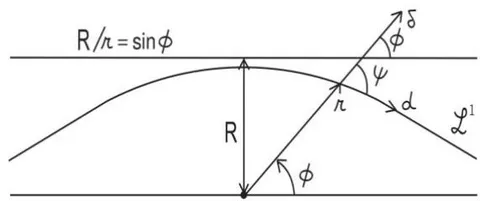
According to the Rindler-Ishak method, one able to compute angle ψ between photon orbit direction d and direction of φ = const. line, δ , by the invariant formula (see Figure 1)
( 14 ) cos ψ = g i j d i δ j g i j d i d j g i j δ i δ j

Fig. 1: The orbital map, light bending in the space-time of a black hole. The one-sided deflection angle is ψ φ ε .

where g i j are the coefficients of the 2-metric on θ = π / 2 and t = const. surface. Substituting d = ( d r , d φ ) and δ = ( δ r , 0 ) in Eq. (9), gives

( 15 ) cos ψ = | d r / d ϕ | ( d r / d ϕ ) 2 + f ( r ) r 2

or equivalently

( 16 ) tan ψ = r f ( r ) | d r / d ϕ |

using equations (12) or (13) for m 1

( 17 ) d r d ϕ r 2 R

finally, by substituting in equations (12) and (13), we find their corresponding expressions for the total deflection angle

( 18 ) 2 ϵ 1 4 m 0 R ( 1 2 m 0 2 R 2 + 2 m 0 2 R 2 ( q E 2 + q M 2 ) ) 2 R 3 ( m 2 R 2 c c 1 8 m 0 ) l 2 + c m 0 m 2 2 R 3 ( 2 R 2 ( c c 2 + c 1 m 0 ) 3 c 1 m 0 ( q E 2 + q M 2 ) ) m 4 c 2 c 1 128 R ( c 1 ( q E 2 + q M 2 ) ( m 2 R 2 c c 1 24 m 0 ) + 8 R 2 ( 2 c c 2 + c 1 m 0 ) )
2 ϵ 2 4 m 0 R ( 1 2 m 0 2 R 2 + 2 m 0 2 R 4 ( q E 2 + q M 2 ) ) + m 2 c 2 c 2 m 0 R + R 3 4 m 0 l 2 + R m 2 c c 1 4

The deflection angle is modified by new terms containing the massive parameter and cosmological constant in both equations (18) and (19).

Canceling out massive parameter and cosmological constant effects gives the same results for both approaches in equations (18) and (19) as

( 20 ) 2 ϵ 4 m 0 R ( 1 2 m 0 2 R 2 + 2 m 0 2 R 4 ( q E 2 + q M 2 ) )

which equals to deflection light equation for charged Schwarzschild black holes.

The effect of the cosmological constant, electric charge and magnetic charge on deflection angle at small scales such as the solar system is expected to be negligible. So by using 1 or Λ 0 and canceling out q E and q M from equations (18) and (19), we have

( 21 ) 2 ϵ 1 4 m 0 R ( 1 + c m 2 4 ( c c 2 + c 1 m 0 ) )
( 22 ) 2 ϵ 2 4 m 0 R ( 1 + c 2 c 2 m 2 4 )

To find constraint on constant m , we use the observational data on light deflection by the sun, from long baseline radio interferometry [19]. According to this observational data, δ ϕ L D = δ ϕ L D ( G R ) ( 1 + Δ L D ) with Δ L D ≤≤ 0.0002 ± 0.0008 , where δ ϕ L D ( G R ) = 1.7510 arc sec. Assuming Δ L D as the geometric effects of the conformal terms, the observational results constrain the two last equations as follows

Assuming

( 23 ) m 2 4 Δ L D ( c 2 + c 1 m 0 )
( 24 ) m 2 4 Δ L D c 2

where we set c = 1 . This selection leads us to find massive parameter m as function of constants c 1 and c 2 . Taking for R and m 0 values of the radius and mass of the sun, R 6.95 × 10 8 m and M 1.99 × 1030 kg , we find following constraints on m according to our approaches, first approximation and perturbative method

( 25 ) | m | 0.0283 1.99 × 10 30 c 1 + c 2 or | m | 0.0282 c 2

In conclusion, in this letter, we have investigated the bending of light in the dyonic black holes in massive gravity.

Following Rindler-Ishak method, we have shown that when the geometry of the Schwarzschild-de Sitter space-time is taken into account, Λ indeed contributes to the light-bending in massive dyonic black holes. Also, using the observational data on bending of light by the sun and constant c = 1 leads us to find strong constraint on massive constant m .

Generally, if we assume that both approaches give same result, one need to set c 1 = 0 .

ACKNOWLEDGEMENT

The author thanks A. H. Fazlollahi for his helpful cooperation and comments.
References

47 Cites in Article
  1. Amol Upadhye,Mustapha Ishak,Paul Steinhardt (2005). Dynamical dark energy: Current constraints and forecasts.
  2. B Chen,R Kantowski,X Dai (2010). Time delay in Swiss cheese gravitational lensing.
  3. K Boudjemaa,M Guenouche,S Zouzou (2011). Unknown Title.
  4. R Alpher (1967). Unknown Title.
  5. N Cruz,M Olivares,J Villanueva (2005). Unknown Title.
  6. Eva Hackmann,Valeria Kagramanova,Jutta Kunz,Claus Lammerzahl (2008). Publisher’s Note: Analytic solutions of the geodesic equation in higher dimensional static spherically symmetric spacetimes [Phys. Rev. D<b>78</b>, 124018 (2008)].
  7. N Islam (1983). The cosmological constant and classical tests of general relativity.
  8. W Freire,V Bezerra,J Lima (2001). Unknown Title.
  9. Andrew Kerr,John Hauck,Bahram Mashhoon (2003). Standard clocks, orbital precession and the cosmological constant.
  10. Valeria Kagramanova,Jutta Kunz,Claus Lämmerzahl (2006). Solar system effects in Schwarzschild–de Sitter space–time.
  11. F Finelli,M Galaverni,A Gruppuso (2007). Unknown Title.
  12. Mauro Sereno,Philippe Jetzer (2006). Solar and stellar system tests of the cosmological constant.
  13. M Ishak (2008). Unknown Title.
  14. J Sultana (2013). Unknown Title.
  15. M Heydari-Fard,S Mojahed,S Rokni (2014). Unknown Title.
  16. C Cattani,M Scalia,E Laserra,I Bochicchio,K Nandi (2013). Unknown Title.
  17. Amrita Bhattacharya,Guzel Garipova,Ettore Laserra,Arunava Bhadra,Kamal Nandi (2011). The vacuole model: new terms in the second order deflection of light.
  18. A Barut (1971). Proton Form Factor, Magnetic Charges, and Dyonium.
  19. A Taub (1951). Empty Space-Times Admitting a Three Parameter Group of Motions.
  20. E Newman,L Tamburino,T Unti (1963). Empty-Space Generalization of the Schwarzschild Metric.
  21. C Misner,A Taub (1969). L’espace-temps Taub-NUT-Misner.
  22. J Dowker (1974). The nut solution as a gravitational dyon.
  23. M Damianski,E Newman (1966). Bulletin of the Polish Academy of Sciences. Mathematics.
  24. Guang-Jiun Cheng,Wei-Fu Lin,Rue-Ron Hsu (1994). Dyonic black holes in dilaton gravity.
  25. David Lowe,Andrew Strominger (1994). Exact Four-Dimensional Dyonic Black Holes and Bertotti-Robinson Spacetimes in String Theory.
  26. S Mignemi (1995). Dyonic black holes in effective string theory.
  27. C Chen,D,D Orlov (2008). Unknown Title.
  28. David Chow,Geoffrey Compère (2014). Dyonic AdS black holes in maximal gauged supergravity.
  29. Rong-Gen Cai,Run-Qiu Yang (2014). Paramagnetism-ferromagnetism phase transition in a dyonic black hole.
  30. B Shepherd,E Winstanley (2016). Unknown Title.
  31. S Weinberg (1972). Gravitation and Cosmology.
  32. Wolfgang Rindler (2006). Relativity.
  33. D Robertson,W Carter,W Dillinger (1991). New measurement of solar gravitational deflection of radio signals using VLBI.
  34. D Lebach,B Corey,I Shapiro,M Ratner,J Webber,A Rogers,J Davis,T Herring (1995). Measurement of the Solar Gravitational Deflection of Radio Waves Using Very-Long-Baseline Interferometry.
  35. M Heydari-Fard (2018). Review Fard et al..
  36. Shubham Kala,Hemwati Nandan,Prateek Sharma (2020). Deflection of light around a rotating BTZ black hole.
  37. M Alawadi,D Batic,M Nowakowski (2020). Light bending in a two black hole metric.
  38. Wolfgang Rindler,Mustapha Ishak (2007). Contribution of the cosmological constant to the relativistic bending of light revisited.
  39. S Hendi,N Riazi,S Panahiyan (2018). Holographical Aspects of Dyonic Black Holes: Massive Gravity Generalization.
  40. G Riess (1998). Unknown Title.
  41. S Perlmutter (1999). Al Hithalal Hoger Kemefateh.
  42. Steven Weinberg (1989). The cosmological constant problem.
  43. M Turner (2000). Unknown Title.
  44. Varun Sahni,Alexei Starobinsky (2000). THE CASE FOR A POSITIVE COSMOLOGICAL Λ-TERM.
  45. T Padmanabhan (2003). Cosmological constant—the weight of the vacuum.
  46. A Unknown Title.
  47. Robin Van Damme (null). Function Follows Form.

Funding

No external funding was declared for this work.

Conflict of Interest

The authors declare no conflict of interest.

Ethical Approval

No ethics committee approval was required for this article type.

Data Availability

Not applicable for this article.

How to Cite This Article

H.R. Fazlollahi. 2026. "Light Deflection in Massive Dyonic Black Holes". Global Journal of Computer Science and Technology - A: Hardware & Computation GJCST-A Volume 23 (GJCST Volume 23 Issue A1).

Download Citation

High-resolution image showing light deflection around massive dyonic black holes.
Journal Specifications

Crossref Journal DOI 10.17406/gjcst

Print ISSN 0975-4350

e-ISSN 0975-4172

Keywords
Classification
GJCST-A Classification FOR Code: 010302
Version of record

v1.2

Issue date
January 4, 2024

Language
English
Experiance in AR

Explore published articles in an immersive Augmented Reality environment. Our platform converts research papers into interactive 3D books, allowing readers to view and interact with content using AR and VR compatible devices.

Read in 3D

Your published article is automatically converted into a realistic 3D book. Flip through pages and read research papers in a more engaging and interactive format.

Article Matrices
Total Views: 604
Total Downloads: 43
All Trends

Request Access

Please fill out the form below to request access to this research paper. Your request will be reviewed by the editorial or author team.
X

This is the heading

Lorem ipsum dolor sit amet, consectetur adipiscing elit. Ut elit tellus, luctus nec ullamcorper mattis, pulvinar dapibus leo.

High-quality academic research articles on global topics and journals.

Light Deflection in Massive Dyonic Black Holes

H.R. Fazlollahi
H.R. Fazlollahi Institute of Gravitation and Cosmology, Peoples Friendship University of Russia