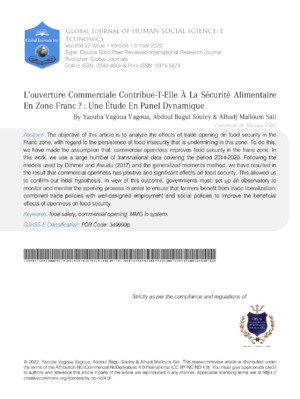
L’ouverture Commerciale Contribue-T-Elle À La Sécurité Alimentaire En Zone Franc ? : Une Étude En Panel Dynamique

α
Yaouba Vagoua Vagoua
σ
Abdoul Bagui Souley
Abdoul Bagui Souley
ρ
Alhadj Malloum Sali
Alhadj Malloum Sali
α to ρ University of Maroua University of Maroua

Send Message

To: Author

L’ouverture Commerciale Contribue-T-Elle À La Sécurité Alimentaire En Zone  Franc ? : Une Étude En Panel Dynamique

Article Fingerprint

ReserarchID

0W21D

L’ouverture Commerciale Contribue-T-Elle À La Sécurité Alimentaire En Zone  Franc ? : Une Étude En Panel Dynamique Banner

AI TAKEAWAY

Connecting with the Eternal Ground
  • English
  • Afrikaans

  • Albanian
  • Amharic
  • Arabic
  • Armenian
  • Azerbaijani
  • Basque
  • Belarusian
  • Bengali
  • Bosnian
  • Bulgarian
  • Catalan
  • Cebuano
  • Chichewa
  • Chinese (Simplified)
  • Chinese (Traditional)
  • Corsican
  • Croatian
  • Czech
  • Danish
  • Dutch
  • Esperanto
  • Estonian
  • Filipino
  • Finnish
  • French
  • Frisian
  • Galician
  • Georgian
  • German
  • Greek
  • Gujarati
  • Haitian Creole
  • Hausa
  • Hawaiian
  • Hebrew
  • Hindi
  • Hmong
  • Hungarian
  • Icelandic
  • Igbo
  • Indonesian
  • Irish
  • Italian
  • Japanese
  • Javanese
  • Kannada
  • Kazakh
  • Khmer
  • Korean
  • Kurdish (Kurmanji)
  • Kyrgyz
  • Lao
  • Latin
  • Latvian
  • Lithuanian
  • Luxembourgish
  • Macedonian
  • Malagasy
  • Malay
  • Malayalam
  • Maltese
  • Maori
  • Marathi
  • Mongolian
  • Myanmar (Burmese)
  • Nepali
  • Norwegian
  • Pashto
  • Persian
  • Polish
  • Portuguese
  • Punjabi
  • Romanian
  • Russian
  • Samoan
  • Scots Gaelic
  • Serbian
  • Sesotho
  • Shona
  • Sindhi
  • Sinhala
  • Slovak
  • Slovenian
  • Somali
  • Spanish
  • Sundanese
  • Swahili
  • Swedish
  • Tajik
  • Tamil
  • Telugu
  • Thai
  • Turkish
  • Ukrainian
  • Urdu
  • Uzbek
  • Vietnamese
  • Welsh
  • Xhosa
  • Yiddish
  • Yoruba
  • Zulu

Abstract

The objective of this article is to analyze the effects of trade opening on food security in the Franc zone, with regard to the persistence of food insecurity that is undermining in this zone. To do this, we have made the assumption that: commercial openness improves food security in the franc zone. In this work, we use a large number of transnational data covering the period 2014-2020. Following the models used by Dithmer and Awudu (2017) and the generalized moments method, we have resulted in the result that commercial openness has positive and significant effects on food security. This allowed us to confirm our initial hypothesis. In view of this outcome, governments must: set up an observatory to monitor and monitor the opening process in order to ensure that farmers benefit from trade liberalization; combined trade policies with well-designed employment and social policies to improve the beneficial effects of openness on food security.

References

46 Cites in Article
  1. O Alesandro,C Daniel,J Swinnen (2017). Trade Liberalization and Child Mortality: a Synthethic Control Method.
  2. Alberto Alesina,David Dollar (2000). Who Gives Foreign Aid to Whom and Why?.
  3. Manuel Arellano,Stephen Bond (1991). Some Tests of Specification for Panel Data: Monte Carlo Evidence and an Application to Employment Equations.
  4. Manuel Arellano,Olympia Bover (1995). Another look at the instrumental variable estimation of error-components models.
  5. B Baltagi (2008). Econometric Analysis of Panel Data.
  6. John Bound,David Jaeger,Regina Baker (1995). Problems with Instrumental Variables Estimation when the Correlation between the Instruments and the Endogenous Explanatory Variable is Weak.
  7. Clive Bowsher (2002). On testing overidentifying restrictions in dynamic panel data models.
  8. Ha Chang (2009). Rethinking public policy in agriculture – lessons from history, distant and recent H A - JOON CHANG.
  9. J Dithner,A Et Awudu (2017). does trade openness contrubued to food security?: a dynamic data panel analysis.
  10. P Dawson,A Sanjuán (2011). Calorie consumption and income: panel cointegration and causality evidence in developing countries.
  11. David Dejong,Marla Ripoll (2006). Tariffs and Growth: An Empirical Exploration of Contingent Relationships.
  12. D Dollar (1992). Outward-oriented developing economies really grow more rapidly: evidence from 95 LDCs, 1976-85.
  13. David Dollar,Aart Kraay (2004). Trade, Growth, and Poverty.
  14. (2012). Perspectives agricoles de l'OCDE et de la FAO 2012.
  15. Fao (1996). World Food Summit Plan of Action, paragraph 1.
  16. Fao (1996). Évaluation du projet «Renforcement de la résilience des communautés rurales pour la sécurité alimentaire et nutritionnelle au Burundi».
  17. Fao (2000). Multilateral Trade Negotiations on Agriculture: A Resource Manual.
  18. Fao (2003). State of food insecurity (SOFI).
  19. Fao (2003). FAO. 2010. Breeding strategies for sustainable management of animal genetic resources. FAO Animal Production and Health Guidelines. No. 3. Rome, pp 155. ISBN 978-92-5-106391-0. Available at: http://www.fao.org/docrep/012/i1103e/i1103e00.htm (English version); http://www.fao.org/docrep/012/i1103s/i1103s.pdf (Spanish version).
  20. Shelley Mcguire (2013). FAO, IFAD, and WFP. The State of Food Insecurity in the World 2015: Meeting the 2015 International Hunger Targets: Taking Stock of Uneven Progress. Rome: FAO, 2015.
  21. (2003). The WTO Agreement on Fisheries Subsidies and the role of FAO.
  22. Fao (2005). Pourquoi faut-il une autre stratégie de développement de l'élevage en Afrique au Sud du Sahara.
  23. (2003). FAO. 2010. Breeding strategies for sustainable management of animal genetic resources. FAO Animal Production and Health Guidelines. No. 3. Rome, pp 155. ISBN 978-92-5-106391-0. Available at: http://www.fao.org/docrep/012/i1103e/i1103e00.htm (English version); http://www.fao.org/docrep/012/i1103s/i1103s.pdf (Spanish version).
  24. Faostat (2010). Relevons le défi: Agir pour un monde libéré des comportements néfastes.
  25. Shiferaw Feleke,Richard Kilmer,Christina Gladwin (2005). Determinants of food security in Southern Ethiopia at the household level.
  26. L Hansen (1982). Large sample properties of generalized method of moments estimators.
  27. Derek Headey (2013). Developmental Drivers of Nutritional Change: A Cross-Country Analysis.
  28. Douglas Holtz-Eakin,Whitney Newey,Harvey Rosen (1988). Estimating Vector Autoregressions with Panel Data.
  29. Steven Jaffee,Spencer Henson,Luz Diaz Rios (2011). Making the Grade : Smallholder Farmers, Emerging Standards, and Development Assistance Programs in Africa - A Research Program Synthesis.
  30. Jean-Paul Minvielle (2000). Sécurité alimentaire et sécurité humaine: Convergence et complémentarité des approches.
  31. P Krugman (1991). The move Toward Free Trade Zones.
  32. Norman Loayza,Eduardo Olaberría,Jamele Rigolini,Luc Christiaensen (2012). Natural Disasters and Growth: Going Beyond the Averages.
  33. Stephen Nickell (1981). Biases in Dynamic Models with Fixed Effects.
  34. D Roodman (2009). How to do xtabond2: an introduction to difference and system GMM in Stata.
  35. David Roodman (2009). A Note on the Theme of Too Many Instruments<sup>*</sup>.
  36. Ravinder Rena (2005). Challenges for Food Security in Eritrea: A Descriptive and Qualitative Analysis.
  37. C Runge,B Senauer,P Pardey,M Rosegrant (2003). Ending Hunger in Our Lifetime: Food Security and Globalization.
  38. L Smith,L Haddad (2000). Explaining Child Malnutrition in Developing Countries: A Cross-Country Analysis.
  39. L Smith,L Haddad (2001). How important is improving food availability for reducing child malnutrition in developing countries?.
  40. Amartya Sen (1981). Ingredients of Famine Analysis: Availability and Entitlements.
  41. A Sen (1981). Poverty and famines: an essay on entitlement and deprivation.
  42. B Suárez,F Pérez-Gil (1999). Sivrihissar. Op. cit. 351, n. 62..
  43. Peter Svedberg (1999). 841 Million Undernourished?.
  44. Romain Wacziarg,Karen Welch (2008). Trade Liberalization and Growth: New Evidence.
  45. Frank Windmeijer (2005). A finite sample correction for the variance of linear efficient two-step GMM estimators.
  46. L Winters,Neil Mcculloch,Andrew Mckay (2004). Trade Liberalization and Poverty: The Evidence So Far.

Funding

No external funding was declared for this work.

Conflict of Interest

The authors declare no conflict of interest.

Ethical Approval

No ethics committee approval was required for this article type.

Data Availability

Not applicable for this article.

How to Cite This Article

Yaouba Vagoua Vagoua. 2026. \u201cL’ouverture Commerciale Contribue-T-Elle À La Sécurité Alimentaire En Zone Franc ? : Une Étude En Panel Dynamique\u201d. Global Journal of Human-Social Science - E: Economics GJHSS-E Volume 22 (GJHSS Volume 22 Issue E1): .

Download Citation

Alt text: Academic research on food and trade security in France, analyzing consumer confidence and social impacts.
Issue Cover
GJHSS Volume 22 Issue E1
Pg. 19- 31
Journal Specifications

Crossref Journal DOI 10.17406/GJHSS

Print ISSN 0975-587X

e-ISSN 2249-460X

Keywords
Classification
GJHSS-E Classification: FOR Code: 349999p
Version of record

v1.2

Issue date

February 7, 2022

Language
fr
Experiance in AR

Explore published articles in an immersive Augmented Reality environment. Our platform converts research papers into interactive 3D books, allowing readers to view and interact with content using AR and VR compatible devices.

Read in 3D

Your published article is automatically converted into a realistic 3D book. Flip through pages and read research papers in a more engaging and interactive format.

Article Matrices
Total Views: 1985
Total Downloads: 53
2026 Trends
Related Research

Published Article

The objective of this article is to analyze the effects of trade opening on food security in the Franc zone, with regard to the persistence of food insecurity that is undermining in this zone. To do this, we have made the assumption that: commercial openness improves food security in the franc zone. In this work, we use a large number of transnational data covering the period 2014-2020. Following the models used by Dithmer and Awudu (2017) and the generalized moments method, we have resulted in the result that commercial openness has positive and significant effects on food security. This allowed us to confirm our initial hypothesis. In view of this outcome, governments must: set up an observatory to monitor and monitor the opening process in order to ensure that farmers benefit from trade liberalization; combined trade policies with well-designed employment and social policies to improve the beneficial effects of openness on food security.

Our website is actively being updated, and changes may occur frequently. Please clear your browser cache if needed. For feedback or error reporting, please email [email protected]

Request Access

Please fill out the form below to request access to this research paper. Your request will be reviewed by the editorial or author team.
X

Quote and Order Details

Contact Person

Invoice Address

Notes or Comments

This is the heading

Lorem ipsum dolor sit amet, consectetur adipiscing elit. Ut elit tellus, luctus nec ullamcorper mattis, pulvinar dapibus leo.

High-quality academic research articles on global topics and journals.

L’ouverture Commerciale Contribue-T-Elle À La Sécurité Alimentaire En Zone Franc ? : Une Étude En Panel Dynamique

Yaouba Vagoua Vagoua
Yaouba Vagoua Vagoua University of Maroua
Abdoul Bagui Souley
Abdoul Bagui Souley
Alhadj Malloum Sali
Alhadj Malloum Sali University of Maroua

Research Journals