We introduce Mouanda’s choice function for matrices which allows us to construct the galaxies of sequences of triples of circulant matrices with positive integers as entries. We give many examples of the galaxies of circulant matrices with positive integers as entries. The characterization of the matrix solutions of the equation allows us to show that the equation has no circulant matrix with positive integers as entries solutions. This allows us to prove that, in general, the equation has no circulant matrix with positive integers as entries solutions. We prove Fermat’s Last Theorem for eigenvalues of circulant matrices. Also, we show Fermat’s Last Theorem for complex polynomials over associated to circulant matrices.
Cubum autem in duos cubos, aut quadratoquadratum in duos quadratoquadratos, et generaliter nullam in infinitum ultra quadratum potestatum in duos ejusdem nominis fas est dividere: cujes rei demonstrationem mirabilem sane detexi. Hane marginis exiguitas non caperet.
## I. INTRODUCTION AND MAIN RESULT
It is well known that there are many solutions in integers to the equation $x^{2} + y^{2} = z^{2}$, for instance (3,4,5); (5,12,13). Around 1500 B.C, the Babylonians were aware of the solution (4961, 6480, 8161) and the Egyptians knew the solutions (148, 2736, 2740) and (514, 66048, 66050). Also Greek mathematicians were attracted to the solutions of this equation. We notice that this equation has sequences of complex number solutions
$$
(1 + 2i \times a^{k}, 2i \times a^{k} - 2 \times a^{2k}, 1 + 2i \times a^{k} - 2 \times a^{2k}), a \in \mathbb{C}, k \in \mathbb{N}
$$
and matrix solutions
$$
\left(\left( \begin{array}{c c c} - 2 & 2 i & 0 \\0 & - 2 & 2 i \\2 i & 0 & - 2 \end{array} \right), \left( \begin{array}{c c c} 0 & 2 i & 1 \\1 & 0 & 2 i \\2 i & 1 & 0 \end{array} \right), \left( \begin{array}{c c c} - 2 & 2 i & 1 \\1 & - 2 & 2 i \\2 i & 1 & - 2 \end{array} \right)\right).
$$
In 1637, Pierre de Fermat wrote a note in the margin of his copy of Diophantus Arithmetica [1] stating that the equation
$$
x ^ {n} + y ^ {n} = z ^ {n}, n \in \mathbb {N} (n > 2), x y z \neq 0 \tag {1.1}
$$
has no integer solutions. This is the Fermat Last Theorem. He claimed that he had found the proof of this Theorem. The only case Fermat actually wrote down a proof is the case $n = 4$. In his proof, Fermat introduced the idea of infinite descent which is still one the main tools in the study of Diophantine equations. He proved that the equation $x^4 + y^4 = z^2$ has no solutions in relatively prime integers with $xyz \neq 0$. Solutions to this equation correspond to rational points on the elliptic curve $v^2 = u^3 - 4u$. The proof of the case $n = 3$ was given first by Karl Gauss. In 1753, Leonhard Euler gave a different prove of Fermat's Last Theorem for $n = 3[2,3]$. In 1823, Sophie Germain proved that if $l$ is a prime and $2l + 1$ is also prime, the equation $x^l + y^l = z^l$ has no solutions (x,y,z) with $xyz \neq 0 (\mathrm{mod} l)$. The case $n = 5$ was proved simultaneously by Adrien Marie Legendre in 1825 [4, 5] and Peter Lejeune Dirichlet [6] in 1832. In 1839, Gabriel Lame proved the case $n = 7$ [7, 8, 9, 10]. Between 1840 - 1843, V. A. Lebesque worked on Fermat's Last Theorem [11, 12]. Between 1847 and 1853, Ernst Eduard Kummer published some masterful papers about this Theorem. Fermat's Last Theorem attracted the attention of many researchers and many studies have been developed around this Theorem. For example the work of Arthur Wieferich (1909), Andre Weil (1940), John Tate (1950), Gerhard Frey (1986), who was the first to suggest that the existence of a solution of the Fermat equation might contradict the modality conjecture of Taniyama, Shimura and Weil [29]; Jean Pierre Serre (1985 - 1986) [14, 15, 16], who gave an interested formulation and (with J. F. Mestre) tested numerically a precise conjecture about modular forms and Galois representations mod $p$ and proved how a small piece of this conjecture the so-called epsilon conjecture together Modularity Conjecture would imply Fermat's Last Theorem; Kennedy Ribet (1986) [17], who proved Serre's epsilon conjecture, thus reducing the proof of Fermat's Last Theorem; Barry Mazur (1986), who introduced a significant piece of work on the deformation of Galois representations [18, 19]. However, no final proof was given to this Theorem. This Theorem was unsolved for nearly 350 years. In 1995, using Mazur's deformation theory of Galois representations, recent results on Serre's conjecture on the modularity of Galois representations, and deep arithmetical properties of Hecke algebras, Andrew Wiles with Richard Taylor succeeded in proving that all semi-stable elliptic curves defined over the rational numbers are modular. This result is less than the full Shimura-Taniyama conjecture. This result does imply that the elliptic curve given above is modular. Therefore, proving Fermat's Last Theorem [20, 21]. Many mathematicians are still heavenly involved on studying Fermat's Last Theorem [22, 23, 24]. In 2021, Nag introduced an elementary proof of Fermat's
Last Theorem for epsilons[25]. In 2022, Mouanda constructed the galaxies of sequences of triples of positive integers solutions of the equation $x^{2} + y^{2} = z^{2}$. The unique characterization of the solutions of this equation allowed him to provide an elementary analytic proof of Fermat's Last Theorem [26]. The Fermat Last Theorem for positive integers has been extended over some number fields. In 1966, Domiaty proved that the equation $X^{4} + Y^{4} = Z^{4}$ is solvable in $M_{2}(\mathbb{Z})$ [27]. Let $GL_{n}(\mathbb{Z})$ be the group of units of ring $M_{n}(\mathbb{Z})$. Denote by
$$
S L _ {n} (\mathbb {Z}) = \left\{A \in M _ {n} (\mathbb {Z}): d e t A = 1 \right\}. \tag {1.2}
$$
In 1989, Vaserstein investigated the question of the solvability of the equation
$$
X ^ {n} + Y ^ {n} = Z ^ {n}, n \geq 2, n \in \mathbb {N}, \tag {1.3}
$$
for matrices of the group $GL_2(\mathbb{Z})$ [28]. In 1993, Frejman studied the solvability of the equation (1.3) in the set of positive integer powers of a matrix $A$ with elements $a_{11} = 0$, $a_{12} = a_{21} = a_{22} = 1$ [29]. In 1995, the same case was studied by Grytczuk [30]. The same year, Khazanov proved that in $GL_3(\mathbb{Z})$ solutions of the equation (1.3 do not exist if $n$ is a multiple of either 21 or 96, and in $SL_3(\mathbb{Z})$ solutions do not exist if $n$ is a multiple of 48 [31]. In 1996, Qin gave another proof of Khazanov's result on the solvability of the equation (1.3) in $SL_2(\mathbb{Z})$ [32]. In 2002, Patay and Szakacs described the periodic elements in $GL_2(\mathbb{Z})$ and gave the answer to some problems concerning the equation (1.3) in matrix groups and in irreducible elements of matrix rings [33]. In 2021, Mao-Ting and Jie proved that Fermat's matrix equation has many solutions in a set of 2-by-2 positive semi-definite integral matrices, and has no nontrivial solutions in some classes including 2-by-2 symmetric rational and stochastic quadratic field matrices [34]. Fermat's Last Theorem has been extended to the field of complex polynomials of one variable [35].
This Theorem has many applications in Cryptography.
In this paper, we are mainly concerned with Fermat's Last Theorem for circulant matrices with positive integers as entries. Firstly, we focus our attention on the construction of the galaxies of sequences of triples of circulant matrices with positive integers as entries solutions of the equation $X^{2} + Y^{2} = Z^{2}$. In particular, Mouanda's matrix choice function allows us to construct practical examples of such galaxies. The elementary characterization of these matrix solutions allows us to prove Fermat's Last Theorem for circulant matrices with positive integers as entries.
Theorem 1.1. The equation
$$
X ^ {n} + Y ^ {n} = Z ^ {n}, X Y Z \neq 0, n \in \mathbb {N} (n \geq 3)
$$
has no circulant matrix with positive integers as entries solutions.
We construct a galaxy of sequences of eigenvalues of circulant matrices and we prove Fermat's Last Theorem for eigenvalues of circulant matrices. Also, we construct a galaxy of sequences of complex polynomials over the unit disk $\mathbb{D}$ associated to circulant matrices and we prove Fermat's Last Theorem for complex polynomials over $\mathbb{D}$.
## II. PRELIMINARIES
Definition 2.1. Let $\mathbb{A}$ be a unital Banach algebra. We say that $a \in \mathbb{A}$ is invertible if there is an element $b \in \mathbb{A}$ such that $ab = ba = 1$. In this case $b$ is unique and written $a^{-1}$. The set
$$
Inv(\mathbb{A}) = \{a \in \mathbb{A} : \exists b \in \mathbb{A}, ab = ba = 1\}
$$
is a group under multiplication. If $a$ is an element of $\mathbb{A}$, the spectrum of $a$ is defined as
$$
\sigma (a) = \left\{\lambda \in \mathbb {C}: a - \lambda . 1 \notin I n v (\mathbb {A}) \right\},
$$
and its spectral radius is defined to be
$$
r (a) = \sup \left\{\left| \lambda \right|: \lambda \in \sigma (a) \right\}.
$$
Let $V = \{a_0, a_1, \ldots, a_{m-1}\} \subset \mathbb{C}$ be a subset of the set of complex numbers, denote by $C_V$ the following Toeplitz matrix:
$$
C _ {V} = \left( \begin{array}{c c c c} a _ {0} & a _ {1} & \ddots & a _ {m - 1} \\a _ {m - 1} & a _ {0} & \ddots & \ddots \\\vdots & \vdots & \vdots & \vdots \\a _ {1} & \ldots & a _ {m - 1} & a _ {0} \end{array} \right).
$$
This matrix is called a $m \times m$ -complex circulant matrix or a complex circulant matrix of order $m$. Denote by $C_m(\mathbb{C})$ the commutative algebra of $m \times m$ -complex circulant matrices. Let $\epsilon = e^{\frac{2\pi i}{m}}$ be a primitive $m$ -th root of unity. Let us denote by $\mathrm{U}$ the following matrix:
$$
U = \frac{1}{\sqrt{m}} \left( \begin{array}{c c c c c c c} 1 & 1 & \ldots & 1 & 1 & 1 & 1 \\1 & \epsilon & \ldots & \ldots & \epsilon^{(m - 3)} & \epsilon^{m - 2} & \epsilon^{m - 1} \\\vdots & \vdots & \vdots & \vdots & \vdots & \vdots & \vdots \\\vdots & \vdots & \vdots & \vdots & \vdots & \vdots & \vdots \\1 & \epsilon^{m - 3} & \ldots & \ldots & \epsilon^{(m - 3)^2} & \epsilon^{(m - 3)(m - 2)} & \epsilon^{(m - 1)(m - 3)} \\1 & \epsilon^{m - 2} & \ldots & \ldots & \epsilon^{(m - 2)(m - 3)} & \epsilon^{(m - 2)^2} & \epsilon^{(m - 1)(m - 2)} \\1 & \epsilon^{m - 1} & \ldots & \ldots & \epsilon^{(m - 1)(m - 3)} & \epsilon^{(m - 1)(m - 2)} & \epsilon^{(m - 1)^2} \end{array} \right) .
$$
This matrix is called Vandermonde matrix. It is well known that this matrix has the following properties:
$$
det(U) = \frac{1}{m^{\frac{m}{2}}} \prod_{i,j=0}^{m-1} (\epsilon^j - \epsilon^i) \neq 0,
$$
U is non-singular, unitary, $U^{-1} = \overline{U}^T$, $U^T = U$ and $U^{-1} = \overline{U} = U^*$. It is well known that all the elements of $C_m(\mathbb{C})$ are simultaneously diagonalized by the same unitary matrix $U$, that is, for $A$ in $C_m(\mathbb{C})$, one has
$$
U ^ {*} A U = D _ {A}
$$
with $D_A$ is a diagonal matrix with diagonal entries given by the ordered eigenvalues of A: $\lambda_1^A, \lambda_2^A, \ldots, \lambda_m^A$. The factorization $U^*AU = D_A$ is called the spectral factorization of A [36, 37, 38, 39]. It is possible to write the matrix $C_V$ as one variable complex polynomial. Indeed, let $P$ be the cyclic permutation $m \times m$ -matrix given by
$$
P = \left( \begin{array}{c c c c c c} 0 & 1 & 0 & \ddots & 0 & 0 \\0 & 0 & 1 & 0 & \ddots & 0 \\\vdots & \vdots & \vdots & \vdots & \vdots & \vdots \\\vdots & \vdots & \vdots & \vdots & \vdots & \vdots \\0 & 0 & \ldots & 0 & 0 & 1 \\1 & 0 & \ldots & 0 & 0 & 0 \end{array} \right).
$$
It is simple to see that
$$
C _ {V} = \sum_ {k = 0} ^ {m - 1} a _ {k} P ^ {k}.
$$
Let $\mathbb{D} = \{z\in \mathbb{C}:|z|\leq 1\}$ be the unit disk. The complex polynomial
$$
f _ {V} (z) = \sum_ {k = 0} ^ {m - 1} a _ {k} z ^ {k}
$$
over $\mathbb{D}$ is called the associated complex polynomial of the matrix $C_V = f_V(P)$. It follows that if
$$
X = \left( \begin{array}{c c c c c c} 0 & 1 & 0 & \ddots & 0 & 0 \\0 & 0 & 1 & 0 & \ddots & 0 \\\vdots & \vdots & \vdots & \vdots & \vdots & \vdots \\\vdots & \vdots & \vdots & \vdots & \vdots & \vdots \\0 & 0 & \ldots & 0 & 0 & 1 \\0 & 0 & \ldots & 0 & 0 & 0 \end{array} \right)
$$
is a $m \times m$ -complex matrix, then
$$
f _ {V} (X) = \sum_ {k = 0} ^ {m - 1} a _ {k} X ^ {k} = \left( \begin{array}{c c c c} a _ {0} & a _ {1} & \ddots & a _ {m - 1} \\0 & a _ {0} & \ddots & \ddots \\\vdots & \vdots & \vdots & \vdots \\0 & \ldots & 0 & a _ {0} \end{array} \right)
$$
is a $m \times m$ -upper complex triangular Toeplitz matrix. The complex polynomial
$$
f _ {V} (z) = \sum_ {k = 0} ^ {m - 1} a _ {k} z ^ {k}
$$
is also called the associated complex polynomial of the matrix $f_V(X)$.
## III. THE UNIVERSE OF AN ALGEBRA
Definition 3.1. Let $x, y, z \in \mathbb{C}$ be complex numbers. Denote by
$$
(x, y, z) ^ {n} = \left(x ^ {n}, y ^ {n}, z ^ {n}\right), n = \frac {p}{q}, p, q \in \mathbb {N}, q \neq 0.
$$
The triple $(x^n, y^n, z^n)$ is called the triple $(x, y, z)$ to the power $n$.
Definition 3.2. Let $x, y, z \in \mathbb{C}$ be complex numbers. Denote by
$$
\alpha (x, y, z) = (\alpha x, \alpha y, \alpha z), (x, y, z) + (a, b, c) = (x + a, y + b, z + c).
$$
Definition 3.3. A universe of degree $\frac{p}{q}$ of the algebra $\mathcal{B}$ is the set $\mathbb{F}_{\frac{p}{q}}(\mathcal{B})$ of triples $(x,y,z)$ of elements of $\mathcal{B}$ which satisfy the law of stability
$$
x ^ {\frac {p}{q}} + y ^ {\frac {p}{q}} = z ^ {\frac {p}{q}}, x y z \neq 0, p, q \in \mathbb {N}, q \neq 0.
$$
The element $(x,y,z)$ is called a star (or a planet) of the universe $\mathbb{F}_{\frac{p}{q}}(\mathcal{B})$. Every sequence $(x_{k},y_{k},z_{k})_{n\geq 0}$ of elements of the universe $\mathbb{F}_{\frac{p}{q}}(\mathcal{B})$ is called a planet system of elements of $\mathcal{B}$.
The set
$$
\mathbb {F} _ {\frac {p}{q}} (C _ {m} (\mathbb {C})) = \left\{(X, Y, Z) \in \mathbb {C} ^ {3}: X ^ {\frac {p}{q}} + Y ^ {\frac {p}{q}} = Z ^ {\frac {p}{q}}, X Y Z \neq 0 \right\}, p, q \in \mathbb {N}, q \neq 0,
$$
is called the complex cicutant universe of degree $\frac{p}{q}$. In particular, the set
$$
\mathbb{F}_n(C_m(\mathbb{N})) = \left\{ (X,Y,Z) \in C_m(\mathbb{N})^3 : X^n + Y^n = Z^n, XYZ \neq 0 \right\}, n \in \mathbb{N}, n \geq 2,
$$
is called the natural circulant universe of degree $n$. We are going to show that the universe $\mathbb{F}_2(C_m(\mathbb{N}))$ is not empty. Fermat's Last Theorem for circulant matrices is equivalent to say that
$$
\mathbb{F}_n(C_m(\mathbb{N})) = \{\} = \phi, n \geq 3.
$$
In other words, there are matrix complex universes which don't have triples of matrices of positive integers as entries elements.
## IV. MOUANDA'S CHOICE FUNCTION FOR MATRICES
Denote by $C_*(C_m(\mathbb{C})) = \{h / h: C_m(\mathbb{C}) \longrightarrow C_m(\mathbb{C})\}$, the set of complex functions over $\mathbb{C}$. Let
$$
\Omega \left(\mathbb {F} _ {2} \left(C _ {m} (\mathbb {C})\right)\right) = \left\{P: P \subseteq \mathbb {F} _ {2} \left(C _ {m} (\mathbb {C})\right) \right\}
$$
be the set of all subsets of $\mathbb{F}_2(C_m(\mathbb{C}))$. Theorem 2.5 of [26] allows us to claim that the appropriate choice of the values of $m_0(k)$ and $n_0(k)$ such that
$$
\frac {2 (m _ {0} (k) - n _ {0} (k)) \pm \sqrt {8 m _ {0} (k) (m _ {0} (k) - n _ {0} (k))}}{2} \in C _ {m} (\mathbb {C})
$$
leads to the construction of sequences of triples of circulant matrices with positive (or negative) integers as entries which satisfy the equation
$$
X ^ {2} + Y ^ {2} = Z ^ {2}.
$$
Let $f_{\mathbb{M}}:C_*(C_m(\mathbb{C}))\times C_*(C_m(\mathbb{C}))\longrightarrow \Omega (\mathbb{F}_2(C_m(\mathbb{C})))$ be the function defined by
$$
f _ {\mathbb {M}} (m _ {0} (k), n _ {0} (k)) = \left[ \begin{array}{c} m _ {0} (k) = a ^ {\beta (k)}, k, a, \beta (k) \in C _ {m} (\mathbb {C}), \beta \in C _ {*} (C _ {m} (\mathbb {C})) \\m _ {0} (k) - n _ {0} (k) \in C _ {m} (\mathbb {C}) \\X _ {k} (m _ {0} (k), n _ {0} (k)) = \frac {2 (m _ {0} (k) - n _ {0} (k)) + \sqrt {8 m _ {0} (k) (m _ {0} (k) - n _ {0} (k))}}{2} \in C _ {m} (\mathbb {C}) \\Y _ {k} (m _ {0} (k), n _ {0} (k)) = \frac {2 (m _ {0} (k) - n _ {0} (k)) + \sqrt {8 m _ {0} (k) (m _ {0} (k) - n _ {0} (k))}}{2} + n _ {0} (k) \\Z _ {k} (m _ {0} (k), n _ {0} (k)) = \frac {2 (m _ {0} (k) - n _ {0} (k)) + \sqrt {8 m _ {0} (k) (m _ {0} (k) - n _ {0} (k))}}{2} + m _ {0} (k) \end{array} \right],
$$
This type of function is called Mouanda's choice function for matrices. Mouanda's choice function for matrices is a galaxy valued function. This function allows us to construct galaxies of sequences of matrices.
## V. A FINITE GALAXY OF SEQUENCES OF CIRCULANT MATRICES WITH POSITIVE INTEGERS AS ENTRIES
All the galaxies defined in this section have been deduced from the galaxies already introduced in [26].
Definition 5.1. A multi-galaxy is a galaxy which contains other galaxies. The order of a galaxy is the number of variables of the galaxy.
Let
$$
P = \left( \begin{array}{l l l l l l} 0 & 1 & 0 & \ddots & 0 & 0 \\0 & 0 & 1 & 0 & \ddots & 0 \\\vdots & \vdots & \vdots & \vdots & \vdots & \vdots \\\vdots & \vdots & \vdots & \vdots & \vdots & \vdots \\0 & 0 & \ldots & 0 & 0 & 1 \\1 & 0 & \ldots & 0 & 0 & 0 \end{array} \right)
$$
be a $m \times m$ -matrix. Denote by $T_{k} = P^{k}$, $k = 1,2,\ldots,m-1$. Let
$$
U _ {m} = \left\{I _ {m}, T _ {1}, T _ {2}, \dots , T _ {m - 1} \right\}
$$
be a finite set of unitary circulant matrices. The elements of the set $U_{m}$ satisfy the following:
$$
T _ {i} T _ {j} = T _ {i + j}, T _ {i} T _ {m - i} = I _ {m}, T _ {m + i} = T _ {i}, T _ {k} = P ^ {k}.
$$
Denote by
$$
\mathcal {P} ^ {(m)} (\mathbb {C}) = \left\{f (z) = \sum_ {k = 0} ^ {m - 1} a _ {k} z ^ {k}: a _ {k} \in \mathbb {C}, z \in \mathbb {D} \right\}.
$$
Let
$$
f (z) = \sum_ {k = 0} ^ {m - 1} a _ {k} z ^ {k}
$$
be a complex polynomial over $\mathbb{D}$. The Toeplitz matrix
$$
\left( \begin{array}{c c c c c c} a _ {0} & a _ {1} & a _ {2} & \ddots & a _ {m - 2} & a _ {m - 1} \\a _ {m - 1} & a _ {0} & a _ {1} & a _ {2} & \ddots & a _ {m - 2} \\\ddots & \ddots & \ddots & \ddots & \ddots & \ddots \\\ddots & \ddots & \ddots & \ddots & \ddots & \ddots \\a _ {2} & \ddots & \ddots & a _ {m - 1} & a _ {0} & a _ {1} \\a _ {1} & a _ {2} & \ddots & \ddots & a _ {m - 1} & a _ {0} \end{array} \right) = f (P)
$$
is called the circulant matrix with complex numbers as entries. The polynomial $f(z)$ is called associated polynomial of the matrix $f(P)$. Recall that the set $C_m(\mathbb{C})$ is the commutative algebra of $m \times m$ -complex circulant matrices. In other words,
$$
C _ {m} (\mathbb {C}) = \left\{\left( \begin{array}{c c c c c c} a _ {0} & a _ {1} & a _ {2} & \ddots & a _ {m - 2} & a _ {m - 1} \\a _ {m - 1} & a _ {0} & a _ {1} & a _ {2} & \ddots & a _ {m - 2} \\\ddots & \ddots & \ddots & \ddots & \ddots & \ddots \\\ddots & \ddots & \ddots & \ddots & \ddots & \ddots \\a _ {2} & \ddots & \ddots & a _ {m - 1} & a _ {0} & a _ {1} \\a _ {1} & a _ {2} & \ddots & \ddots & a _ {m - 1} & a _ {0} \end{array} \right): a _ {k} \in \mathbb {C} \right\}.
$$
It follows that
$$
C _ {m} (\mathbb {C}) = \left\{f (P): f \in \mathcal {P} ^ {(m)} (\mathbb {C}) \right\}
$$
and
$$
C _ {m} (\mathbb {N}) = \left\{\left( \begin{array}{c c c c c c} a _ {0} & a _ {1} & a _ {2} & \ddots & a _ {m - 2} & a _ {m - 1} \\a _ {m - 1} & a _ {0} & a _ {1} & a _ {2} & \ddots & a _ {m - 2} \\\ddots & \ddots & \ddots & \ddots & \ddots & \ddots \\\ddots & \ddots & \ddots & \ddots & \ddots & \ddots \\a _ {2} & \ddots & \ddots & a _ {m - 1} & a _ {0} & a _ {1} \\a _ {1} & a _ {2} & \ddots & \ddots & a _ {m - 1} & a _ {0} \end{array} \right): a _ {k} \in \mathbb {N} \right\}.
$$
It is quiet clear that
$$
C _ {m} (\mathbb {N}) \subset C _ {m} (\mathbb {Z}) \subset C _ {m} (\mathbb {Q}) \subset C _ {m} (\mathbb {R}) \subset C _ {m} (\mathbb {C}).
$$
Mouanda's matrix choice function $f_{\mathbb{M}}$ allows us to construct galaxies of circulant matrices. For instance, if we choose $m_0 = A^{2k} \times 2$, $m_0 - n_0 = \alpha I_m$, $A \in C_m(\mathbb{N})$ the model
$$
\begin{array}{r} G a l a (\mathbb {N} I _ {m}, C _ {m} (\mathbb {N})) = \left[ \begin{array}{c} X _ {k} (\alpha I _ {m}, A) = \alpha I _ {m} + 2 \sqrt {\alpha} \times A ^ {k} \\Y _ {k} (\alpha I _ {m}, A) = 2 \sqrt {\alpha} \times A ^ {k} + 2 \times A ^ {2 k} \\Z _ {k} (\alpha I _ {m}, A) = \alpha I _ {m} + 2 \sqrt {\alpha} \times A ^ {k} + 2 \times A ^ {2 k} \\\alpha = r ^ {2}, k, r \in \mathbb {N}, A \in C _ {m} (\mathbb {N}) \end{array} \right] \end{array}
$$
is called the galaxy of sequences of circulant matrices with positive integers as entries of order 2. For $\alpha_0$ and $A$ fixed, the triple
$$
(X_0(\alpha_0 I_m, A), Y_0(\alpha_0 I_m, A), Z_0(\alpha_0 I_m, A))
$$
is called the origin of the galaxy $Gala(\alpha_0I_m, C_m(\mathbb{N}))$. The elements of $Gala(\alpha_0I_m, C_m(\mathbb{N}))$ satisfy
$$
X _ {k} ^ {2} (\alpha_ {0} I _ {m}, A) + Y _ {k} ^ {2} (\alpha_ {0} I _ {m}, A) = Z _ {k} ^ {2} (\alpha_ {0} I _ {m}, A), k \in \mathbb {N}, A \in C _ {m} (\mathbb {N})
$$
and
$$
\bigl (X _ {k} (\alpha_ {0} I _ {m}, A), Y _ {k} (\alpha_ {0} I _ {m}, A), Z _ {k} (\alpha_ {0} I _ {m}, A) \bigr) \neq \Bigl (D ^ {\frac {p}{q}}, B ^ {\frac {p}{q}}, C ^ {\frac {p}{q}} \Bigr), A, B, C, D \in C _ {m} (\mathbb {N})
$$
with $k,p,q\in \mathbb{N},q\neq 0$
# 5.2. A Finite Galaxy of Sequences of Circulant Matrices
The model
$$
G a l a (4 I _ {m}, U _ {m}) = \left[ \begin{array}{c} X _ {k} (4 I _ {m}, A) = 4 I _ {m} + 4 \times A ^ {k} \\Y _ {k} (4 I _ {m}, A) = 4 \times A ^ {k} + 2 \times A ^ {2 k} \\Z _ {k} (4 I _ {m}, A) = 4 I _ {m} + 4 \times A ^ {k} + 2 \times A ^ {2 k} \\k \in \mathbb {N}, A \in U _ {m} \\(X _ {0} (4 I _ {m}, A), Y _ {0} (4 I _ {m}, A), Z _ {0} (4 I _ {m}, A)) = (8 I _ {m}, 6 I _ {m}, 1 0 I _ {m}) \end{array} \right]
$$
is called the finite galaxy of sequences of circulant matrices with positive integers as entries of order 1. The triple $(X_0(4I_m, A), Y_0(4I_m, A), Z_0(4I_m, A))$ is called the origin of the galaxy $Gala(4I_m, U_m)$. The triple
$$
(X_k(4I_m,A),Y_k(4I_m,A),Z_k(4I_m,A))
$$
satisfies
$$
X _ {k} ^ {2} (4 I _ {m}, A) + Y _ {k} ^ {2} (4 I _ {m}, A) = Z _ {k} ^ {2} (4 I _ {m}, A), k \in \mathbb {N},
$$
$$
X_{0}(4I_{m},A) + Y_{0}(4I_{m},A) + Z_{0}(4I_{m}, ext{A}) = 24I_{m}
$$
and
$$
(X_k(4I_m,A),Y_k(4I_m,A),Z_k(4I_m,A))\neq(D_q^p,B_q^p,C_q^p),k,p,q\in\mathbb{N},q\neq0,
$$
$D, B, C \in U_m$. The finite galaxy $Gala(4I_m, U_m)$ allows the construction of the infinite galaxy
$$
G a l a (4 I _ {m}, C _ {m} (\mathbb {N})) = \left[ \begin{array}{c} X _ {k} (4 I _ {m}, A) = 4 I _ {m} + 4 \times A ^ {k} \\Y _ {k} (4 I _ {m}, A) = 4 \times A ^ {k} + 2 \times A ^ {2 k} \\Z _ {k} (4 I _ {m}, A) = 4 I _ {m} + 4 \times A ^ {k} + 2 \times A ^ {2 k} \\k \in \mathbb {N}, A \in C _ {m} (\mathbb {N}) \\(X _ {0} (4 I _ {m}, A), Y _ {0} (4 I _ {m}, A), Z _ {0} (4 I _ {m}, A)) = (8 I _ {m}, 6 I _ {m}, 1 0 I _ {m}) \end{array} \right]
$$
which has the same origin and stability law than $Gala(4I_m, U_m)$. Therefore, we can say that the galaxy $Gala(\mathbb{N}I_m, C_m(\mathbb{N}))$ is a multi-galaxy.
- Assume that $m = 5, U_{5} = \{I_{5}, T_{1}, T_{2}, T_{3}, T_{4}\}$ and
$$
A = \left( \begin{array}{c c c c c} 0 & 1 & 0 & 0 & 0 \\0 & 0 & 1 & 0 & 0 \\0 & 0 & 0 & 1 & 0 \\0 & 0 & 0 & 0 & 1 \\1 & 0 & 0 & 0 & 0 \end{array} \right) ^ {2} = \left( \begin{array}{c c c c c} 0 & 0 & 1 & 0 & 0 \\0 & 0 & 0 & 1 & 0 \\0 & 0 & 0 & 0 & 1 \\1 & 0 & 0 & 0 & 0 \\0 & 1 & 0 & 0 & 0 \end{array} \right) = T _ {2} \in U _ {5}.
$$
The triples $(X_{k}(4I_{5},A),Y_{k}(4I_{5},A),Z_{k}(4I_{5},A))$ of the galaxy
$$
\left[ \begin{array}{c} X _ {k} (4 I _ {5}, A) = \left( \begin{array}{l l l l l} 4 & 0 & 0 & 0 & 0 \\0 & 4 & 0 & 0 & 0 \\0 & 0 & 4 & 0 & 0 \\0 & 0 & 0 & 4 & 0 \\0 & 0 & 0 & 0 & 4 \end{array} \right) + 4 \left( \begin{array}{l l l l l} 0 & 0 & 1 & 0 & 0 \\0 & 0 & 0 & 1 & 0 \\0 & 0 & 0 & 0 & 1 \\1 & 0 & 0 & 0 & 0 \\0 & 1 & 0 & 0 & 0 \end{array} \right) ^ {k} \\Y _ {k} (4 I _ {5}, A) = 4 \left( \begin{array}{l l l l l} 0 & 0 & 1 & 0 & 0 \\0 & 0 & 0 & 1 & 0 \\0 & 0 & 0 & 0 & 1 \\1 & 0 & 0 & 0 & 0 \\0 & 1 & 0 & 0 & 0 \end{array} \right) ^ {\boldsymbol {k}} + 2 \left( \begin{array}{l l l l l} 0 & 0 & 1 & 0 & 0 \\0 & 0 & 0 & 1 & 0 \\0 & 0 & 0 & 0 & 1 \\1 & 0 & 0 & 0 & 0 \\0 & 1 & 0 & 0 & 0 \end{array} \right) ^ {2 k} \\Z _ {k} (4 I _ {5}, A) = 4 I _ {5} + 4 \left( \begin{array}{l l l l l} 0 & 0 & 1 & 0 & 0 \\0 & 0 & 0 & 1 & 0 \\0 & 0 & 0 & 0 & 1 \\1 & 0 & 0 & 0 & 0 \\0 & 1 & 0 & 0 & 0 \end{array} \right) _ {\boldsymbol {k}} ^ {\boldsymbol {k}} + 2 \left( \begin{array}{l l l l l} 0 & 0 & 1 & 0 & 0 \\0 & 0 & 0 & 1 & 0 \\0 & 0 & 0 & 0 & 1 \\1 & 0 & 0 & 0 & 0 \\0 & 1 & 0 & 0 & 0 \hskip - 2. c m / s _ {k} \end{array} \right) ^ {2 k} \\(X _ {0} (4 I _ {5}, A), Y _ {0} (4 I _ {5}, A), Z _ {0} (4 I _ {5}, A)) = (8 I _ {5}, 6 I _ {5}, 1 0 I _ {5}) \\X _ {1} (4 I _ {5}, A) = 4 I _ {5} + 4 T _ {2} \\Y _ {1} (4 I _ {5}, A) = 4 T _ {2} + 2 T _ {4} \\Z _ {1} (4 I _ {5}, A) = 4 I _ {5} + 4 T _ {2} + 2 T _ {4} \end{array} \right]
$$
satisfy the equation
$$
X _ {k} ^ {2} (4 I _ {5}, A) + Y _ {k} ^ {2} (4 I _ {5}, A) = Z _ {k} ^ {2} (4 I _ {5}, A), k \in \mathbb {N}
$$
$$
\left(X _ {k} \left(4 I _ {5}, A\right), Y _ {k} \left(4 I _ {5}, A\right), Z _ {k} \left(4 I _ {5}, A\right)\right) \neq \left(D ^ {\frac{p}{q}}, B ^ {\frac{p}{q}}, C ^ {\frac{p}{ q}}\right), D, B, C \in U _ {n}, k, q, p \in \mathbb{N}, q \neq 0.
$$
$$
G a l a (9 I _ {m}, U _ {m}) = \left[ \begin{array}{c} X _ {k} (9 I _ {m}, A) = 9 I _ {m} + 6 \times A ^ {k} \\Y _ {k} (9 I _ {m}, A) = 6 \times A ^ {k} + 2 \times A ^ {2 k} \\Z _ {k} (9 I _ {m}, A) = 9 I _ {m} + 6 \times A ^ {k} + 2 \times A ^ {2 k} \\k \in \mathbb {N}, A \in U _ {m} \\(X _ {0} (9 I _ {m}, A), Y _ {0} (9 I _ {m}, A), Z _ {0} (9 I _ {m}, A)) = (1 5 I _ {m}, 8 I _ {m}, 1 7 I _ {m}) \end{array} \right]
$$
$$
X _ {k} ^ {2} (9 I _ {m}, A) + Y _ {k} ^ {2} (9 I _ {m}, A) = Z _ {k} ^ {2} (9 I _ {m}, A), k \in \mathbb {N}
$$
and
$$
(X_k(9I_m,A),Y_k(9I_m,A),Z_k(9I_m,A)) \neq (D^{\frac{p}{q}},B^{\frac{p}{q}},C^{\frac{p}{q}}),\,p,q,k\in\mathbb{N},q\neq0,
$$
$D, B, C \in U_m$. Again, from the galaxy $Gala(9I_m, U_m)$, we can construct a galaxy which has an infinite number of elements. Indeed, the galaxy
$$
G a l a (9 I _ {m}, C _ {m} (\mathbb {N})) = \left[ \begin{array}{c} X _ {k} (9 I _ {m}, A) = 9 I _ {m} + 6 \times A ^ {k} \\Y _ {k} (9 I _ {m}, A) = 6 \times A ^ {k} + 2 \times A ^ {2 k} \\Z _ {k} (9 I _ {m}, A) = 9 I _ {m} + 6 \times A ^ {k} + 2 \times A ^ {2 k} \\k \in \mathbb {N}, A \in C _ {m} (\mathbb {N}) \\(X _ {0} (9 I _ {m}, A), Y _ {0} (9 I _ {m}, A), Z _ {0} (9 I _ {m}, A)) = (1 5 I _ {m}, 8 I _ {m}, 1 7 I _ {m}) \end{array} \right]
$$
has the same origin and stability law than the galaxy $Gala(9I_m, U_m)$. This galaxy has an infinite number of elements.
The elements of the galaxy
$$
G a l a (1 6 I _ {m}, U _ {m}) = \left[ \begin{array}{c} X _ {k} (1 6 I _ {m}, A) = 1 6 I _ {m} + 8 \times A ^ {k} \\Y _ {k} (1 6 I _ {m}, A) = 8 \times A ^ {k} + 2 \times A ^ {2 k} \\Z _ {k} (1 6 I _ {m}, A) = 1 6 I _ {m} + 8 \times A ^ {k} + 2 \times A ^ {2 k} \\k \in \mathbb {N}, A \in U _ {m} \\(X _ {0} (1 6 I _ {m}, A), Y _ {0} (1 6 I _ {m}, A), Z _ {0} (1 6 I _ {m}, A)) = (2 4 I _ {m}, 1 0 I _ {m}, 2 6 I _ {m}) \end{array} \right]
$$
satisfy
$$
X _ {k} ^ {2} (1 6 I _ {m}, A) + Y _ {k} ^ {2} (1 6 I _ {m}, A) = Z _ {k} ^ {2} (1 6 I _ {m}, A), k \in \mathbb {N}
$$
and
$$
(X_k(16I_m,A),Y_k(16I_m,A),Z_k(16I_m,A))\neq(D_q^p,B_q^p,C_q^p),p,k,q\in\mathbb{N},q\neq0,
$$
$D, B, C \in U_m$. The galaxy $Gala(16, U_m)$ has a finite number of elements (or planets). However, the galaxy
$$
G a l a (1 6 I _ {m}, C _ {m} (\mathbb {N})) = \left[ \begin{array}{c} X _ {k} (1 6 I _ {m}, A) = 1 6 I _ {m} + 8 \times A ^ {k} \\Y _ {k} (1 6 I _ {m}, A) = 8 \times A ^ {k} + 2 \times A ^ {2 k} \\Z _ {k} (1 6 I _ {m}, A) = 1 6 I _ {m} + 8 \times A ^ {k} + 2 \times A ^ {2 k} \\k \in \mathbb {N}, A \in C _ {m} (\mathbb {N}) \\(X _ {0} (1 6 I _ {m}, A), Y _ {0} (1 6 I _ {m}, A), Z _ {0} (1 6 I _ {m}, A)) = (2 4 I _ {m}, 1 0 I _ {m}, 2 6 I _ {m}) \end{array} \right]
$$
has an infinite number of elements (or planets).
Example 5.3. Assume that $m_0 - n_0 = 2I_m, m_0 = A^{2k}, A \in C_m(\mathbb{N})$. We can define the galaxy
$$
\Delta (2 I _ {m}, C _ {m} (\mathbb {N})) = \left[ \begin{array}{c} X _ {k} (2 I _ {m}, A) = 2 I _ {m} + 2 \times A ^ {k} \\Y _ {k} (2 I _ {m}, A) = 2 \times A ^ {k} + A ^ {2 k} \\Z _ {k} (2 I _ {m}, A) = 2 I _ {m} + 2 \times A ^ {k} + A ^ {2 k} \\k \in \mathbb {N}, A \in C _ {m} (\mathbb {N}) \end{array} \right]
$$
in which the triples $(X_{k}(2I_{m},A),Y_{k}(2I_{m},A),Z_{k}(2I_{m},A)),k\in \mathbb{N}$, satisfy
$$
X _ {k} ^ {2} (2 I _ {m}, A) + Y _ {k} ^ {2} (2 I _ {m}, A) = Z _ {k} ^ {2} (2 I _ {m}, A), k \in \mathbb {N},
$$
$$
$$
and
$$
\left(X _ {k} (2 I _ {m}, A), Y _ {k} (2 I _ {m}, A), Z _ {k} (2 I _ {m}, A)\right) \neq \left(D _ {q} ^ {\underline {{p}}}, B _ {q} ^ {\underline {{p}}}, C _ {q} ^ {\underline {{p}}}\right),
$$
$$
p, q, k \in \mathbb {N}, q \neq 0, C, D, B \in C _ {m} (\mathbb {N}).
$$
### Example 5.4. A Finite Galaxy
The triples $(X_{k}(2I_{m},A),Y_{k}(2I_{m},A),Z_{k}(2I_{m},A))$ $k\in \mathbb{N}$, of the galaxy
$$
\Delta (2 I _ {m}, U _ {m}) = \left[ \begin{array}{c} X _ {k} (2 I _ {m}, A) = 2 I _ {m} + 2 \times A ^ {k} \\Y _ {k} (2 I _ {m}, A) = 2 \times A ^ {k} + A ^ {2 k} \\Z _ {k} (2 I _ {m}, A) = 2 I _ {m} + 2 \times A ^ {k} + A ^ {2 k} \\k \in \mathbb {N}, A \in U _ {m} \end{array} \right]
$$
satisfy
$$
X _ {k} ^ {2} (2 I _ {m}, A) + Y _ {k} ^ {2} (2 I _ {m}, A) = Z _ {k} ^ {2} (2 I _ {m}, A), k \in \mathbb {N},
$$
$$
$$
and
$$
\left(X _ {k} (2 I _ {m}, A), Y _ {k} (2 I _ {m}, A), Z _ {k} (2 I _ {m}, A)\right) \neq \left(D _ {q} ^ {\underline {{p}}}, B _ {q} ^ {\underline {{p}}}, C _ {q} ^ {\underline {{p}}}\right),
$$
$$
p, q, k \in \mathbb {N}, q \neq 0, C, D, B \in U _ {m}.
$$
Example 5.5. Assume that $m = 10, U_{10} = \{I_{10}, T_1, T_2, T_3, T_4, T_5, T_6, T_7, T_8, T_9\}$ with
$$
T _ {1} = \left( \begin{array}{c c c c c c c c c c} 0 & 1 & 0 & 0 & 0 & 0 & 0 & 0 & 0 \\0 & 0 & 1 & 0 & 0 & 0 & 0 & 0 & 0 \\0 & 0 & 0 & 1 & 0 & 0 & 0 & 0 & 0 \\0 & 0 & 0 & 0 & 1 & 0 & 0 & 0 & 0 \\0 & 0 & 0 & 0 & 0 & 1 & 0 & 0 & 0 \\0 & 0 & 0 & 0 & 0 & 0 & 1 & 0 & 0 \\0 & 0 & 0 & 0 & 0 & 0 & 0 & 1 & 0 \\0 & 0 & 0 & 0 & 0 & 0 & 0 & 0 & 1 \\0 & 0 & 0 & 0 & 0 & 0 & 0 & 0 & 1 \\1 & 0 & 0 & 0 & 0 & 0 & 0 & 0 & 0 \end{array} \right).
$$
The triples $(X_{k}(2I_{10},T_{1}),Y_{k}(2I_{10},T_{1}),Z_{k}(2I_{10},T_{1}))$ of the galaxy
$$
\Delta (2 I _ {1 0}, T _ {1}) = \left[ \begin{array}{c} X _ {k} (2 I _ {1 0}, T _ {1}) = 2 I _ {1 0} + 2 \times T _ {1} ^ {k} \\Y _ {k} (2 I _ {1 0}, T _ {1}) = 2 \times T _ {1} ^ {k} + T _ {1} ^ {2 k} \\Z _ {k} (2 I _ {1 0}, T _ {1}) = 2 I _ {1 0} + 2 \times T _ {1} ^ {k} + T _ {1} ^ {2 k} \\k \in \mathbb {N} \end{array} \right]
$$
satisfy
$$
X _ {k} ^ {2} (2 I _ {1 0}, T _ {1}) + Y _ {k} ^ {2} (2 I _ {1 0}, T _ {1}) = Z _ {k} ^ {2} (2 I _ {1 0}, T _ {1}), k \in \mathbb {N}
$$
and
$$
\left(X _ {k} \left(2 I _ {1 0}, T _ {1}\right), Y _ {k} \left(2 I _ {1 0}, T _ {1}\right), Z _ {k} \left(2 I _ {1 0}, T _ {1}\right)\right) \neq \left(D ^ {\frac {p}{q}}, B ^ {\frac {p}{q}}, C ^ {\frac {p}{q}}\right), p, q, k \in \mathbb {N}, q \neq 0,
$$
$$
D, B, C \in U _ {1 0}.
$$
## VI. $\Sigma$ -MODEL
The triples $(X_{k}(2I_{m},A),Y_{k}(2I_{m},A),Z_{k}(2I_{m},A))$ of the galaxy
$$
\Sigma (2 I _ {m}, U _ {m}) = \left[ \begin{array}{c} X _ {k} (2 I _ {m}, A) = 2 I _ {m} + 2 \times A ^ {4 k} \\Y _ {k} (2 I _ {m}, A) = 2 \times A ^ {4 k} + A ^ {8 k} \\Z _ {k} (2 I _ {m}, A) = 2 I _ {m} + 2 \times A ^ {4 k} + A ^ {8 k} \\k \in \mathbb {N}, A \in U _ {m} \end{array} \right]
$$
satisfy
$$
X _ {k} ^ {2} (2 I _ {m}, A) + Y _ {k} ^ {2} (2 I _ {m}, A) = Z _ {k} ^ {2} (2 I _ {m}, A), k \in \mathbb {N},
$$
$$
$$
and
$$
\left(X _ {k} (2 I _ {m}, A), Y _ {k} (2 I _ {m}, A), Z _ {k} (2 I _ {m}, A)\right) \neq \left(D ^ {\frac {p}{q}}, B ^ {\frac {p}{q}}, C ^ {\frac {p}{q}}\right), p, q, k \in \mathbb {N}, q \neq 0,
$$
$C, D, B \in U_m$. The multi-galaxy $\Sigma(2I_m, C_m(\mathbb{N}))$ has an infinite number of planets.
Example 6.1. The triples $(X_{k}(2I_{m},T_{4}),Y_{k}(2I_{m},T_{4}),Z_{k}(2I_{m},T_{4}))$ of the galaxy
$$
\Sigma (2 I _ {m}, T _ {4}) = \left[ \begin{array}{c} X _ {k} (2 I _ {m}, T _ {4}) = 2 I _ {m} + 2 \times T _ {4} ^ {4 k} \\Y _ {k} (2 I _ {m}, T _ {4}) = 2 \times T _ {4} ^ {4 k} + T _ {4} ^ {8 k} \\Z _ {k} (2 I _ {m}, T _ {4}) = 2 I _ {m} + 2 \times T _ {4} ^ {4 k} + T _ {4} ^ {8 k} \\k \in \mathbb {N}, \end{array} \right]
$$
$$
X _ {k} ^ {2} (2 I _ {m}, T _ {4}) + Y _ {k} ^ {2} (2 I _ {m}, T _ {4}) = Z _ {k} ^ {2} (2 I _ {m}, T _ {4}), k \in \mathbb {N},
$$
$$
X _ {0} \left(2 I _ {m}, T _ {4}\right) + Y _ {0} \left(2 I _ {m}, T _ {4}\right) + Z _ {0} \left(2 I _ {m}, T _ {4}\right) = 1 2 I _ {m}
$$
and
$$
\left(X _ {k} \left(2 I _ {m}, T _ {4}\right), Y _ {k} \left(2 I _ {m}, T _ {4}\right), Z _ {k} \left(2 I _ {m}, T _ {4}\right)\right) \neq \left(D ^ {\frac {p}{q}}, B ^ {\frac {p}{q}}, C ^ {\frac {p}{q}}\right), p, q, k \in \mathbb {N}, q \neq 0,
$$
$$
D, B, C, T _ {4} \in U _ {m}.
$$
Example 6.2. The triples $(X_{k}(2I_{m},T_{3}),Y_{k}(2I_{m},T_{3}),Z_{k}(2I_{m},T_{3}))$ of the sequence
$$
\Sigma (2 I _ {m}, T _ {3}) = \left[ \begin{array}{c} X _ {k} (2 I _ {m}, T _ {3}) = 2 I _ {m} + 2 \times T _ {3} ^ {4 k} \\Y _ {k} (2 I _ {m}, T _ {3}) = 2 \times T _ {3} ^ {4 k} + T _ {3} ^ {8 k} \\Z _ {k} (2 I _ {m}, T _ {3}) = 2 I _ {m} + 2 \times T _ {3} ^ {4 k} + T _ {3} ^ {8 k} \\k \in \mathbb {N} \\(X _ {0} (2 I _ {m}, T _ {3}), Y _ {0} (2 I _ {m}, T _ {3}), Z _ {0} (2 I _ {m}, T _ {3})) = (4 I _ {m}, 3 I _ {m}, 5 I _ {m}) \end{array} \right]
$$
satisfy
$$
X _ {k} ^ {2} \left(2 I _ {m}, T _ {3}\right) + Y _ {k} ^ {2} \left(2 I _ {m}, T _ {3}\right) = Z _ {k} ^ {2} \left(2 I _ {m}, T _ {3}\right), k \in \mathbb {N},
$$
$$
X _ {0} \left(2 I _ {m}, T _ {3}\right) + Y _ {0} \left(2 I _ {m}, T _ {3}\right) + Z _ {0} \left(2 I _ {m}, T _ {3}\right) = 1 2 I _ {m}
$$
and
$$
\left(X _ {k} \left(2 I _ {m}, T _ {3}\right), Y _ {k} \left(2 I _ {m}, T _ {3}\right), Z _ {k} \left(2 I _ {m}, T _ {3}\right)\right) \neq \left(D ^ {\frac {p}{q}}, B ^ {\frac {p}{q}}, C ^ {\frac {p}{q}}\right), p, q, k \in \mathbb {N}, q \neq 0,
$$
$$
D, B, C, T _ {3} \in U _ {m}, \Sigma (2 I _ {m}, T _ {3}) \subset \Sigma (2 I _ {m}, U _ {m}) \subset \Sigma (2 I _ {m}, C _ {m} (\mathbb {N})).
$$
## VII. POWER MODELS OF GALAXIES OF SEQUENCES OF CIRCULANT MATRICES WITH POSITIVE INTEGERS AS ENTRIES OF ORDER 3
A model of a galaxy is a power model if the power of the lead of the model is a power. For example, if we choose $m_0 = A^{2\lambda^k}$ and $m_0 - n_0 = 2 \times \alpha^2 \times \lambda^2 I_m$, the model
$$
U R S (\mathbb {N} I _ {m}, U _ {m}, \mathbb {N} I _ {m}) = \left[ \begin{array}{c} X _ {k} (\alpha I _ {m}, A, \lambda I _ {m}) = 2 \times \alpha^ {2} \times \lambda^ {2} I _ {m} + 2 \alpha \times \lambda \times A ^ {\lambda^ {k}} \\Y _ {k} (\alpha I _ {m}, A, \lambda I _ {m}) = 2 \alpha \times \lambda \times A ^ {\lambda^ {k}} + A ^ {2 \lambda^ {k}} \\Z _ {k} (\alpha I _ {m}, A, \lambda I _ {m}) = 2 \times \alpha^ {2} \times \lambda^ {2} I _ {m} + 2 \alpha \times \lambda \times A ^ {\lambda^ {k}} + A ^ {2 \lambda^ {k}} \\k, \alpha , a, \lambda \in \mathbb {N}, \alpha \neq 0, a \neq 0, \lambda \neq 0, A \in U _ {m} \end{array} \right]
$$
is a power model. The elements of the model $URS(U_m, U_m, U_m)$ satisfy
$$
X _ {k} ^ {2} (\alpha I _ {m}, A, \lambda I _ {m}) + Y _ {k} ^ {2} (\alpha I _ {m}, A, \lambda I _ {m}) = Z _ {k} ^ {2} (\alpha I _ {m}, A, \lambda I _ {m}), k \in \mathbb {N}
$$
and
$$
\begin{array}{l} \left(X _ {k} (\alpha I _ {m}, A, \lambda I _ {m}), Y _ {k} (\alpha I _ {m}, A, \lambda I _ {m}), Z _ {k} (\alpha I _ {m}, A, \lambda I _ {m})\right) \neq \left(D ^ {\frac {p}{q}}, B ^ {\frac {p}{q}}, C ^ {\frac {p}{q}}\right), k, p, q \in \mathbb {N}, \\, q \neq 0, D, B, C \in U _ {m}, U R S (U _ {m}, U _ {m}, U _ {m}) \subset U R S (C _ {m} (\mathbb {N}), C _ {m} (\mathbb {N}), C _ {m} (\mathbb {N})). \\\end{array}
$$
Example 7.1. The elements of the galaxy
$$
U R S (2 I _ {m}, U _ {m}, 2 I _ {m}) = \left[ \begin{array}{c} X _ {k} (2 I _ {m}, A, 2 I _ {m}) = 3 2 I _ {m} + 8 \times A ^ {2 ^ {k}} \\Y _ {k} (2 I _ {m}, A, 2 I _ {m}) = 8 \times A ^ {2 ^ {k}} + A ^ {2 ^ {k + 1}} \\Z _ {k} (2 I _ {m}, A, 2 I _ {m}) = 3 2 I _ {m} + 8 \times A ^ {2 ^ {k}} + A ^ {2 ^ {k + 1}} \\k \in \mathbb {N}, A \in U _ {m} \end{array} \right]
$$
satisfy
$$
X _ {k} ^ {2} (2 I _ {m}, A, 2 I _ {m}) + Y _ {k} ^ {2} (2 I _ {m}, A, 2 I _ {m}) = Z _ {k} ^ {2} (2 I _ {m}, A, 2 I _ {m}), k \in \mathbb {N}
$$
and
$$
\left(X _ {k} \left(2 I _ {m}, A, 2 I _ {m}\right), Y _ {k} \left(2 I _ {m}, A, 2 I _ {m}\right), Z _ {k} \left(2 I _ {m}, A, 2 I _ {m}\right)\right) \neq \left(D ^ {\underline {{p}}} _ {q}, B ^ {\underline {{p}}} _ {q}, C ^ {\underline {{p}}} _ {q}\right),
$$
$$
p, q, k \in \mathbb {N}, q \neq 0, D, B, C \in U _ {m}.
$$
Example 7.2. If we choose $m_0 = A^{2^{k + 1}}$ and $m_0 - n_0 = 2 \times \alpha^2 I_m$, we could construct the galaxy
$$
\Omega (\alpha I _ {m}, U _ {m}) = \left[ \begin{array}{c} X _ {k} (\alpha I _ {m}, A) = \alpha^ {2} I _ {m} + 2 \times \alpha \times A ^ {2 ^ {k}} \\Y _ {k} (\alpha I _ {m}, A) = 2 \times \alpha \times A ^ {2 ^ {k}} + A ^ {2 ^ {k + 1}} \\Z _ {k} (\alpha I _ {m}, A) = \alpha^ {2} I _ {m} + 2 \times \alpha \times A ^ {2 ^ {k}} + A ^ {2 ^ {k + 1}} \\k \in \mathbb {N}, A \in U _ {m} \end{array} \right], \alpha \in \mathbb {N}.
$$
The elements of the galaxy $\Omega (\alpha I_m,U_m)$ satisfy
$$
X _ {k} ^ {2} (\alpha I _ {m}, A) + Y _ {k} ^ {2} (\alpha I _ {m}, A) = Z _ {k} ^ {2} (\alpha I _ {m}, A), k \in \mathbb {N}
$$
$$
\left(X _ {k} (\alpha I _ {m}, A), Y _ {k} (\alpha I _ {m}, A), Z _ {k} (\alpha I _ {m}, A)\right) \neq \left(D ^ {\frac {p}{q}}, B ^ {\frac {p}{q}}, C ^ {\frac {p}{q}}\right), p, k, q \in \mathbb {N}, q \neq 0,
$$
$D, B, C \in U_{m}$. The galaxy
$$
\Omega (\alpha I _ {m}, C _ {m} (\mathbb {N})) = \left[ \begin{array}{c} X _ {k} (\alpha I _ {m}, A) = \alpha^ {2} I _ {m} + 2 \times \alpha \times A ^ {2 ^ {k}} \\Y _ {k} (\alpha I _ {m}, A) = 2 \times \alpha \times A ^ {2 ^ {k}} + A ^ {2 ^ {k + 1}} \\Z _ {k} (\alpha I _ {m}, A) = \alpha^ {2} I _ {m} + 2 \times \alpha \times A ^ {2 ^ {k}} + A ^ {2 ^ {k + 1}} \\k \in \mathbb {N}, A \in C _ {m} (\mathbb {N}) \end{array} \right], \alpha \in \mathbb {N},
$$
has an infinite number of planet systems.
The characterization of the elements of the set $\mathbb{F}_2(C_m(\mathbb{N}))$ is completely the same as the characterization of the elements of the set $\mathbb{F}_2(\mathbb{N})$ [26].
Remark 7.3. Let $(X,Y,Z)$ and $(X_{1},Y_{1},Z_{1})$ be two elements of $\mathbb{F}_2(C_m(\mathbb{N}))$. Then
$$
(X, Y, Z) \neq \left(A _ {q} ^ {\underline {{p}}}, B _ {q} ^ {\underline {{p}}}, C _ {q} ^ {\underline {{p}}}\right), (X _ {1}, Y _ {1}, Z _ {1}) \neq \left(A _ {1} ^ {\underline {{p}}}, B _ {1} ^ {\underline {{p}}}, C _ {1} ^ {\underline {{p}}}\right), (X, Y, Z) \neq \left(X _ {1}, Y _ {1}, Z _ {1}\right),
$$
$$
A, B, C, A _ {1}, B _ {1}, C _ {1} \in \mathbb {F} _ {2} \left(C _ {m} (\mathbb {N})\right).
$$
Let us observe that the characterization of one element of the set $\mathbb{F}_2(C_m(\mathbb{N}))$ allows us to deduce the characterization of the elements of the set $\mathbb{F}_2(C_m(\mathbb{N}))$. In other words, the set $\mathbb{F}_2(C_m(\mathbb{N}))$ has no power elements. Remark 7.3 allows us to prove the following result:
Theorem 7.4. The equation
$$
X ^ {2 n} + Y ^ {2 n} = Z ^ {2 n}, X Y Z \neq 0, n \in \mathbb {N} (n \geq 2)
$$
has no circulant matrix with positive integers as entries solutions.
Proof. Assume that there exist $X, Y, Z \in C_m(\mathbb{N})$ such that
$$
X ^ {2 n} + Y ^ {2 n} = Z ^ {2 n}, n \geq 2, n \in \mathbb {N}.
$$
This means that
$$
\left(X ^ {n}\right) ^ {2} + \left(Y ^ {n}\right) ^ {2} = \left(Z ^ {n}\right) ^ {2}.
$$
Therefore,
$$
\left(X ^ {n}, Y ^ {n}, Z ^ {n}\right) \in \mathbb {F} _ {2} \big (C _ {m} (\mathbb {N}) \big) = \left\{\left(A, B, C\right) \in C _ {m} (\mathbb {N}) ^ {3}: A ^ {2} + B ^ {2} = C ^ {2} \right\}.
$$
Remark 7.3 allows us to claim that we have a contradiction because the universe $\mathbb{F}_2(C_m(\mathbb{N}))$ has no power elements. Finally, there exist no circulant matrices with positive integers as entries $X,Y,Z\in C_m(\mathbb{N})$ such that
$$
X ^ {2 n} + Y ^ {2 n} = Z ^ {2 n}, n \in \mathbb {N}, n \geq 2.
$$
This result allows to claim that the equation
$$
\left(X ^ {2}\right) ^ {n} + \left(Y ^ {2}\right) ^ {n} = \left(Z ^ {2}\right) ^ {n}, n \geq 2,
$$
has no solution in $C_m(\mathbb{N})$. We can now prove our main result.
### Proof of Theorem 1.1
We just need to show that if $(X,Y,Z)\in \mathbb{F}_n(C_m(\mathbb{C}))$ $n\in \mathbb{N},n\geq 3$, then $(X,Y,Z)\notin C_m(\mathbb{N})$. Let $(X,Y,Z)$ be an element of the universe $\mathbb{F}_n(C_m(\mathbb{C}))$ $n\geq 3$. Then
$$
X ^ {n} + Y ^ {n} = Z ^ {n}.
$$
This implies that
$$
(\sqrt {X}) ^ {2 n} + (\sqrt {Y}) ^ {2 n} = (\sqrt {Z}) ^ {2 n} \Longleftrightarrow (X ^ {2 n}) ^ {\frac {1}{2}} + (Y ^ {2 n}) ^ {\frac {1}{2}} = (Z ^ {2 n}) ^ {\frac {1}{2}}.
$$
and
$$
\left(X ^ {2 n}\right) ^ {\frac {1}{2}} + \left(Y ^ {2 n}\right) ^ {\frac {1}{2}} = \left(Z ^ {2 n}\right) ^ {\frac {1}{2}} \Longleftrightarrow \left(X ^ {\frac {n}{2}}\right) ^ {2} + \left(Y ^ {\frac {n}{2}}\right) ^ {2} = \left(Z ^ {\frac {n}{2}}\right) ^ {2}.
$$
Theorem 7.4 and Remark 7.3 allow us to claim that
$$
(\sqrt {X}, \sqrt {Y}, \sqrt {Z}) \notin \mathbb {F} _ {2} (C _ {m} (\mathbb {N})), (X ^ {2 n}, Y ^ {2 n}, Z ^ {2 n}) \notin \mathbb {F} _ {2} (C _ {m} (\mathbb {N}))
$$
and
$$
\left(X ^ {\frac {n}{2}}, Y ^ {\frac {n}{2}}, Z ^ {\frac {n}{2}}\right) \notin \mathbb {F} _ {2} \left(C _ {m} (\mathbb {N})\right), n \geq 3,
$$
since $\mathbb{F}_2(C_m(\mathbb{N}))$ has no power elements. In other words,
$$
(\sqrt {X}, \sqrt {Y}, \sqrt {Z}) \notin C _ {m} (\mathbb {N}), (X ^ {2 n}, Y ^ {2 n}, Z ^ {2 n}) \notin C _ {m} (\mathbb {N})
$$
and
$$
\left(X ^ {\frac {n}{2}}, Y ^ {\frac {n}{2}}, Z ^ {\frac {n}{2}}\right) \notin C _ {m} (\mathbb {N}), n \geq 3.
$$
The fact that
$$
\left(X ^ {2 n}, Y ^ {2 n}, Z ^ {2 n}\right) \notin C _ {m} (\mathbb {N}), n \geq 3
$$
implies that
$$
(X, Y, Z) \notin C _ {m} (\mathbb {N}).
$$
## VIII. EIGENVALUES OF CIRCULANT MATRICES
It is well known that if $A = C(\Omega)$, where $\Omega$ is a compact Hausdorff space, then $\sigma(f) = f(\Omega)$ for all $f \in A$. Let
$$
\varphi (z) = \sum_ {k = 0} ^ {m - 1} a _ {k} z ^ {k}
$$
be a complex polynomial over $\mathbb{D}$. Then $\sigma(\varphi) = \varphi(\mathbb{D})$.
The Spectral Mapping Theorem 1. [40]. Let $T \in B(H)$ be a normal bounded linear operator on the Hilbert space $H$ and let $f: \sigma(T) \longrightarrow \mathbb{C}$ be a continuous function on $\sigma(T)$. Then $\sigma(f(T)) = f(\sigma(T))$.
Let us introduce the well-known spectrum of circulant matrices associated to complex polynomials over $\mathbb{D}$. Let
$$
\varphi (z) = \sum_ {k = 0} ^ {m - 1} a _ {k} z ^ {k}
$$
be a complex polynomial over $\mathbb{D}$. Let
$$
P = \left( \begin{array}{c c c c c c} 0 & 1 & 0 & \ddots & 0 & 0 \\0 & 0 & 1 & 0 & \ddots & 0 \\\vdots & \vdots & \vdots & \vdots & \vdots & \vdots \\\vdots & \vdots & \vdots & \vdots & \vdots & \vdots \\0 & 0 & \ldots & 0 & 0 & 1 \\1 & 0 & \ldots & 0 & 0 & 0 \end{array} \right)
$$
be an $m \times m$ -matrix. The matrix $\mathrm{P}$ is normal. Indeed, $PP^{*} = P^{*}P = I_{m}$. Assume that
$$
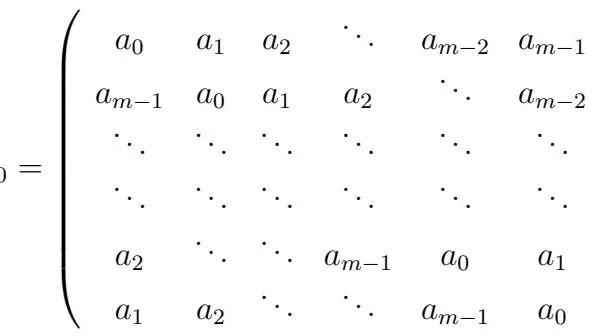
A _ {0} = \left( \begin{array}{c c c c c c} a _ {0} & a _ {1} & a _ {2} & \ddots & a _ {m - 2} & a _ {m - 1} \\a _ {m - 1} & a _ {0} & a _ {1} & a _ {2} & \ddots & a _ {m - 2} \\\ddots & \ddots & \ddots & \ddots & \ddots & \ddots \\\ddots & \ddots & \ddots & \ddots & \ddots & \ddots \\a _ {2} & \ddots & \ddots & a _ {m - 1} & a _ {0} & a _ {1} \\a _ {1} & a _ {2} & \ddots & \ddots & a _ {m - 1} & a _ {0} \end{array} \right).
$$
A simple calculation shows that
$$
A _ {0} = \varphi (P) = \sum_ {k = 0} ^ {m - 1} a _ {k} P ^ {k}.
$$
The matrix $A_0$ is considered as a polynomial of one variable. Let us compute the spectrum of the normal matrix P. Let
$$
f (\lambda) = d e t (P - \lambda I _ {m}) = \left| \begin{array}{c c c c c c} - \lambda & 1 & 0 & \ddots & 0 & 0 \\0 & - \lambda & 1 & 0 & \ddots & 0 \\\vdots & \vdots & \vdots & \vdots & \vdots & \vdots \\\vdots & \vdots & \vdots & \vdots & \vdots & \vdots \\0 & 0 & \ldots & 0 & - \lambda & 1 \\1 & 0 & \ldots & 0 & 0 & - \lambda \end{array} \right| = 1 - \lambda^ {m}.
$$
be the characteristic polynomial of $\mathbf{P}$. Thus, $\lambda$ is a primitive $m$ -th root of unity. Therefore,
$$
\sigma (P) = \left\{\lambda_ {k} ^ {P} = e ^ {\frac {2 \pi k i}{m}}: k = 0, 1, 2, \dots , m - 1 \right\}.
$$
In other words,
$$
\sigma (P) = \left\{1, e ^ {\frac {2 \pi i}{m}}, e ^ {\frac {4 \pi i}{m}}, e ^ {\frac {6 \pi i}{m}}, e ^ {\frac {8 \pi i}{m}}, e ^ {\frac {1 0 \pi i}{m}}, e ^ {\frac {1 2 \pi i}{m}}, \dots , e ^ {\frac {2 (m - 1) \pi i}{m}} \right\}.
$$
Finally,
$$
\sigma (P) = \left\{\lambda_ {0} ^ {P}, \lambda_ {1} ^ {P}, \dots , \lambda_ {m - 1} ^ {P} \right\} \subset \mathbb {D}.
$$
The spectral mapping Theorem allows us to claim that
$$
\varphi (\sigma (P)) = \sigma (\varphi (P)) = \sigma (A _ {0}).
$$
Therefore,
$$
\sigma (A _ {0}) = \left\{\varphi (\lambda_ {0} ^ {P}), \varphi (\lambda_ {1} ^ {P}), \dots , \varphi (\lambda_ {m - 1} ^ {P}) \right\}.
$$
## IX. GALAXY OF SEQUENCES OF EIGENVALUES OF CIRCULANT MATRICES
In this section, we construct galaxies of sequences of eigenvalues of circulant matrices.
Theorem 9.1. Let $X, Y, Z \in C_m(\mathbb{C})$ be three circulant matrices with complex numbers as entries such that
$$
X ^ {n} + Y ^ {n} = Z ^ {n}.
$$
Then
$$
(\lambda_ {k} ^ {X}) ^ {n} + (\lambda_ {k} ^ {Y}) ^ {n} = (\lambda_ {k} ^ {Z}) ^ {n}, \lambda_ {k} ^ {X} \in \sigma (X), \lambda_ {k} ^ {Y} \in \sigma (Y), \lambda_ {k} ^ {Z} \in \sigma (Z), k = 0, 1, 2, \dots , m - 1.
$$
In other words, the triples $(\lambda_k^X,\lambda_k^Y,\lambda_k^Z)\in \mathbb{F}_n(\mathbb{C}),k = 0,1,2,\ldots,m - 1$. That is, the planet system
$$
M (X, Y, Z) = \left[ \begin{array}{c} \lambda_ {k} ^ {X} \\\lambda_ {k} ^ {Y} \\\lambda_ {k} ^ {Z} \\k = 0, 1, 2, \ldots , m - 1 \end{array} \right] \subset \mathbb {F} _ {n} (\mathbb {C}).
$$
Proof: Let $(X,Y,Z) \in C_m(\mathbb{C}), n \in \mathbb{N}, n \geq 3$, be an element of the universe $\mathbb{F}_n(C_m(\mathbb{C}))$. The spectral factorization of the matrices $X,Y,Z$ [36, 37, 38] allows us to claim that there exists a unitary matrix $\mathbf{U}$ such that
$$
X = U \left( \begin{array}{c c c c c c} \lambda_ {0} ^ {X} & 0 & 0 & \ddots & 0 & 0 \\0 & \lambda_ {1} ^ {X} & 0 & 0 & \ddots & 0 \\\ddots & \ddots & \ddots & \ddots & \ddots & \ddots \\\ddots & \ddots & \ddots & \ddots & \ddots & \ddots \\0 & \ddots & \ddots & 0 & \lambda_ {m - 2} ^ {X} & 0 \\0 & 0 & \ddots & \ddots & 0 & \lambda_ {m - 1} ^ {X} \end{array} \right) U ^ {*} = U D _ {X} U ^ {*},
$$
$$
Y = U \left( \begin{array}{c c c c c c} \lambda_ {0} ^ {Y} & 0 & 0 & \ddots & 0 & 0 \\0 & \lambda_ {1} ^ {Y} & 0 & 0 & \ddots & 0 \\\ddots & \ddots & \ddots & \ddots & \ddots & \ddots \\\ddots & \ddots & \ddots & \ddots & \ddots & \ddots \\0 & \ddots & \ddots & 0 & \lambda_ {m - 2} ^ {Y} & 0 \\0 & 0 & \ddots & \ddots & 0 & \lambda_ {m - 1} ^ {Y} \end{array} \right) U ^ {*} = U D _ {Y} U ^ {*}
$$
and
$$
Z = U \left( \begin{array}{c c c c c c} \lambda_ {0} ^ {Z} & 0 & 0 & \ddots & 0 & 0 \\0 & \lambda_ {1} ^ {Z} & 0 & 0 & \ddots & 0 \\\ddots & \ddots & \ddots & \ddots & \ddots & \ddots \\\ddots & \ddots & \ddots & \ddots & \ddots & \ddots \\0 & \ddots & \ddots & 0 & \lambda_ {m - 2} ^ {Z} & 0 \\0 & 0 & \ddots & \ddots & 0 & \lambda_ {m - 1} ^ {Z} \end{array} \right) U ^ {*} = U D _ {Z} U ^ {*}.
$$
The equation $X^n + Y^n = Z^n$ implies
$$
U D _ {X} ^ {n} U ^ {*} + U D _ {Y} ^ {n} U ^ {*} = U D _ {Z} ^ {n} U ^ {*}.
$$
$$
U \left[ D _ {X} ^ {n} + D _ {Y} ^ {n} \right] U ^ {*} = U D _ {Z} ^ {n} U ^ {*}.
$$
We can claim that
$$
D _ {X} ^ {n} + D _ {Y} ^ {n} = D _ {Z} ^ {n}.
$$
Finally,
$$
\left(\lambda_ {k} ^ {X}\right) ^ {n} + \left(\lambda_ {k} ^ {Y}\right) ^ {n} = \left(\lambda_ {k} ^ {Z}\right) ^ {n}, \lambda_ {k} ^ {X} \in \sigma (X), \lambda_ {k} ^ {Y} \in \sigma (Y), \lambda_ {k} ^ {Z} \in \sigma (Z), k = 0, 1, 2, \dots , m - 1.
$$
In other words, the triples $(\lambda_k^X,\lambda_k^Y,\lambda_k^Z)\in \mathbb{F}_n(\mathbb{C}),k = 0,1,2,\ldots,m - 1$. That is, the planet system
$$
M (X, Y, Z) = \left[ \begin{array}{c} \lambda_ {k} ^ {X} \\\lambda_ {k} ^ {Y} \\\lambda_ {k} ^ {Z} \\k = 0, 1, 2, \ldots , m - 1 \end{array} \right] \subset \mathbb {F} _ {n} (\mathbb {C}).
$$
Every triple $(\mathrm{X},\mathrm{Y},\mathrm{Z})$ of the universe $\mathbb{F}_n(C_m(\mathbb{C}))$ generates a planet system $\mathrm{M}(\mathrm{X},\mathrm{Y},\mathrm{Z})$ which has exactly $m$ elements of the universe $\mathbb{F}_n(\mathbb{C})$. We can say that the galaxies of sequences of circulant matrices are linked to the galaxies of sequences of eigenvalues of circulant matrices. Let us consider the galaxies
$$
\Omega (\alpha I _ {m}, C _ {m} (\mathbb {N})) = \left[ \begin{array}{c} X _ {k} (\alpha I _ {m}, A) = \alpha^ {2} I _ {m} + 2 \times \alpha \times A ^ {2 ^ {k}} \\Y _ {k} (\alpha I _ {m}, A) = 2 \times \alpha \times A ^ {2 ^ {k}} + A ^ {2 ^ {k + 1}} \\Z _ {k} (\alpha I _ {m}, A) = \alpha^ {2} I _ {m} + 2 \times \alpha \times A ^ {2 ^ {k}} + A ^ {2 ^ {k + 1}} \\k \in \mathbb {N}, A \in C _ {m} (\mathbb {N}) \end{array} \right], \alpha \in \mathbb {N},
$$
of circulant matrices. We can construct the galaxies of sequences of eigenvalues of the triples of circulant matrices of the galaxies $\Omega (\alpha I_m,C_m(\mathbb{N})),\alpha \in \mathbb{N}$. For example, the galaxies
$$
\Omega (\alpha , \sigma (C _ {m} (\mathbb {N}))) = \left[ \begin{array}{c} X _ {k} (\alpha , \lambda) = \alpha^ {2} + 2 \times \alpha \times \lambda^ {2 ^ {k}} \\Y _ {k} (\alpha , \lambda) = 2 \times \alpha \times \lambda^ {2 ^ {k}} + \lambda^ {2 ^ {k + 1}} \\Z _ {k} (\alpha , \lambda) = \alpha^ {2} + 2 \times \alpha \times \lambda^ {2 ^ {k}} + \lambda^ {2 ^ {k + 1}} \\k \in \mathbb {N}, \lambda \in \sigma (A), A \in C _ {m} (\mathbb {N}) \end{array} \right] \subset \mathbb {F} _ {2} (\mathbb {N}), \alpha \in \mathbb {N},
$$
are galaxies of sequences of eigenvalues of triples of circulant matrices of the galaxies $\Omega (\alpha I_m,C_m(\mathbb{N})),\alpha \in \mathbb{N}$. As we can see that the galaxies
$$
\Omega (\alpha , \sigma (A)) = \left[ \begin{array}{c} X _ {k} (\alpha , \lambda) = \alpha^ {2} + 2 \times \alpha \times \lambda^ {2 ^ {k}} \\Y _ {k} (\alpha , \lambda) = 2 \times \alpha \times \lambda^ {2 ^ {k}} + \lambda^ {2 ^ {k + 1}} \\Z _ {k} (\alpha , \lambda) = \alpha^ {2} + 2 \times \alpha \times \lambda^ {2 ^ {k}} + \lambda^ {2 ^ {k + 1}} \\k \in \mathbb {N}, \lambda \in \sigma (A) \end{array} \right] \subset \mathbb {F} _ {2} (\mathbb {N}), \alpha \in \mathbb {N}, A \in C _ {m} (\mathbb {N}),
$$
have each a finite number of planet systems. In our case, each galaxy has $m$ planet systems. Every galaxy of the universe $\mathbb{F}_2(C_m(\mathbb{N}))$ generates a new galaxy of eigenvalues of elements of $C_m(\mathbb{N})$. Let us consider the galaxy
$$
\Sigma (2 I _ {m}, C _ {m} (\mathbb {N})) = \left[ \begin{array}{c} X _ {k} (2 I _ {m}, A) = 2 I _ {m} + 2 \times A ^ {4 k} \\Y _ {k} (2 I _ {m}, A) = 2 \times A ^ {4 k} + A ^ {8 k} \\Z _ {k} (2 I _ {m}, A) = 2 I _ {m} + 2 \times A ^ {4 k} + A ^ {8 k} \\k \in \mathbb {N}, A \in C _ {m} (\mathbb {N}) \end{array} \right].
$$
We know that the triples $(X_{k}(2I_{m},A),Y_{k}(2I_{m},A),Z_{k}(2I_{m},A))$ of the galaxy $\Sigma (2I_m,C_m(\mathbb{N}))$ satisfy
$$
X _ {k} ^ {2} (2 I _ {m}, A) + Y _ {k} ^ {2} (2 I _ {m}, A) = Z _ {k} ^ {2} (2 I _ {m}, A), k \in \mathbb {N}.
$$
Define the galaxy
$$
\Sigma (2, \sigma (C _ {m} (\mathbb {N}))) = \left[ \begin{array}{c} X _ {k} (\lambda) = 2 + 2 \times \lambda^ {4 k} \\Y _ {k} (\lambda) = 2 \times \lambda^ {4 k} + \lambda^ {8 k} \\Z _ {k} (\lambda) = 2 + 2 \times \lambda^ {4 k} + \lambda^ {8 k} \\k \in \mathbb {N}, \lambda \in \sigma (A), A \in C _ {m} (\mathbb {N}) \end{array} \right].
$$
The triples $(X_{k}(\lambda),Y_{k}(\lambda),Z_{k}(\lambda))$ of the galaxy $\Sigma (2,\sigma (C_m(\mathbb{N})))$ satisfy
$$
X _ {k} ^ {2} (\lambda) + Y _ {k} ^ {2} (\lambda) = Z _ {k} ^ {2} (\lambda), k \in \mathbb {N}.
$$
We can deduce the galaxies
$$
\Sigma (2, \sigma (A)) = \left[ \begin{array}{c} X _ {k} (\lambda) = 2 + 2 \times \lambda^ {4 k} \\Y _ {k} (\lambda) = 2 \times \lambda^ {4 k} + \lambda^ {8 k} \\Z _ {k} (\lambda) = 2 + 2 \times \lambda^ {4 k} + \lambda^ {8 k} \\k \in \mathbb {N}, \lambda \in \sigma (A), \end{array} \right], A \in C _ {m} (\mathbb {N}),
$$
which have a finite number of planet systems. The triples $(X_{k}(\lambda),Y_{k}(\lambda),Z_{k}(\lambda))$ of the galaxy $\Sigma (2,\sigma (A))$ also satisfy
$$
X _ {k} ^ {2} (\lambda) + Y _ {k} ^ {2} (\lambda) = Z _ {k} ^ {2} (\lambda), k \in \mathbb {N}.
$$
The first eigenvalue of every matrix of $C_m(\mathbb{N})$ is a positive integer.
Theorem 9.2. Let $A \in C_m(\mathbb{N})$ be a circulant matrix with positive integers as entries. Then the first eigenvalue $\lambda_0^A$ of $A$ is a positive integer. In other words, $\lambda_0^A \in \mathbb{N}$.
Proof. Let
$$
A = \left( \begin{array}{c c c c c c} a _ {0} & a _ {1} & a _ {2} & \ddots & a _ {m - 2} & a _ {m - 1} \\a _ {m - 1} & a _ {0} & a _ {1} & a _ {2} & \ddots & a _ {m - 2} \\\ddots & \ddots & \ddots & \ddots & \ddots & \ddots \\\ddots & \ddots & \ddots & \ddots & \ddots & \ddots \\a _ {2} & \ddots & \ddots & a _ {m - 1} & a _ {0} & a _ {1} \\a _ {1} & a _ {2} & \ddots & \ddots & a _ {m - 1} & a _ {0} \end{array} \right) \in C _ {m} (\mathbb {N})
$$
be a circulant matrix with positive integers as entries. Then there exists a polynomial
$$
\varphi (z) = \sum_ {k = 0} ^ {m - 1} a _ {k} z ^ {k}, a _ {k} \in \mathbb {N}, z \in \mathbb {D},
$$
such that
$$
A = \varphi (P) = \sum_ {k = 0} ^ {m - 1} a _ {k} P ^ {k}.
$$
We know that
$$
\sigma (A) = \{\varphi (\lambda_ {0} ^ {P}), \varphi (\lambda_ {1} ^ {P}), \dots , \varphi (\lambda_ {m - 1} ^ {P}) \}
$$
with
$$
\left\{\lambda_ {0} ^ {P}, \lambda_ {1} ^ {P}, \dots , \lambda_ {m - 1} ^ {P} \right\} = \left\{1, e ^ {\frac {2 \pi i}{m}}, e ^ {\frac {4 \pi i}{m}}, e ^ {\frac {6 \pi i}{m}}, e ^ {\frac {8 \pi i}{m}}, e ^ {\frac {1 0 \pi i}{m}}, e ^ {\frac {1 2 \pi i}{m}}, \dots , e ^ {\frac {2 (m - 1) \pi i}{m}} \right\}.
$$
Therefore,
$$
\lambda_ {0} ^ {A} = \varphi (1) = \sum_ {k = 0} ^ {m - 1} a _ {k} \in \mathbb {N}.
$$
Remark 9.3. Let $\mathcal{A}$ be an algebra and let $A\in C_m(\mathcal{A})$. Then
$$
\lambda_ {0} ^ {A} = \varphi (1) = \sum_ {k = 0} ^ {m - 1} a _ {k} \in \mathcal {A}.
$$
Theorem 9.1 and Theorem 9.2 allow us to provide another proof of our main result.
### Second Proof of Theorem 1.1
Assume that there exist $X, Y, Z \in C_m(\mathbb{N}), n \in \mathbb{N}, n \geq 3$, three circulant matrices with positive integers as entries such that
$$
X ^ {n} + Y ^ {n} = Z ^ {n}.
$$
Theorem 9.1 and Theorem 9.2 allow us to claim that
$$
\left(\lambda_ {0} ^ {X}\right) ^ {n} + \left(\lambda_ {0} ^ {Y}\right) ^ {n} = \left(\lambda_ {0} ^ {Z}\right) ^ {n}, n \geq 3.
$$
This implies that the equation $x^n + y^n = z^n, n \geq 3$ has positive integer solutions. We have a contradiction. Therefore, the equation
$$
X ^ {n} + Y ^ {n} = Z ^ {n}, X Y Z \neq 0, n \in \mathbb {N} (n \geq 3)
$$
has no circulant matrix with positive integers as entries solutions.
Let $\mathcal{A}$ be an algebra and let
$$
\mathcal {P} ^ {(m)} (\mathcal {A}) = \left\{f (z) = \sum_ {k = 0} ^ {m - 1} a _ {k} z ^ {k}: a _ {k} \in \mathcal {A}, z \in \mathbb {D} \right\}
$$
be the algebra of polynomials over $\mathbb{D}$. Complex polynomials of the algebra $\mathcal{P}^{(m)}(\mathbb{N})$ allow us to provide Fermat's Last Theorem for eigenvalues of circulant matrices.
Theorem 9.4. The equation
$$
x ^ {n} + y ^ {n} = z ^ {n}, x y z \neq 0, n \in \mathbb {N} (n \geq 3)
$$
has no positive integer eigenvalues of circulant matrices solutions.
Proof. Assume that there exists a triple $(\lambda, \eta, \mu)$ of positive integer eigenvalues of circulant matrices $X, Y$ and $Z$ of $C_m(\mathbb{N})$ such that
$$
\lambda^ {n} + \eta^ {n} = \mu^ {n}, \lambda \eta \mu \neq 0, n \in \mathbb {N}, n \geq 3, \lambda \in \sigma (X), \eta \in \sigma (Y), \mu \in \sigma (Z).
$$
Therefore, there exist three $f,g,h$ complex polynomials of $\mathcal{P}^{(m)}(\mathbb{N})$ such that
$$
f (z) ^ {n} + g (z) ^ {n} = h (z) ^ {n}, n \in \mathbb {N}, n \geq 3, z \in \mathbb {D}.
$$
In particular,
$$
f (P) ^ {n} + g (P) ^ {n} = h (P) ^ {n}, n \in \mathbb {N}, n \geq 3, z \in \mathbb {D}
$$
with $\mathrm{P}$ the cyclic permutation $m\times m$ -matrix given by
$$
P = \left( \begin{array}{c c c c c c} 0 & 1 & 0 & \ddots & 0 & 0 \\0 & 0 & 1 & 0 & \ddots & 0 \\\vdots & \vdots & \vdots & \vdots & \vdots & \vdots \\\vdots & \vdots & \vdots & \vdots & \vdots & \vdots \\0 & 0 & \ldots & 0 & 0 & 1 \\1 & 0 & \ldots & 0 & 0 & 0 \end{array} \right).
$$
In other words,
$$
X ^ {n} + Y ^ {n} = Z ^ {n}, X Y Z \neq 0, n \in \mathbb {N}, n \geq 3.
$$
We have a contradiction. Finally, The equation
$$
x ^ {n} + y ^ {n} = z ^ {n}, x y z \neq 0, n \in \mathbb {N} (n \geq 3)
$$
has no positive integer eigenvalues of circulant matrices solutions.
## X. FERMAT'S LAST THEOREM FOR COMPLEX POLYNOMIALS ASSOCIATED TO CIRCULANT MATRICES
We can now construct models of galaxies of complex polynomials associated to circulant matrices. Recall that
$$
\mathcal {P} ^ {(m)} (\mathbb {C}) = \left\{f (z) = \sum_ {k = 0} ^ {m - 1} a _ {k} z ^ {k}: a _ {k} \in \mathbb {C}, z \in \mathbb {D} \right\}.
$$
The galaxies of the universe $\mathbb{F}_n(C_m(\mathbb{C}))$ generate the galaxies of the universe $\mathbb{F}_n(\mathcal{P}^{(m)}(\mathbb{C}))$. For example, from the galaxy $\Sigma (2I_m,C_m(\mathbb{C}))$, we can construct the galaxy
$$
\Sigma (2, \mathcal {P} ^ {(m)} (\mathbb {C})) = \left[ \begin{array}{c} X _ {k} (f) = 2 + 2 \times f ^ {4 k} \\Y _ {k} (f) = 2 \times f ^ {4 k} + f ^ {8 k} \\Z _ {k} (f) = 2 + 2 \times f ^ {4 k} + f ^ {8 k} \\k \in \mathbb {N}, f \in \mathcal {P} ^ {(m)} (\mathbb {C}) \end{array} \right] \subset \mathbb {F} _ {2} (\mathcal {P} ^ {(m)} (\mathbb {C})).
$$
We can continue doing the same identification process with the remaining galaxies of $\mathbb{F}_2(C_m(\mathbb{C}))$. This process will lead to the construction of the universe $\mathbb{F}_2(\mathcal{P}^{(m)}(\mathbb{C}))$. Now, we are able to provide Fermat's Last Theorem for complex polynomials over the unit disk $\mathbb{D}$ associated to circulant matrices of the set $C_m(\mathbb{N})$.
Theorem 10.1. The equation
$$
x ^ {n} + y ^ {n} = z ^ {n}, x y z \neq 0, n \in \mathbb {N} (n \geq 3)
$$
has no solutions in $\mathcal{P}^{(m)}(\mathbb{N}), m \in \mathbb{N}, m \neq 0$.
Proof. Assume that there exists a triple $(f, g, h)$ of complex polynomials of the set $\mathcal{P}^{(m)}(\mathbb{N}), m \in \mathbb{N}, m \neq 0$, such that
$$
f (z) ^ {n} + g (z) ^ {n} = h (z) ^ {n}, n \in \mathbb {N}, n \geq 3, z \in \mathbb {D}.
$$
This implies that
$$
f (P) ^ {n} + g (P) ^ {n} = h (P) ^ {n}, n \in \mathbb {N}, n \geq 3.
$$
with $\mathrm{P}$ the cyclic permutation $m\times m$ -matrix given by
$$
P = \left( \begin{array}{c c c c c c} 0 & 1 & 0 & \ddots & 0 & 0 \\0 & 0 & 1 & 0 & \ddots & 0 \\\vdots & \vdots & \vdots & \vdots & \vdots & \vdots \\\vdots & \vdots & \vdots & \vdots & \vdots & \vdots \\0 & 0 & \ldots & 0 & 0 & 1 \\1 & 0 & \ldots & 0 & 0 & 0 \end{array} \right).
$$
In other words, there exist $X,Y,Z\in C_m(\mathbb{N})$ such that
$$
X ^ {n} + Y ^ {n} = Z ^ {n}, X Y Z \neq 0, n \in \mathbb {N}, n \geq 3.
$$
We have a contradiction. Finally, The equation
$$
x ^ {n} + y ^ {n} = z ^ {n}, x y z \neq 0, n \in \mathbb {N} (n \geq 3)
$$
has no solutions in $\mathcal{P}^{(m)}(\mathbb{N}), m \in \mathbb{N}, m \neq 0$.
Theorem 1.1, Theorem 9.4 and Theorem 10.1 are equivalent.
Generating HTML Viewer...
References
40 Cites in Article
Alexandria Diophantus (2014). Diophantus of Alexandria and Arithmetica.
L Euler (2020). E-98: Theorematum quorundam arithmeticorum demonstrationes.
L Euler (1770). Vollstandige Anleitung zur Algebra.
A Legendre (1823). Recherches sur quelques objets d'analyse indeterminee, et particulierement sur the theoreme de Fermat.
A Legendre (1830). Didot, Firmin.
P Dirichlet (1832). Démonstration du théorème de Fermat pour le cas des 14ièmes puissances..
G Lame (1839). THÉORIE DES NOMBRES. – Mémoire sur de nouvelles formules relatives à la théorie des polynômes radicaux, et sur le dernier theoreme de Fermat..
G Lame (1840). Memoire d'analyse indeterminee demontrant que l'equation x 7 + y 7 = z 7 est impossible en nombres entiers.
G Lame (1847). Memoire sur la resolution en nombres complexe de l'equation A 5 + B 5 + C 5 = 0.
G Lame (1865). Comptes Rendus Hebdomadaires des Seances de L'Academie des Sciences.
V Lebesque (1840). Demonstration de l'impossibilite de resoudre l'equation x 7 + y 7 + z 7 = 0 est impossible en nombres entiers.
V Lebesque (1843). Theoremes nouveaux sur l'equation indeterminee x 5 +y 5 = az 5.
G Frey (1986). Links between stable elliptic curves and certain Diophantine equations.
Jean-Pierre Serre (1972). Propri�t�s galoisiennes des points d'ordre fini des courbes elliptiques.
Jean-Pierre Serre (1987). Sur les représentations modulaires de degré 2 de Gal(Q¯/Q).
J Serre (1996). Travaux de Wiles (et Taylor).
K Ribet (1990). On modular representations of $$(\bar Q/Q)$$ arising from modular forms.
B Mazur (1987). Deforming Galois Representations.
Barry Mazur (1977). Modular curves and the Eisenstein ideal.
Richard Taylor,Andrew Wiles (1995). Ring-Theoretic Properties of Certain Hecke Algebras.
Andrew Wiles (1995). Modular Elliptic Curves and Fermat's Last Theorem.
C Breuil,B Conrad,F Diamond,R Taylor (2001). On the modularity of elliptic curves over : wild 3-adic exercices.
Brian Conrad,Fred Diamond,Richard Taylor (1999). Modularity of certain potentially Barsotti-Tate Galois representations.
Fred Diamond (1996). On Deformation Rings and Hecke Rings.
Bibek Nag (2021). An Elementary Proof of Fermat’s Last Theorem for Epsilons.
Joachim Mouanda (2022). On Fermat’s Last Theorem and Galaxies of Sequences of Positive Integers.
R Domiaty (1966). Solutions of x 4 + y 4 = z 4 in 2 × 2 Integral Matrices.
L Veserstein (1989). Noncommutative number theory.
D Frejman (1993). On Fermat's in the set of Fibonacci matrices.
Aleksander Grytczuk (1995). On Fermat's equation in the set of integral 2×2 matrices.
A Khazanov (1995). Fermat's equation in matrices.
H Qin (1996). Fermat's problem and Goldbach problem over Mn( ).
Z Patay,A Szakacs (2002). On Fermat's problem in matrix ring and groups.
Mao-Ting Chien,Jie Meng (2021). Fermat's equation over 2-by-2 matrices.
Enrico Laeng (1999). On Fermat's Last Theorem for Polynomials.
P Davis (1979). John Wiley & Sons, Inc..
P Davis (1994). Circulant Matrices.
P Davis (2013). Circulant Matrices.
D Geller,I Kra,S Popescu,S Simanca (2002). On circulant matrices.
No ethics committee approval was required for this article type.
Data Availability
Not applicable for this article.
How to Cite This Article
Joachim Moussounda Mouanda. 2026. \u201cOn Fermat’s Last Theorem Matrix Version and Galaxies of Sequences of Circulant Matrices with Positive Integers as Entries\u201d. Global Journal of Science Frontier Research - F: Mathematics & Decision GJSFR-F Volume 22 (GJSFR Volume 22 Issue F2).
Explore published articles in an immersive Augmented Reality environment. Our platform converts research papers into interactive 3D books, allowing readers to view and interact with content using AR and VR compatible devices.
Your published article is automatically converted into a realistic 3D book. Flip through pages and read research papers in a more engaging and interactive format.

Our website is actively being updated, and changes may occur frequently. Please clear your browser cache if needed. For feedback or error reporting, please email [email protected]
Thank you for connecting with us. We will respond to you shortly.