Optimization of Supply Chain Network Perspective Environmental Impact Based on Fuzzy Mathematical Programming

Md. Shakil
Md. Shakil
Subrata Talapatra
Subrata Talapatra
Khulna University of Engineering and Technology

Send Message

To: Author

Optimization of Supply Chain Network Perspective Environmental Impact Based on Fuzzy Mathematical Programming

Article Fingerprint

ReserarchID

1WZJT

Optimization of Supply Chain Network Perspective Environmental Impact Based on Fuzzy Mathematical Programming Banner

AI TAKEAWAY

Connecting with the Eternal Ground
  • English
  • Afrikaans
  • Albanian
  • Amharic
  • Arabic
  • Armenian
  • Azerbaijani
  • Basque
  • Belarusian
  • Bengali
  • Bosnian
  • Bulgarian
  • Catalan
  • Cebuano
  • Chichewa
  • Chinese (Simplified)
  • Chinese (Traditional)
  • Corsican
  • Croatian
  • Czech
  • Danish
  • Dutch
  • Esperanto
  • Estonian
  • Filipino
  • Finnish
  • French
  • Frisian
  • Galician
  • Georgian
  • German
  • Greek
  • Gujarati
  • Haitian Creole
  • Hausa
  • Hawaiian
  • Hebrew
  • Hindi
  • Hmong
  • Hungarian
  • Icelandic
  • Igbo
  • Indonesian
  • Irish
  • Italian
  • Japanese
  • Javanese
  • Kannada
  • Kazakh
  • Khmer
  • Korean
  • Kurdish (Kurmanji)
  • Kyrgyz
  • Lao
  • Latin
  • Latvian
  • Lithuanian
  • Luxembourgish
  • Macedonian
  • Malagasy
  • Malay
  • Malayalam
  • Maltese
  • Maori
  • Marathi
  • Mongolian
  • Myanmar (Burmese)
  • Nepali
  • Norwegian
  • Pashto
  • Persian
  • Polish
  • Portuguese
  • Punjabi
  • Romanian
  • Russian
  • Samoan
  • Scots Gaelic
  • Serbian
  • Sesotho
  • Shona
  • Sindhi
  • Sinhala
  • Slovak
  • Slovenian
  • Somali
  • Spanish
  • Sundanese
  • Swahili
  • Swedish
  • Tajik
  • Tamil
  • Telugu
  • Thai
  • Turkish
  • Ukrainian
  • Urdu
  • Uzbek
  • Vietnamese
  • Welsh
  • Xhosa
  • Yiddish
  • Yoruba
  • Zulu
Font Type
Font Size
Font Size
Bedground

Abstract

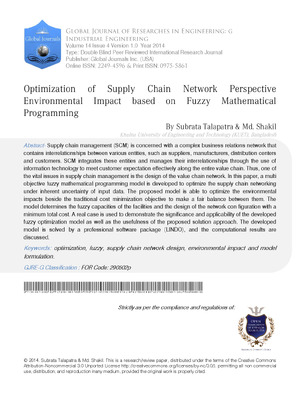
Supply chain management (SCM) is concerned with a complex business relations network that contains interrelationships between various entities, such as suppliers, manufacturers, distribution centers and customers. SCM integrates these entities and manages their interrelationships through the use of information technology to meet customer expectation effectively along the entire value chain. Thus, one of the vital issues in supply chain management is the design of the value chain network. In this paper, a multi objective fuzzy mathematical programming model is developed to optimize the supply chain networking under inherent uncertainty of input data. The proposed model is able to optimize the environmental impacts beside the traditional cost minimization objective to make a fair balance between them. The model determines the fuzzy capacities of the facilities and the design of the network con figuration with a minimum total cost. A real case is used to demonstrate the significance and applicability of the developed fuzzy optimization model as well as the usefulness of the proposed solution approach. The developed model is solved by a professional software package (LINDO), and the computational results are discussed.

References

25 Cites in Article
  1. H Pirkul,V Jayaraman (1998). A multi-commodity, multiplant, capacitated facility location problem: formulation and efficient heuristic solution.
  2. M Ilgin,M Surendra,S Gupta (2010). Environmentally conscious manufacturing and product recovery (ECMPRO): a review of the state of the art.
  3. C Timpe,J Kallrath (2000). Optimal planning in large multi-site production networks.
  4. Andi Cakravastia,Isa Toha,Nobuto Nakamura (2002). A two-stage model for the design of supply chain networks.
  5. Srinivas Talluri,R Baker (2002). A multi-phase mathematical programming approach for effective supply chain design.
  6. A Syarif,Y Yun,M Gen (2002). Study on multi-stage logistic chain network: a spanning tree-based genetic algorithm approach.
  7. Amir Sanayei,S Farid Mousavi,M Abdi,Ali Mohaghar (2008). An integrated group decision-making process for supplier selection and order allocation using multi-attribute utility theory and linear programming.
  8. B Javadi,M Saidi-Mehrabad,A Haji,I Mahdavi,F Jolai,N Mahdavi-Amiri (2008). No-wait flow shop scheduling using fuzzy multi-objective linear programming.
  9. M Jimenez,M Arenas,A Bilbao,M Rodriguez (2007). Linear programming with fuzzy parameters: An interactive method resolution.
  10. M Jimenez (1996). RANKING FUZZY NUMBERS THROUGH THE COMPARISON OF ITS EXPECTED INTERVALS.
  11. L Meade,J Sarkis,A Presley (2007). The theory and practice of reverse logistics.
  12. S Srivastara (2007). Green supply-chain management: a state-of-the-art literature review.
  13. M Melo,S Nickel,F Saldanha-Da-Gama (2009). Facility location and supply chain management -A review.
  14. A Barros,R Dekker,V Scholten (1998). A two-level network for recycling sand: A case study.
  15. V Jayaraman,V Guide,R Srivastava (1999). A closed-loop logistics model for remanufacturing.
  16. F Du,G Evans (2008). A bi-objective reverse logistics network analysis for post-sale service.
  17. H Krikke,A Van Harten,P Schuur (1999). Business case Océ: Reverse logistic network re-design for copiers.
  18. Jeong-Eun Lee,Mitsuo Gen,Kyong-Gu Rhee (2009). Network model and optimization of reverse logistics by hybrid genetic algorithm.
  19. Necati Aras,Deniz Aksen (2008). Locating collection centers for distance- and incentive-dependent returns.
  20. Mir Pishvaee,Reza Farahani,Wout Dullaert (2010). A memetic algorithm for bi-objective integrated forward/reverse logistics network design.
  21. Hyun Ko,Gerald Evans (2007). A genetic algorithm-based heuristic for the dynamic integrated forward/reverse logistics network for 3PLs.
  22. Mir Pishvaee,Fariborz Jolai,Jafar Razmi (2009). A stochastic optimization model for integrated forward/reverse logistics network design.
  23. M El-Sayed,N Afia,A El-Kharbotly (2010). A stochastic model for forward–reverse logistics network design under risk.
  24. (1996). Optimization of Supply Chain Network Perspective Environmental Impact based on Fuzzy Mathematical Programming Uncertain.
  25. M Pishvaee,S Torabi (2010). A possibilistic programming approach for closed-loop supply chain network design under uncertainty.

Funding

No external funding was declared for this work.

Conflict of Interest

The authors declare no conflict of interest.

Ethical Approval

No ethics committee approval was required for this article type.

Data Availability

Not applicable for this article.

How to Cite This Article

Md. Shakil. 2014. \u201cOptimization of Supply Chain Network Perspective Environmental Impact Based on Fuzzy Mathematical Programming\u201d. Global Journal of Research in Engineering - G: Industrial Engineering GJRE-G Volume 14 (GJRE Volume 14 Issue G4).

Download Citation

Journal Specifications

Crossref Journal DOI 10.17406/gjre

Print ISSN 0975-5861

e-ISSN 2249-4596

Version of record

v1.2

Issue date
October 17, 2014

Language
en
Experiance in AR

Explore published articles in an immersive Augmented Reality environment. Our platform converts research papers into interactive 3D books, allowing readers to view and interact with content using AR and VR compatible devices.

Read in 3D

Your published article is automatically converted into a realistic 3D book. Flip through pages and read research papers in a more engaging and interactive format.

Article Matrices
Total Views: 4481
Total Downloads: 2219
2026 Trends
Related Research
Our website is actively being updated, and changes may occur frequently. Please clear your browser cache if needed. For feedback or error reporting, please email [email protected]

Request Access

Please fill out the form below to request access to this research paper. Your request will be reviewed by the editorial or author team.
X

Quote and Order Details

Contact Person

Invoice Address

Notes or Comments

This is the heading

Lorem ipsum dolor sit amet, consectetur adipiscing elit. Ut elit tellus, luctus nec ullamcorper mattis, pulvinar dapibus leo.


High-quality academic research articles on global topics and journals.

Optimization of Supply Chain Network Perspective Environmental Impact Based on Fuzzy Mathematical Programming

Subrata Talapatra
Subrata Talapatra
Md. Shakil
Md. Shakil <p>Khulna University of Engineering and Technology</p>

Research Journals