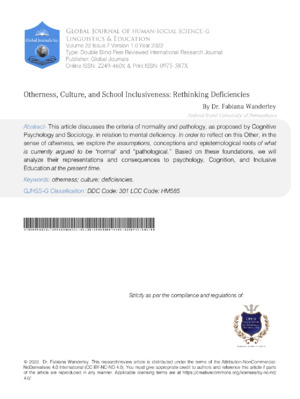
Otherness, Culture, and School Inclusiveness: Rethinking Deficiencies

α
Dr. Fabiana Wanderley
α Universidade Federal Rural de Pernambuco

Send Message

To: Author

Otherness, Culture, and School Inclusiveness: Rethinking Deficiencies

Article Fingerprint

ReserarchID

R77CK

Otherness, Culture, and School Inclusiveness: Rethinking Deficiencies Banner

AI TAKEAWAY

Connecting with the Eternal Ground
  • English
  • Afrikaans
  • Albanian
  • Amharic
  • Arabic
  • Armenian
  • Azerbaijani
  • Basque
  • Belarusian
  • Bengali
  • Bosnian
  • Bulgarian
  • Catalan
  • Cebuano
  • Chichewa
  • Chinese (Simplified)
  • Chinese (Traditional)
  • Corsican
  • Croatian
  • Czech
  • Danish
  • Dutch
  • Esperanto
  • Estonian
  • Filipino
  • Finnish
  • French
  • Frisian
  • Galician
  • Georgian
  • German
  • Greek
  • Gujarati
  • Haitian Creole
  • Hausa
  • Hawaiian
  • Hebrew
  • Hindi
  • Hmong
  • Hungarian
  • Icelandic
  • Igbo
  • Indonesian
  • Irish
  • Italian
  • Japanese
  • Javanese
  • Kannada
  • Kazakh
  • Khmer
  • Korean
  • Kurdish (Kurmanji)
  • Kyrgyz
  • Lao
  • Latin
  • Latvian
  • Lithuanian
  • Luxembourgish
  • Macedonian
  • Malagasy
  • Malay
  • Malayalam
  • Maltese
  • Maori
  • Marathi
  • Mongolian
  • Myanmar (Burmese)
  • Nepali
  • Norwegian
  • Pashto
  • Persian
  • Polish
  • Portuguese
  • Punjabi
  • Romanian
  • Russian
  • Samoan
  • Scots Gaelic
  • Serbian
  • Sesotho
  • Shona
  • Sindhi
  • Sinhala
  • Slovak
  • Slovenian
  • Somali
  • Spanish
  • Sundanese
  • Swahili
  • Swedish
  • Tajik
  • Tamil
  • Telugu
  • Thai
  • Turkish
  • Ukrainian
  • Urdu
  • Uzbek
  • Vietnamese
  • Welsh
  • Xhosa
  • Yiddish
  • Yoruba
  • Zulu

Abstract

This article discusses the criteria of normality and pathology, as proposed by Cognitive Psychology and Sociology, in relation to mental deficiency. In order to reflect on this Other, in the sense of otherness, we explore the assumptions, conceptions and epistemological roots of what is currently argued to be “normal” and “pathological.” Based on these foundations, we will analyze their representations and consequences to psychology, Cognition, and Inclusive Education at the present time.

References

30 Cites in Article
  1. J Bueno (1993). Educação Especial Brasileira: Integração/Segregação do Aluno Diferente.
  2. G Canguilhem (1995). O Normal e o Patológico.
  3. Harry Daniels,Org (1994). Vygotsky em Foco: Pressupostos e Desdobramentos.
  4. E Durkheim As Regras do Método Sociológico.
  5. José Laier,João Barreiro,Walter Savassi (1983). Complementos de resistência dos materiais. 2. ed..
  6. Evans (1994). Vygotsky em Foco: Pressupostos e Desdobramentos.
  7. Jonathan Freitas (1975). Processo e leitura genealógica em “Delírio e transcendência” de “História da loucura na idade clássica”.
  8. Maria Pimentel (1980). LEOPOLDO J0BIM, Ideologia e Colonialismo, Rio de Janeiro, Editora Forense- Universitária, 1985, 131pp..
  9. J González (2002). Carta de Porto Alegre.
  10. Luria (1988). Diferenças culturais de pensamento.
  11. R Maturana,F Varela (1995). A Árvore do Conhecimento: as bases biológics do centendimento humano.
  12. R Mcdermott,L Hood (1982). Understanding Shadow Education & Formal Schooling Practices Using Institutional Ethnography.
  13. Ray Mcdermott,Hervé Varenne (1995). Culture as Disability.
  14. L Meira (2004). Zonas de Desenvolvimento Proximal nas salas de aula de ciências e matemática.
  15. L Meira,S Lerman (2001). The Zone of Proximal Development as a symbolic space.
  16. L Meira (1995). Análise microgenética e videografia: Ferramentas de pesquisa em psicologia cognitiva.
  17. Fabiana Moreira (1997). "A simbologia de procusto e a normalização do Plano Estadual de Educação - PE - 1988-1991".
  18. F Moreira (2010). Na Contramão das Limitações: a produção de sentido na deficiência mental.
  19. O Sacks (2001). Um Antropólogo em Marte -Sete Histórias Paradoxiais.
  20. J Valsiner The Development of the Concept of Development: historical and epistemological perspectives.
  21. J Valsiner (1997). Culture and the development of childrens's action: A theory of human development.
  22. Jaan Valsiner (2000). Culture and Human Development: An Introduction.
  23. René Van Der Veer,Jaan Valsiner (1999). Vygotsky -Uma Síntese.
  24. S Vygotsky Lev (1989). Fundamentos de Defectologia. Obras completas -tomo cinco.
  25. Lev Vygotsky (1993). The collect works of L.S. Vigotsky: the fundamentals of defectology.
  26. L Vygotsky (1984). A formação social da mente.
  27. L Vygotsky (2001). A construção do pensamento e da linguagem.
  28. (1996). Teoria e Método em Psicologia.
  29. L Vygotsky,A Luria (1996). Estudos sobre a História do Comportamento: o Símios, Homem Primitivo e a Criança.
  30. F Wanderley (1997). Expressões e Silêncios do Discurso Cidadania-Deficiência Mental -Uma Abordagem Histórico-Discursiva do Plano Estadual de Educação 1988-1991.

Funding

No external funding was declared for this work.

Conflict of Interest

The authors declare no conflict of interest.

Ethical Approval

No ethics committee approval was required for this article type.

Data Availability

Not applicable for this article.

How to Cite This Article

Dr. Fabiana Wanderley. 2026. \u201cOtherness, Culture, and School Inclusiveness: Rethinking Deficiencies\u201d. Global Journal of Human-Social Science - G: Linguistics & Education GJHSS-G Volume 22 (GJHSS Volume 22 Issue G7): .

Download Citation

Obedience, culture, and school inclusiveness are key factors influencing students' psychological and social development.
Issue Cover
GJHSS Volume 22 Issue G7
Pg. 47- 55
Journal Specifications

Crossref Journal DOI 10.17406/GJHSS

Print ISSN 0975-587X

e-ISSN 2249-460X

Keywords
Classification
GJHSS-G Classification: DDC Code: 301 LCC Code: HM585
Version of record

v1.2

Issue date

June 27, 2022

Language
en
Experiance in AR

Explore published articles in an immersive Augmented Reality environment. Our platform converts research papers into interactive 3D books, allowing readers to view and interact with content using AR and VR compatible devices.

Read in 3D

Your published article is automatically converted into a realistic 3D book. Flip through pages and read research papers in a more engaging and interactive format.

Article Matrices
Total Views: 1709
Total Downloads: 49
2026 Trends
Related Research

Published Article

This article discusses the criteria of normality and pathology, as proposed by Cognitive Psychology and Sociology, in relation to mental deficiency. In order to reflect on this Other, in the sense of otherness, we explore the assumptions, conceptions and epistemological roots of what is currently argued to be “normal” and “pathological.” Based on these foundations, we will analyze their representations and consequences to psychology, Cognition, and Inclusive Education at the present time.

Our website is actively being updated, and changes may occur frequently. Please clear your browser cache if needed. For feedback or error reporting, please email [email protected]

Request Access

Please fill out the form below to request access to this research paper. Your request will be reviewed by the editorial or author team.
X

Quote and Order Details

Contact Person

Invoice Address

Notes or Comments

This is the heading

Lorem ipsum dolor sit amet, consectetur adipiscing elit. Ut elit tellus, luctus nec ullamcorper mattis, pulvinar dapibus leo.

High-quality academic research articles on global topics and journals.

Otherness, Culture, and School Inclusiveness: Rethinking Deficiencies

Dr. Fabiana Wanderley
Dr. Fabiana Wanderley Universidade Federal Rural de Pernambuco

Research Journals