I. INTRODUCTION
In world practice, geothermal energy finds its wide application in heating premises, resorts, hospitals, greenhouses, in general, in economic activity. In agricultural production, which is the main activity of this region, the use of thermal water will provide tangible benefits. Heating livestock complexes, heating drinking water for livestock in winter, the use of wastewater in fish breeding ponds is no less promising areas of geothermal heat utilization. The use of complex geothermal source schemes in the cold season allows you to supply hot water from the well in the heating system of greenhouses. The waste water through the system forms a temperature difference of . Then water with a temperature of about is sent to livestock farms. After circulation of such scheme, the water temperature is and goes for tanks and ponds.
During the warm season, using water from artesian wells to irrigate outdoor vegetables can increase yields by . Geothermal water can be used in energy-intensive technological processes, such as heat treatment of concrete in construction, washing wool, drying wood and others. The thermal springs are especially important in the treatment of various diseases, their chemical composition has therapeutic properties. Another important aspect of using geothermal sources is the extraction of valuable chemical elements and various compounds from water: iodine, bromine, sodium chloride, boric acid, alkali, sulfur, Glauber's salt, etc. [1]. The economic value of these resources is significant.
Not only in the Issyk-Kul region, but also in other areas of the Republic, the use of renewable energy sources is not yet widespread. The study of the literature, gives the background to the need to introduce this type of energy sources, as with global climate change, the large demand for natural resources and a sharp increase in population cannot provide the necessary conditions and products from natural resources in a timely manner. The purpose of this work is to study the qualitative composition of geothermal sources of Kyrgyzstan, on the example of the Issyk-Kul region.
II. MATERIALS AND METHODS
a) Subject of the Study
The Kyrgyz Republic is rich in natural resources, the Issyk-Kul region, located in the northeastern part of the Republic and is an administrative and special natural-climatic zone. In the north of the Issyk-Kul hollow is the Kungoi Ala-Too ridge, the southern border of the region is the Teskei Ala-Too ridge, which sharply separates it from the inner Tien Shan. The total length of the Issyk-Kul basin, including the slopes of the surrounding ridges, is more than 250 km with the greatest width of 100 km. The area of the region is 43.1 thousand square kilometers, which is of the country's area [2]. The landscape of the Issyk-Kul hollow is quite complex and is represented by a complex of plains, foothills and mountains [3].
Number of residents 470.1 thousand people, number of inhabitants per 11 people (2017 at the beginning of the year). The administrative-territorial structure of the Issyk-Kul region includes five districts, according to favorable agro-climatic conditions, specialized for growing grains, fodder crops, vegetables and fruits (total area of cultivated land is 87.1 thousand ha, i.e. of the total area of cultivated land of the country), small and cattle and horse breeding. There are
3 cities, 2 urban-type settlements, 61 rural areas. The urban population is 128.9 thousand people, the rural population is 329.6 thousand people [2].
III. METHODOLOGY
The methodology of this study includes a review of the literature on the issues of relevant topics. As input data geothermal resources are used data on the mineralogical resources, the topography of the area in the form of its digital model. The variability of the climatic regime of the study area was studied using data from the meteorological stations of Cholpon-Ata city. The collection and systematization of hydrochemical data are compiled for the location of geothermal resources [4].
IV. RESULTS
This area contains a huge reserve of mineral and thermal waters, which can be applied as renewable energy resources. Jetty-Oguz resort is located on the northern slope of the Teskei Ala-Too ridge at a distance of from Karakol at an altitude of above sea level. The main characteristics of the resort waters are represented as medium-mineralized (11-13 g/l) and medium-mineralized (9-11g/l). Of these mediums mineralized (11-13g/l) thermal Rhodonium medium concentration (111-154 nCi/L) calcium-sodium chloride water well 1-K is used for balneotherapy. Low saline (9-11g/l) thermal slightly rhodonated (5.3-10.6nCi/l) calcium-sodium chloride waters of the well 6 are used for balneotherapy. Radon water from well 5 is mainly used for therapeutic and drinking purposes. These waters have a temperature of and a low concentration of calcium and sodium chloride (3-4 g/l) at an average concentration (45.0-54.0 nCi/L).
Zhyrgalan resort is located in the Issyk-Kul basin, 6 km from Karakol. The therapeutic base of this resort is slightly mineralized (0.9 g/l) thermal (35-43°C) waters of the well 1-A, discovered in 1960, as well as of the well 2/74, drilled in 1974. Mineral waters are characterized by sulfate-chloride sodium composition, alkaline reaction. The balneo-technical condition of the wells is in good condition. These thermal waters with the volume of 1728 m3/day are recommended both in the balneotherapy for expansion of the spa area and industrial bottling
The Ak-Suu mineral water deposit is located in the southeast of the Issyk-Kul hollow, on the northern part of the Teskei Ala-Too ridge, in the narrow gorge of the river of the same name. The nearest settlement is the village of Teploklyuchenka, situated 5-6 km away. Ak-Suu thermal waters are similar to the Issyk-Ata thermal waters. The water flow rate of the three operating wells is , the water temperature is up to .
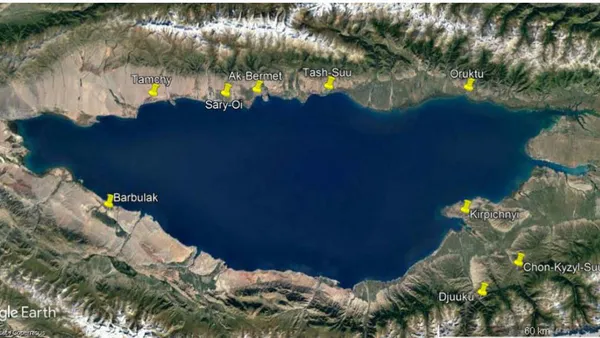
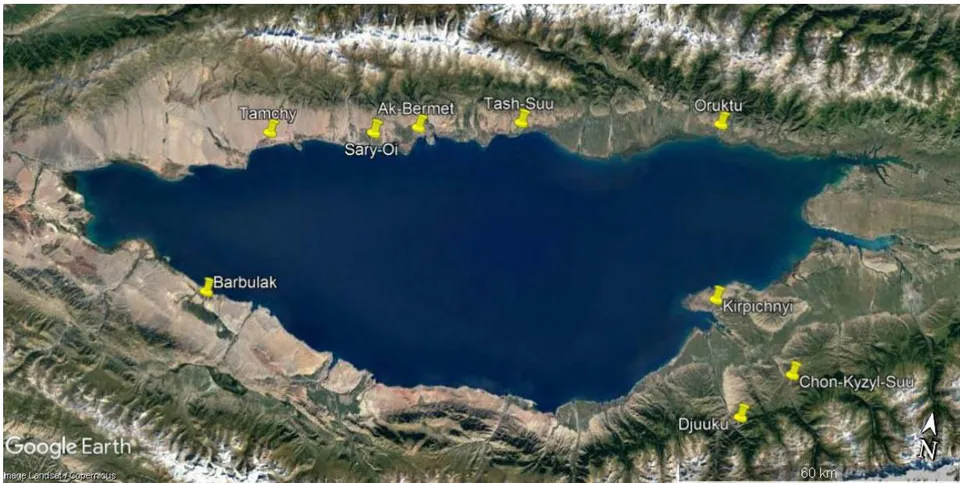
The Barbulak deposit is located on the southern shore of Lake Issyk-Kul to the east of the town of Balykchy. Water salinity is 4.0-4.7 g/l and is characterized by sulfate-chloride calcium-sodium composition.
Cholpon-Ata thermal water deposits (35-53°C) are represented by medium and high-mineralized calcium-sodium chloride (15-40 g/l) springs. It is located in the northern part of the coastal strip of Lake Issyk-Kul. They are brought to the surface by a number of wells from 800-200m depth and found wide application
in:Blue Issyk-Kul (wells 773.1/81), Cholpon-Ata (well 846), Issyk-Kul (wells 775, 1268), Kazakhstan (well 999), Ala-Too (well 887).
Kosh-Kol, wells 1112, 1112, -A, 1375 are located from Rybachie. Thermal waters are brought out on the northern shore of the lake. The flow rate of the wells is 2592, 2281, and 1296 day, respectively, water salinity is 0.6-1.7 g/l and sodium chloride-sulfate and sulfate-chloride composition. The pH value is about 7.80 to 9.50. Silicic acid concentration is up to and fluorine- .
Tamchi. Well 1579 was drilled in 1984 in the territory of Tamchyvillage. The water flow rate is 1347, 8 . Water temperature is , pH 8.9, salinity 0.5 g/l, the composition is characterized by sodium chloride-sulfate, concentration of silicic acid , fluoride . Thermal water is used for household and domestic needs.
Chock-Tal, well 1517. Drilledin 1983 with a supply of and used for balneological and therapeutic-drinking purposes according to indications. Water temperature is , the reaction is alkaline 9.50). In terms of composition, it belongs to the hydrocarbonate-sulfate sodium with mineralization of . The content of silicic acid is about and fluorine .
Chon-Sary-Oy well 1543, discovered in 1981 and located on the territory of the Altyn-Kum resort. Preliminary reserve of this spring is , temperature , pH -8.90. Water is characterized by mineralization up to chloride-hydrocarbonatesulfate composition. Silicic acid content is up to and fluorine content is up to . Well 1215 with a flow rate of and temperature of has a similar composition and properties of water of well 1543.
Kurskoye wells 833, 1516. Well 833 was discovered as one of the first on the shore of Lake Issyk-Kul. It was drilled in the end of 1985 in the territory of the boarding house "Geologist". Wells 1516 and 833 are put into exploitation to provide household needs. Mineral water of these wells is characterized as slightly mineralized (0.9-1.9 g/l) of sodium chloride-sulfate composition and alkaline (pH 8.50-9.12). Concentration of silicic acid is in the range of 31-45mg/l, fluorine-4,2-6,6mg/l. Preliminary water reserves for well 833-388-388 m3, and for well 1516-604.8 m3/d.
Dolinkawells 888 and 1183 were opened in 1979 and 1981, of which well 888 is mothballed, and well 1183 is used for self-monitoring and for domestic needs. Approximate water reserves of the wells make respectively and . Water composition of these wells is the same type of sulfate-chloride sodium water with significant fluoride content (up to ) and silicic acid (up to ). Water temperature is within with salinity of and water reaction is alkaline .
Karabulunskoe thermal water deposit (39-50°C) is located on the peninsula of the same name in the southeastern part of the Issyk-Kul depression, 15 km northwest of the Kara-Suu village. Exploration of the field was carried out in 1975-1981. Reserves amount to 3154 . Waters of this deposit have an alkaline reaction (pH 9.50-10.50), low mineralization in the range of 0.3-1.2 g/l, different anionic composition. These waters are characterized by a high content of silicic acid (up to 52 mg/l) and fluorine (7.6-9.3 mg/l).
Ak-Terek, well 851 was drilled in 1979 with an estimated supply of /day. The water temperature of the well is , the pH value is 8.90. The composition of this source belongs to the sulfate-chloride-hydrocarbonate sodium with a total salt content of .
The Chon-Kyzyl-Suu springs, represented by three springs, are located on the northern slope of the Terskey Ala-Too ridge, in the gorge of the river of the same name, to the south of the Kyzyl-Suu village. The Chon-Kyzyl-Suu springs, represented by three springs, are located on the northern slope of the Terskey Ala-Too ridge, in the gorge of the river of the same name, to the south of the Kyzyl-Suu village. Of the three springs, two of them are captive pools with overhead wooden logs. The water of the springs is clear, clean, fresh to the taste of hydrogen sulfide. Water temperature is , water reaction is alkaline . The total water flow rate of the springs is about . Their chemical composition is low-mineralized sodium chloride-sulfate with a significant content of silicic acid (over ) and fluoride up to .
The Juukuchak spring is located in the river gorge of the same name, away from these springs is the village of Kyzyl-Suu. Kyzyl-Suu. The springs are used by the local population. The water of the springs is transparent, clean, fresh to the taste with a smell of hydrogen sulfide. Water temperature 32.0- , alkaline water with pH 7.9-8.70, flow rate 1 l/sec. Water refers to nitric, slightly mineralized (0.3-0.4 g/l), chloride-sulfate sodium, with silicic acid 50mg/l and fluoride -7-9 mg/l.
The Altyn-Arashan springs are located on the northern side of the Teskei Ala-Too ridge and are divided into three groups of springs: northern, middle and southern. These springs are characterized by the same composition. The Altyn-Arashan northern springs are located on the northern slope of the Ak-Suu river, 20-23 km southwest of Karakol. The water temperature varies from 35.5 to with a flow rate of about 1 l/sec. All the springs are captive, used for therapeutic purposes and are difficult to access.
Altyn-Arashan middle springs are located upstream the Ak-Suu River southeast of Karakol and are hard to reach. Along 1000 m along the river valley 15 outlets of the springs were fixed with the total flow rate
according to the measurements of 1952. . The water in them is fresh, with a smell of hydrogen sulfide, the temperature varies from 17.5 to . Some of the springs are dripped and used by the local population for medicinal purposes. In the Ak-Suu Gorge, such springs are about away, and in the future can be used for heating purposes for the year of Karakol.
The Allyn-Arashan South springs are located in the basin of the Chatyr-Tor River. There are five known outlets of the springs with water temperature , the total flow rate is about 1 l/sec. The spring water is transparent, clean, fresh to the taste and is presented as nitrogen slightly mineralized (0.3-0.5 g/l), alkaline (pH 8.15-9.04), siliceous (50mg/l), chloride-hydrocarbonate sodium composition. Increased fluoride content (up to 21 mg/l) from this source, which makes it unsuitable for therapeutic and drinking purposes.
V. DISCUSSION
Heat reserves determine the climate of the Issyk-Kul region. According to studies of lake posts, from April to August the air temperature is higher than the lake water temperature and air heats the water, and from September to March it is lower and the water heats the air. Thus, the average annual air temperature is 3.5- below the water temperature. This contributes to the conditions: the exchange is cool in summer and warm in winter. The average multi-year annual heat budget of Lake Issyk-Kul is 41700 calories/cm2. According to D. Hutchinson, except for Baikal and Michigan, it is not typical for other lakes to have an annual budget exceeding 50.000cal/cm2. [5]. Duration of sunshine during the year on Lake Issyk-Kul (2880 hours) is 1.3 times higher than the same indicator for Yalta (2250 hours) [6]. These climate factors create additional favorable conditions for the use of renewable energy sources and reduce the cost.
Currently, the population of the Issyk-Kul region, mainly use electricity generated by hydropower (about ), other types of energy are not developed. The main energy resources are imported at market prices and their consumption increases year after year. At the same time, the economy of the Kyrgyz Republic cannot afford such a high level of consumption of energy resources because our economy is considered to be energy-intensive. Although electrification covers about of the population in the Kyrgyz Republic, there are interruptions in the supply of electricity during winter periods. In terms of electricity consumption per capita, the Kyrgyz Republic ranks 120th out of 133 countries and amounts to 1375 kWh of electricity per year [7].
Prices for 1 kWh of electricity in the Kyrgyz Republic from 2004 to 2014 was 0.7som [7], from 2015 to the present with consumption up to 700 kWh per month is 0.77som, with consumption over 700 kWh per month is 2.16 som for individuals and 2.5 som for legal entities [8].
Geothermal sources have a low cost, so the use of geothermal sources in the Issyk-Kul region is a promising direction to increase the capacity of the energy system. Since the energy potential of renewable energy sources in Kyrgyzstan is significant. According to estimates of the Ministry of Economy of the Kyrgyz Republic and foreign experts, the energy from geothermal sources is 5-10 thousand kWh per year [9,10]. Ecology is an important factor in calculating the cost of resources; the cleaner the ecology, the more expensive natural resources are. Sustainability of resources and the natural environment is a necessity.
VI. CONCLUSION
The intensive use of the basin's natural resources is unfortunately carried out without proper economic and technical-economic justification and scientific analysis of potential natural opportunities and requirements for the natural environment. The negative consequences of this approach are beginning to be felt now and may be even more significant in the future. On this basis, it is recommended that:
- Build resource-saving technologies, ensure the integrated use of resources, and improve the protection of mineral and thermal water resources.
- Introduce renewable energy sources in agriculture, resorts and tourism facilities, in heating various kinds of buildings and facilities, as well as wide application among the population.
- Improve the management of nature protection in the republic, increase the effectiveness of state control over the state of nature and sources of pollution.