High-energy ions have the potential to damage the walls of nuclear fusion Tokamak reactors. As a result, it is essential to establish dependable methods for determining whether the materials are still resilient. This investigation examines the most effective methods for assessing the reliability of materials that contain tritium plasma in graphene crystals. The impact of varying energy levels from 5 keV to 35 keV on tritium plasma was investigated using molecular dynamics in a computer simulation to investigate the retention mechanisms. The quantity of tritium retained, Shannon entropy based on kinetic energy, and Shannon entropy are all factors that are used to calculate reliability. A valuable instrument for comparing various categories of tritium plasma on graphene crystals, with kinetic energies ranging from 5 keV to 35 keV, are the Pearson correlation coefficients. The designer can employ Pearson Correlation to ascertain the most efficient structural reliability computation method for a variety of reliability calculations. This research simplifies the process of selecting plasma-resistant materials for nuclear fusion applications and allows designers to enhance the design of reactor walls.
## I. INTRODUCTION
The modification of condensed matter is a significant topic, as evidenced by the extensive corpus of research that is available in the literature, specifically the interaction between plasma and surface materials. In temperature-variable environments, plasma-material interactions modify the surfaces of materials, leading to sputtering, retention, and chemical variations. Interactions between plasma materials in magnetic fusion devices, including nuclear fusion reactors, generate substantial anomalies. The Tokamak configuration exemplifies a nuclear fusion reactor given in figure 1 [1].
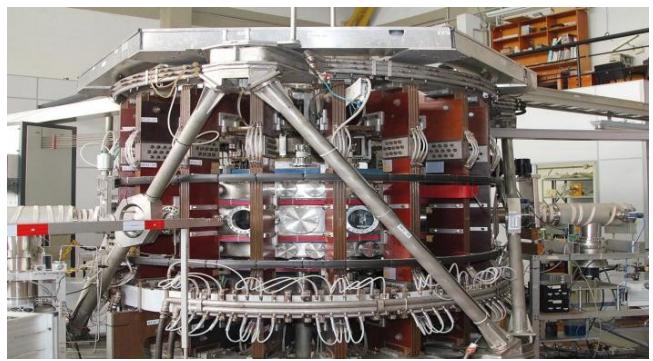 Figure 1: TCABR-Tokamak reactor at USP's Institute of Physics
A diverse array of factors influences the interactions of plasma materials. The retention of tritium in graphite poses a safety concern and reduces recycling efficiency. Fusion neutrons degrade the microstructure of graphite. The concentration of tritium in the universe may result in the restriction of certain areas. It is imperative to conduct a measurement to evaluate the effect of neutron irradiation on the tritium inventory of carbon-based materials.
The way plasma interacts with the walls of the reactor is crucial for building fusion energy reactors, because tritium can get trapped and greatly shorten the life of the wall materials. The fusion reactor's design must consider the life cycle of the reactor wall structures from this perspective. We can achieve these goals by forecasting the reliability parameter of the reactor wall constructions. We can analyze the deformations and defects of the reactor wall surface to predict the reliability risks. The best way to assess how reliable Tokamak fusion reactors are is by using commercial plasma applications that apply surface coatings. Plasma-facing structures located in space must endure radiation and particles to minimize the effects of impacts from space debris [2-15]. The walls of Tokamak nuclear fusion reactors faced a challenge in terms of tritium retention. The depletion of tritium is the consequence of plasma-facing graphene magnetic fusion. The retention of plasma tritium was $40\%$ for JET and $51\%$ for TFTR, respectively. Following the conclusion of the experiments, sanitization of the fusion reactor occurred at a rate of $12 - 16\%$. In favor of Recent simulations indicate that the French experimental Tokamak reactor ITER will surpass its tritium threshold after 100 oscillations. The increasing quantities of tritium diminish the duration of the reactor walls, causing them to extend. This effect affects the process of converting thermal energy into electrical energy during fusion. The dependability of the wall material significantly influences its durability. This part is used to study how the tritium plasma behaves on a graphene crystal, with energy levels ranging from 5 keV to 25 keV. Shannon Entropy, tritium retention, and the kinetic energies of the simulated box are calculated at the conclusion of the molecular simulation. We then implement these values as failure data sets to evaluate material reliability in three-parameter Weibull forecasts. The following ten methods are available for FORM: normal, log normal, Weibull, beta, exponential, Gumbel, extreme value type I and II, uniform, and gamma distributions [16-19]. The three-parameter Weibull, log-normal, and exponential distributions are frequently used in structural reliability evaluations due to their capacity to precisely estimate data on material failure distribution. The three-parameter Weibull method is employed in this study due to its advantageous characteristics and simplicity, which make it suitable for modeling failure data with the appropriate skewness. The three-parameter Weibull method is the best choice for making calculations easier and improving results when working with a small amount of data, as shown by previous studies on the reliability of materials used in nuclear reactor walls [20]. By identifying contiguous experimental process periods in the reliability datasets, researchers compare the two calculated reliability statistics against each other. There is a dearth of research on the prediction of reliability for Tokamak fusion reactors in the literature. The experimental reactor design is the primary focus of the fusion reactor methodology, while material reliability prediction is a topic that has only recently emerged. This work outlines a preliminary reliability allocation strategy for fusion facilities, as outlined in [21]. We base this approach on a probabilistic safety evaluation of the International Thermonuclear Experimental Reactor (ITER) initiative in France. As the new reactor engineering phase progresses, this investigation guarantees reliability. We implement the reliability index to assess the system's dependability and ensure the safety of the fusion system during engineering design evaluations. This study fails to adequately depict the reliability of the material structure's placement. The most recent study on the ITER project is primarily concerned with the probabilistic safety assessment of the nuclear fusion reactor [22]. The results suggest that the Probabilistic Safety Assessment (PSA) is a crucial instrument for assessing the safety hazards associated with nuclear power plants (NPPs) from a probabilistic perspective. The investigation focuses on the RAMI strategy, as advocated by the International
Thermonuclear Experimental Reactor (ITER) organization. RAMI is an acronym that stands for Reliability, Availability, Maintainability, and inspection. This method reduces the technical risks associated with fusion devices to a probabilistically acceptable threshold to assess the system's reliability and availability. This investigation has not yet demonstrated the structural reliability of the fusion reactor's materials. Conventional nuclear fission power reactors serve as the foundation for reliability assessments. A publication in [23] introduces a framework for uncertainty analysis and dependability forecasting. We will implement the frame count methodology and the component stress method to predict reliability for a diverse array of equipment types. The publication referenced as [24] serves as an additional investigation into reliability. The study established the safety assessment of nuclear power facilities by utilizing apparatus reliability data. The primary source of reliability data for safety evaluations in the study was the general dependability statistics of mechanical apparatus in nuclear power facilities. [25] is the singular research that validates the reliability of Tokamak reactor walls using the Weibull distribution. This information comes from the behavior of tritium plasma, which experiences a constant electromagnetic force of 3T on a graphene crystal and has kinetic energies between 5 keV and 35 keV. Shannon entropy, kinetic energy-based Shannon entropy, and the results of tritium retention counts form the foundation of the dependability assessment. This research provides a comprehensive example of how material reliability data can be employed to assess the efficacy of nuclear fusion power facilities. We implement the Pearson correlation coefficient to evaluate the dependability of three datasets and to investigate the similarities between the three distinct reliability methodologies. The designer of a nuclear fusion reactor can determine the most effective material reliability strategy for selecting appropriate materials and constructing the reactor wall by analyzing the similarities.
## II. METHOD
The Python programming language was initially employed to conduct molecular dynamics simulations. This task was conducted using Spyder, a component of the Anaconda suite, version 6.0.3. The Dell Precision 7680, which is equipped with an Intel Core i7 13th Generation processor and runs Ubuntu 24.10 Linux, was used to perform the calculations. The Python compiler version that was implemented was 3.12.7. The Atomic Simulation Environment (ASE [26]), a Python framework, is used to conduct the molecular dynamics simulation. The retention mechanism was developed by simulating a significant amount of graphite, which contains approximately 1,200 carbon atoms. The results of the simulation suggested that the retention efficacy was influenced by a variety of parameters, such as the pressure and temperature conditions. The findings have substantial implications for future research on carbon-based materials and their multifaceted applications in a variety of fields. The block was subjected to hydrogen at energy levels ranging from 5 to $35\mathrm{keV}$, utilizing a 3T magnetic induction force to facilitate calculations and to replace tritium. The energy levels selected for the simulation were adequate, as demonstrated by the current simulations, which encompass an appropriate range of collision energy, as documented in the literature. In molecular dynamics, a computational framework, the integral of Newton's Second Law of Motion is employed to simulate the motion of a collection of particles (atoms or molecules). The motion of the i-th atom is denoted as follows \[27\]:
$$
F_i = \left(m_i * d^2 r_i(t)\right) / dt^2
$$
where $r_i(t)$ is position vector of the ith particle, $F_i$ is the force acting on the ith particle at time $t$ and $m_i$ is the mass of the particle.
The variables in equation (1) represent the mass, the location, and an interatomic potential energy function that characterizes the interactions between atoms and their neighbors. The molecular dynamics modeling of the hcp function in ASE results in the formation of a graphene structure within a large graphite crystal. The hydrogen atoms are arbitrarily distributed throughout the graphite structure, with a starting kinetic energy that ranges from 5 keV to 35 keV. They are subject to an magnetic induction field of 3T. The Velocity-Verlet method is employed in molecular dynamics simulations to simulate the system's dynamics [22-24]. At the conclusion of the simulation, we determine the Shannon entropy of the system, quantify the quantity of tritium stored in the graphene, and determine the kinetic energy of the simulation box. This information is utilized to evaluate the material's reliability. The application's specific failure modes necessitate that reliability engineers select the appropriate parameters, including Shannon entropy, kinetic energy-based Shannon entropy, and tritium retention levels. The introduction section explains the rationale behind the selection of Weibull reliability predictions. In general, Weibull reliability prediction is superior in the calculation of material structural dependability. Three distinct reliability sets are computed using the three-parameter Weibull reliability prediction method, which is based on Shannon entropy, kinetic energy-based Shannon entropy, and tritium retention data. The three-parameter Weibull reliability prediction is expressed by the following formula (2) \[25\]:
$$
R (t) = e ^ {- \left(\frac {t - y}{\alpha}\right) ^ {\beta}} \tag {2}
$$
The shape parameter $(\beta > 0)$, scale parameter $(\alpha > 0)$, location parameter $(\nu)$, and irradiation duration $(t \geq \nu)$ are all taken into account. $\nu$ is typically presumed to be zero in computations, as it represents the displacement of the origin in the dependability distribution graph. The failure probability function is defined as in (3) and (4):
$$
F (t) = 1 - R (t) \tag {3}
$$
$$
1 - F (t) = e ^ {- \left(\frac {t}{\alpha}\right) ^ {\beta}} \tag {4}
$$
where $0 < F(t) < 1$ and $\gamma = 0$. The equation can be expressed in (5) and (6) as follows:
$$
\ln \left(\ln \frac{1}{1 - F (t)}\right) = \beta \ln t - \beta \ln \alpha \tag{5}
$$
$$
y(t) = \ln\left(\ln\frac{1}{1 - F(t)}\right), m = \beta \wedge n = -\beta \ln \alpha \tag{6}
$$
The Bernard Approximation for Median Ranks [28] can be employed to estimate the unreliability of each failure in order to deduce an equation in the form $y = mx + n$. The following (7) is the Bernard Approximations for Median Ranks:
$$
F(t)=MedianRank=\frac{Rank-0,3}{N+0,4}
$$
The ordinal position is denoted by rank in the dataset table, while N represents the utmost number of orders. The kinetic energy range of 5 keV to 25 keV is applied to the tritium plasma, which is under a steady 3T magnetic induction force on the graphene crystal. Tables 1a, 1b, 1c, and 1d illustrate the varying levels of reliability based on Shannon entropy, kinetic energy-based Shannon entropy, and tritium retention amounts.
Table 1a: Weibull Reliability Calculated Dataset for 5keV Applied Tritium Plasma with constant 3T magnetic induction Force
<table><tr><td>Process Time (fs)</td><td>Reliability of Kinetic Energy based Shannon Entropy</td><td>Reliability of Retention of Tritium Amount</td><td>Reliability of Shannon Entropy of the Simulation System</td></tr><tr><td>0</td><td>1</td><td>0</td><td>1</td></tr><tr><td>25</td><td>0,206529857</td><td>0,377064539</td><td>0,521357984</td></tr><tr><td>50</td><td>0,176563403</td><td>0,37905274</td><td>0,496981029</td></tr><tr><td>75</td><td>0,159948474</td><td>0,380215617</td><td>0,482960909</td></tr><tr><td>100</td><td>0,148611365</td><td>0,381040619</td><td>0,473130049</td></tr><tr><td>125</td><td>0,140090081</td><td>0,381680496</td><td>0,4655745</td></tr><tr><td>150</td><td>0,133310901</td><td>0,382203283</td><td>0,459447947</td></tr><tr><td>175</td><td>0,127711149</td><td>0,382645271</td><td>0,454301632</td></tr><tr><td>200</td><td>0,122960135</td><td>0,383028121</td><td>0,449869054</td></tr></table>
Table 1b: Weibull Reliability Calculated Dataset for 15keV Applied Tritium Plasma with constant 3T magnetic induction Force
<table><tr><td>Process Time (fs)</td><td>Reliability of Kinetic Energy based Shannon Entropy</td><td>Reliability of Retention of Tritium Amount</td><td>Reliability of Shannon Entropy of the Simulation System</td></tr><tr><td>0</td><td>1</td><td>1</td><td>1</td></tr><tr><td>25</td><td>0,198968365</td><td>0,290599909</td><td>0,610725773</td></tr><tr><td>50</td><td>0,168116675</td><td>0,274979548</td><td>0,606079077</td></tr><tr><td>75</td><td>0,151118198</td><td>0,265931567</td><td>0,603362753</td></tr><tr><td>100</td><td>0,139573118</td><td>0,259556876</td><td>0,601436401</td></tr><tr><td>125</td><td>0,130928245</td><td>0,254639858</td><td>0,599942761</td></tr><tr><td>150</td><td>0,124072886</td><td>0,250641167</td><td>0,598722747</td></tr><tr><td>175</td><td>0,118426234</td><td>0,247274038</td><td>0,597691514</td></tr><tr><td>200</td><td>0,11364758</td><td>0,244367781</td><td>0,596798429</td></tr></table>
Table 1c: Weibull Reliability Calculated Dataset for 25keV Applied Tritium Plasma with constant 3T magnetic induction Force
<table><tr><td>Process Time (fs)</td><td>Reliability of Kinetic Energy based Shannon Entropy</td><td>Reliability of Retention of Tritium Amount</td><td>Reliability of Shannon Entropy of the Simulation System</td></tr><tr><td>0</td><td>1</td><td>0</td><td>1</td></tr><tr><td>25</td><td>0,18345641</td><td>0,367926806</td><td>0,442325519</td></tr><tr><td>50</td><td>0,150723429</td><td>0,367937006</td><td>0,400401165</td></tr><tr><td>75</td><td>0,132965227</td><td>0,367942972</td><td>0,377081129</td></tr><tr><td>100</td><td>0,121042209</td><td>0,367947206</td><td>0,361099258</td></tr><tr><td>125</td><td>0,112197999</td><td>0,367950489</td><td>0,349031472</td></tr><tr><td>150</td><td>0,105240905</td><td>0,367953172</td><td>0,339386732</td></tr><tr><td>175</td><td>0,099551042</td><td>0,367955441</td><td>0,331384173</td></tr><tr><td>200</td><td>0,094766473</td><td>0,367957406</td><td>0,32456493</td></tr></table>
Table 1d: Weibull Reliability Calculated Dataset for 35keV Applied Tritium Plasma with constant 3T magnetic induction Force
<table><tr><td>Process Time (fs)</td><td>Reliability of Kinetic Energy based Shannon Entropy</td><td>Reliability of Retention of Tritium Amount</td><td>Reliability of Shannon Entropy of the Simulation System</td></tr><tr><td>0</td><td>1</td><td>1</td><td>1</td></tr><tr><td>25</td><td>0,205324751</td><td>0,352345491</td><td>0,525956527</td></tr><tr><td>50</td><td>0,175198344</td><td>0,349034249</td><td>0,502644599</td></tr><tr><td>75</td><td>0,158511436</td><td>0,347098006</td><td>0,489218329</td></tr><tr><td>100</td><td>0,147133639</td><td>0,345724577</td><td>0,479794794</td></tr><tr><td>125</td><td>0,138586928</td><td>0,344659481</td><td>0,472546865</td></tr><tr><td>150</td><td>0,131791019</td><td>0,343789383</td><td>0,46666612</td></tr><tr><td>175</td><td>0,126179989</td><td>0,343053834</td><td>0,461723681</td></tr><tr><td>200</td><td>0,121421338</td><td>0,342416756</td><td>0,457464742</td></tr></table>

The Pearson Correlation method is employed to compare three data sets for each process time at the conclusion of the material reliability data sets for molecular dynamics process times. We assess the reliability of each data set, present the Pearson correlation formula below, and compare them in pairs. The four distinct varieties of Pearson correlation matrices that we present are categorized according to their differing reliability classifications. Three distinct categories of correlation coefficients are produced by the Pearson correlation calculation. The value falls within the range of -1 to +1. The intensity of the negative linear association increases as the value approaches -1. As the value approaches +1, the positive linear association's potency increases. As the value approaches zero, the linear relationship decreases. The Pearson Correlation formula is as follows \[15\]:
$$
r = \frac{n(\sum XY) - (\sum X)(\sum Y)}{\sqrt{1 - F(t)}}
$$
This (8) formula denotes Pearson's correlation coefficient by $r$, the first variable's score by $X$, and the second variable's score by $Y$. The number of coupled scores is denoted as $n$.
## III. RESULTS & DISCUSSION
The methods described are employed to compute Pearson correlation coefficients for the
Shannon entropy, the retention quantity of tritium plasma atoms, and the kinetic energy-based Shannon entropy of the simulation system reliability data. Pearson correlation coefficients are calculated for combinations of reliability categories at identical process times in molecular dynamics simulations. The simulations investigate various kinetic energies spanning from 5 keV to 35 keV within a tritium plasma, all while upholding a steady 3T magnetic induction force applied to the graphene crystal. Table 1 presents the data sets utilized to develop four matrices of Pearson correlation coefficients. The Pearson correlation calculation involves determining correlations through the comparison of reliability categories within pairings. The tables for the Pearson correlation coefficient utilize pseudo-coloring due to the application of conditional formatting. The highest value is established at 1, with dark blue indicating a positive correlation through the use of conditional formatting. In order to illustrate a negative correlation of -1, we utilize the color red. The final zero indicates an uncorrelated relationship between two data sets, represented by a white color. Table 3a presents the Pearson correlation among the reliability categories of Shannon entropy, the retention of tritium plasma atoms, and the kinetic energy of the simulation system based on Shannon entropy for tritium plasma at 5 keV applied kinetic energy under a constant 3T magnetic induction force on graphene crystal.
Table 3a: Pearson Correlation Coefficient Matrix of the Reliability for 5keV kinetic energy applied tritium plasma with 3T magnetic induction force graphene crystal
<table><tr><td>Correlation of Reliability Types For Tritium on Graphene at 5 keV kinetic energy with 3T constant magnetic induction force</td><td>Reliability Kinetic Eng Shannon</td><td>Reliability Retention</td><td>Reliability Shannon Entropy</td></tr><tr><td>Reliability Kinetic Eng Shannon</td><td>1</td><td>-0,99693824</td><td>-0,989552796</td></tr><tr><td>Reliability Retention</td><td>0,978999008</td><td>1</td><td>-0,993541661</td></tr><tr><td>Reliability Shannon Entropy</td><td>-0,989552796</td><td>-0,993541661</td><td>1</td></tr></table>
Based on the results of table 3a, reliability of tritium plasma with kinetic energy with $5\mathrm{keV}$ application on graphene crystal reliability calculation tritium retention count vs reliability on kinetic energy based Shannon Entropy has a positive correlation. However reliability of kinetic energy based Shannon Entropy reliability vs reliability tritium retention count negative correlation. Reliability with Shannon Entropy vs reliability with kinetic energy based Shannon Entropy and tritium retention count are negatively correlated.
Table 3b: Pearson Correlation Coefficient Matrix of the Reliability for $15\mathrm{keV}$ kinetic energy applied tritium plasma with 3T magnetic induction force on graphene crystal
<table><tr><td>Correlation of Reliability Types For Tritium on Graphene at 15 keV kinetic energy with 3T constant magnetic induction force</td><td>Reliability Kinetic Eng Shannon</td><td>Reliability Retention</td><td>Reliability Shannon Entropy</td></tr><tr><td>Reliability Kinetic Eng Shannon</td><td>1</td><td>-0,908412836</td><td>-0,993884598</td></tr><tr><td>Reliability Retention</td><td>-0,908412836</td><td>1</td><td>0,795536481</td></tr><tr><td>Reliability Shannon Entropy</td><td>-0,993884598</td><td>0,795536481</td><td>1</td></tr></table>
According to the table 3b 15keV application of kinetic energy of tritium with constant 3T magnetic induction force to graphene crystal, Shannon Entropy based reliability vs tritium retention count based reliability have positive correlation. Tritium retention amount vs Shannon Entropy based reliability has positive correlation. Tritium retention count reliability vs kinetic energy based Shannon Entropy reliability, reliability based on Shannon Entropy vs kinetic energy based Shannon Entropy reliability, kinetic energy based Shannon Entropy reliability vs Shannon Entropy based reliability have negative correlation.
Table 3c: Pearson Correlation Coefficient Matrix of the Reliability for $25\mathrm{keV}$ kinetic energy applied tritium plasma with 3T magnetic induction force on graphene crystal
<table><tr><td>Correlation of Reliability Types For Tritium on Graphene at 25 keV kinetic energy with 3T constant magnetic induction force</td><td>Reliability Kinetic Eng Shannon</td><td>Reliability Retention</td><td>Reliability Shannon Entropy</td></tr><tr><td>Reliability Kinetic Eng Shannon</td><td>1</td><td>0,962776586</td><td>-0,992039443</td></tr><tr><td>Reliability Retention</td><td>0,962776586</td><td>1</td><td>-0,984894096</td></tr><tr><td>Reliability Shannon Entropy</td><td>-0,992039443</td><td>-0,984894096</td><td>1</td></tr></table>
In table 3c, tritium with a $25\mathrm{keV}$ kinetic energy application with 3T constant magnetic induction force on graphene crystal, reliability of tritium retention amount vs reliability with kinetic energy based Shannon Entropy has a positive correlation. Reliability with kinetic energy based Shannon Entropy vs Shannon Entropy based reliability, Shannon Entropy reliability vs tritium retention count amount based reliability have a negative correlation.
Table 3d: Pearson Correlation Coefficient Matrix of the Reliability for $35\mathrm{keV}$ kinetic energy applied tritium plasma with 3T magnetic induction force on graphene crystal
<table><tr><td>Correlation of Reliability Types For Tritium on Graphene at 35 keV kinetic energy with 3T constant magnetic induction force</td><td>Reliability Kinetic Eng Shannon</td><td>Reliability Retention</td><td>Reliability Shannon Entropy</td></tr><tr><td>Reliability Kinetic Eng Shannon</td><td>1</td><td>-0.973958593</td><td>-0.98616763</td></tr><tr><td>Reliability Retention</td><td>-0.973958593</td><td>1</td><td>0.993914508</td></tr><tr><td>Reliability Shannon Entropy</td><td>-0.98616763</td><td>0.993914508</td><td>1</td></tr></table>
According to the table 3d, $35\mathrm{keV}$ applied kinetic energy affected tritium with constant 3T magnetic induction force on a graphene crystal, reliability based Shannon Entropy vs tritium retention amount reliability has positive correlation. Tritium retention amount reliability vs kinetic energy based Shannon Entropy reliability, Shannon Entropy reliability vs kinetic energy based Shannon Entropy reliability have a negative correlation.


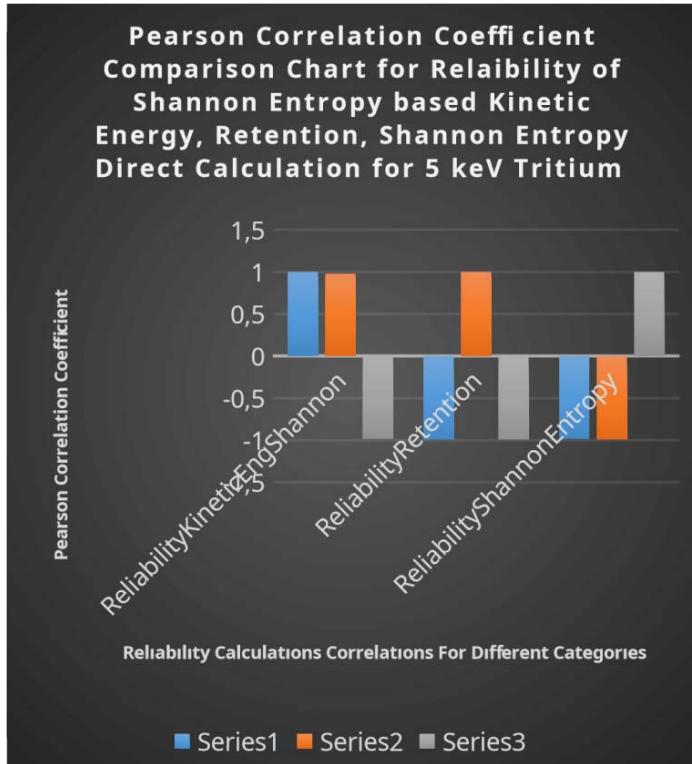 Figure 4: Pearson Coefficient Correlation Comparison Chart for 5keV applied kinetic energy of tritium reliability categories In figure 4, the Pearson correlation coefficient comparison chart shows results given in table 3a correlation coefficient matrice comparisons as in graphics form.
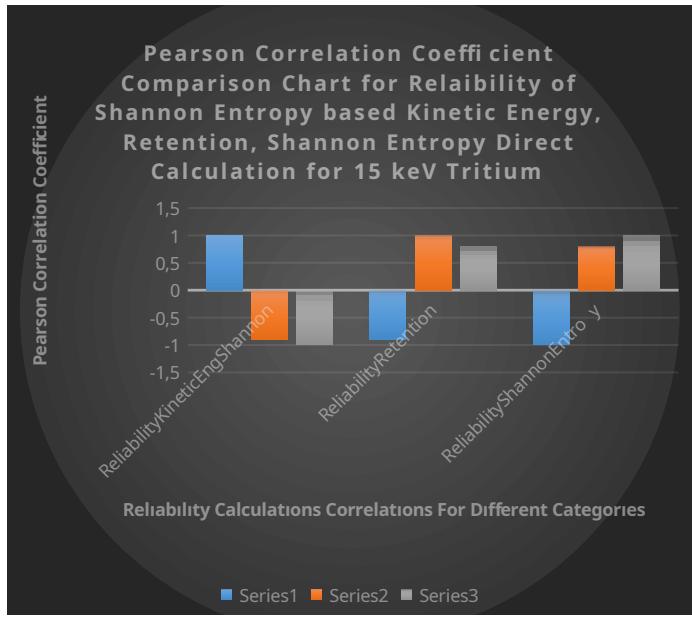 Figure 5: Pearson Coefficient Correlation Comparison Chart for 15keV applied kinetic energy of tritium reliability categories In figure 5, the Pearson correlation coefficient comparison chart shows results given in table 3b. correlation coefficient matrices comparisons as in graphics form.
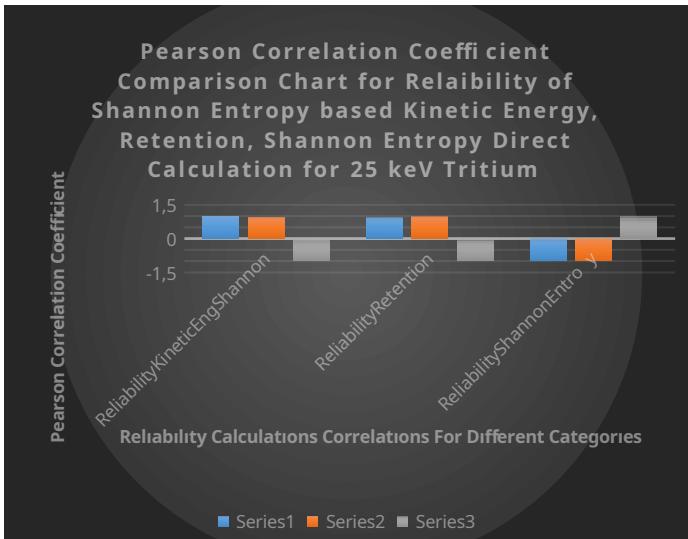 Figure 6: Pearson Coefficient Correlation Comparison Chart for $25\mathrm{keV}$ applied kinetic energy of tritium reliability categories In figure 6, the Pearson correlation coefficient comparison chart shows results given in table 3c correlation coefficient matric comparisons as in graphics form.
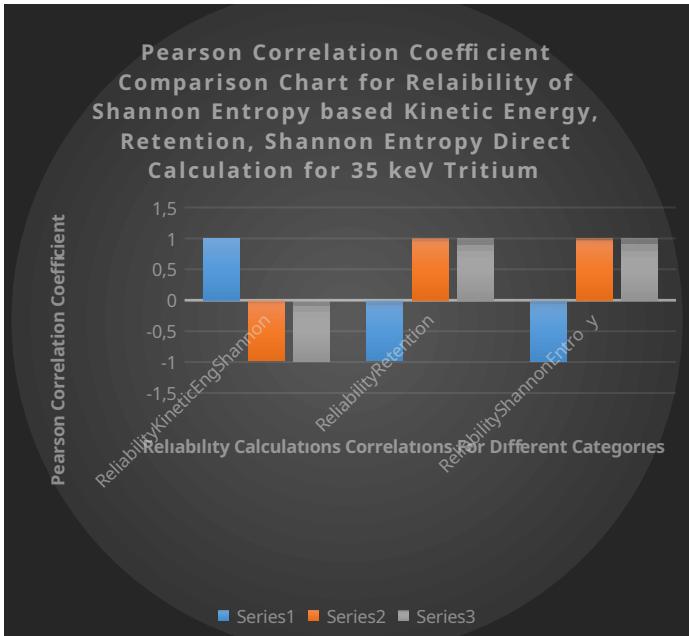 Figure 7: Pearson Coefficient Correlation Comparison Chart for 35keV applied kinetic energy of tritium reliability categories In figure 7, the Pearson correlation coefficient comparison chart shows results given in table 3d correlation coefficient matrice comparisons as in graphics form.
The above results can be compared to [28] work reliability results in the literature, which show consistency. For instance, table 3a, table 3b, table 3c and table 3d show the similarity trend with the work given in [28], that the plasma-created retention effects as the ion energy increase created a surface deterioration growth on the material surface. These studies show that physical incidents related to plasma effects on material can be used in reliability predictions.
## IV. CONCLUSION
According to the investigation, the most effective method for evaluating the reliability of wall materials in contemporary experimental nuclear fusion reactors is to utilize the quantity of tritium retained and kinetic-based Shannon entropy. The findings indicate that the tritium plasma atoms' energy on the graphene crystal can be used to determine the probability of failure of the material by examining the Shannon entropy associated with kinetic energy and the tritium plasma concentration. Nevertheless, the failure data can be altered by the use of Shannon entropy for reliability, resulting in a negative correlation between the retention amount and the kinetic energy calculations. Consequently, it is imperative to modify the method by which Shannon entropy is calculated. Nevertheless, the Shannon entropy is a reflection of the entire simulated system. If it were to be applied for reliability, it would affect the failure data and demonstrate a negative correlation with both the retention amount and the kinetic energy-based Shannon entropy calculation. It is imperative to modify the Shannon entropy calculation's configuration. The ratios should be subtracted from the Shannon entropy context in order to substantiate the parameter. Failure data regarding the reliability of the material structures. It is ranked as the third option when material reliability calculations are implemented during the design of the fusion reactor's walls. In research on wall materials that are impacted by tritium plasma retention, the reliability of tritium plasma retention can be the primary criterion for predicting the future reliability of a material. This information is essential for the evaluation of events in which plasma interacts with materials that are associated with structural reliability. AFM data is utilized by the nuclear fission industry to predict the structural reliability of pumps and conduits using the Weibull distribution [21-22]. The Weibull method could be employed in future research to investigate the interactions between plasma and materials on the basis of plasma properties. The Pearson correlation suggests that the values calculated from tritium plasma, such as the kinetic energy-based Shannon entropy or the amount stored, can be used to make predictions using the Weibull distribution to evaluate the reliability of materials. The Weibull distribution is designed to guarantee material dependability by incorporating these parameters of the reliability calculation technique, which is a cost-effective approach to ensuring safe, secure, and efficient operations. The aforementioned methods are employed to evaluate the effectiveness of plasma processing by examining heat and stress control, predicting reliability with Weibull analysis, planning maintenance in advance, and assessing surface roughness for wear and damage. Additionally, the procedure involves the selection of materials. In the future, the Weibull method may be employed to evaluate the utility and predict the reliability of boronization in the walls of nuclear fusion reactors. The reliability of wall materials in the divertor zone will be improved by identifying the optimal material design. It is crucial that personnel in energy system engineering who are involved in the design of nuclear fusion energy reactors in the future refer to this study. When the fusion procedure commences, it is imperative to select the appropriate materials for these designs. The fusion
process is a complex endeavor that involves the interaction of materials with plasma at the atomic level, as well as electromagnetism and the material science required to design the surface where the fusion reaction occurs. This process also involves heat transfer and cooling systems.
## ACKNOWLEDGMENT
This work is supported by the research and development department of Havelsan Inc.
### Declarations
The investigation was devoid of any potential conflicts of interest, regardless of whether they were financial or non-financial. Additionally, the investigation conducted in accordance with the ethical standards of globally recognized research and publication standards and did not require informed consent from either human or animal research participants.
#### Data Availability
The study's conclusions are corroborated by the article and other material files. Upon reasonable request, the author in question can furnish information regarding the necessary study.
Generating HTML Viewer...
References
27 Cites in Article
M Pivetta (2023). There are about 90 nuclear fusion reactors operating worldwide.
J Freidberg,F Mangiarotti,J Minervini (2015). Desgining a Tokamak Fusion Reactor-How Does Plasma Physics Fit In?.
K Miyamoto (2011). Fundamentals of Plasma Physics and Controlled Fusion.
C Braams,P Stott (2002). Nuclear Fusion: half a century of magnetic confinement research.
A Chan,G Herdrich,C Syring (2016). Development of Inertial Electrostatic Confinement in IRS.
E Jones,J Rafelski (1987). Cold Nuclear Fusion.
Iaea (2007). Atomic and Plasma Material Interaction Data for Fusion.
L Rajablou,S Motevalli,F Fadaei (2022). Study of alpha particle concentration effects as the ash of deuterium-tritium fusion reaction on ignition criteria.
Vladislav Kotov (2017). Particle conservation in numerical models of the tokamak plasma edge.
J Rapp,D Temmerman,G Van Rooij,V Emmichoven,A Kleyn (2011). Plasma Facing Materials Research For Fuision Reactors At Fom Rijnhuizen.
M Malo,A Moroño,E Hodgson (2016). Plasma etching to enhance the surface insulating stability of alumina for fusion applications.
A Adegbulugbe (1984). Comparison of lifetime calculation for fusion reactor first walls based on two creep-fatigue design criteria.
M Abdelrahman (2015). Study of Plasma and Ion Beam Sputtering Processes.
(1985). Lifetime Predictions For The First Wall and Blanket Structure of Fusion Reactors.
D Chee (2015). Pearson's Product-Moment Correlation: Sample Analysis.
Xiaoping Du (2008). Unified Uncertainty Analysis by the First Order Reliability Method.
Y Zhao,T Ono (1999). Generated Procedure for First/Second Order Reliability Method (FORM/SORM).
Jia Guo,Xiaoping Du (2010). Reliability Analysis for Multidisciplinary Systems with Random and Interval Variables.
Meichen Yan,Bo Sun,Baopeng Liao,Yi Ren,Jinghua Yao,Mumeng Wei (2017). FORM and Out-Crossing Combined Time-Variant Reliability Analysis Method for Ship Structures.
Dagui Wang,Jin Wang,Liqin Hu,Jie Wu,Fang Wang (2019). Preliminary Reliability Allocation Method for Fusion Facility Based on Probabilistic Safety Assessment.
Ming Sun,Jie Yu,Taosheng Li,Daochuan Ge (2023). An integrated safety assessment method based on PSA and RAMI for fusion reactors.
Changzheng Yin,Haiying Li,Xiwen Xie,Changhong Peng (2024). Study of reliability prediction method and uncertainty analysis of the pump and valve of a floating nuclear power plant.
J Zhang,A Liu,J Zhao (2022). Study on reliability prediction of mechanical equipment in nuclear power plant.
A Pahsa,Y Aydoğdu,F Göktaş (2023). Mathematical Calculation of Material Reliability Using Surface Roughness Feature Based on Plasma Material Interaction Experiment Results.
No ethics committee approval was required for this article type.
Data Availability
Not applicable for this article.
How to Cite This Article
Dr. Alper Pahsa. 2026. \u201cPearson Correlation based Comparison of Shannon Entropy Computed Reliability of Tritium Plasma Graphene Interaction\u201d. Global Journal of Research in Engineering - J: General Engineering GJRE-J Volume 25 (GJRE Volume 25 Issue J1): .
Explore published articles in an immersive Augmented Reality environment. Our platform converts research papers into interactive 3D books, allowing readers to view and interact with content using AR and VR compatible devices.
Your published article is automatically converted into a realistic 3D book. Flip through pages and read research papers in a more engaging and interactive format.
High-energy ions have the potential to damage the walls of nuclear fusion Tokamak reactors. As a result, it is essential to establish dependable methods for determining whether the materials are still resilient. This investigation examines the most effective methods for assessing the reliability of materials that contain tritium plasma in graphene crystals. The impact of varying energy levels from 5 keV to 35 keV on tritium plasma was investigated using molecular dynamics in a computer simulation to investigate the retention mechanisms. The quantity of tritium retained, Shannon entropy based on kinetic energy, and Shannon entropy are all factors that are used to calculate reliability. A valuable instrument for comparing various categories of tritium plasma on graphene crystals, with kinetic energies ranging from 5 keV to 35 keV, are the Pearson correlation coefficients. The designer can employ Pearson Correlation to ascertain the most efficient structural reliability computation method for a variety of reliability calculations. This research simplifies the process of selecting plasma-resistant materials for nuclear fusion applications and allows designers to enhance the design of reactor walls.
Our website is actively being updated, and changes may occur frequently. Please clear your browser cache if needed. For feedback or error reporting, please email [email protected]
Thank you for connecting with us. We will respond to you shortly.