### INTRODUCTION
In between the two possible ways of dealing with the multi-functionality of connectives (monosemy and homonymy), the polysemy approach assumes that 'there are different distinct readings of a connective and that these different senses are related' (Fischer 2006: 13). I will adopt this latter position in this paper with respect to the analysis of but and its Kurdish equivalences. The current study explores the various meanings encoded by the connective but in English such as 'contrary to expectations', 'contrast', 'correction' and 'dismissal' (Lakoff 1971, Blakemore 1987, 2002; Hall 2007, Horn 1989, Bell 1998 and Iten 2005). This study suggests that but is not an ambiguous connective and to argue the ambiguity account of but claimed by Anscombre and Ducrot (1977) and Horn (1989). Based on the Relevance Theory's (RT) procedural meaning, the paper gives a unified account of the meaning encoded by but. Then it argues that but encodes a general procedure that can be implemented in four different situations to generate four different meanings. This is illustrated by its translation into Kurdish. Thus, but is not ambiguous but it is rather a linguistic expression with a general sense. The argument is supported by data from
Kurdish language. The data show that there are four different linguistic expressions that can translate but in Kurdish. These are keci, be peçewanewe, betku and belam which represent the four different procedural meanings of 'contrary to expectations', 'contrast', 'correction' and cancellation' respectively.
## I. THEORETICAL BACKGROUND
The English connective but has been dealt with widely by several researchers such as Lakoff (1977), Fraser (1995), Blakemore (1987, 2002), Iten (2000) and Hall (2007). It has been described with various labels such as 'discourse marker', 'connective', 'pragmatic marker' and 'cohesive device'. I will be drawing on the existing accounts of but and show how translation can disambiguate the polysemy of connectives especially the case of but in light of the Relevance Theory (RT). According to Wilson and Sperber, relevance theory is 'an inferential theory of communication, which aims at explaining how the audience infers the communicator's intended meaning.' (1995: 176). In this sense, human cognition is thought to be directed towards the maximization of relevance between two inputs, in a way that the information an input carries has a relation with information already stored in the cognitive system to strengthen an existing assumption or to contradict and eliminate an assumption, and 'the higher cognitive effects the input has, the more relevant it is' (Ibid: 177). Thus, relevance can be thought of as a positive function of effects achieved, and a negative function of effort incurred. That is, the relevance needs to be achieved with minimum efforts. This is in line with Wilson and Sperber's claim that 'use of an obvious stimulus may create precise and predictable expectations of relevance not raised by other stimuli.' (Wilson and Sperber, 2004: 617). For instance, successful communication is a matter of the reader recognizing the writer's communicative intentions, typically by utilizing suitable connectives in order to help the reader get to the point faster.
The meanings associated with the connectives are context-dependent, thus connectives should not be examined in isolation. For instance, it is very difficult to answer a question like: What does but mean? Whereas it is easier to answer a question such as: How is but used in a given context? Schiffrin claims that 'discourse markers' - here named connectives- could have semantic, syntactic, and pragmatic roles simultaneously but they are not 'structural or semantic components in the sentence' (1987: 190). Nonetheless, this multifunctionality is different based on the categories of the DM group. For example, conjunctions have pragmatic effects that are closely associated with the type of meaning they signal, such as the case of but which reflects a difference between two text segments S1 and S2. The semantic meaning implied by the connection could be contrary to expectation, contrast, correction or cancellation as proposed previously in the text.
Blakemore (1987) analyses but and regards it as a linguistic expression that does not contribute to the content of the sentence. Adopting the RT framework, she focuses on two different specific relations, namely 'denial' and 'contrast'. Blakemore argues that but means 'and + something else'. I will attempt to explain the 'something else' through translating but into Kurdish. The different procedures; denial of expectation (S2 denies an expectation forwarded in S1), contrast (S2 contrasts a state of affair or an action in S1), correction (S2 corrects a proposition in S1) and dismissal (S2 cancels what has been mentioned in S1), as shown in Figure 1, in which but plays a role as a connective, have been translated into four Kurdish adversative connectives; keci, belam, be pêçewanewe and befkû.
## II. TRANSLATION AND LINGUISTICS
As far as translation and linguistics are concerned, the assumption is that translation data contain texts that are intended to express the same meanings and have identical or at least very similar textual functions in the two languages concerned, here English and Kurdish. Dyvik was one of the first to argue in favour of the use of translation data to establish the precise semantic values of words. He suggests that 'by successively using the source and target language as a starting-point, we can establish paradigms of correspondences: the translations can be arranged as a paradigm where each target item corresponds to a different meaning of the source item' (1998: 12). Simon-Vandenbergen likewise states that 'translations of pragmatic markers can serve as a heuristic for discovering contextual dimensions or for making more fine-grained divisions in these dimensions, because the translations force one to account for the contextual factors that lead to particular choices.' (2006: 111). These choices would pose a challenge for translators when translating a polysemous connective such as but into Kurdish. As of yet, there is little linguistic research regarding Kurdish connectives and hence there is no recognised list of Kurdish connectives from which to select an equivalent connective to but. The four choices available to translators are described in detail in sections (4-1, 4-2, 4-3 and 4-4).
## III. DATA AND METHODOLOGY
The data comprise of translation of all occurrences of but in 30 English newspaper opinion articles along with all the equivalents' occurrences in 30 Kurdish newspaper opinion articles. These examples result in a corpus that can be used to identify the possible meanings of but in Kurdish. However, using translation corpora as base for analysis seems to be biased, because of the diversity of results and according to Degande 'not only is there a problem of context and typological differences, one should also be careful not to generalize individual instances of language use' (2009: 178). Nonetheless, in terms of the correspondence paradigms, it is possible to obtain suggestive results in assigning certain meanings to words, especially connectives. Aijmer et al argue that 'such semantic fields can be established by checking back and forth' (2006: 111). Thus, the correspondence paradigm is built by double checking the equivalences, i.e., through translation and back translation we can assign correspondence values to the functional equivalences. For instance, if but in English is translated by beftku and keci in Kurdish, then using Kurdish as a source language, we should be able to check for the translation of beftku and keci in English, which will become the target language. Such an analysis, Aijmer et al state would allow us 'to show how the pragmatic marker X is related to other pragmatic markers, or to other linguistic items such as modal particles or response words, in the same language' (Ibid.: 112).
Also, Dyvik states, in favour of this approach, that 'translators have no theoretic concern in mind, evaluate the interpretational possibilities of linguistic expressions [...] and then try to recreate the same interpretational possibilities in a target text serving a comparable purpose in another language' (1998: 7). Finally, a translation approach to examining linguistic phenomena seems to meet the criteria for most of the demands of contemporary linguistics, as Noel states that 'it is corpus-based, it is contrastive and thus has typological relevance [...] it is task-based, in as much as it treats translation data as a collection of informants' judgments about the meanings of the linguistic forms in the source text' (2003: 759). Thus, I will adopt Degand's approach which she calls 'mirror analysis' which takes 'back-and-forth translation as a way of establishing semantic field of equivalents in one language or across languages' (2009: 179). This will help me establish what is the most suitable Kurdish equivalent for English but, subject to relevant context, and also what semantic values can be linked to each connective.
## IV. BUT IN TRANSLATION
This paper suggests that there are four distinct Kurdish connectives corresponding to these four implementations of the general procedure encoded by but which are: keçı, beşkı, be pęçewanewe and belam. These findings are in line with Simon-Vandenbergen's claims that 'translations of connectives can serve as a heuristic for discovering contextual dimensions or for making more fine-grained divisions in these dimensions, because the translations force one to account for the
contextual factors that lead to particular choices.' (2006: 111). This paper seeks to answer questions such as: Is the English connective but polysemous? What can translation add to linguistic studies? How are the Kurdish equivalences for the English connective but accounted for by a relevance-theoretic approach?
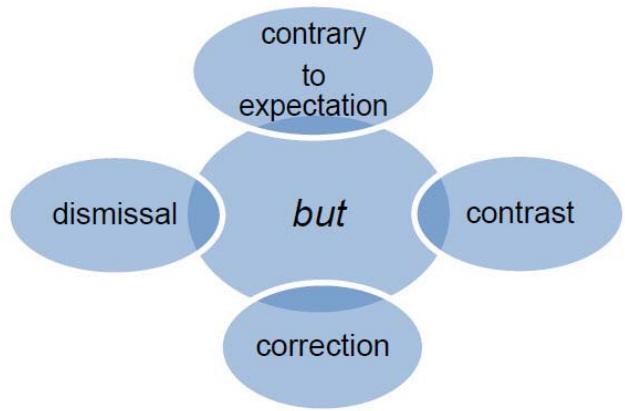 Figure 1: Procedural meanings of but
One way of accounting for the functions of but and its meanings is to analyse it as encoding a procedural meaning rather than as a concept or conceptual representation. According to Hall the 'function of but is to guide the hearer to the intended interpretation of the utterance' (2007: 200). The type of the implementation of but constrains the type of implicatures to be communicated in the text. I agree with Hall concerning the assignment of a superordinate meaning of but as 'contrast', because the other meanings seem to be more complicated and that all of the other three meanings of but have some degree of contrastive meaning in common apart from their main, more specific, procedural meaning. So, based on the general procedure encoded by but which creates the superordinate meaning as:
Treat the proposition communicated by the but-clause as contrasting with the assumption explicitly or implicitly communicated by the utterance of the preceding clause. (Iten, 2005: 147)
The next sections are going to examine the different implementations of this general procedure of but and will translate each implementation into Kurdish in order to disambiguate but and establish the Kurdish equivalences systematically.
### a) 'Contrary to expectation' but
Allerton states that the connectives signaling the sense of contrary to/denial of expectations 'show that the sentence has to be seen as detracting from what went before and thus either reducing the impact of the previous point or replacing it with a different one' (1979: 277). The typical connectives that signal this subtype of adversative relations in English is but and its equivalence in Kurdish is keci. The implementation of the general procedure for this type is: what follows but denies and replaces an assumption or expectation communicated by what precedes it.
Depending on the RT framework, Blakemore states that but means denial, because 'it encodes a constraint that triggers an inferential route involving contradicting and eliminating an assumption' (2002: 95). However, this claim is not entirely true and it does not apply to diverse uses of but (See sections 4-1, 4-3, and 4-4). The S1 message in 1 (below) implies that 'the rebels' heroic actions were the cause of overthrowing the tyrant'. So, the reader expects the writer to elaborate on that. However, this expectation is denied in S2, as it is contrary to the expectations to see that 'Nato had overthrown the tyrant'. This sense of 'contrary to expectations' is introduced by but as in 9.
1) Watching al-Jazeera television, it might appear that heroic rebel militiamen had overthrown a tyrant but, in reality, military victory was almost wholly due to the NATO air assault. (Online 1)
Katěk sáridí telefzyoni aljazíře dekeit, wa pědeçét ke pyawe paławane milísyakan zordarekyan leser deselat ladawe, keci le rastida serkawtini milísyakan tenha behoy hérse asmanyekani Nato bu.
keci (but)
According to Tofiq's (2002) claim, there is no difference between keci and other adversative connectives. However, he had studied the 'conjunction particles', as he labels them, in a rather general sense and does not give detailed accounts for each connective. The data from opinion articles suggest that keci signals a different relation from other adversative connectives such as belam, be pécewanewe depending on the different procedures implemented in the text. The Kurdish connective corresponding to the 'contrary to expectations' meaning of but is keci as shown in 2. None of the other adversative connectives can substitute keci in a procedure such as in 2.
2) Eger anjumen azadbuyaye deituani le budjey emsa† (4 ta 5) hezar ganj dabmezrenet, keci regri bo drustkirawe. (Online 2)
if council-of governorate free was-it would-able-it in budgetof this-year (4 to 5) thousand youth employ-would-it onbudget-of development-of regions-the, but obstacle for itmade-has-been
If the provincial council was independent, they could employ 4 to 5 thousand youths on the regional development budget. But there were obstacles.
Thus, the implementation of the general procedure for keci is: what follows keci denies and replaces an assumption or expectation communicated by what precedes it.
### b) 'Contrastive' but
According to Schwenter, 'contrast' is different from the other subtypes of adversative relations, as it guides the reader to find 'incompatibility between P and Q' (2000: 260) and indicates the writer's viewpoint as the only relevant one. Looking at the relation signaled in 3a, it is not about denial of/contrary to expectations. However, by using but, the writer guides the reader in S2 to interpret the relation between S1 and S2 as a contrast between two states: 'unrepresentative' and 'representative'. The implementation for the general procedure in this case is: what follows but contrasts a proposition communicated by what precedes it.
3a)...the problem with Iowa is not that it's unrepresentative of the party's mindset but that it's too representative... (Online 3)
The connective but in 3a is represented in Kurdish as be péçewanewe, because it is the typical connective to be used to convey contrast between S1 and S2 in Kurdish texts, such as 3b.
3b) Kęsey lowa ewe nîye ke nwēnerayeti bīrǔai hizbeke nakat, be pèçewanewe zor nwēneraneney.
Lakoff claims that when but is used in these contexts; showing contrasting ideas or features, it can only signal 'semantic opposition'(1971:133), and it is simply a contrastive relation between S1 and S2, which is also signaled by be pèçewanewe in 3b.
### be péçewanewe (but)
According to Tofiq, be pêçewanewe is the typical 'conjunction particle' that signals contrast between two sentences (2002: 230). His claim is based on the fact that the word is a prepositional phrase consisting of $(be = \text{with}, pêçewanewe = \text{contrast})$. However, there are reasons why it is considered as a connective and to suggest that it signals a contrastive relation. The data from Kurdish opinion articles suggest that be pêçewanewe operates in a procedure where S2 contrasts S1 by presenting incompatibility between two view points as in 4.
4) Serçawekani opozisyon propagandei ewe dekan ke sarokayati heremi Kurdistan basi le jyabūnewei Kurdistan kirdûe le Āraqda. Be peçewanewe le Çendīn boneda seroki harem jexti leser yek parçê Āraq kirdotewe. (Online 4)
Source-of opposition propaganda this make-they that presidency of region Kurdistan talk about separation-of Kurdistan has-done in Iraq. But in many occasions president-of region Kurdistan insisted on one-piece-of Iraq have-done-he.
The opposition sources argue that the Kurdistan Region presidency intends to detach Kurdistan from Iraq. But, in several occasions, the Kurdistan Region's president has insisted on a unified Iraq.
In 4, be pécewanewe signals an incompatibility between two viewpoints; opposing unity' and 'supporting unity'. This incompatibility is a sense of contrast as it can be stressed contrastively with the presence of negation. Thus, there is a contrastive relation between S1 and S2 in 4, and it is explicated by using be pécewanewe. So, the implementation for this Kurdish connective will be: what follows be pécewanewe contrasts a proposition communicated by what precedes it.
### c) 'Correction' but
Correction relations are recognised in the procedure such as: S1 is a misconception or a misunderstanding and is corrected by the correct information in S2. Hall claims that the correction may be in the conceptual content of the assumption in S1 and/or 'some aspect of the linguistic form used to express it' (2007: 201). The connectives that signal correction relation and replace the previous proposition in discourse with another include: but, in English and belkû, in Kurdish. The English connective but can also signal correction relation as a subtype of adversative relations. For instance, the procedure implemented in 5a is; what follows but (S2) corrects an assumption put forward in what precedes it (S1). That is S1 is a false assumption and S2 is a correction of this false assumption with the help of but.
5a) All sorts of games have hat-tricks these days, not merely football but hockey as well... (Online 5)
This function is verified in a procedural account from the RT, in which the implementation is (what follows but corrects a statement in what precedes it). Regarding the procedure in 29a, S2 'Hockey has hattrick' corrects a proposition in S1 (Only football has hattrick'. Contrary to Fraser's claim that but cannot signal a corrective contrast' (2005: 18) between S1 and S2, it is observed in the translation data that but does signal correction between two text segments and as such it is translated into Kurdish as belk. Kurdish belk u operates in a similar procedure to the one of 'correction but' as in 5b:
5b) Lem rozgareda, le hemu jore yariek yarizan detwané sê goli leser yaktir tomar brikat, nek tenha le yari topi pê befkû le hoki.
befkU (but)
The Kurdish connective corresponding to 'correction' but is $\text{be} \ell k \hat{u}$. The adversative relation signalled by $\text{be} \ell k \hat{u}$ is specifically correction. That is, S1 presents an assumption which is ordinarily false and S2, with the help of $\text{be} \ell k \hat{u}$, corrects that false assumption, such as in 6:
6) Her štek bedīhatbēt bo Kūrd xer w sedeqe nebûe. Belkū beri mandūbūni xoyane deidūrnewe. (Online 6)
Any think-a achieved for Kurds charity was-not-it. But product hard work-of theirs-was-it harvest-it-they.
All achievements of the Kurds are not given by charity. But the Kurds are harvesting their hard work.
Belkhat has been studied in Shwani's (2003) work. He states that 'belkhat is a conjunction particle that has the function of signalling contrast between two sentences' (2003: 99). According to the data in this study, however, belkhat signals a correction of a previous statement. That is, the procedure in which belkhat operates is as such (S2 corrects a misunderstanding in S1). For instance, S2 in 6 which is introduced by belkhat is forms a correction to a misunderstood situation. Thus, the implementation of the general procedure is also applicable to belkhat such as: what follows belkhat corrects an assumption communicated by what precedes it.
### d) 'Dismissal' but
The implementation of the procedure in which but signals dismissal or cancellation is: what follows but (S2) cancels and dismisses the importance of what precedes it (S1). This type of relation is typically signaled by but in English and the Kurdish equivalence is belam.
Consider but in the translation procedure implemented in 7a, in which S2 cancels or dismisses the importance of the topic forwarded in S1. The proposition expressed by S1 in 7a and indirectly contradicted and dismissed by S2, and it is introduced by but. So, in terms of RT's procedural approach, but can also signal dismissal in English texts. This claim is supported by the fact that in such contexts but is translated into Kurdish as belam as in 7b. This type of relation is not found in other procedures in which but signals other subtypes of adversative relation. Bach (1999) claims that the different interpretations of but have proven but to be ambiguous. However, these different readings of but should not be considered as ambiguous, because each interpretation can be attributed to different procedures.
bēṭam (but)
The procedure in which belam is used is similar to the one where 'dismissal' but is used. S1 is cancelled and dismissed by a more important statement in S2. For instance, belam in 8 introduces a positive statement 'the region is now trouble free' which dismisses a negative statement put forward in S1 'catastrophic events happened'.
7a) Our troops will be stuck in the front line of a strategy that has an end date but has no clear end game. (Online 7)
7b) Hézekanman le héti pèsewei stratižiyék gir dexon ke kotai heye befam coniyeti kotayekéi rún nîye.
8) Ew Šūdawane zor karesatbar bún, belam ɔsta doxi herēmakeman zor arame. (Online 8)
that events very unpleasant were-they, but now situation-of region-the-our very quiet-is-it.
Those events were catastrophic, but now our region enjoys tranquility.
Considering the procedural meaning of belam in 8, it is obvious that implementation of the general procedure in 8 is: what follows belam cancels an assumption communicated by what precedes it. Thus, belam is the most suitable Kurdish equivalent for dismissal but.
## V. CONCLUSIONS
The claims about the 'ambiguity' of the English connective but are not entirely true (Anscombe and Ducrot, 1977: 26). Based on a relevance-theoretic approach and according to the different translation options, this paper concludes that but is a polysemous connective and that it has four distinct, yet interrelated, procedural meanings. These meanings shall cause minimal ambiguity when translating from English into Kurdish, because each of the four distinct meanings fits into a specific interpretation of the general procedure. However, having no detailed research about Kurdish connectives would pose a challenge to translators, as they need to be aware of the textual functions of each connective and the contexts in which they are used in order to have a flawless final product in their translation. Based on the Relevance Theory's procedural account, there are four distinct interpretations of the general procedure associated with but, namely; denial, contrast, correction and cancellation, which are translated into Kurdish as keci, be peçewanewe, belkû and belam respectively as shown in Figure 2.
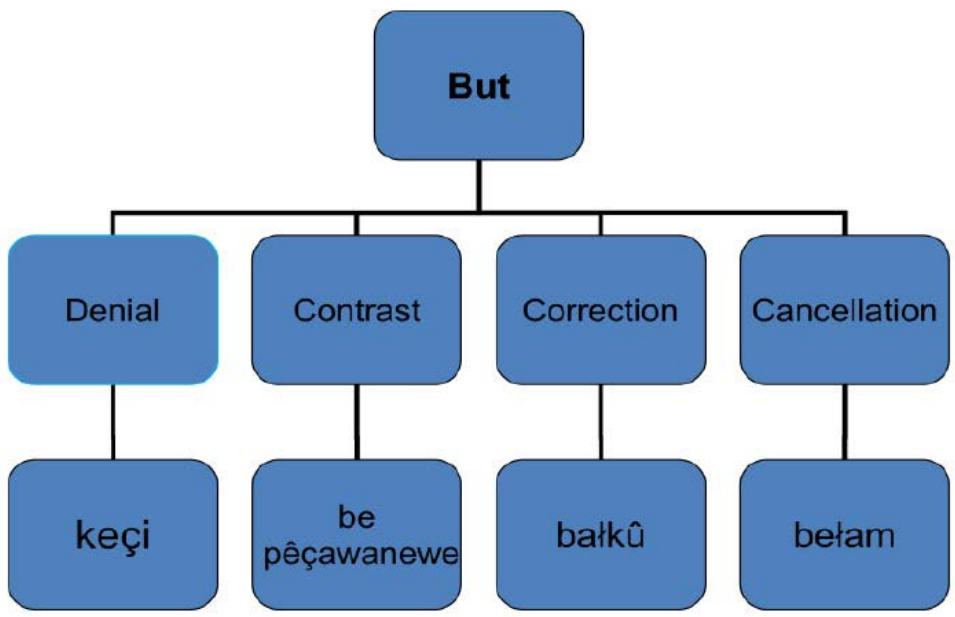 Figure 2: Translations of the implementations of the general procedure encoded by but. 10
### Internet Sources
1. Available from: http://www.independent.co.uk/opinion/commentators/patrick-cockburn-the-attempt-to-topple-president-assad-has-failed-7584493.html [Accessed March 25, 2012]
2. Available from: http://xebat.net/detail-articals.php? id=9904&z=4&l=1 [Accessed August 2, 201]
3. Available from: http://www Guardian.co.uk/commentfree/2011/jul/31/us-reckless-right-forgot-participation [Accessed July 31, 2011]
4. Available from: http://xebat.net/detail-articals.php? id=14539&z=10&l=1 [Accessed April 16, 2012]
5. Available from: http://www Guardian.co.uk/comment isfree/2011/jul/31/in-praise-of-hat-tricks [Accessed July 31, 2011]
6. Available from: http://xebat.net/detail-articals.php? id=13739&z=4&l=1 [Accessed March 5, 2012]
7. Available from: http://www Guardian.co.uk/politics/2011/apr/12/david-milliband-critical-us-afghanistan [Accessed April 13, 2011]
8. Available from: http://xebat.net/detail-articals.php? id =13606&z=4&l=1 [Accessed February 16, 2012] 11
Generating HTML Viewer...
References
15 Cites in Article
J Anscombre,O Ducrot (1977). Deux mais en français?.
M Bell (1998). Cancellative discourse markers: a core/periphery approach.
Diane Blakemore (2002). Relevance and Linguistic Meaning.
L Brinton (1996). Pragmatic Markers in English: Grammaticalization and Discourse Functions.
L Degand (2009). Karin Aijmer and Anne-Marie Simon-Vandenbergen (eds), Pragmatic Markers in Contrast.
Helge Dyvik (1998). A translational basis for semantics.
K Fischer (2006). Approaches to Discourse Particles.
A Hall (2004). The meaning of but: a relevance theoretic analysis.
M Halliday,Christian Matthiessen,Michael Halliday,Christian Matthiessen (2004). An Introduction to Functional Grammar.
C Iten (2005). Linguistic Meaning, Truth Conditions and Relevance.
K Fischer (2006). Approaches to Discourse Particles.
Jacques Moeschler (1989). Pragmatic connectives, argumentative coherence and relevance.
D Noël (2003). Translations as evidence of semantics: an illustration.
D Sperber,D Wilson (1995). Relevance: Communication and Cognition.
No ethics committee approval was required for this article type.
Data Availability
Not applicable for this article.
How to Cite This Article
Rashwan Ramadan Salih. 2026. \u201cPolysemy of English “But” and Challenges in its Translation into Kurdish\u201d. Global Journal of Human-Social Science - G: Linguistics & Education GJHSS-G Volume 23 (GJHSS Volume 23 Issue G9): .
Explore published articles in an immersive Augmented Reality environment. Our platform converts research papers into interactive 3D books, allowing readers to view and interact with content using AR and VR compatible devices.
Your published article is automatically converted into a realistic 3D book. Flip through pages and read research papers in a more engaging and interactive format.
Our website is actively being updated, and changes may occur frequently. Please clear your browser cache if needed. For feedback or error reporting, please email [email protected]
Thank you for connecting with us. We will respond to you shortly.