Poverty Penalty: A Market-Based Review

1
Wagner Nóbrega
Wagner Nóbrega

Send Message

To: Author

GJHSS Volume 22 Issue E2

Article Fingerprint

ReserarchID

F1SF1

Poverty Penalty: A Market-Based Review Banner
  • English
  • Afrikaans

  • Albanian
  • Amharic
  • Arabic
  • Armenian
  • Azerbaijani
  • Basque
  • Belarusian
  • Bengali
  • Bosnian
  • Bulgarian
  • Catalan
  • Cebuano
  • Chichewa
  • Chinese (Simplified)
  • Chinese (Traditional)
  • Corsican
  • Croatian
  • Czech
  • Danish
  • Dutch
  • Esperanto
  • Estonian
  • Filipino
  • Finnish
  • French
  • Frisian
  • Galician
  • Georgian
  • German
  • Greek
  • Gujarati
  • Haitian Creole
  • Hausa
  • Hawaiian
  • Hebrew
  • Hindi
  • Hmong
  • Hungarian
  • Icelandic
  • Igbo
  • Indonesian
  • Irish
  • Italian
  • Japanese
  • Javanese
  • Kannada
  • Kazakh
  • Khmer
  • Korean
  • Kurdish (Kurmanji)
  • Kyrgyz
  • Lao
  • Latin
  • Latvian
  • Lithuanian
  • Luxembourgish
  • Macedonian
  • Malagasy
  • Malay
  • Malayalam
  • Maltese
  • Maori
  • Marathi
  • Mongolian
  • Myanmar (Burmese)
  • Nepali
  • Norwegian
  • Pashto
  • Persian
  • Polish
  • Portuguese
  • Punjabi
  • Romanian
  • Russian
  • Samoan
  • Scots Gaelic
  • Serbian
  • Sesotho
  • Shona
  • Sindhi
  • Sinhala
  • Slovak
  • Slovenian
  • Somali
  • Spanish
  • Sundanese
  • Swahili
  • Swedish
  • Tajik
  • Tamil
  • Telugu
  • Thai
  • Turkish
  • Ukrainian
  • Urdu
  • Uzbek
  • Vietnamese
  • Welsh
  • Xhosa
  • Yiddish
  • Yoruba
  • Zulu

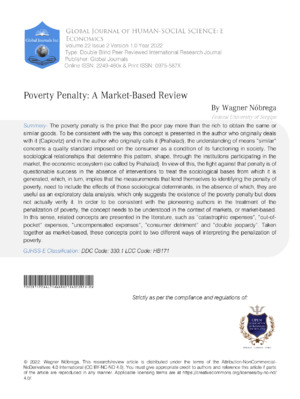
Summery-The poverty penalty is the price that the poor pay more than the rich to obtain the same or similar goods. To be consistent with the way this concept is presented in the author who originally deals with it (Caplovitz) and in the author who originally calls it (Prahalad), the understanding of means “similar” concerns a quality standard imposed on the consumer as a condition of its functioning in society. The sociological relationships that determine this pattern, shape, through the institutions participating in the market, the economic ecosystem (so called by Prahalad). In view of this, the fight against that penalty is of questionable success in the absence of interventions to treat the sociological bases from which it is generated, which, in turn, implies that the measurements that lend themselves to identifying the penalty of poverty, need to include the effects of those sociological determinants, in the absence of which, they are useful as an exploratory data analysis, which only suggests the existence of the poverty penalty but does not actually verify it. In order to be consistent with the pioneering authors in the treatment of the penalization of poverty, the concept needs to be understood in the context of markets, or market-based. In this sense, related concepts are presented in the literature, such as “catastrophic expenses”, “out-ofpocket” expenses, “uncompensated expenses”, “consumer detriment” and “double jeopardy”. Taken together as market-based, these concepts point to two different ways of interpreting the penalization of poverty.

Funding

No external funding was declared for this work.

Conflict of Interest

The authors declare no conflict of interest.

Ethical Approval

No ethics committee approval was required for this article type.

Data Availability

Not applicable for this article.

Wagner Nóbrega. 2026. \u201cPoverty Penalty: A Market-Based Review\u201d. Global Journal of Human-Social Science - E: Economics GJHSS-E Volume 22 (GJHSS Volume 22 Issue E2): .

Download Citation

Poverty, social science, research, global journal, human social science, economic study, review, academic peer-reviewed.
Issue Cover
GJHSS Volume 22 Issue E2
Pg. 19- 28
Journal Specifications

Crossref Journal DOI 10.17406/GJHSS

Print ISSN 0975-587X

e-ISSN 2249-460X

Keywords
Classification
GJHSS-E Classification: DDC Code: 330.1 LCC Code: HB171
Version of record

v1.2

Issue date

March 30, 2022

Language

English

Experiance in AR

The methods for personal identification and authentication are no exception.

Read in 3D

The methods for personal identification and authentication are no exception.

Article Matrices
Total Views: 1843
Total Downloads: 22
2026 Trends
Research Identity (RIN)
Related Research

Published Article

Summery-The poverty penalty is the price that the poor pay more than the rich to obtain the same or similar goods. To be consistent with the way this concept is presented in the author who originally deals with it (Caplovitz) and in the author who originally calls it (Prahalad), the understanding of means “similar” concerns a quality standard imposed on the consumer as a condition of its functioning in society. The sociological relationships that determine this pattern, shape, through the institutions participating in the market, the economic ecosystem (so called by Prahalad). In view of this, the fight against that penalty is of questionable success in the absence of interventions to treat the sociological bases from which it is generated, which, in turn, implies that the measurements that lend themselves to identifying the penalty of poverty, need to include the effects of those sociological determinants, in the absence of which, they are useful as an exploratory data analysis, which only suggests the existence of the poverty penalty but does not actually verify it. In order to be consistent with the pioneering authors in the treatment of the penalization of poverty, the concept needs to be understood in the context of markets, or market-based. In this sense, related concepts are presented in the literature, such as “catastrophic expenses”, “out-ofpocket” expenses, “uncompensated expenses”, “consumer detriment” and “double jeopardy”. Taken together as market-based, these concepts point to two different ways of interpreting the penalization of poverty.

Our website is actively being updated, and changes may occur frequently. Please clear your browser cache if needed. For feedback or error reporting, please email [email protected]
×

This Page is Under Development

We are currently updating this article page for a better experience.

Request Access

Please fill out the form below to request access to this research paper. Your request will be reviewed by the editorial or author team.
X

Quote and Order Details

Contact Person

Invoice Address

Notes or Comments

This is the heading

Lorem ipsum dolor sit amet, consectetur adipiscing elit. Ut elit tellus, luctus nec ullamcorper mattis, pulvinar dapibus leo.

High-quality academic research articles on global topics and journals.

Poverty Penalty: A Market-Based Review

Wagner Nóbrega
Wagner Nóbrega

Research Journals