
In present paper we introduce four theorems using pathway fractional integral operator involving product of Srivastava polynomial and generalized Struve function. Our results are quite general in nature. We obtain our results in term of hypergeometric function. Certain special cases of the main results are also obtained here. Our results will help to extend some classical statistical distribution to wider classes of distribution, these are useful in practical applications.
## I. INTRODUCTION
Let $f(x) \in L(a, b), \alpha \in \mathbb{C}, R(\alpha) > 0$, then left-sided Reimann-Liouville fractional integral operator is defined as [9]
$$
\left(\mathrm{I} _ {0 ^ {+}} ^ {\alpha} f\right) (x) = \frac{1}{\Gamma (\alpha)} \int_ {0} ^ {x} (x - t) ^ {\alpha - 1} f (t) d t \text{where} R (\alpha) > 0. \tag{1.1}
$$
Let $f(x) \in L(a, b), \eta \in \mathbb{C}, R(\eta) > 0, a > 0$ and a "Pathway parameter" $\alpha < 1$. Then the pathway fractional integration operator is defined by [6], also see [10]
$$
\left(\mathrm{p}_{0^{+}}^{(\eta,\alpha)}f\right) = \mathrm{x}^{\eta}\int_{0}^{\frac{x}{a(1-\alpha)}}\left(1-\frac{a(1-\alpha)t}{x}\right)^{\frac{\eta}{1-\alpha}}f(t)\,dt\quad\dots\tag{1.2}
$$
when $\alpha = 0$, $a = 1$ and $\eta$ is replaced by $\eta - 1$ in (1.2) it yields
$$
\left(\mathrm{I}_{0^{+}}^{\eta} f\right)(x) = \frac{1}{\Gamma(\eta)} \int_{0}^{x} (x - t)^{\eta - 1} f(t)\,dt \tag{1.3}
$$
Fractional integration operators play an important role in the solution of several problems of diversified fields of science and engineering. Many fractional integral operators like Riemann - Liouville, Weyl, Kober, Erdely - Koberand Saigo operator are studied by various workers due to their applications in the solutions of integral equation arising in several problems of many areas of physical, engineering and technological science. A detailed description of these operators can be found in the survey paper by Srivastava and Saxena [17].
In this paper, we consider following functions defined as follows:
The Struve function of order $\mathfrak{p}$ is given by
$$
\mathrm {H} _ {\mathrm {p}} (\mathrm {z}) = \left(\frac {\mathrm {z}}{2}\right) ^ {\mathrm {p} + 1} \sum_ {\mathrm {K} = 0} ^ {\infty} \frac {(- 1) ^ {\mathrm {k}}}{\Gamma \left(\mathrm {k} + \frac {3}{2}\right) \Gamma \left(\mathrm {k} + \mathrm {p} + \frac {1}{2}\right)} \left(\frac {\mathrm {z}}{2}\right) ^ {2 \mathrm {k}} \qquad \dots \dots \dots \dots \dots \dots \dots \dots \dots \dots \dots \dots \dots \dots \dots \dots \dots \dots \dots \dots (1. 4)
$$
The Struve function and its more generalization are found in many papers [1,2,4,12,7,13,14,15]. The generalized Struve function studied by [13] as follows:
$$
\mathrm{H}_{\mathrm{l},\varepsilon}^{\lambda}(\mathrm{z}) = \sum_{\mathrm{k}=0}^{\infty} \frac{(-1)^{\mathrm{k}}}{\Gamma\left(\lambda\mathrm{k}+\frac{1}{\varepsilon}+\frac{3}{2}\right)\Gamma\left(\mathrm{k}+\frac{3}{2}\right)} \left(\frac{\mathrm{z}}{2}\right)^{2\mathrm{k}+\mathrm{l}+1},\,\lambda>0,\varepsilon>0\dots\tag{1.5}
$$
The generalized Struve function of the first kind $\mathrm{H}_{\mathfrak{p},\mathfrak{b},\mathfrak{c}}(\mathbf{z})$ [see 7] defined for complex $\mathbf{z} \in \mathbb{C}$ and $\mathbf{b}, \mathbf{c}, \mathbf{p} \in \mathbb{C}$, $(\operatorname{Re}(\mathfrak{p}) > -1$ by:
$$
H_{\mathrm{p},\mathrm{b},\mathrm{c}}(\mathbf{z}) = \sum_{\mathrm{K}=0}^{\infty} \frac{(-1)^{\mathrm{k}} \, \mathrm{C}^{\mathrm{k}}}{\Gamma\left(\mathrm{p}+1+\frac{\mathrm{b}}{2}+\mathrm{k}\right) \, \Gamma\left(\mathrm{k}+\frac{3}{2}\right)} \left(\frac{\mathbf{z}}{2}\right)^{2\mathrm{k}+\mathrm{p}+1} \dots \tag{1.6}
$$
Where $\Gamma$ is the classical gamma function whose Euler's integral is given by Srivastava and Choi(see [11])
$$
\Gamma (y) = \int_ {0} ^ {\infty} e ^ {- t} t ^ {y - 1} d t R e (y) > 0 \quad \dots \tag {1.7}
$$
The special cases of Struve function are as follows[7]:
$$
\mathrm{H}_{1-\frac{\mathrm{b}}{2},\mathrm{b},c^{2}} = \frac{1}{C^{2}\sqrt{\pi}} \left[ \frac{2}{z} \right]^{b/2} (1 - \cos(c z)) \mathrm{b} \in \mathbb{R}, \& \mathrm{c} \neq 0 \quad \dots \quad \dots \dots \dots \tag{1.8}
$$
$$
\mathrm{H}_{1-\frac{b}{2},b,-c^{2}} = \frac{1}{C^{2}\sqrt{\pi}} \left[ \frac{2}{z} \right]^{b/2} (\cosh(c z) - 1) \quad b \in \mathbb{R},\& c \neq 0
$$
$$
\mathrm{H}_{-\frac{b}{2},\mathrm{b},c^{2}} = \frac{1}{C\sqrt{\pi}} \left[ \frac{2}{z} \right]^{b/2} \sin(\mathrm{c}z) \quad \mathrm{b} \in \mathbb{R},\&\mathrm{c} \neq 0
$$
$$
\mathrm{H}_{-\frac{b}{2},\mathrm{b},-c^{2}} = \frac{1}{C\sqrt{\pi}} \left[ \frac{2}{z} \right]^{b/2} \sinh(\mathrm{c}z) \quad \mathrm{b} \in \mathbb{R},\&\mathrm{c} \neq 0 \quad \dots \dots \text{.} \quad (1.11)
$$
The generalized Wright hypergeometric function $r\Psi s(z)$ defined for $a_i, b_j \in \mathbb{C}$, and real $\alpha_i, \beta_j \in \mathbb{R}$ ( $\alpha_i, \beta_j \neq 0$; $i = 1,2,\ldots,r$; $j = 1,2,\ldots,s$ ) is given by the series:
$$
\mathrm {r} \Psi \mathrm {s} (\mathrm {z}) = \mathrm {r} \Psi \mathrm {s} \left[ \begin{array}{c} \left(\mathrm {a} _ {\mathrm {i}} + \alpha \cdot 1\right) _ {1, \mathrm {r}} \\\mathrm {z} \\\left(\left(\mathrm {a} _ {\mathrm {i}} + \alpha \cdot 1\right) _ {1, \mathrm {s}}\right) \end{array} \right] = \sum_ {\mathrm {k} = 0} ^ {\infty} \frac {\prod_ {\mathrm {i} = 1} ^ {\mathrm {r}} \Gamma \left(\mathrm {a} _ {\mathrm {i}} + \alpha_ {\mathrm {i}} k\right) z ^ {k}}{\prod_ {\mathrm {j} = 1} ^ {\mathrm {s}} \Gamma \left(\mathrm {b} _ {\mathrm {j}} + \beta_ {\mathrm {j}} k\right) k !} \quad \dots \dots \dots . (1. 1 2)
$$
where $\Gamma z$ is the Euler gamma function and the asymptotic behavior of this function for large values of argument of $z \in \mathbb{C}$ were studied in [3] and under the condition:
$$
\sum_ {\mathrm {j} = 1} ^ {\mathrm {r}} \beta_ {\mathrm {j}} - \sum_ {\mathrm {i} = 1} ^ {\mathrm {s}} \alpha_ {\mathrm {i}} > - 1 \tag {1.13}
$$
For detailed Study of various properties, generalization and applications of wright function and generalized wright function, we refer to paper (for instance see [19] [20] [21]). The generalized hypergeometric function represented as follows [8]:
$$
r \Psi s \left[ \begin{array}{c} (\alpha_ {\mathrm {r}}); \\z \\(\beta_ {s}); \end{array} \right] = \sum_ {\mathrm {R} = 0} ^ {\infty} \frac {\prod_ {\mathrm {i} = 1} ^ {\mathrm {r}} (\alpha_ {\mathrm {i}}) _ {\mathrm {n}} z ^ {n}}{\prod_ {\mathrm {j} = 1} ^ {\mathrm {s}} (\beta_ {i}) _ {n} n !} \quad \dots \dots \dots \dots \dots \dots \dots \dots \dots \dots \dots (1. 1 4)
$$
Provided $r \leq s$; $r = s + 1$ and $|z| < 1$ where $(\lambda)_{n}$ is well known pochhammer symbol defined for $\lambda \in \mathbb{C}$ [3][8]
$$
\begin{array}{l} (\lambda) _ {\mathrm {n}} = \left\{ \begin{array}{c c} 1 & (n = 0) \\\lambda (\lambda + 1) \dots (\lambda + \mathrm {n - 1}) & (n \in \mathrm {N} = 1, 2, 3, \dots) \end{array} \right\} \dots \dots .. (1. 1 5) \\= \frac {\Gamma (\lambda + n)}{\Gamma (\lambda)} (\lambda \in \mathbb {C} / Z _ {0} ^ {-}) \\\end{array}
$$
where $Z_0^-$ is the set of non-positive integers. If we put $\alpha_{1} = \ldots = \alpha_{r} \ldots = \beta_{1} = \ldots = \beta_{s}$ in equation (1.8), then (1.10) is a special case of the generalized wright function [16]
$$
r \Psi s = r \Psi s \left[ \begin{array}{c} (\alpha_ {1}, 1), \ldots , (\alpha_ {\mathrm {r}}, 1); \\z \\(\beta_ {1}, 1), \ldots ,; (\beta_ {\mathrm {s}}, 1); \end{array} \right] = \frac {\prod_ {\mathrm {i} = 1} ^ {\mathrm {r}} (\alpha_ {\mathrm {i}}) _ {\mathrm {n}} z ^ {n}}{\prod_ {\mathrm {j} = 1} ^ {\mathrm {s}} (\beta_ {i}) _ {\mathrm {n}} n !} r \mathrm {F s} \left[ \begin{array}{c} (\alpha_ {1}), \ldots ,, (\alpha_ {\mathrm {r}}); \\z \\(\beta_ {1}), \ldots ,, (\beta_ {\mathrm {s}}); \end{array} \right] (1. 1 6)
$$
The Srivastava polynomial defined by Srivastava [18](pp. 1, eq.1), [5](pp. 11, eq. 7) in the following manner
$$
S _ {\mathrm {w}} ^ {\mathrm {u}} [ \mathrm {x} ] = \sum_ {s = 0} ^ {(w / u)} \frac {(- W) u , s}{s !} A _ {w, s} x ^ {s}, \qquad \mathrm {w} = 0, 1, 2, \dots \dots . (1. 1 7)
$$
where $w$ is an arbitrary positive integer and the coefficient $A_{w,s}(w,s) > 0$ are the arbitrary constant real or complex. This polynomial provides a large number spectrum of well-known polynomials as one of its particular cases on appropriately specializing the coefficient $A_{w,s}$ particularly by setting $u = 1$, $A_{w,s}$ for $s = k$ and $A_{w,s} = 0$ for $s \neq k$ the above polynomial leads to a power function.
$$
S _ {w} ^ {u} [ x ] = x ^ {k} \quad (k \in \mathbb {Z} ^ {+} w i t h k \leq w) \dots \tag {1.18}
$$
## II. MAIN RESULTS
Theorem 1: Let $\eta, \rho, \beta, \gamma, \mu, \delta \in \mathbb{C}$, $\mathrm{R}\left(1 + \frac{\eta}{(1 - \alpha)}\right) > 0$ $\min\{Re(\rho), Re(\beta), Re(\gamma), Re(\mu), Re(\delta), Re(\eta)\} > 0$ and $\mathfrak{p}_{\mathrm{i}}, \mathfrak{q}_{\mathrm{i}} > 0, \alpha < 1$. Then the pathaway fractional integral operator $(\mathfrak{p}_{0^+}^{(\mathrm{n},\alpha)})$ defined by (1.2) then the following formula holds:
$$
\mathrm {P} _ {0 ^ {+}} ^ {(\eta , \alpha)} \left\{\mathrm {t} ^ {\mu_ {-} 1} \mathrm {H} _ {\mathrm {l}, \varepsilon} ^ {\lambda} (\mathrm {t}) \mathrm {S} _ {\mathrm {w}} ^ {\mathrm {u}} [ \sigma t ^ {\rho} ] \right\} (x) =
$$
$$
\frac{\mathrm{x}^{\eta + 1 + \mu + 1} \Gamma\left(1 + \frac{\eta}{1 - \alpha}\right)}{[\mathrm{a}(1 - \alpha)]^{1 + \mu + 1}} \Big(\frac{1}{2}\Big)^{1 + 1} \sum_{s = 0}^{(w / u)} \frac{(- W) u , s}{s !} A_{w, s} \left[ \sigma \left(\frac{x}{[\mathrm{a}(1 - \alpha)]}\right)^{\rho} \right]^{s} \\\times 1^{\Psi} 3 \left[ \begin{array}{c} (l + \mu + \rho s + 1, 2) \\\left(\frac{l}{3} + \frac{3}{2}, \lambda\right), \left(\frac{3}{2}, 1\right), \left(l + \frac{\eta}{(1 - \alpha)} + \mu + \rho s + 2, 2\right); - \frac{x^{2}}{4 [ a (1 - \alpha) ]^{2}} \end{array} \right] \quad \dots \dots \dots \dots \dots \dots \tag{2.1} \end{array}
$$
Proof: Making the use of (1.2), (1.5) and (1.17) in LHS of the theorem first and then interchange the order of integration and summation, we evaluate the inner integral by making use of beta function and using (1.12) we arrive at the desired result RHS of (2.1).
Theorem 2: Let $\eta, \mu, \mathsf{p}, \mathsf{b}, \mathsf{c} \in \mathbb{C}$ and $\alpha < 1$ such that $\{Re(\eta), \operatorname{Re}(\mu), \operatorname{Re}(\mu + \mathsf{p})\} > 0$, $\operatorname{Re}(p + 1 + \frac{b}{2}) > -1$ and $\operatorname{Re}\left(\frac{\eta}{1 - \alpha}\right) > -1$ then the following formula holds:
$$
\mathrm {P} _ {0 ^ {+}} ^ {(\eta , \alpha)} \left\{\mathrm {t} ^ {\mu_ {- 1}} \mathrm {H} _ {\mathrm {p}, \mathrm {b}, \mathrm {c}} (\mathrm {t}) \mathrm {S} _ {\mathrm {w}} ^ {\mathrm {u}} [ \sigma t ^ {\rho} ] \right\} (x) =
$$
$$
\frac{\mathrm{x}^{\eta + \mathrm{p} + \mu + 1} \Gamma\left(1 + \frac{\eta}{1 - \alpha}\right)}{[\mathrm{a}(1 - \alpha)]^{\mathrm{p} + \mu + 1}} \Big(\frac{1}{2}\Big)^{\mathrm{p} + 1} \sum_{s = 0}^{(w / u)} \frac{(- W) u , s}{s !} A_{w, s} \left[ \sigma \left(\frac{x}{[\mathrm{a}(1 - \alpha)]}\right)^{\rho} \right]^{s} \times 1^{\Psi} 3 \left[ \begin{array}{c} (p + \mu + \rho s + 1, 2) \\\left(p + \frac{b}{2} + 1, 1\right), \left(\frac{3}{2}, 1\right), \left(p + \frac{\eta}{(1 - \alpha)} + \mu + \rho s + 2, 2\right) \end{array} \Big| - \frac{c x^{2}}{4 [ a (1 - \alpha) ]^{2}} \right] \dots \tag{2.2} \end{array}
$$
Proof: Making the use of (1.2), (1.6) and (1.18) in LHS of the theorem 2 and then interchange the order of integration and summation, we evaluate the inner integral by making use of beta function and using (1.12) we arrive at the desired result RHS of (2.2).
Theorem 3: Let $\eta, \mu, \mathfrak{p}, \mathfrak{b}, \mathfrak{c} \in \mathbb{C}$ and $\alpha < 1$ such that $\{Re(\eta), \operatorname{Re}(\mu), \operatorname{Re}(\mu + \mathfrak{p})\} > 0$, and $\operatorname{Re}\left(\frac{\eta}{1 - \alpha}\right) > -1$ then the following formula holds:
(i) $\mathrm{P}_{0^{+}}^{(\eta,\alpha)}\{\mathrm{t}^{\mu_{-}1}\sin (ct)\mathrm{S}_{\mathrm{w}}^{\mathrm{u}}[\sigma t^{\rho}]\}$ $(x) =$
$$
\frac{1}{4} c \sqrt{\pi} \frac{\mathrm{x}^{\eta + \mu + 1} \Gamma\left(1 + \frac{\eta}{1 - \alpha}\right)}{\left[ \mathrm{a} (1 - \alpha) \right]^{\mu + 1}} \sum_{s = 0}^{(w / u)} \frac{(- W) u , s}{s !} A_{w, s} \left[ \sigma \left(\frac{x}{\left[ \mathrm{a} (1 - \alpha) \right]}\right) ^{\rho} \right]^{s} \times 1^{\psi} 3 \left[ \begin{array}{c} (\mu + \rho s + 1, 2) \\\left(\frac{3}{2}, 1\right), (1, 1), \left(\frac{\eta}{(1 - \alpha)} + \mu + \rho s + 2, 2\right); - \frac{(c x)^{2}}{4 [ a (1 - \alpha) ]^{2}} \end{array} \right] \dots \tag{2.3}
$$
Proof: Making the use of (1.2), (1.10) and (1.18) in LHS of the theorem 3 (part I) and then interchange the order of integration and summation, we evaluate the inner integral by making use of beta function and using (1.12) we arrive at the desired result RHS of (2.3)
(ii) $\mathrm{P}_{0^{+}}^{(\eta,\alpha)}\{\mathfrak{t}^{\mu_{-}1}\sinh (\mathfrak{ct})S_{\mathrm{w}}^{\mathrm{u}}[\sigma t^{\rho}]\}$ $(x) =$
$$
\begin{array}{l} \frac {1}{4} c \sqrt {\pi} \frac {\mathrm {x} ^ {\eta + \mu + 1} \Gamma \left(1 + \frac {\eta}{1 - \alpha}\right)}{[ \mathrm {a} (1 - \alpha) ] ^ {\mu + 1}} \sum_ {s = 0} ^ {(w / u)} \frac {(- W) u , s}{s !} A _ {w, s} [ \sigma \left(\frac {x}{[ \mathrm {a} (1 - \alpha) ]}\right) ^ {\rho} ] ^ {s} \\\times 1 ^ {\Psi} 3 \left[ \frac {(\mu + \rho s + 1 , 2)}{\left(\frac {3}{2} , 1\right) , (1 , 1) , \left(\frac {\eta}{(1 - \alpha)} + \mu + \rho s + 2 , 2\right)}; - \frac {(c x) ^ {2}}{4 [ a (1 - \alpha) ] ^ {2}} \right] \quad \dots \dots \dots \dots \dots \dots \dots \dots \dots \dots \dots \dots \dots \dots \dots \dots \dots \dots \dots \dots \dots \dots \dots \dots \dots \dots \dots \dots \dots \dots \dots \dots \dots \dots \dots \dots \dots \dots \dots \dots \dots \\\end{array}
$$
Proof: Making the use of (1.2), (1.11) and (1.18) in LHS of the theorem 3 (part II) and then interchange the order of integration and summation, we evaluate the inner integral by making use of beta function and using (1.12) we arrive at the desired result RHS of(2.4).
Theorem 4: Let $\eta, \mu, \mathsf{p}, \mathsf{b}, \mathsf{c} \in \mathbb{C}$ and $\alpha < 1$ such that $Re(\alpha) > 0$, and $\operatorname{Re}(\beta - \eta) > 2$ then the following formula hold:
(i) $\mathrm{P}_{0^{+}}^{(\eta,\alpha)}\{\mathrm{t}^{\mu_{-}1}(1 - \cos (\mathrm{ct}))\mathrm{S}_{\mathrm{w}}^{\mathrm{u}}[\sigma t^{\rho}]\}$ $(x) =$
$$
\frac{1}{4} c^{2} \sqrt{\pi} \frac{\mathrm{x}^{\eta + \mu + 2} \Gamma \left(1 + \frac{\eta}{1 - \alpha}\right)}{[\mathrm{a} (1 - \alpha)]^{\mu + 2}} \sum_{s = 0}^{(w / u)} \frac{(- W) u , s}{s !} A_{w, s} \left[ \sigma \left(\frac{\mathrm{x}}{[\mathrm{a} (1 - \alpha)]}\right)^{\rho} \right]^{s} \times 1^{\Psi} 3 \left[ \begin{array}{c} (\mu + \rho s + 2, 2); \\\left(\frac{3}{2}, 1\right), (2, 1), \left(\frac{\eta}{(1 - \alpha)} + \mu + \rho s + 3, 2\right); \end{array} ; - \frac{(c x)^{2}}{4 [ a (1 - \alpha) ]^{2}} \right] \dots \tag{2.5}
$$
Proof: Making the use of (1.2), (1.8) and (1.18) in LHS of the theorem 4 (part I) and then interchange the order of integration and summation, we evaluate the inner integral by making use of beta function and we arrive at the desired result RHS of (2.5) (ii) $\mathrm{P}_{0^{+}}^{(\eta,\alpha)}\{\mathrm{t}^{\mu_{-}1}(\cosh (\mathrm{ct}) - 1)\mathrm{S}_{\mathrm{w}}^{\mathrm{u}}[\sigma t^{\rho}]\}$ $(x) =$
$$
\frac{1}{4} c^{2} \sqrt{\pi} \frac{\mathrm{x}^{\eta + \mu + 2} \Gamma \left(1 + \frac{\eta}{1 - \alpha}\right)}{[\mathrm{a} (1 - \alpha)]^{\mu + 2}} \sum_{s = 0}^{(w / u)} \frac{(- W) u , s}{s !} A_{w, s} \left[ \sigma \left(\frac{x}{[\mathrm{a} (1 - \alpha)]}\right)^{\rho} \right]^{s} \times 1^{\Psi} 3 \left[ \begin{array}{l l} (\mu + \rho s + 2, 2); & \\\left(\frac{3}{2}, 1\right), (2, 1), \left(\frac{\eta}{(1 - \alpha)} + \mu + \rho s + 3, 2\right); & \frac{(c x)^{2}}{4 [a (1 - \alpha)]^{2}} \end{array} \right] \quad \dots \dots \dots \dots \dots \dots \dots \dots \tag{2.6} \end{array}
$$
Proof: Making the use of (1.2), (1.9) and (1.18) in LHS of the theorem 4 (part II) and then interchange the order of integration and summation, we evaluate the inner integral by making use of beta function and using (1.12) we arrive at the desired result RHS of (2.6)
## III. SPECIAL CASES
1. If we take $\alpha = 0, a = 1$ and $\eta$ is replaced by $\eta - 1$ in (2.1), then pathway fractional integral operator will reduce Riemann-Liouville fractional integral defined in (1.1). Then we get the following result:
$$
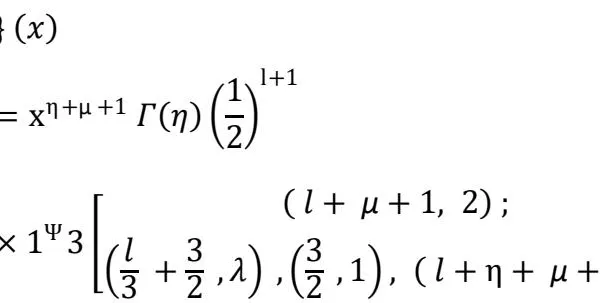
\mathrm{I}_{0^{+}}^{\alpha} \{ \mathrm{t}^{\mu - 1} \mathrm{H}_{\mathrm{l}, \varepsilon}^{\lambda} (\mathfrak{t}) \mathrm{S}_{\mathrm{w}}^{\mathrm{u}} [ \sigma t^{\rho} ] \} (x) = x^{\eta + \mu + 1} \Gamma (\eta) \left(\frac{1}{2}\right)^{\mathrm{l} + 1} \sum_{s = 0}^{(w / u)} \frac{(- W) u , s}{s !} A_{w, s} (\sigma x^{\rho})^{s} \\\times 1^{\Psi} 3 \left[ \begin{array}{c} (l + \mu + \rho s + 1, 2); \\\left(\frac{l}{3} + \frac{3}{2}, \lambda\right), \left(\frac{3}{2}, 1\right), (l + \eta + \mu + \rho s + 1, 2); \end{array} (- x^{2}) \right]
$$
2. If we take $\alpha = 0, a = 1$, $\eta$ is replaced by $\eta - 1$ and also on setting $\mathrm{w} = 0$, $A_{0,0} = 1$, then $\mathrm{S}_0^{\mathrm{u}}[\mathrm{x}] \to 1$ in (2.1), then pathway fractional integral operator will reduce Riemann-Liouville fractional integral defined in (1.1) and general class of polynomial will reduce to 1 defined in (1.13). then we get the following result:
$$
\begin{array}{l} \mathrm {I} _ {0 ^ {+}} ^ {\alpha} \left\{\mathrm {t} ^ {\mu_ {-} 1} \mathrm {H} _ {\mathrm {l}, \varepsilon} ^ {\lambda} (\mathrm {t}) \right\} (x) \\= \mathrm {x} ^ {\eta + \mu + 1} \Gamma (\eta) \left(\frac {1}{2}\right) ^ {\mathrm {l} + 1} \\\times 1 ^ {\Psi} 3 \left[ \begin{array}{c} (l + \mu + 1, 2); \\\left(\frac {l}{3} + \frac {3}{2}, \lambda\right), \left(\frac {3}{2}, 1\right), (l + \eta + \mu + 1, 2); \end{array} (- x ^ {2}) \right] \\\end{array}
$$
3. On setting $\mathrm{w} = 0$, $A_{0,0} = 1$, then $\mathbf{S}_0^{\mathrm{u}}[\mathbf{x}] \to 1$ in (2.2), we arrive at the known result given by Nisar K.S [10, pp. 66, eq. 13]
4. On setting $\mathbf{w} = 0$, $A_{0,0} = 1$, then $\mathrm{S}_0^{\mathrm{u}}[\mathbf{x}] \to 1$ in (2.3), we arrive at the known result given by Nisar K.S [10, pp. 67, theorem (3.1)(part I)].
5. On setting $\mathbf{w} = 0$, $A_{0,0} = 1$, then $\mathrm{S}_0^{\mathrm{u}}[\mathrm{x}] \to 1$ in (2.4), we arrive at the known result given by Nisar K.S [10, pp. 67, theorem (3.1)(part II)].
6. On setting $\mathbf{w} = 0$, $A_{0,0} = 1$, then $\mathbf{S}_0^{\mathrm{u}}[\mathbf{x}] \to 1$ in (2.5), we arrive at the known result given by Nisar K.S [10, pp. 68 theorem (3.2), (part I)].
7. On setting $\mathrm{w} = 0$, $A_{0,0} = 1$, then $S_0^{\mathrm{u}}[\mathbf{x}] \to 1$ in (2.6), we arrive at the known result given by Nisar K.S [10, pp. 68 theorem (3.2), (part II)].
## IV. CONCLUSION
In this paper, we have presented Struve function, generalized Struve function and Srivastava polynomial via pathway fractional integral operator. As in this operator $\alpha$ establishes a path of going from one distribution to another and to different classes of distribution, we conclude this investigation by remarking that the result obtained here are general in character and useful in deriving various integral formulas in the theory of the pathway fractional integration operator and also our result will help to extend some classical statistical distribution to wider classes of distribution, useful in practical application.
Generating HTML Viewer...
References
19 Cites in Article
K Bhowmick (1962). Some relations between a generalized Struve's function and hypergeometric functions.
K Bhowmick (1993). A generalized Struve's function and its recurrence formula.
C Fox (1928). The Asymptotic Expansion of Generalized Hypergeometric Functions.
Dinesh Kumar,S Purohit,A Secer,A Atangana (2015). On Generalized Fractional Kinetic Equations Involving Generalized Bessel Function of the First Kind.
No ethics committee approval was required for this article type.
Data Availability
Not applicable for this article.
How to Cite This Article
Danishwar Farooq. 2026. \u201cProduct of Special Function and Polynomial Associated via Pathway Fractional Integral Operator\u201d. Global Journal of Science Frontier Research - F: Mathematics & Decision GJSFR-F Volume 22 (GJSFR Volume 22 Issue F2).
Explore published articles in an immersive Augmented Reality environment. Our platform converts research papers into interactive 3D books, allowing readers to view and interact with content using AR and VR compatible devices.
Your published article is automatically converted into a realistic 3D book. Flip through pages and read research papers in a more engaging and interactive format.
Our website is actively being updated, and changes may occur frequently. Please clear your browser cache if needed. For feedback or error reporting, please email [email protected]
Thank you for connecting with us. We will respond to you shortly.