Public Debt and Private Investment in Subsaharan Africa

1
Alioum Hamadou
Alioum Hamadou

Send Message

To: Author

GJHSS Volume 22 Issue E1

Article Fingerprint

ReserarchID

LO2KQ

Public Debt and Private Investment in Subsaharan Africa Banner
  • English
  • Afrikaans

  • Albanian
  • Amharic
  • Arabic
  • Armenian
  • Azerbaijani
  • Basque
  • Belarusian
  • Bengali
  • Bosnian
  • Bulgarian
  • Catalan
  • Cebuano
  • Chichewa
  • Chinese (Simplified)
  • Chinese (Traditional)
  • Corsican
  • Croatian
  • Czech
  • Danish
  • Dutch
  • Esperanto
  • Estonian
  • Filipino
  • Finnish
  • French
  • Frisian
  • Galician
  • Georgian
  • German
  • Greek
  • Gujarati
  • Haitian Creole
  • Hausa
  • Hawaiian
  • Hebrew
  • Hindi
  • Hmong
  • Hungarian
  • Icelandic
  • Igbo
  • Indonesian
  • Irish
  • Italian
  • Japanese
  • Javanese
  • Kannada
  • Kazakh
  • Khmer
  • Korean
  • Kurdish (Kurmanji)
  • Kyrgyz
  • Lao
  • Latin
  • Latvian
  • Lithuanian
  • Luxembourgish
  • Macedonian
  • Malagasy
  • Malay
  • Malayalam
  • Maltese
  • Maori
  • Marathi
  • Mongolian
  • Myanmar (Burmese)
  • Nepali
  • Norwegian
  • Pashto
  • Persian
  • Polish
  • Portuguese
  • Punjabi
  • Romanian
  • Russian
  • Samoan
  • Scots Gaelic
  • Serbian
  • Sesotho
  • Shona
  • Sindhi
  • Sinhala
  • Slovak
  • Slovenian
  • Somali
  • Spanish
  • Sundanese
  • Swahili
  • Swedish
  • Tajik
  • Tamil
  • Telugu
  • Thai
  • Turkish
  • Ukrainian
  • Urdu
  • Uzbek
  • Vietnamese
  • Welsh
  • Xhosa
  • Yiddish
  • Yoruba
  • Zulu

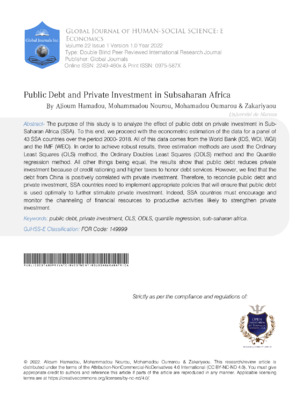
The purpose of this study is to analyze the effect of public debt on private investment in Sub-Saharan Africa (SSA). To this end, we proceed with the econometric estimation of the data for a panel of 43 SSA countries over the period 2000-2018. All of this data comes from the World Bank (IDS, WDI, WGI) and the IMF (WEO). In order to achieve robust results, three estimation methods are used: the Ordinary Least Squares (OLS) method, the Ordinary Doubles Least Squares (ODLS) method and the Quantile regression method. All other things being equal, the results show that public debt reduces private investment because of credit rationing and higher taxes to honor debt services. However, we find that the debt from China is positively correlated with private investment. Therefore, to reconcile public debt and private investment, SSA countries need to implement appropriate policies that will ensure that public debt is used optimally to further stimulate private investment. Indeed, SSA countries must encourage and monitor the channeling of financial resources to productive activities likely to strengthen private investment.

Funding

No external funding was declared for this work.

Conflict of Interest

The authors declare no conflict of interest.

Ethical Approval

No ethics committee approval was required for this article type.

Data Availability

Not applicable for this article.

Alioum Hamadou. 2026. \u201cPublic Debt and Private Investment in Subsaharan Africa\u201d. Global Journal of Human-Social Science - E: Economics GJHSS-E Volume 22 (GJHSS Volume 22 Issue E1): .

Download Citation

Study on public and private financial growth in Sub-Saharan Africa.
Issue Cover
GJHSS Volume 22 Issue E1
Pg. 61- 74
Journal Specifications

Crossref Journal DOI 10.17406/GJHSS

Print ISSN 0975-587X

e-ISSN 2249-460X

Keywords
Classification
GJHSS-E Classification: FOR Code: 149999
Version of record

v1.2

Issue date

February 7, 2022

Language

English

Experiance in AR

The methods for personal identification and authentication are no exception.

Read in 3D

The methods for personal identification and authentication are no exception.

Article Matrices
Total Views: 1924
Total Downloads: 36
2026 Trends
Research Identity (RIN)
Related Research

Published Article

The purpose of this study is to analyze the effect of public debt on private investment in Sub-Saharan Africa (SSA). To this end, we proceed with the econometric estimation of the data for a panel of 43 SSA countries over the period 2000-2018. All of this data comes from the World Bank (IDS, WDI, WGI) and the IMF (WEO). In order to achieve robust results, three estimation methods are used: the Ordinary Least Squares (OLS) method, the Ordinary Doubles Least Squares (ODLS) method and the Quantile regression method. All other things being equal, the results show that public debt reduces private investment because of credit rationing and higher taxes to honor debt services. However, we find that the debt from China is positively correlated with private investment. Therefore, to reconcile public debt and private investment, SSA countries need to implement appropriate policies that will ensure that public debt is used optimally to further stimulate private investment. Indeed, SSA countries must encourage and monitor the channeling of financial resources to productive activities likely to strengthen private investment.

Our website is actively being updated, and changes may occur frequently. Please clear your browser cache if needed. For feedback or error reporting, please email [email protected]
×

This Page is Under Development

We are currently updating this article page for a better experience.

Request Access

Please fill out the form below to request access to this research paper. Your request will be reviewed by the editorial or author team.
X

Quote and Order Details

Contact Person

Invoice Address

Notes or Comments

This is the heading

Lorem ipsum dolor sit amet, consectetur adipiscing elit. Ut elit tellus, luctus nec ullamcorper mattis, pulvinar dapibus leo.

High-quality academic research articles on global topics and journals.

Public Debt and Private Investment in Subsaharan Africa

Alioum Hamadou
Alioum Hamadou

Research Journals