
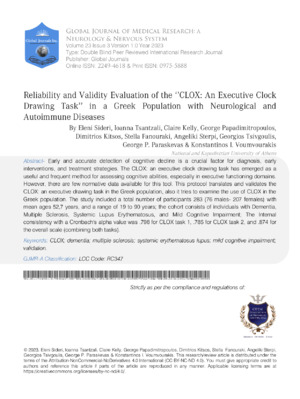
Reliability and Validity Evaluation of the ‘’CLOX: an executive clock drawing task’’ in a Greek Population with Neurological and Autoimmune Diseases

Article ID

3607C

Accurate assessment of executive clock functions in neurological research.

Reliability and Validity Evaluation of the ‘’CLOX: an executive clock drawing task’’ in a Greek Population with Neurological and Autoimmune Diseases

Konstantinos Voumvourakis
Eleni Sideri
Eleni Sideri
Ioanna Tsantzali
Ioanna Tsantzali
Claire Kelly
Claire Kelly
George Papadimitropoulos
Dimitrios Kitsos
Dimitrios Kitsos
DOI

Abstract

Early and accurate detection of cognitive decline is a crucial factor for diagnosis, early interventions, and treatment strategies. The CLOX: an executive clock drawing task has emerged as a useful and frequent method for assessing cognitive abilities, especially in executive functioning domains. However, there are few normative data available for this tool. This protocol translates and validates the CLOX: an executive drawing task in the Greek population, also it tries to examine the use of CLOX in the Greek population. The study included a total number of participants 283 (76 males- 207 females) with mean ages 52,7 years, and a range of 19 to 90 years; the cohort consists of individuals with Dementia, Multiple Sclerosis, Systemic Lupus Erythematosus, and Mild Cognitive Impairment; The Internal consistency with a Cronbach’s alpha value was .798 for CLOX task 1, .785 for CLOX task 2, and .874 for the overall scale (combining both tasks).

Reliability and Validity Evaluation of the ‘’CLOX: an executive clock drawing task’’ in a Greek Population with Neurological and Autoimmune Diseases

Early and accurate detection of cognitive decline is a crucial factor for diagnosis, early interventions, and treatment strategies. The CLOX: an executive clock drawing task has emerged as a useful and frequent method for assessing cognitive abilities, especially in executive functioning domains. However, there are few normative data available for this tool. This protocol translates and validates the CLOX: an executive drawing task in the Greek population, also it tries to examine the use of CLOX in the Greek population. The study included a total number of participants 283 (76 males- 207 females) with mean ages 52,7 years, and a range of 19 to 90 years; the cohort consists of individuals with Dementia, Multiple Sclerosis, Systemic Lupus Erythematosus, and Mild Cognitive Impairment; The Internal consistency with a Cronbach’s alpha value was .798 for CLOX task 1, .785 for CLOX task 2, and .874 for the overall scale (combining both tasks).

Konstantinos Voumvourakis
Eleni Sideri
Eleni Sideri
Ioanna Tsantzali
Ioanna Tsantzali
Claire Kelly
Claire Kelly
George Papadimitropoulos
Dimitrios Kitsos
Dimitrios Kitsos

No Figures found in article.

Konstantinos Voumvourakis. 2026. “. Global Journal of Medical Research – A: Neurology & Nervous System GJMR-A Volume 23 (GJMR Volume 23 Issue A3): .

Download Citation

Journal Specifications

Crossref Journal DOI 10.17406/gjmra

Print ISSN 0975-5888

e-ISSN 2249-4618

Classification
GJMR-A Classification: LCC Code: RC347
Keywords
Article Matrices
Total Views: 1212
Total Downloads: 18
2026 Trends
Research Identity (RIN)
Related Research
Our website is actively being updated, and changes may occur frequently. Please clear your browser cache if needed. For feedback or error reporting, please email [email protected]

Request Access

Please fill out the form below to request access to this research paper. Your request will be reviewed by the editorial or author team.
X

Quote and Order Details

Contact Person

Invoice Address

Notes or Comments

This is the heading

Lorem ipsum dolor sit amet, consectetur adipiscing elit. Ut elit tellus, luctus nec ullamcorper mattis, pulvinar dapibus leo.


High-quality academic research articles on global topics and journals.

Reliability and Validity Evaluation of the ‘’CLOX: an executive clock drawing task’’ in a Greek Population with Neurological and Autoimmune Diseases

Konstantinos Voumvourakis
Eleni Sideri
Eleni Sideri
Ioanna Tsantzali
Ioanna Tsantzali
Claire Kelly
Claire Kelly
George Papadimitropoulos
Dimitrios Kitsos
Dimitrios Kitsos

Research Journals






























































