
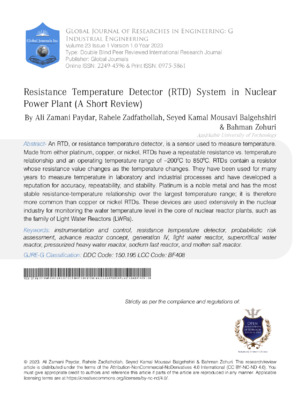

Resistance Temperature Detector (RTD) System in Nuclear Power Plant (A Short Review)

1
Ali Zamani Paydar
Ali Zamani Paydar
2
Rahele Zadfathollah
Rahele Zadfathollah
3
Seyed Kamal Mousavi Balgehshiri
4
Bahman Zohuri
Bahman Zohuri

Send Message

To: Author

GJRE Volume 23 Issue G1

Article Fingerprint

ReserarchID

YIF13

Resistance Temperature Detector (RTD) System in Nuclear Power Plant (A Short Review) Banner
  • English
  • Afrikaans
  • Albanian
  • Amharic
  • Arabic
  • Armenian
  • Azerbaijani
  • Basque
  • Belarusian
  • Bengali
  • Bosnian
  • Bulgarian
  • Catalan
  • Cebuano
  • Chichewa
  • Chinese (Simplified)
  • Chinese (Traditional)
  • Corsican
  • Croatian
  • Czech
  • Danish
  • Dutch
  • Esperanto
  • Estonian
  • Filipino
  • Finnish
  • French
  • Frisian
  • Galician
  • Georgian
  • German
  • Greek
  • Gujarati
  • Haitian Creole
  • Hausa
  • Hawaiian
  • Hebrew
  • Hindi
  • Hmong
  • Hungarian
  • Icelandic
  • Igbo
  • Indonesian
  • Irish
  • Italian
  • Japanese
  • Javanese
  • Kannada
  • Kazakh
  • Khmer
  • Korean
  • Kurdish (Kurmanji)
  • Kyrgyz
  • Lao
  • Latin
  • Latvian
  • Lithuanian
  • Luxembourgish
  • Macedonian
  • Malagasy
  • Malay
  • Malayalam
  • Maltese
  • Maori
  • Marathi
  • Mongolian
  • Myanmar (Burmese)
  • Nepali
  • Norwegian
  • Pashto
  • Persian
  • Polish
  • Portuguese
  • Punjabi
  • Romanian
  • Russian
  • Samoan
  • Scots Gaelic
  • Serbian
  • Sesotho
  • Shona
  • Sindhi
  • Sinhala
  • Slovak
  • Slovenian
  • Somali
  • Spanish
  • Sundanese
  • Swahili
  • Swedish
  • Tajik
  • Tamil
  • Telugu
  • Thai
  • Turkish
  • Ukrainian
  • Urdu
  • Uzbek
  • Vietnamese
  • Welsh
  • Xhosa
  • Yiddish
  • Yoruba
  • Zulu

An RTD, or resistance temperature detector, is a sensor used to measure temperature. Made from either platinum, copper, or nickel, RTDs have a repeatable resistance vs. temperature relationship and an operating temperature range of -200 0 C to 850 0 C. RTDs contain a resistor whose resistance value changes as the temperature changes. They have been used for many years to measure temperature in laboratory and industrial processes and have developed a reputation for accuracy, repeatability, and stability. Platinum is a noble metal and has the most stable resistance-temperature relationship over the largest temperature range; it is therefore more common than copper or nickel RTDs. These devices are used extensively in the nuclear industry for monitoring the water temperature level in the core of nuclear reactor plants, such as the family of Light Water Reactors (LWRs).

Funding

No external funding was declared for this work.

Conflict of Interest

The authors declare no conflict of interest.

Ethical Approval

No ethics committee approval was required for this article type.

Data Availability

Not applicable for this article.

Ali Zamani Paydar. 2026. \u201cResistance Temperature Detector (RTD) System in Nuclear Power Plant (A Short Review)\u201d. Global Journal of Research in Engineering - G: Industrial Engineering GJRE-G Volume 23 (GJRE Volume 23 Issue G1): .

Download Citation

High-accuracy resistance temperature detector system in nuclear power plants.
Journal Specifications

Crossref Journal DOI 10.17406/gjre

Print ISSN 0975-5861

e-ISSN 2249-4596

Keywords
Classification
GJRE-G Classification: DDC Code: 150.195 LCC Code: BF408
Version of record

v1.2

Issue date

February 28, 2023

Language

English

Experiance in AR

The methods for personal identification and authentication are no exception.

Read in 3D

The methods for personal identification and authentication are no exception.

Article Matrices
Total Views: 1467
Total Downloads: 18
2026 Trends
Research Identity (RIN)
Related Research

Published Article

An RTD, or resistance temperature detector, is a sensor used to measure temperature. Made from either platinum, copper, or nickel, RTDs have a repeatable resistance vs. temperature relationship and an operating temperature range of -200 0 C to 850 0 C. RTDs contain a resistor whose resistance value changes as the temperature changes. They have been used for many years to measure temperature in laboratory and industrial processes and have developed a reputation for accuracy, repeatability, and stability. Platinum is a noble metal and has the most stable resistance-temperature relationship over the largest temperature range; it is therefore more common than copper or nickel RTDs. These devices are used extensively in the nuclear industry for monitoring the water temperature level in the core of nuclear reactor plants, such as the family of Light Water Reactors (LWRs).

Our website is actively being updated, and changes may occur frequently. Please clear your browser cache if needed. For feedback or error reporting, please email [email protected]
×

This Page is Under Development

We are currently updating this article page for a better experience.

Request Access

Please fill out the form below to request access to this research paper. Your request will be reviewed by the editorial or author team.
X

Quote and Order Details

Contact Person

Invoice Address

Notes or Comments

This is the heading

Lorem ipsum dolor sit amet, consectetur adipiscing elit. Ut elit tellus, luctus nec ullamcorper mattis, pulvinar dapibus leo.


High-quality academic research articles on global topics and journals.

Resistance Temperature Detector (RTD) System in Nuclear Power Plant (A Short Review)

Ali Zamani Paydar
Ali Zamani Paydar
Rahele Zadfathollah
Rahele Zadfathollah
Seyed Kamal Mousavi Balgehshiri
Bahman Zohuri
Bahman Zohuri

Research Journals





























































